




This year, global organizations are expected to generate more than 180 zettabytes of data, making enterprise information more distributed and difficult to secure than ever before
As cyber threats, regulatory requirements, and AI adoption continue to grow data. Security management has become a business priority rather than just an IT responsibility.
Understanding what data security management is and how to manage it effectively helps organizations to protect sensitive information, reduce risk, and build a resilient, compliant data ecosystem.
What is data security management?
Data security management is the process of protecting enterprise data throughout its life cycle by implementing policies, tech technologies, and governance controls that preserve its confidentiality, integrity, and availability.
Simply put, the data security management definition extends beyond preventing cyber attacks.
It also ensures that sensitive information is discovered, classified, monitored, and accessed only by authorized users across on-premises, cloud, and hybrid environments.
However, it is quite different from cybersecurity, which primarily protects networks, applications, and infrastructure from external threats.
Data security and management focus specifically on securing the data itself. It also complements data governance by enforcing security policies that support compliance, risk management, and responsible data usage.
Lastly, when combined with an effective data quality issue management framework, organizations cannot only protect sensitive information but also identify, remediate, and prevent data defects that compromise security, compliance, and business decisions.
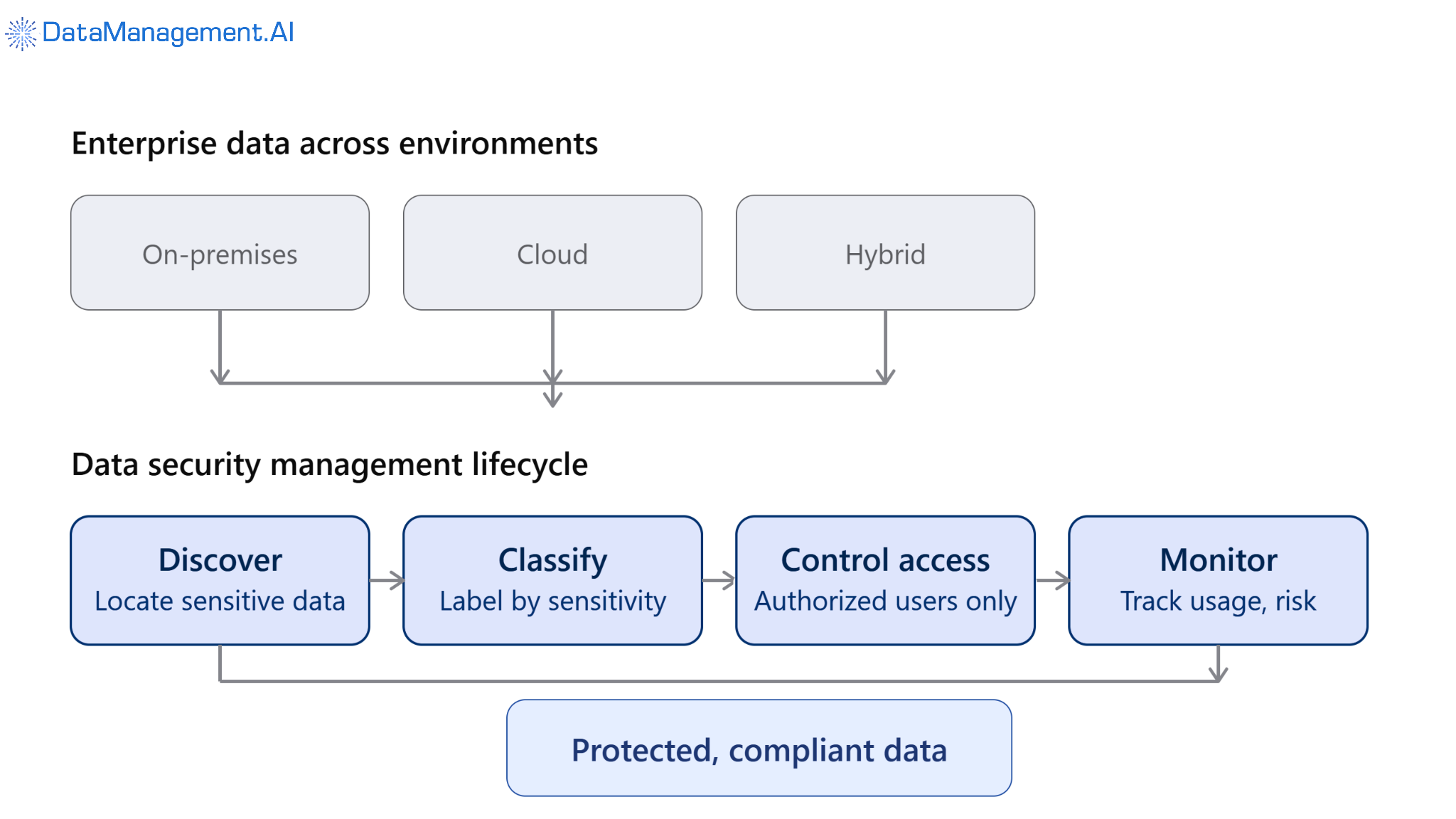
What are the biggest data management security management risks?
A modern data security management system must protect enterprise data wherever it resides, whether in on-premises databases, cloud platforms, SaaS applications, or AI environments.
As organizations generate and share larger volumes of information, data, security risk management has become a continuous business function rather than a one-time security initiative.
Understanding how to manage data security begins with identifying the risks that expose sensitive data across the enterprise.
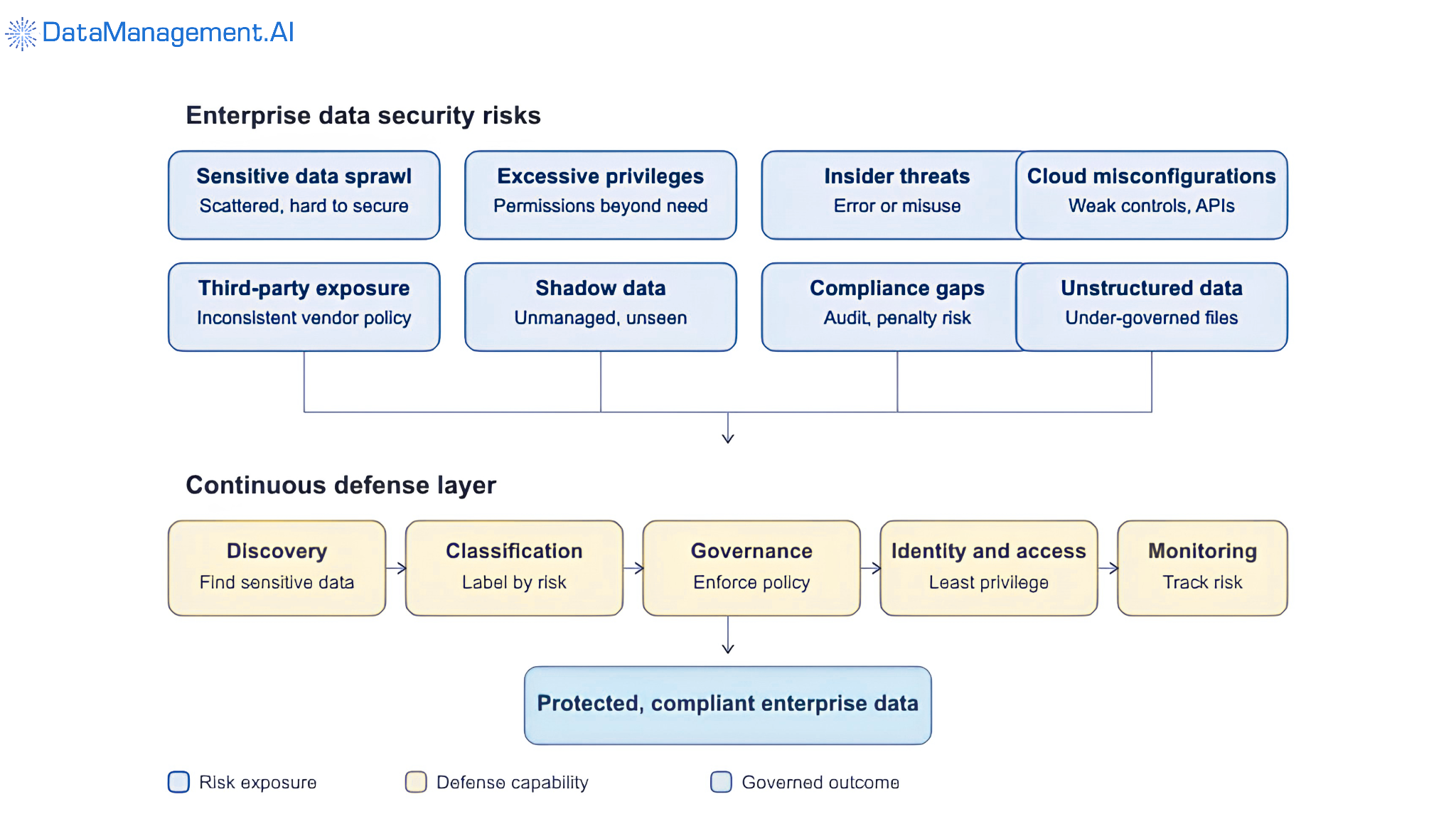
Some of the most significant risks include:
Sensitive data sprawl
Critical information is often distributed across databases, cloud storage, collaboration, platforms, and endpoints, making it difficult to discover, classify, and secure consistently.
Excessive access privileges
Employees, contractors, and applications frequently retain permissions beyond their operational needs, increasing the likelihood of unauthorized access and data misuse.
Insider threats
Sometimes privileged users can intentionally or unintentionally expose confidential information through human error, compromised credentials, or policy violations.
Cloud misconfigurations
Weak access controls, unsecured APIs, and improperly configured cloud resources remain one of the leading causes of enterprise data breaches, and it highlights the importance of cloud data management security.
Third-party data exposure
Business partners and external vendors often require access to enterprise data, creating additional risk when governance policies and security controls are inconsistently applied.
Shadow data
Unmanaged datasets created outside approved governance processes reduce visibility and make sensitive information significantly harder to monitor and protect.
Compliance gaps
Inconsistent enforcement of security policies can result in regulatory violations, audit failures, and financial penalties, weakening your overall data management and security strategy.
Unstructured data
Emails, contracts, PDFs, presentations, chat messages, and multimedia files frequently contain sensitive information, but are rarely governed as rigorously as structured databases.
Addressing challenges requires more than deploying isolated security controls. The best data security management approach combines continuous data discovery, classification, governance, identity, and access management, and monitoring.
Also, learning what data quality management is will help you to build stronger governance practices, ensuring security policies are enforced on trusted, standardized, and well-managed enterprise data.
Modern data security management tools help organizations automate these capabilities, reduce enterprise risk, and protect sensitive information throughout the entire data life-cycle.
What are the core components of a data management security management system?
A modern data security management system protects enterprise data by combining governance, security controls, metadata intelligence, and continuous monitoring into a single operational framework.
Thus, rather than focusing only on infrastructure security, if you want to build an effective data security and management system, you should also ensure that your organization’s sensitive information remains protected throughout its life-cycle, from creation and storage to sharing, analytics, AI workloads, and archival.
Organizations implementing managed data security capabilities are already better positioned to reduce cyber risk, simplify compliance, and strengthen business resilience.
The following components from the foundation of an enterprise-grade data management security strategy:
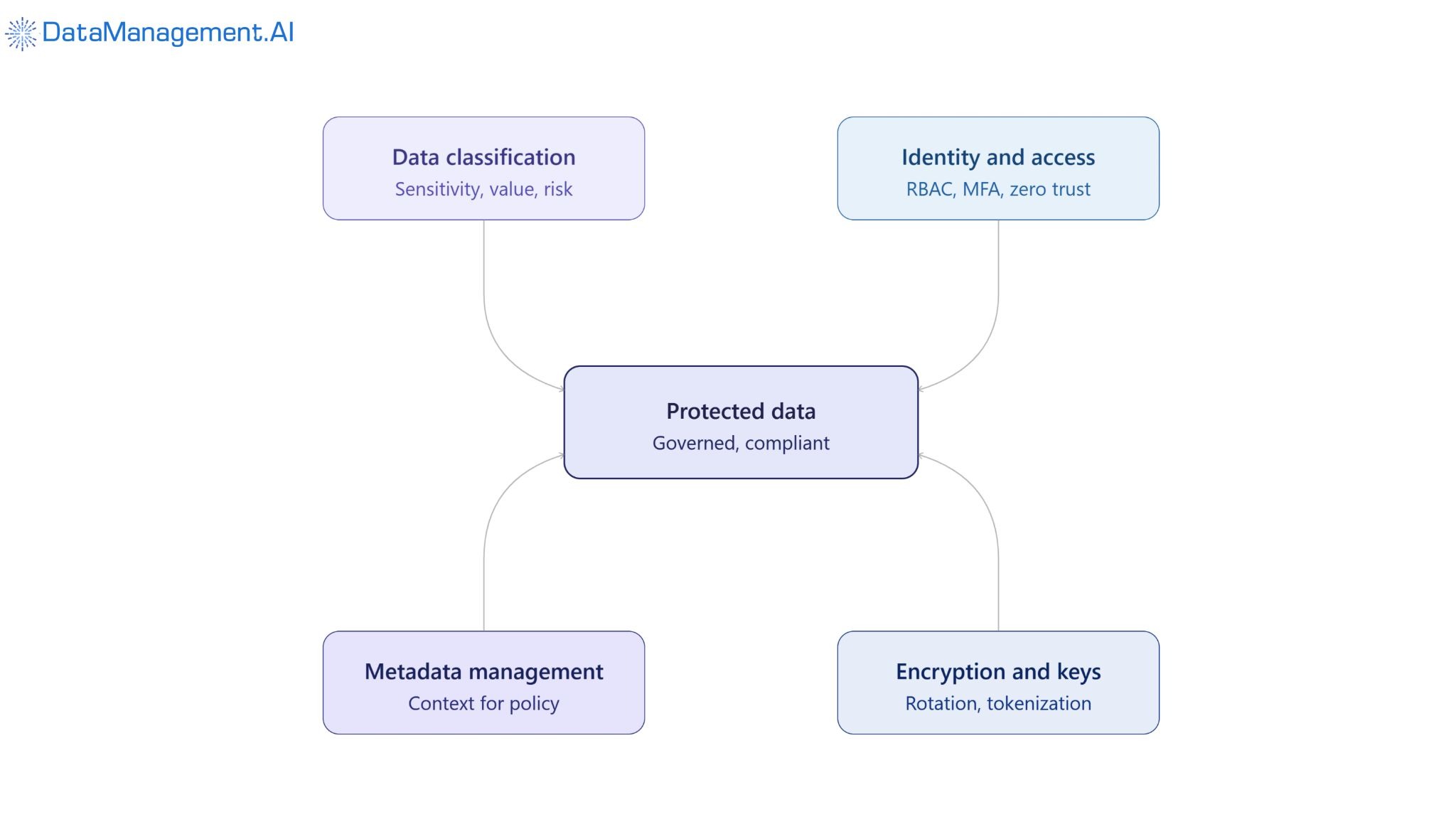
Data discovery
You cannot secure the data that you can’t see. Automated discovery continuously scans databases, cloud storage, SaaS applications, data leaks, and endpoints to identify where sensitive information resides.
This creates a comprehensive inventory of enterprise data assets and reduces the risk of unmanaged or shadow data.
This also demonstrates why master data management is important, as maintaining consistent, trusted, and centrally governed business entities significantly improves data, discovery, classification, and enterprise wide security.
Data classification
Once discovered, your data should be automatically classified based on sensitivity, business value, regulatory requirements, and criticality.
Classification enables organizations to prioritize protection for personally identifiable information (PII), financial records, intellectual property, and confidential business information while supporting policy-driven security controls.
Identity and access management (IAM)
User and machine identities should serve as the primary security boundary.
Features like role-based access control (RBAC), attribute-based access control (ABAC), multi-factor authentication (MFA), privileged access management (PAM), and Zero Trust principles ensure users, applications, and services access only the data required for their responsibilities.
Encryption and key management
Your sensitive data should remain encrypted both at rest and in transit using enterprise-grade cryptographic standards.
Centralized key management, tokenization, and secure key rotation reduce the impact of unauthorized access while strengthening regulatory compliance.
Metadata management
Your security decisions will become significantly more effective when they are enriched with metadata.
Technical metadata, business metadata, ownership, information, and data sensitivity labels provide the context needed to automate governance, risk assessment, and policy enforcement across distributed environments.
Data lineage
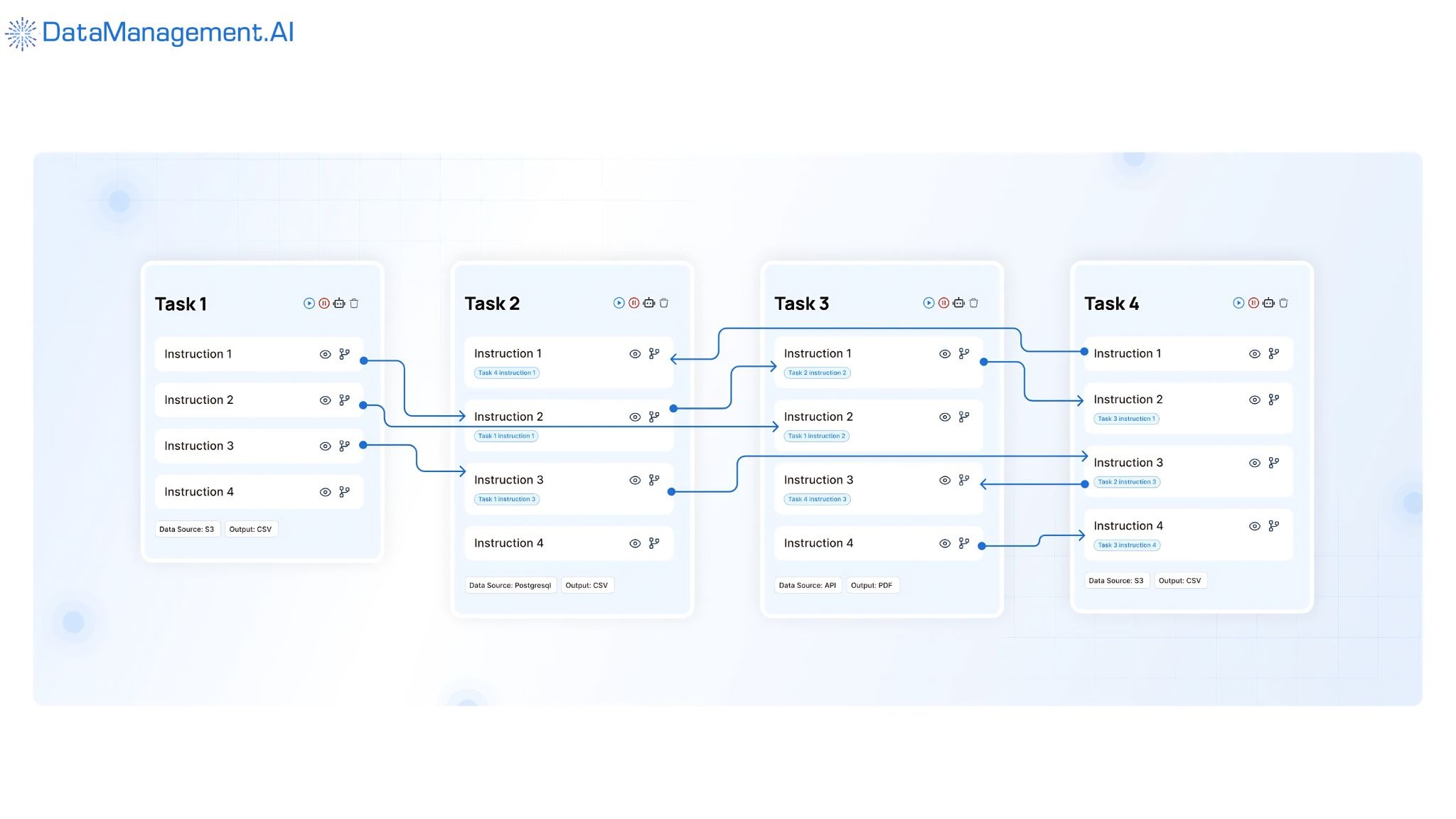
End-to-end lineage provides complete visibility into how data moves across ingestion pipelines, transformation, layers, analytical platforms, APIs, and AI models.
This helps organizations to perform faster impact analysis, trace security incidents, and demonstrate regulatory compliance through transparent data flows.
Continuous monitoring and observability
Static security controls are no longer sufficient for modern enterprises. Continuous monitoring tracks user activity, access patterns, configuration changes, data movement, and anomalous behavior in real time.
AI-driven analytics further improve threat detection by identifying deviations from established behavioral baselines.
Policy enforcement
Your security policies should be enforced automatically across every stage of the data life-cycle.
Policy as code enables organizations to consistently apply data retention rules, access restrictions, encryption requirements, geography residency, controls, and compliance mandates without relying on manual intervention.
Audit logging and compliance reporting
Comprehensive audit logs record every access, request, policy, change, administrative action, and data modification.
These immutable records support forensic investigations, simplify regulatory reporting, and demonstrate compliance with frameworks like GDPR, HIPAA, ISO 27001, PCI DSS, and industry-specific regulations.
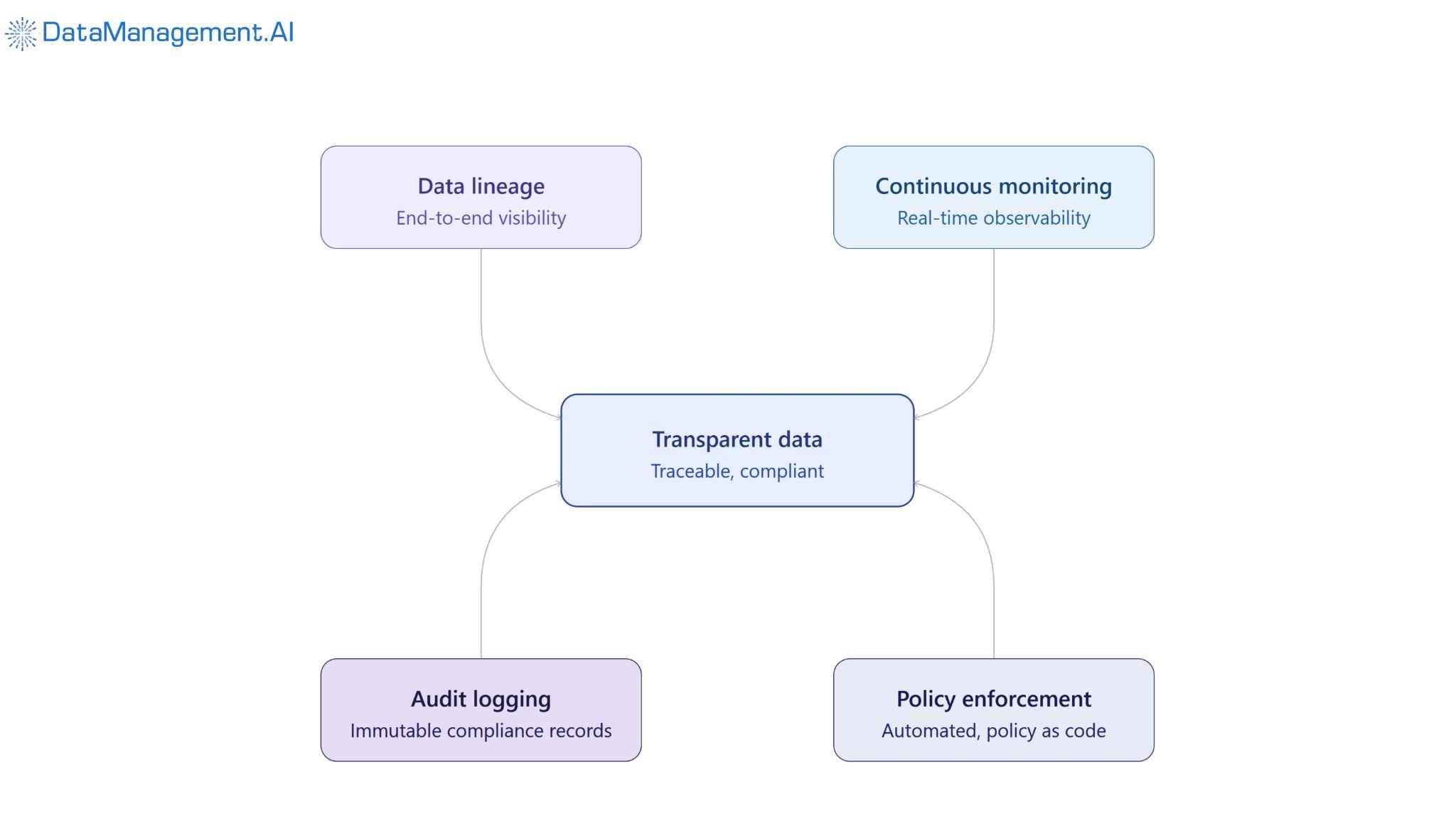
Together, these capabilities define the best data security management approach for modern enterprises.
Rather than deploying disconnected security solutions, organizations should adopt data security management tools that integrate discovery, governance, metadata, lineage, monitoring, and policy automation into a unified platform.
This will make sure scalable, cloud, data management, security, strengthen data, security risk management, and provide business leaders with continuous visibility into the organization’s overall security posture.
How to manage data security across the enterprise?
Managing enterprise data securely requires a structured framework that extends beyond traditional cybersecurity controls.
As data moves across cloud platforms, AI applications, third-party ecosystems, and distributed environments, organisations must embed security into every stage of the data life-cycle.
An effective data security management plan, combines governance, identity management, continuous, monitoring, and automation to reduce risk, maintain regulatory compliance, and ensure sensitive data remains protected across the enterprise.
Step 1: Discover and classify sensitive enterprise data
You should begin by continuously discovering structured and structured data across databases, cloud environments, SaaS applications, data lakes, and AI platforms.
Then, classify datasets according to sensitivity, business, criticality, ownership, and regulatory requirements to prioritize security controls.
| Bonus tip: If you understand how does a data management platform work, it will help you see how automated discovery, meta data management, and classification established the foundation for scalable, enterprise, data security and governance. |
Step 2: Build a data security management plan
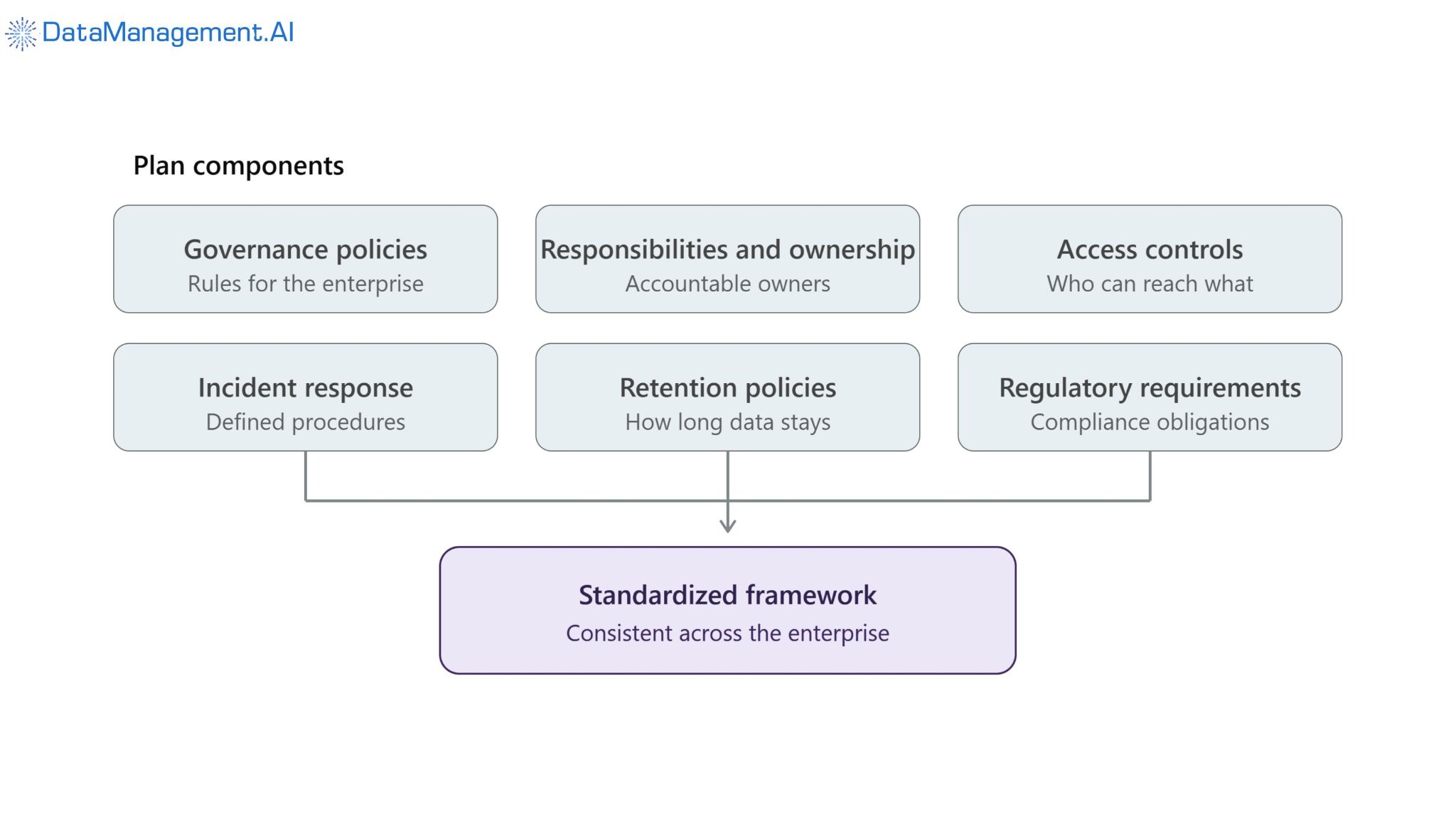
Next, develop a centralised data security management plan that defines governance policies, security responsibilities, data, ownership, access controls, incident, response, procedures, retention policies, and regulatory requirements.
A standardized framework ensures security policies remain constant across the enterprise.
Step 3: Secure access using Zero Trust and least privilege
Make sure to implement Zero Trust principles by verifying every user, application, API, and workload before granting anyone access.
Enforce least privilege access using RBAC, ABAC, MFA, and Privileged Access Management (PAM) to minimize unauthorized data exposure.
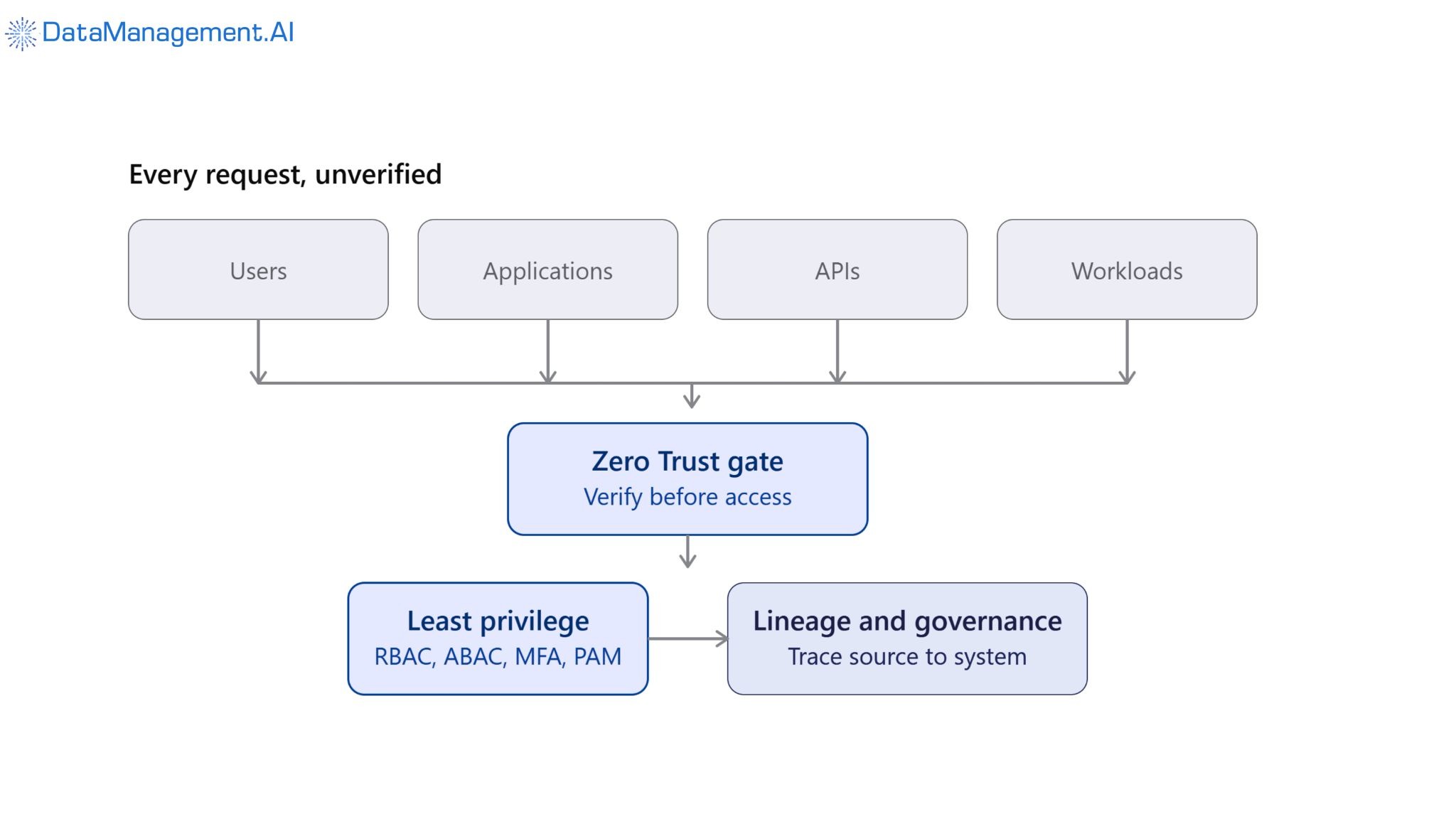
DataManagement.AI’s data lineage, and governance capability strengthens access control by tracing every data element from its source to downstream systems, providing complete visibility into data flows, ownership, and access patterns.
This enables you to identify sensitive data paths, enforce security policies, consistently, and accelerate impact analysis when access permissions or data structures change.
Step 4: Continuously monitor enterprise data
Then start deploying data security management tools that provide real visibility into data movement, access patterns, policy violations, and anomalous behavior.
Continuous monitoring enables security teams to detect threats before they disrupt business operations.
Step 5: Automate governance and compliance
Integrate policy enforcement into your data security management system to automatically classify sensitive data, enforce encryption standards, validate regulatory controls, and generate audit-ready compliance reports across hybrid and multi-cloud environments.
Step 6: Measure and improve your security posture
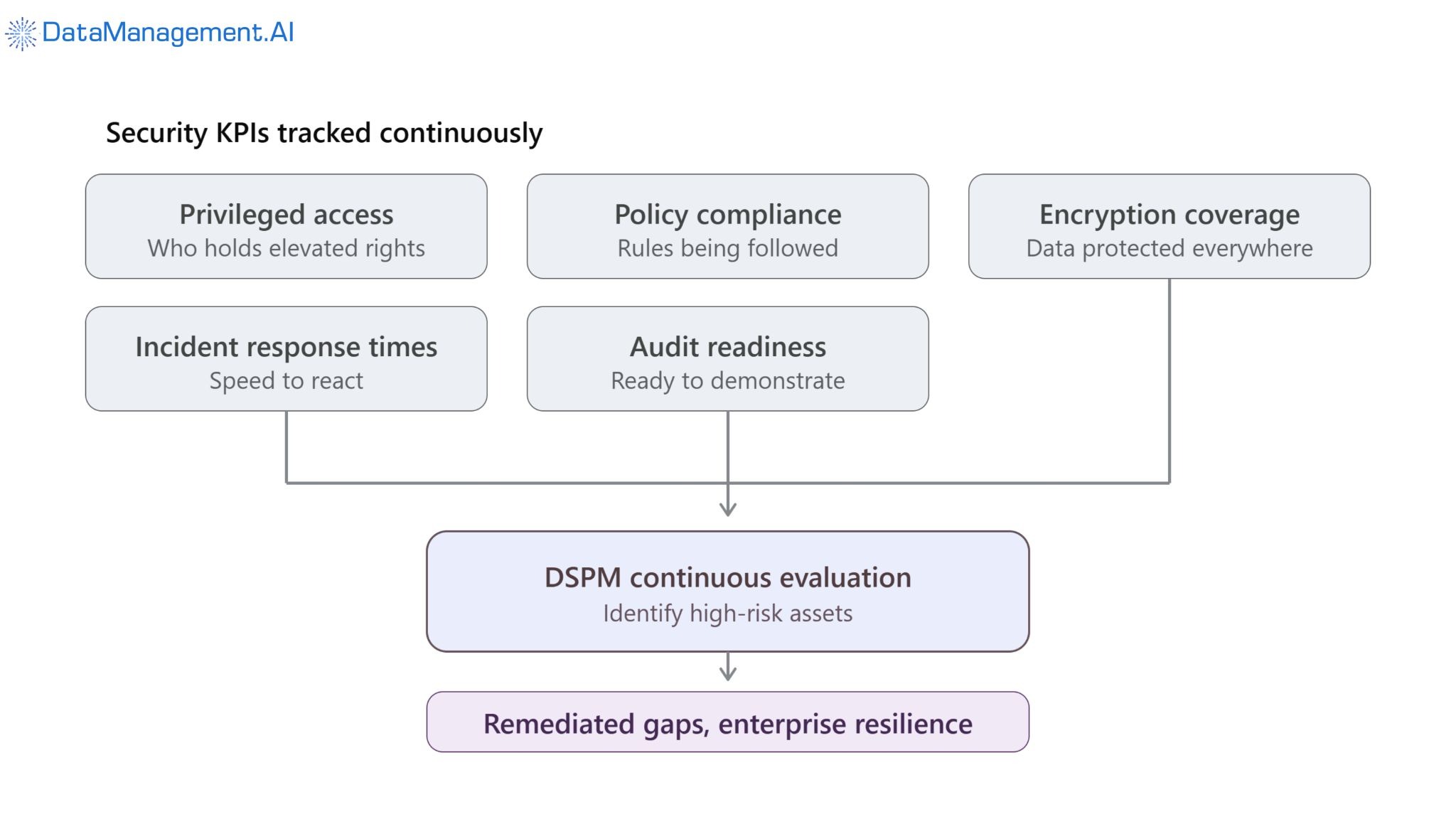
Make sure you are tracking your security KPIs like privileged access, policy, compliance, encryption coverage, incident response times, and audit readiness.
If you practice this continuously, it will enable proactive data, security, and risk management, and help you strengthen cloud data management and improve enterprise resilience as your data ecosystem evolves.
This is where understanding what is data security posture management becomes valuable as DSPM continuously. Evaluate your data environment, identify high-risk assets, and help you remediate security gaps before they impact business operations. and helps you remediate security gaps before they impact business operations.
Build a resilient data security management strategy
As enterprise data continues to expand across cloud platforms, AI applications, and distributed ecosystems, security must evolve from a reactive control to a strategic business capability.
Organizations that integrate security into every stage of the data life-cycle are better equipped to minimize risk, accelerate compliance, improve operational resilience, and enable trusted innovation without compromising sensitive information.
With DataManagement.AI, you can unify data, discovery, classification, governance, metadata, lineage, and continuous monitoring within a single platform, giving your teams the visibility and control needed to secure enterprise data at scale.
Schedule a demo with us and discover how you can build a modern data security management framework that protects critical data while supporting AI, analytics, and enterprise growth.
FAQs
What is data security risk management?
Data security risk management is the continuous process of identifying, assessing, prioritizing, and mitigating risks that could compromise sensitive data to cyber threats, insider activity, misconfigurations, or regulatory non-compliance.
Why is data security important in data management?
Data security ensures that enterprise data remains protected from unauthorized access, alteration, and loss, enabling organizations to maintain regulatory compliance, preserve data integrity, and support trusted analytics, AI, and business operations.
What are the best data security management tools?
The best data security management tools, combine data discovery, classification, identity and access management, encryption, meta data management, data management, continuous monitoring, policy, enforcement, and compliance reporting within a unified platform.
DataManagement.AI is equipped with all these capabilities and is turning out to be a business leader’s first choice these days.
What is cloud data management security?
Cloud data management security refers to the policies, technologies, and controls used to protect enterprise data, stored, processed, and shared across public, private, and hybrid cloud environments, while ensuring compliance and security access.
What is data management in cybersecurity?
Data management in cybersecurity involves organizing, classifying, storing, governing, and protecting enterprise data to reduce cyber risks, strengthen access controls, and ensure sensitive information remains secure throughout its life-cycle.
Why is data management important in cybersecurity?
Data security is a core pillar of cybersecurity because it protects sensitive information from unauthorized access, ransomware, insider threats, and data breaches, while maintaining business continuity, customer trust, and regulatory compliance.
What is the difference between data governance and data security?
Data governance defines how enterprise data is managed, owned, and used through policies, standards, and accountability, whereas data security focuses on protecting that data using technical controls like encryption, identity management, monitoring, and access enforcement.