




In 2026, your databases are no longer just repositories of information. They power AI models, customer experiences, financial operations, and real-time business decisions.
Yet, several organizations with weak AI access controls are significantly more likely to experience security incidents, while the global average cost of a data breach remains around $4.4 million.
Database security has therefore evolved beyond preventing unauthorized access.
It now requires a proactive strategy that combines identity management, encryption, continuous monitoring, governance, and automated controls to protect your most valuable data assets across the enterprise.
| In 2024, attackers breached Snowflake customer environments not by exploiting Snowflake’s infrastructure, but by using stolen credentials without multifactor authentication. The result affected organisations including Ticketmaster and Santander, proving that modern database breaches often begin with identity failures rather than firewall failures. That’s the uncomfortable reality of database security these days. Attackers no longer break into databases; they just log in. |
What is database security?
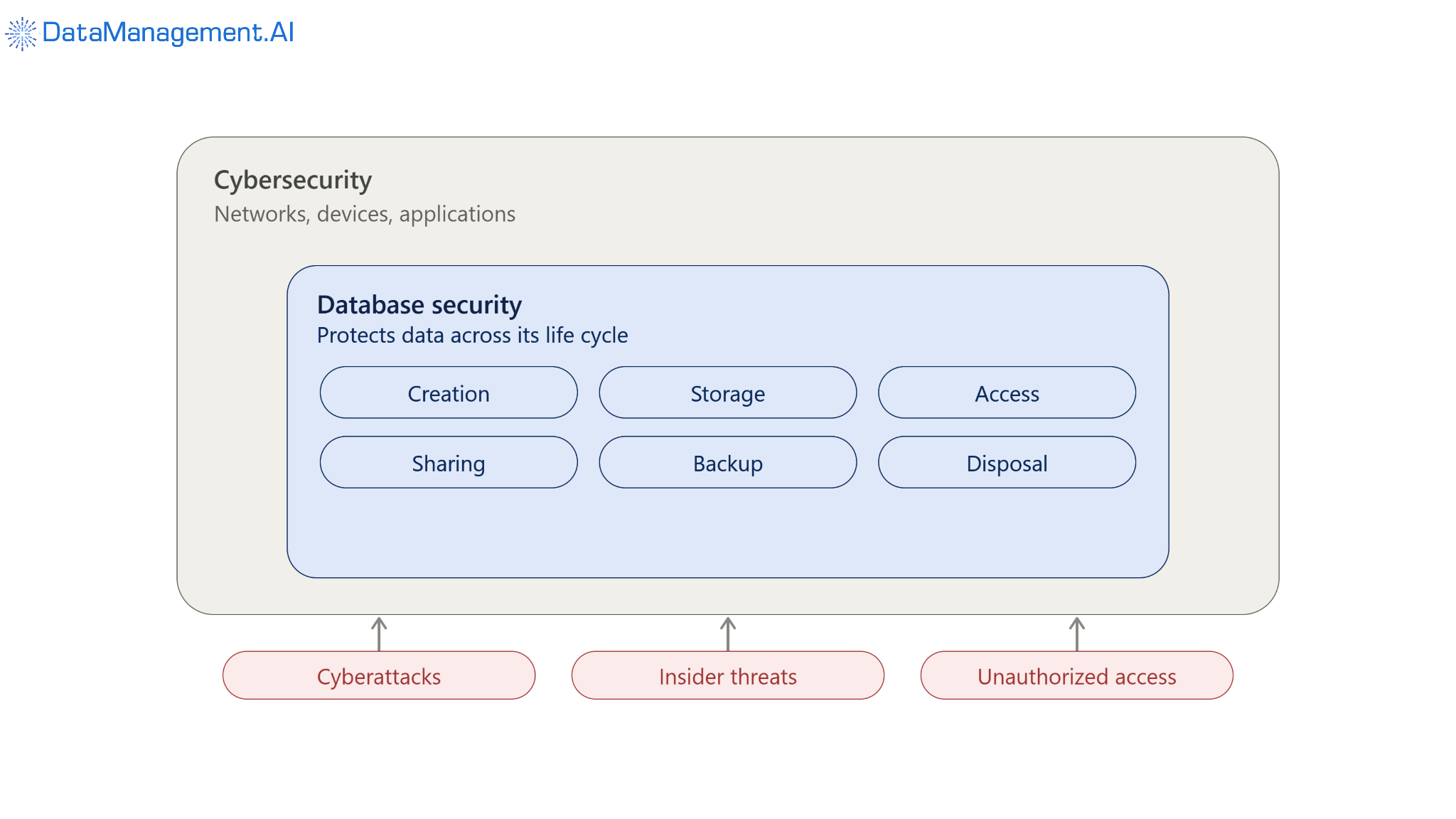
Database security is the practice of protecting databases and the sensitive information they store through access controls, encryption, monitoring, and governance throughout the entire data life-cycle. While cybersecurity protects networks, devices, and applications, database security management focuses specifically on safeguarding data from creation and storage to access, sharing, backup, and disposal.
Because databases centralize an organization’s most valuable information, they remain a primary target for cyber attacks, insider threats, and unauthorized access.
Moreover, understanding what is data security posture management further strengthens data security by continuously assessing security risks, identifying misconfigurations, and enforcing policies that improve your overall security posture.
Why is database security important for modern enterprises?
Your databases power customer transactions, AI models, financial systems, and operational workloads, making them one of the most valuable assets in your technology ecosystem.
As AI adoption accelerates, security risks are growing just as quickly. A recent industry report found that 64% of organizations identify data security and privacy as their biggest challenge, while 58% are willing to accept higher security risk to accelerate AI initiatives.
Implementing modern database security best practices enables you to protect sensitive information, maintain regulatory compliance, strengthen customer trust, and ensure resilient data security in database management systems.
Where does your organization stand?
Before implementing database security best practices, you should first assess your organization’s security maturity.
| Level | Security maturity |
| Level 1 | Security is reactive, with investigations beginning only after incidents or data breach occur. |
| Level 2 | Core controls like encryption, multi factor authentication, and role based access controls are implemented to protect critical databases. |
| Level 3 | Continuous database, activity, monitoring, behavioural analytics, and real-time alerting detect suspicious activity before escalates. |
| Level 4 | Metadata, data, lineage, automated governance, and policy enforcement provide complete visibility into how sensitive data moves across the enterprise. |
| Level 5 | AI continuously predicts security risks, detects anomalies, prioritizes threats based on business impact, and recommends remediation before vulnerabilities can be exploited. |
Common database security risks you should know
Modern databases face increasingly sophisticated attacks as organizations adopt cloud architectures, AI applications, and distributed data environments.
According to IBM, stolen or compromised credentials remain the most common attack vector, accounting for 16% of breaches, while cloud misconfigurations and unmatched systems continue to expand enterprise attack surfaces.
Therefore, implementing database security best practices begins with identifying the most critical risks before they disrupt operations or expose sensitive information.
Strong database security also supports big data and knowledge management by ensuring enterprise data remains protected, governed, and trustworthy as it moves across analytical, operational, and AI-driven workloads.
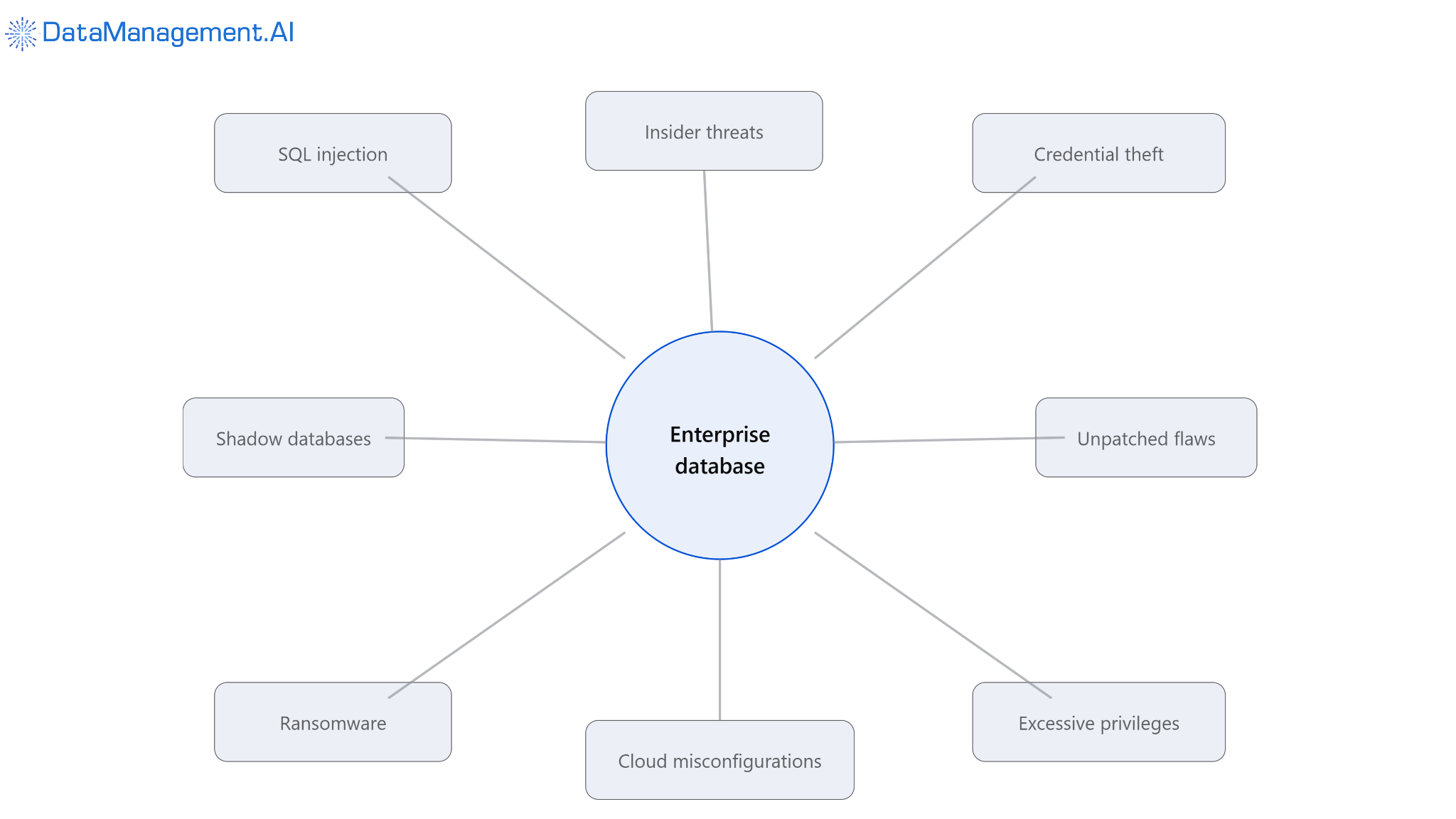
Some of the most common database security risks include:
- SQL injection attacks exploit vulnerable database queries.
- Insider threats that result from malicious or negligent employees and contractors.
- Credential theft that occurs through phishing, weak authentication, or compromised privileged accounts.
- Ransomware attacks target production databases and backup repositories.
- Misconfigured cloud databases expose sensitive data through insecure permissions or public access.
- Excessive user privileges that lead to violations of least privilege principles and increase unauthorized access risks.
- Shadow, databases operating outside governance and security controls.
- Unmatched database vulnerabilities that attackers exploit before security updates are applied.
Whether you are evaluating data security in a database management system or strengthening it, addressing these risks requires a proactive, policy-driven approach.
The following best practices for data security and compliance will help you build a resilient database security strategy that protects critical business data across the enterprise.
11 best database security best practices and compliance
Protecting enterprise databases requires more than firewalls and encryption. As organizations scale, AI, cloud native applications, and distributed data platforms, database security best practises must evolve into a continuous discipline that combines governance, entity, observability, and automation.
Reports organizations that extensively use AI and automation in cybersecurity identify and contain threats significantly faster than those that do not, highlighting the value of proactive security operations.
Discover and classify sensitive database assets
You should maintain a complete inventory of every database, schema, table, and data store across your enterprise. Then, continuously discover and classify sensitive information like personally identifiable information (PII), financial records, intellectual property, and regulated data based on business criticality and compliance requirements.
This allows you to apply appropriate security controls, prioritize remediation efforts, and eliminate unmanaged or shadow databases before they become security risks.
Implement least-privilege access controls
You should grant users, applications, APIs, and service accounts only the permissions required to perform their responsibilities.
Implement role-based access control (RBAC), attribute-based access control (ABAC), privileged access management (PAM), and Zero Trust policies to minimize excessive privileges, prevent unauthorized access, and reduce lateral movement if credentials are compromised.
Regular access reviews also help you revoke unnecessary permissions as business roles evolve.
Enforce strong authentication
You should protect every database connection using multi-factor authentication (MFA), certificate-based authentication, strong password policies, secure API authentication, and tightly governed service accounts.
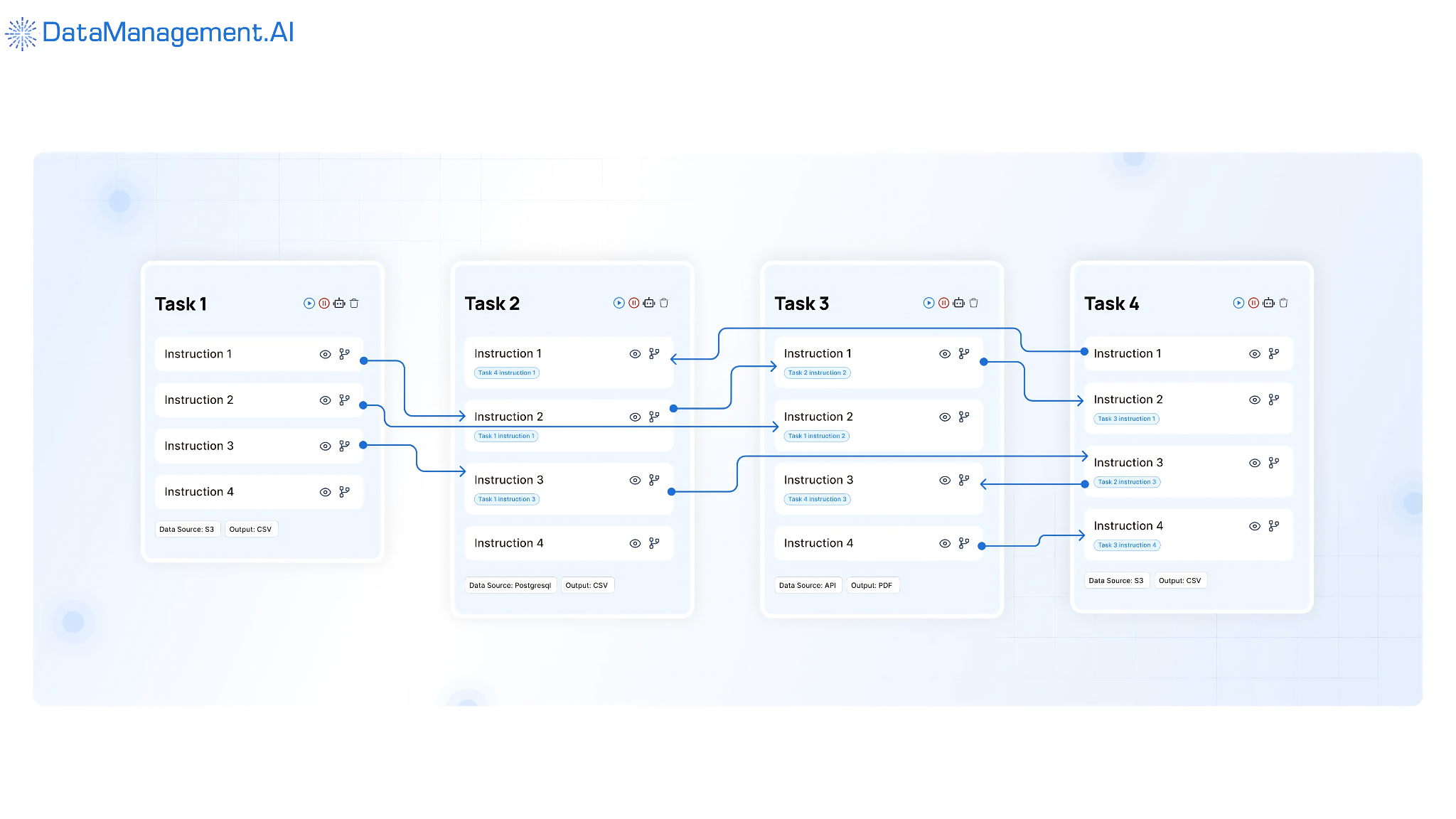
Rather than managing identities across isolated systems, DataManagement.AI centralizes metadata, governance policies, and access visibility, enabling you to enforce consistent authentication, controls, and strengthen security across distributed database environments.
Encrypt data at rest and in transit
You should encrypt sensitive information throughout its life cycle using Transport Layer Security (TLS) for data in transit and Transparent Data Encryption (TDE) for stored data.
Combine these controls with centralized key management, tokenization, automated key rotation, and hardware security module (HSMs) to ensure sensitive information remains protected even if storage infrastructure or credentials are compromised.
Monitor database activity continuously
You should continuously monitor database activity instead of relying solely on periodic log reviews. Implement database activity monitoring (DAM), behavioral analytics, anomaly detection, and real-time alerting to identify suspicious queries, privilege escalation, abnormal access patterns, and unusual data movement.
DataManagement.AI’s operational anomaly detection automatically detects abnormal database behavior, prioritizes security incidents based on business impact, and enables your teams to investigate threats before they affect critical systems.
Maintain complete metadata and data lineage
You should maintain end to end meta data and data lineage for every critical database. So you always know where sensitive data originated, how it was transformed, who accessed it, and which downstream applications consume it.
Complete visibility enables faster root cause analysis, improves governance, simplifies regulatory audits, and helps you assess the business impact of security incident before changes a Lelo the business impact of security incident before changes are deployed.
Keep database software patched and configurations hardened
Unpatched databases remain one of the easiest attack vectors. Establish automated patch management, continuous vulnerability assessments, secure configuration baselines, and CIS benchmark validation to eliminate known weaknesses before they are exploited.
Regular hardening also reduces configuration drift across database environments.
Automate backups and disaster recovery
You should automate encrypted backups, define recovery point objectives (RPOs) and recovery time objectives (RTOs), and regularly test recovery procedures to verify business continuity.
DataManagement.AI strengthens disaster recovery by providing metadata, intelligence, governance, visibility, and real-time monitoring that help you validate, backup integrity, detect recovery failures early disaster recovery by providing meta-data, intelligence, governance, visibility, and real time, monitoring that help you validate, backup, integrity, detect recovery, failures, early
and ensure critical business data can be restored quickly and accurately.
Continuously audit user activity and policy compliance
You should maintain comprehensive audit logs that capture authentication events, administrative actions, privilege changes, configuration updates, and data modifications.
Regular access reviews, automated compliance, reporting, and continuous policy validation help you demonstrate compliance with frameworks such as GDPR, HIPAA, PCI DSS, and ISO 27001, while improving forensic investigations and reducing audit complexity.
Secure cloud and hybrid databases
You should apply consistent security policies across public cloud, private cloud, hybrid, and on-premises database environments.
Implement cloud native identity and access management (IAM), network segmentation, secrets management, encryption, workload isolation, and centralized governance to reduce configuration drift and maintain a consistent security posture, regardless of where your databases reside.
You should also integrate data security posture management solutions to continuously assess security, configurations, identify misconfigurations, prioritize risks, and strengthen protection across cloud, on-premises, and hybrid database environments.
Continuously monitor data quality alongside database security
You should treat data integrity as an essential component of database security, because compromised, incomplete, or inconsistent data can undermine analytics, AI models, and operational decisions even when infrastructure remains secure.
DataManagement.AI’s data quality monitoring continuously validates data accuracy, completeness, consistency, and schema integrity while detecting unauthorized changes and quality anomalies through a centralized monitoring dashboard, enabling you to maintain secure, trusted, and decision-ready enterprise data. through a centralized monitoring dashboard, enabling you to maintain secure, trusted, and decision-ready enterprise data.
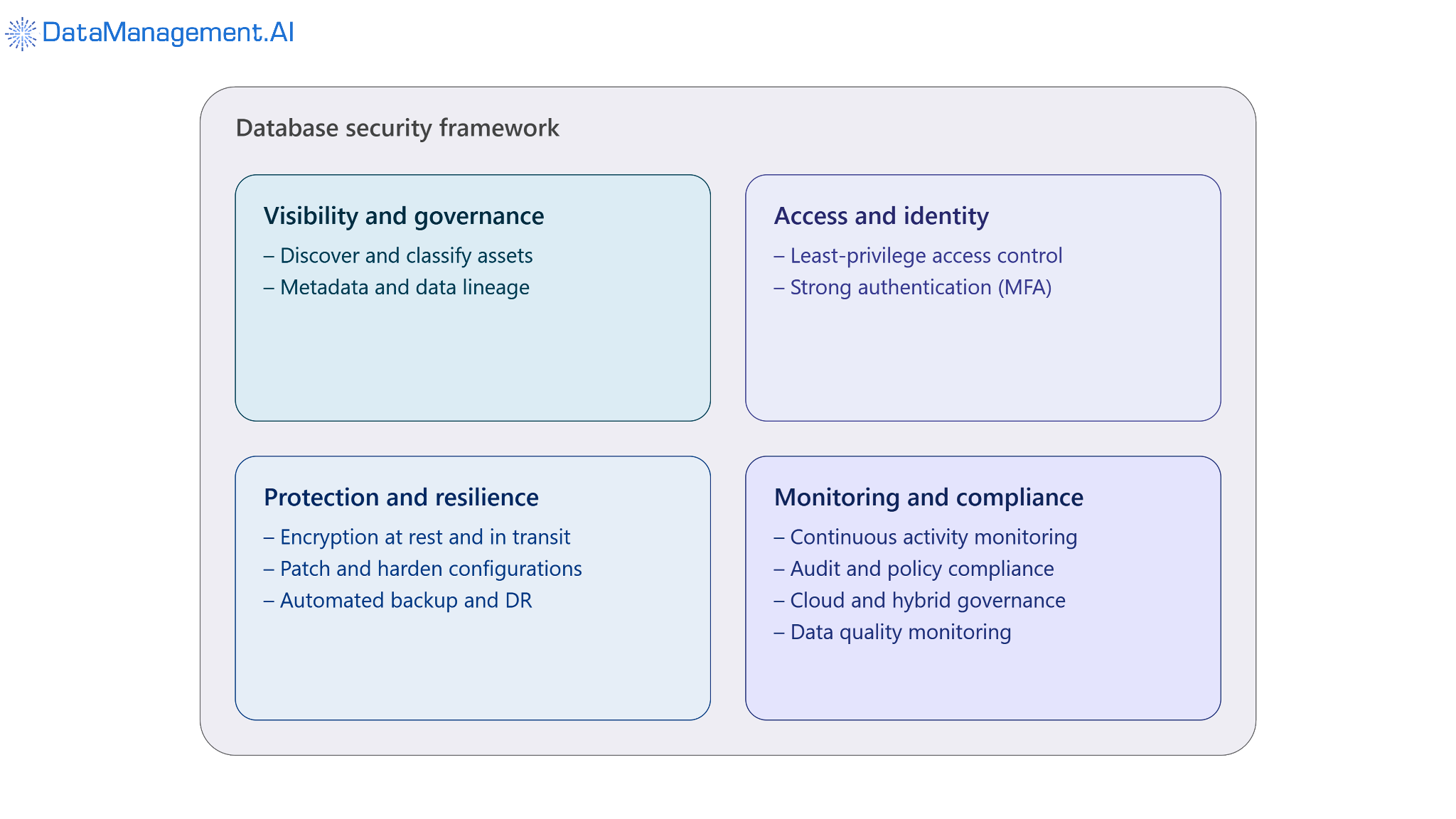
How to implement database security across your enterprise?
Implementing database security best practices requires a structured, enterprise-wide approach rather than isolated security controls.
You should begin by discovering and classifying sensitive database assets, then enforcing least privilege access, strong authentication, encryption, and continuous activity monitoring across every environment.
Integrating governance, metadata, data, lineage, automated compliance, and regular vulnerability assessments further strengthens data security in database management systems while reducing operational risk.
By embedding these best practices for database security and compliance into your data life-cycle, you can build a resilient security framework that protects critical databases, supports AI-driven workloads, and scales confidently across cloud, hybrid, and on-premises environments.
Schedule a demo with DataManagement.AI to see how our platform can help you protect sensitive data, streamline governance, and build a resilient, enterprise-grade database security framework.
FAQs
Why is database security important?
Database security protects sensitive business information from unauthorized access, data breaches, ransomware, and insider threats.
It also helps you maintain regulatory compliance, preserve data integrity, support AI and analytics initiatives, and ensure business continuity across on-premises, cloud, and hybrid environments.
How do you secure enterprise databases?
You can secure enterprise databases by discovering and classifying sensitive data, implementing least privilege, access controls, enforcing multifactor authentication, encrypting data at rest and in transit, continuously monitoring database activity, maintaining metadata and lineage, applying security patches, automating backups, and conducting regular compliance audits.
What is the difference between database security and cybersecurity?
Cybersecurity protects an organization’s entire digital infrastructure, including networks, endpoints, applications, and cloud environments.
Database security is a specialized discipline that focuses on protecting databases and the data they store through access controls, encryption, monitoring, governance, and compliance throughout the data life-cycle.
What is database activity monitoring?
Database activity monitoring (DAM) is the continuous tracking and analysis of database transactions, user activities, administrative actions, and SQL queries.
It helps you detect unauthorized access, privilege, abuse, anomalous behavior, and policy violations in real time while supporting regulatory compliance and foreign investigations.
Why is encryption important for database security?
Encryption protects sensitive information by converting readable data into ciphertext that can only be accessed with authorized cryptographic keys.
Encrypting data at rest and in transit helps prevent unauthorized disclosure, supports compliance requirements, and minimizes the impact of stolen storage media, intercepted network traffic or compromised credentials.
How does metadata improve database security?
Metadata contextual information about database assets, including data ownership, classifications, schemas, lineage, and access permissions.
Maintaining accurate metadata enables you to identify sensitive data, enforce security policies, accelerate impact analysis, improve audit readiness, and strengthen governance across your enterprise database environment.