




You rarely commit on the first touch anymore.
A survey of 46,000 retail shoppers found that 73% of you now engage across multiple channels before purchasing, averaging six touchpoints—up from just two, 15 years ago.
That shift has redefined what understanding you truly means. It is not just about tracking your clicks, but connecting your behavior across every channel in real time.
This guide breaks down the best customer journey analytics platforms for 2026 and how to choose the right one for your business.
What is customer journey analytics?
Most companiCustomer journey analytics is essentially the technology that tracks and connects every step a person takes with a brand from start to finish, rather than looking at each interaction in isolation.
Instead of seeing isolated snapshots (e.g., “100 people clicked an email” or “50 people visited the website”), it stitches those actions together into a single storyline for each individual:
The core difference
Traditional analytics
Answers “What happened on this channel?” (e.g., 500 users dropped off at checkout on the website).
Customer journey analytics
Answers “Why did they do that, and what else did they do?” (e.g., Users dropped off at checkout because they got an unhelpful email response from support 10 minutes earlier on their phone).
What does it actually connect?
It bridges the gaps across separate systems by tracking:
Digital actions
Mobile app activity, website visits, clicked links, and session replays (seeing where people get stuck on a screen).
Direct communication
Email opens, live chat logs, and customer support tickets.
Offline touches
In-store purchases, phone calls, or physical location check-ins.
By unifying all these touchpoints, it gives companies a complete picture of the real customer experience, helping them fix hidden friction points and boost overall revenue.es still treat each channel as its own scoreboard, and that’s the problem. Siloed customer data can cut marketing ROI by 20 to 30%, largely because no one sees the full path a customer actually takes.
Customer journey analytics connects every touch point, mobile, email, support, and offline, into one continuous view instead of isolated reports.
Unlike traditional web analytics, it combines funnels and conversion data with session replay and AI-driven insights, showing you not just where customers drop off, but why.
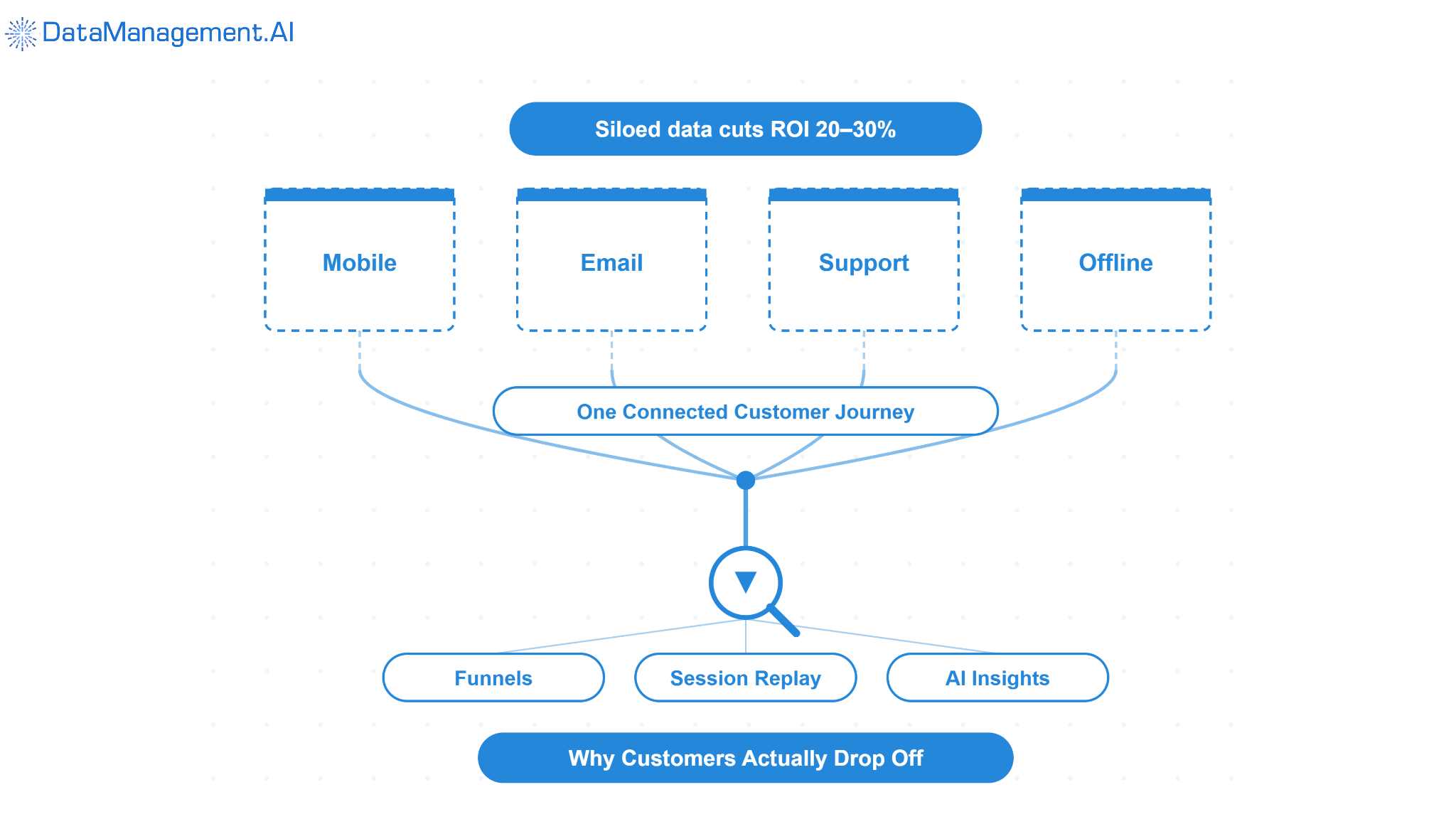
Fragmented channels unite into one journey.
Best 7 customer journey analytics tools for 2026
From data foundation to journey visualization, these platforms represent the strongest options available today, each solving a different piece of how you understand and act on customer behavior.
- DataManagement.AI
Customer journey analytics fails without clean, unified data. DataManagement.AI isn’t competing with surface-level journey mappers; it powers them by solving the fundamental data fragmentation that breaks traditional analytics initiatives before they start.
Instead of routing customer data through months of manual pipeline building, the platform uses Chain-of-Data technology to link every step into a single, unified matrix. You get instant, in-place data access to query and analyze customer interactions directly in their source systems, meaning zero data replication, no extra storage costs, and no latency before segmentation begins.
Through an intuitive Visual Canvas, teams can use agentic workflows to drag, drop, and build complex pipelines in minutes, mapping the entire underlying data engine in a single view.
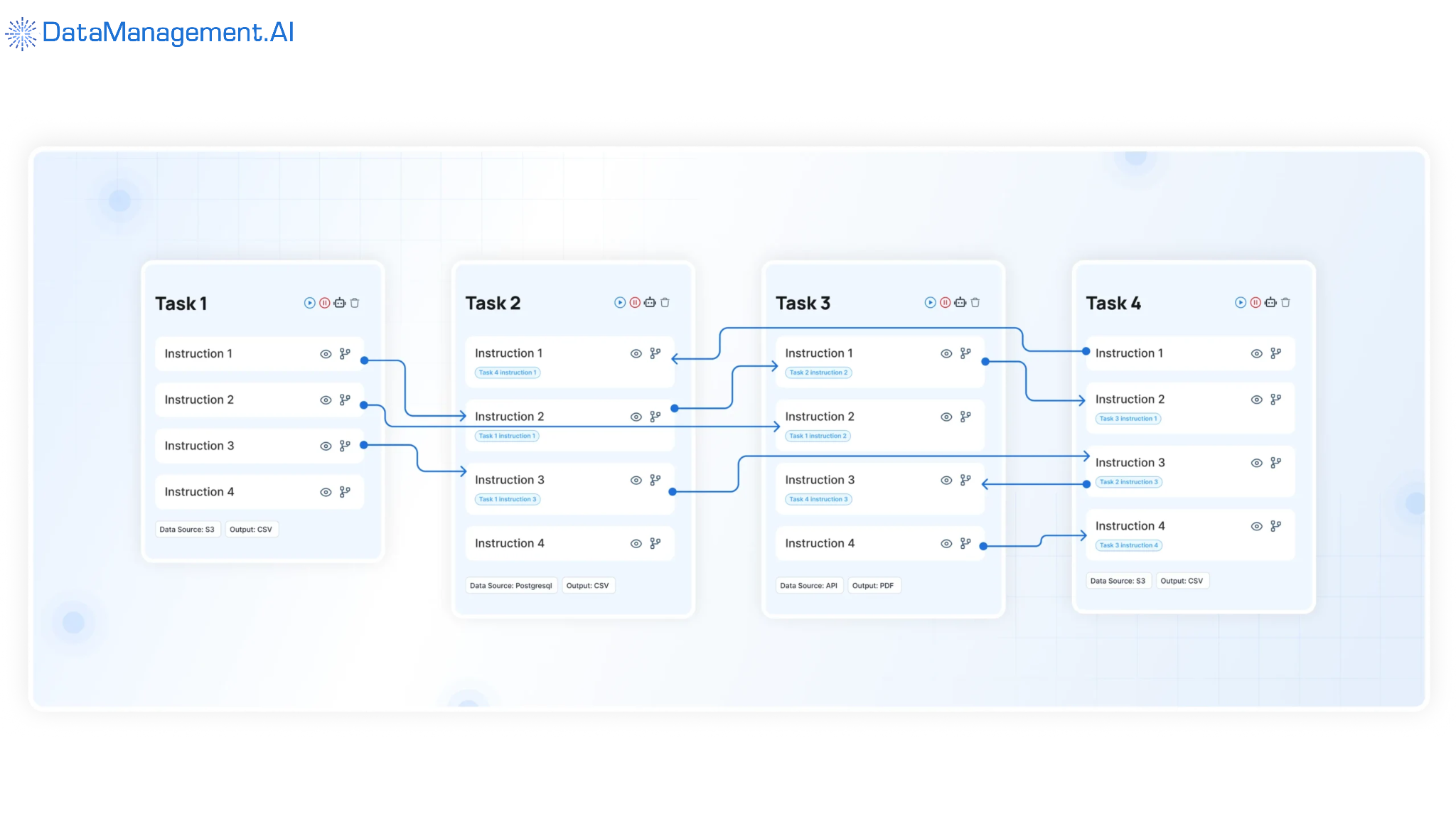
Analyze connected customer steps across touchpoints.
‘Intelligent Execution’ then runs these workflows on demand or on schedule, with agents, automatically detecting and recovering from failures.
Every run updates a living metadata catalog through ‘End-to-End Lineage,’ generating audit trails and compliance reports without manual effort, which is a meaningful advantage for teams handling sensitive customer data across regions and regulations.
DataManagement.AI also has specialized AI agents to extend this further. Profile AI automatically analyses and profiles customer data to surface patterns, anomalies, and quality issues before they reach downstream reporting.
Combined with its customer segmentation, real-time alerts, and self-service analytics capabilities, teams get continuously refreshed segments, immediate notification of behavioral anomalies, and reports they can build without waiting on a central data team.
The efficiency gains of using this platform are substantial. Organizations report up to 60% more efficiency and over 50% in cost savings, with DataManagement.AI’s broader benchmarks pointing to more than 15x efficiency gains and over 10x cost reduction compared to manual, fragmented data processes.
For organizations whose journey analytics school is only as good as the customer data feeding it, this platform serves as that foundation, ensuring the segmentation, alerts, and reports reaching your journey analytics platform are accurate, current, and governed before they ever get there.
Amplitude
Amplitude is a product and behavioral analytics platform widely used for understanding how users move through digital products. It offers strong funnel analysis, retention, curves, and path exploration, letting teams see exactly where users drop off within an app or website.
Amplitude’s strength lies in granular event-level tracking and its ability to segment behavior by cohort, making it a popular choice for product teams optimizing feature adoption and onboarding flows.
It’s less focused on offline or cross-channel journeys, which makes it best suited for organizations whose customer journey lives primarily in digital products.
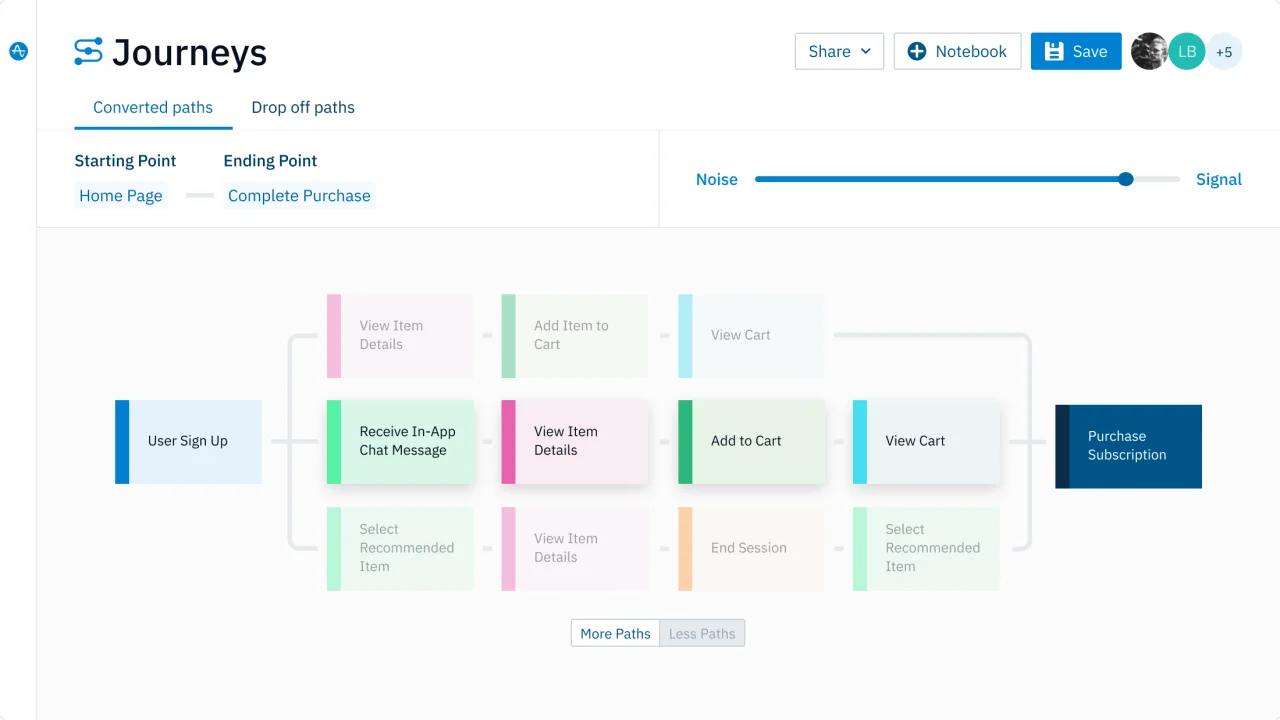
Track user pathways leading to subscription purchases.
Contentsquare
Contentsquare specializes in experience analytics, combining behavioral data with visual tools, like heat maps and session replay. It helps teams understand, not just where customers drop off, but what they were experiencing at that moment, whether that’s a confusing layout, a slow-loading element, or a broken checkout flow.
The platform’s zone-based analysis and AI-powered insights surface friction points automatically, reducing the manual work of digging through session recordings, one by one. It’s particularly strong for e-commerce and content-heavy sites focused on conversion optimization.
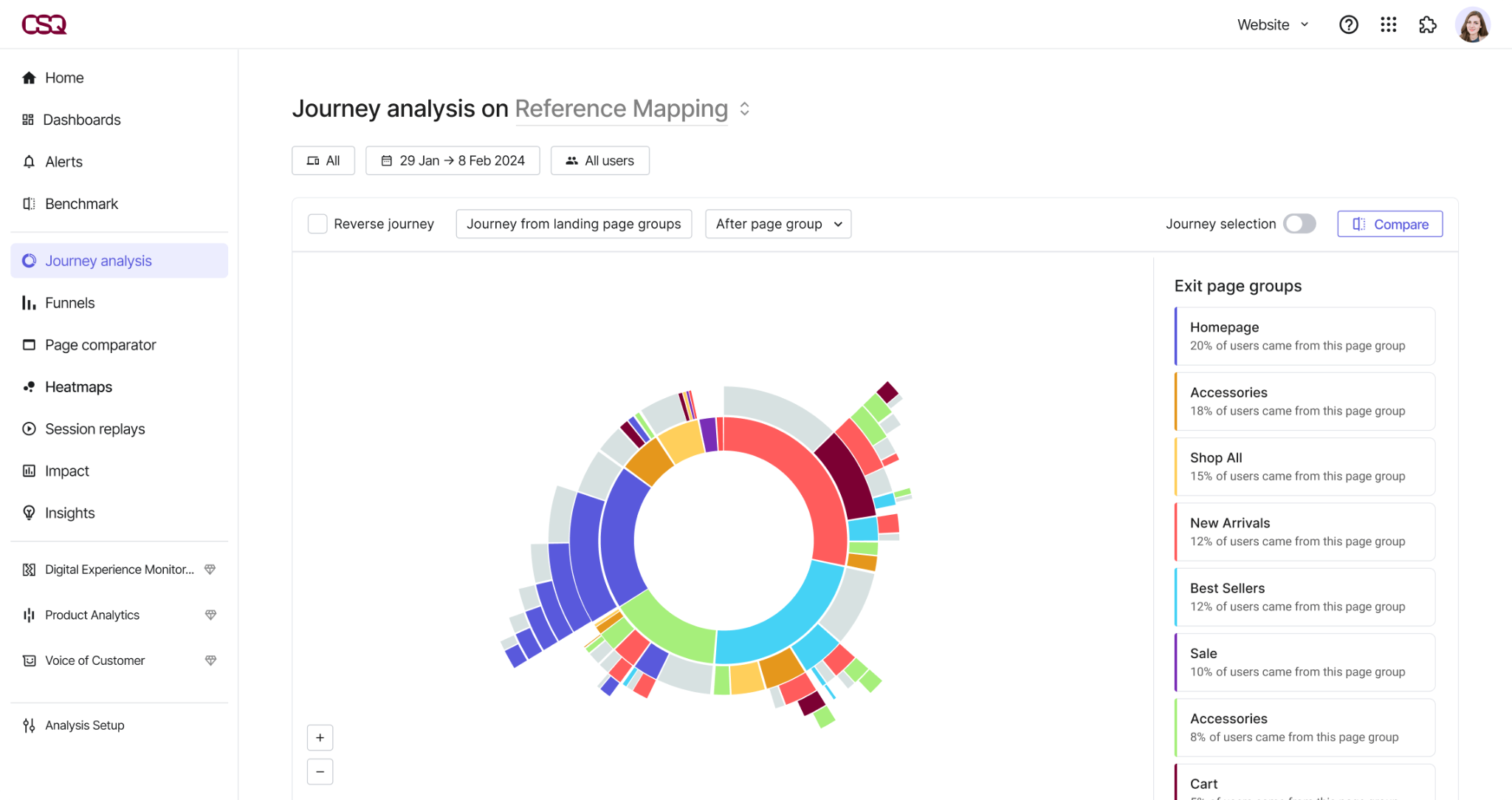
Analyze website navigation paths and exit groups.
Adobe customer journey analytics
Adobe’s platform is built for large enterprises, managing complex multichannel data environments. It stitches together data from any source, web, mobile, CRM, call center, and offline systems, into a unified journey view without requiring a fixed schema.
This flexibility makes it well-suited for organizations with deeply customized data architectures. Its integration with the broader Adobe Experience Cloud also makes it a natural fit for enterprises already invested in Adobe’s marketing and personalization stack. Its complexity and cost typically position it toward larger organizations rather than midmarket teams.
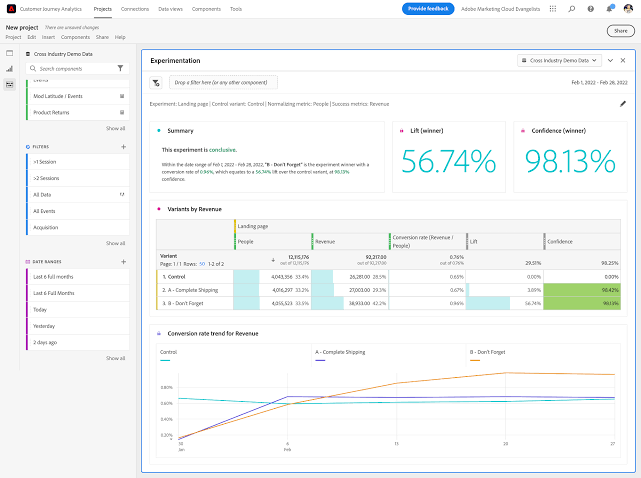
Analyze website navigation paths and exit groups.
Quantum Metric
Quantum Metric focuses on real-time digital experience analytics, combining journey visualization with continuous, automated anomaly detection. Rather than requiring teams to manually query for issues, it proactively surfaces friction points, errors, and revenue-impacting bugs as they happen.
This real-time orientation makes it particularly valuable for organizations where digital experience issues have direct, immediate revenue consequences, like e-commerce and financial services.
The platform also emphasizes collaboration, allowing product, engineering, and CX teams to work from the same live data rather than disconnected reports.
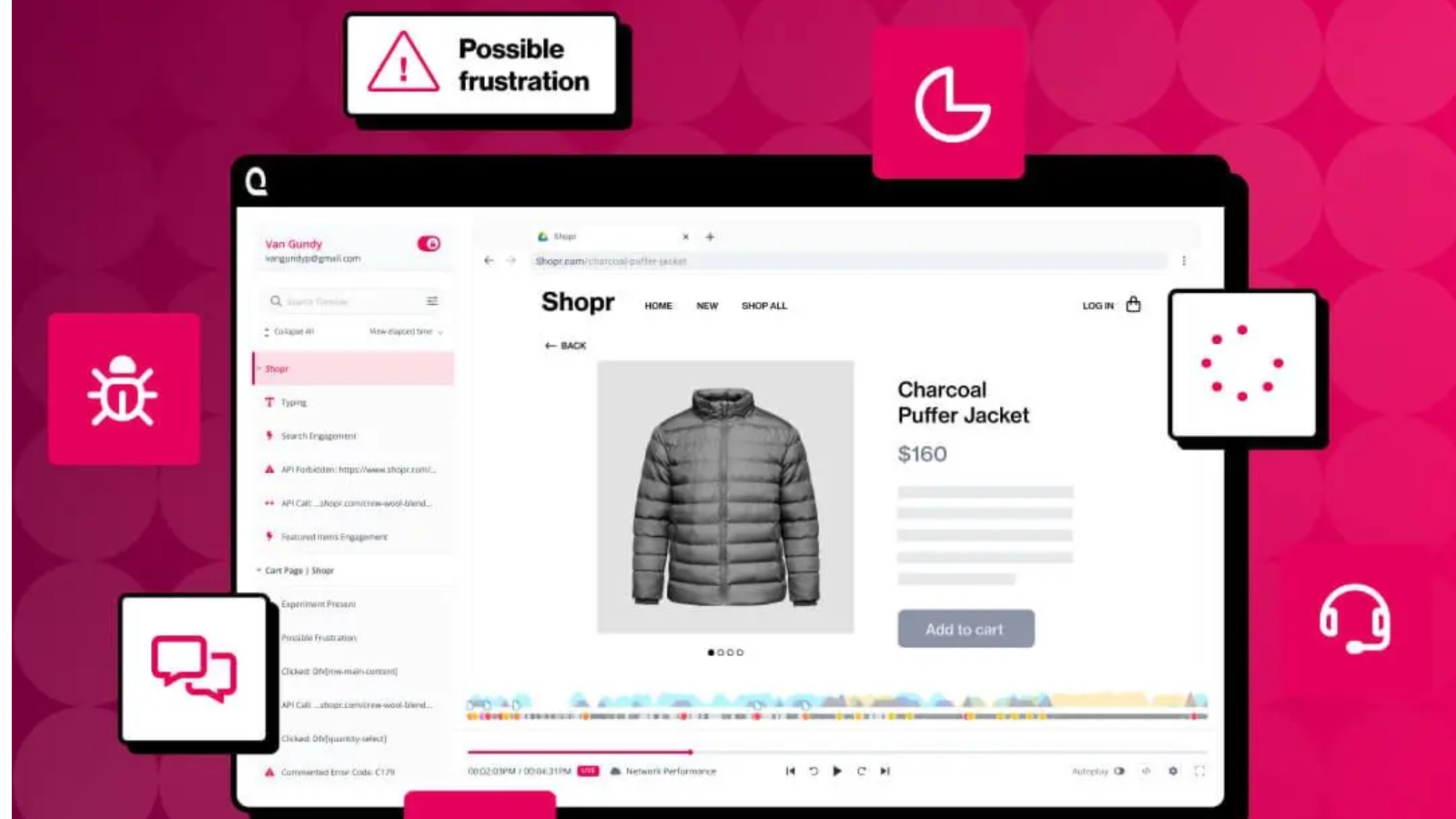
Identify user friction points and rage clicks.
Mixpanel
Mixpanel is a product analytics platform centered on event-based tracking and self-serve exploration. It allows teams to build custom funnels, cohorts, and retention reports without heavy reliance on data teams, making it a popular choice for product-led growth organizations.
Mixpanel’s strength is speed and accessibility, so that non-technical users can explore behavioral data and answer specific questions quickly. It’s less oriented toward qualitative context, like session replay, so teams often pair it with a complementary tool like DataManagement.AI for deeper behavioral detail.
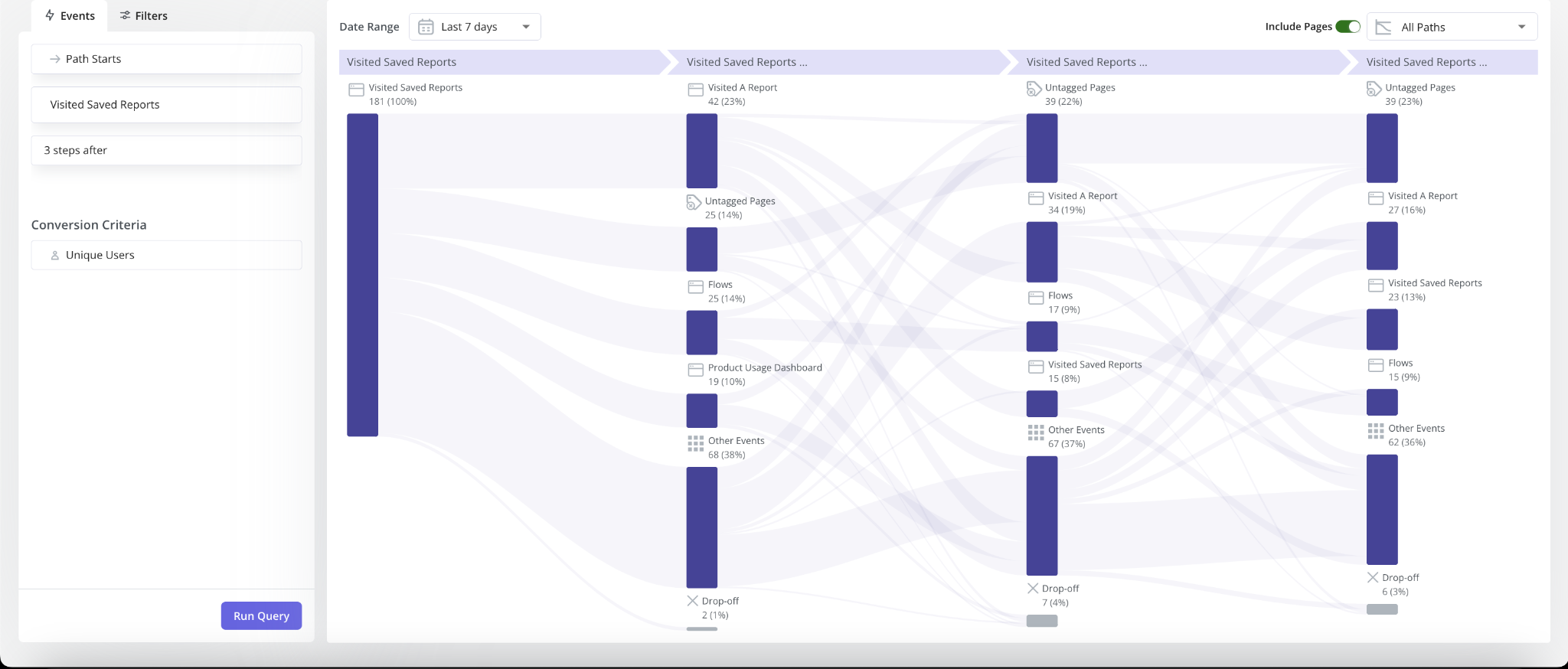
Visualize user step progression and drop-offs.
Insider One
Insider One combines journey orchestration with behavioral analytics and segmentation, positioning itself as both an analytics and activation platform. Beyond reporting on customer journeys, it allows teams to act on insights directly, triggering personalized campaigns across channels based on observed behavior.
Its broad channel reach and real-time optimization capabilities make it a strong fit for marketing teams who want journey insight and journey action within a single platform, rather than exporting insights to separate execution tools.
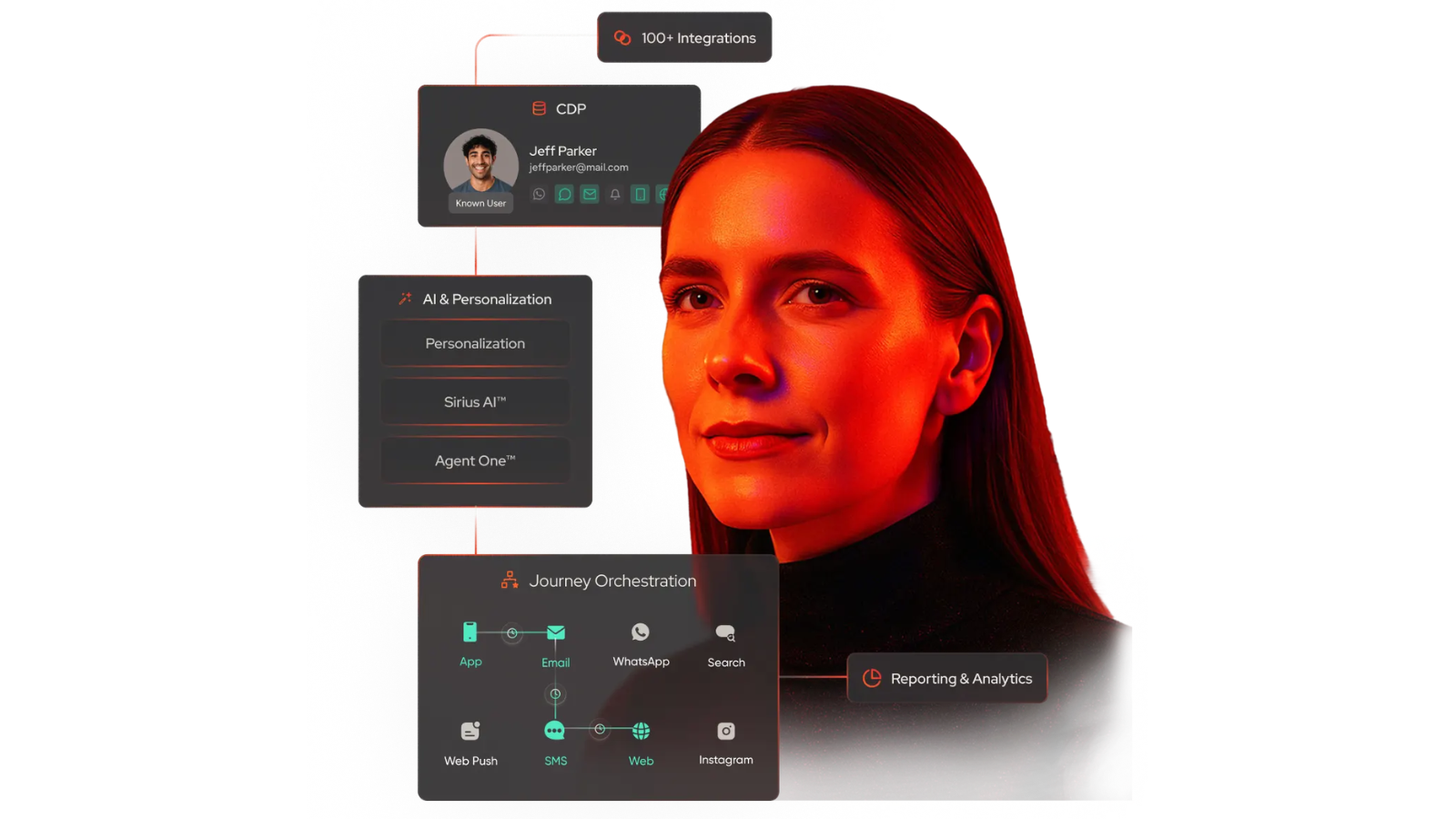
Orchestrate personalized customer journeys across channels.
What makes customer journey analytics the best fit?
Not every organization needs the same capabilities from a journey analytics platform, but a few criteria consistently separate strong tools from the weak ones.
- Automatic data capture matters because manual event tagging creates gaps and inconsistencies over time. The best tools capture behavioral data automatically, reducing the engineering overhead of maintaining tracking plans.
- Cross-section and cross-device tracking are essential, given how rarely a customer journey happens in a single sitting. A tool that can’t stitch together a user’s behavior across devices will always show an incomplete picture.
- Visual path and journey mapping turn raw event data into something teams can actually interpret and act on, rather than requiring analysts to manually reconstruct journeys from spreadsheets
- Funnel and drop of analysis identifies exactly where customers abandon a process, which is often the single most actionable insight a journey tool can provide.
- Qualitative context, like session replay and heatmaps, explains the “why” behind the quantity drop-off, showing what a customer actually experienced rather than just what they did.
- AI-powered insights are increasingly separating modern platforms from legacy ones, surfacing patterns and anomalies automatically rather than requiring teams to know what to look for in advance.
- Integrations with the existing stack, including CRM, marketing automation, and data infrastructure, determine how easily a tool fits into an organization’s broader data ecosystem rather than existing as an isolated silo.
Customer journey platforms compared
| Tool | Best for | Core strength | Data foundation |
| DataManagement.AI | Unifying customer data before analysis | Segmentation, real-time alerts, self-service reporting | Yes, purpose-built |
| Amplitude | Digital product analytics | Funnel and retention analysis | Event based |
| Contentsquare | Experience optimisation | Session reply and heat maps | Behavioral + visual |
| Adobe customer journey analytics | Large enterprise, multichannel data | Flexible, schema-free data stitching | Cross-source |
| Quantum Metric | Real-time digital experience | Automated anomaly detection | Real-time behavioral |
| Mixpanel | Self-serve product analytics | Fast, accessible funnel building | Event-based |
| Insider One | Journey orchestration and activation | Insight-to-action in one platform | Behavioral + campaign |
How to choose the right platform for your team?
You should start with your data foundation, and not the analytics interface. A journey analytics tool is only as reliable as the customer data feeding it, and fragmented or duplicated records will undermine even the most sophisticated visualization.
This is where DataManagement.AI adds value upstream by unifying segmentation, behavioral, and touch point data before it ever reaches a journey mapping tool. This ensures the analysis layer is working from accurate, current information rather than compensation for messy inputs.
From there, match the tool to your team’s actual workflow. Product teams optimizing digital experiences will lean toward platforms like Amplitude or Mixpanel, which emphasize fast, self-serve funnel and cohort analysis.
Teams focused on conversation and UX friction will get more value from Contentsquare’s qualitative depth.
Large enterprises, managing genuinely multichannel, cross-system data, will need the flexibility of a platform like Adobe Customer Journey Analytics, while teams that want to act on insights immediately, not just observe them, should weigh platforms like Insider One or Quantum Metric that combine analysis with real-time response.
Finally, consider the integration effort. A platform that requires months of custom implementation before delivering value will delay the very insights you are trying to generate.
Prioritize tools that connect cleanly with your existing data infrastructure and customer data foundation, rather than ones that require rebuilding your data architecture around the analytics tool itself.
Schedule a demo with DataManagement.AI to see how automated segmentation, real-time alerts, and self-service reporting can prepare your customer data for deeper journey insight.