



Have you ever celebrated a healthy pipeline only to discover that many qualified leads were duplicates or outdated accounts?
Poor data quality management creates inaccurate forecasts, flawed risk models, incomplete supply chains, data, and unreliable compliance reports.
That’s why every organization needs a structured approach to managing data quality.
What is Data Quality Management?
Data quality management is the engineering discipline that ensures that your data remains structurally valid, semantically consistent, and operationally reliable throughout its lifecycle. It includes profiling, rule definition, validation logic, standardization, deduplication, monitoring, and remediation of data into a continuous control loop that’s embedded within data pipelines.
| Research from Gartner shows that poor data quality costs organizations an average of $12.9 million per year. That figure compounds in AI-driven environments, where flawed inputs are amplified algorithmically. |
It operates at multiple layers: schema enforcement at ingestion, transformation checks during ETL/ELT, referential integrity across relational systems, anomaly detection in analytical workloads, and freshness monitoring in streaming environments.
Thus, data quality management ensures that your metrics, models, and operational decisions are built on data that is measurably trustworthy, and not just assumed to be.
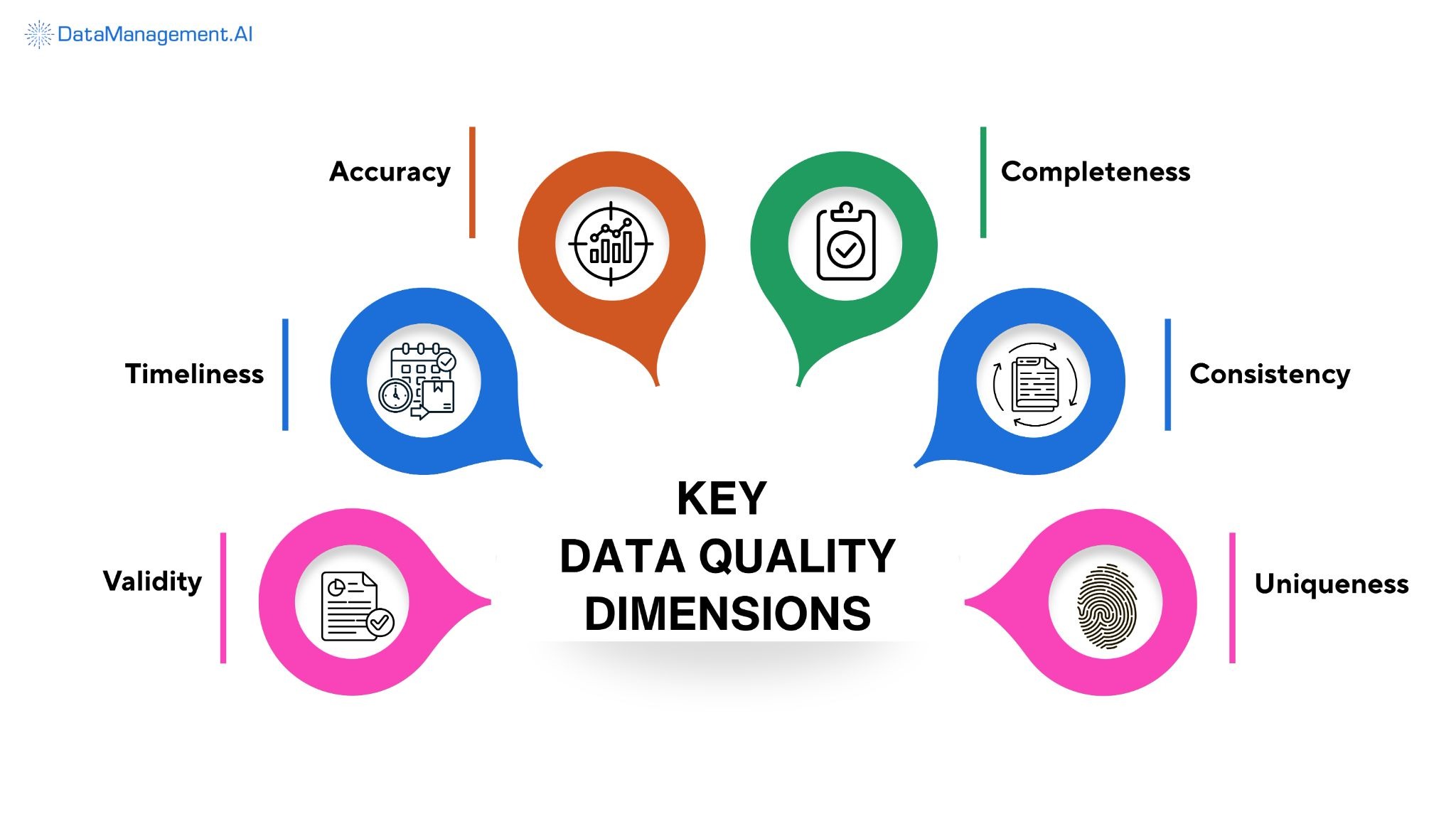
The data quality dimensions help determine if a company’s data is “fit for use” for business purposes
Why is Data Quality Management important?
The simple reason is that modern enterprises no longer run on isolated databases. They depend on operational workflows, analytics platforms, compliance reporting, and AI models that share upstream dependencies.
Thus, when a single data element is incorrect, duplicated, delayed, or misclassified, the error doesn’t stay local; it often propagates, especially in AI environments, which becomes more dangerous. It’s because in such situations, models don’t question inputs; they start optimizing against them.
From an enterprise data quality management POV, the issue is systemic.
| First, data flows through ingestion pipelines, then transformation layers, APIs, data lakes, and downstream applications. Thus, without structured controls, defects accumulate silently. |
This is the reason organizations increasingly treat data governance and data quality management as interconnected disciplines, using governance frameworks to define ownership, policies, and controls while implementing quality processes that continuously validate and improve data reliability.
Compliance intensifies the stakes.
Data quality management for compliance ensures that financial statements reconcile, healthcare records remain accurate, and audit trails become defensible.
Moreover, in data quality for asset management, inaccurate pricing feeds, inconsistent instrument identifiers, or delayed market data can distort portfolio valuation and risk exposure calculations.
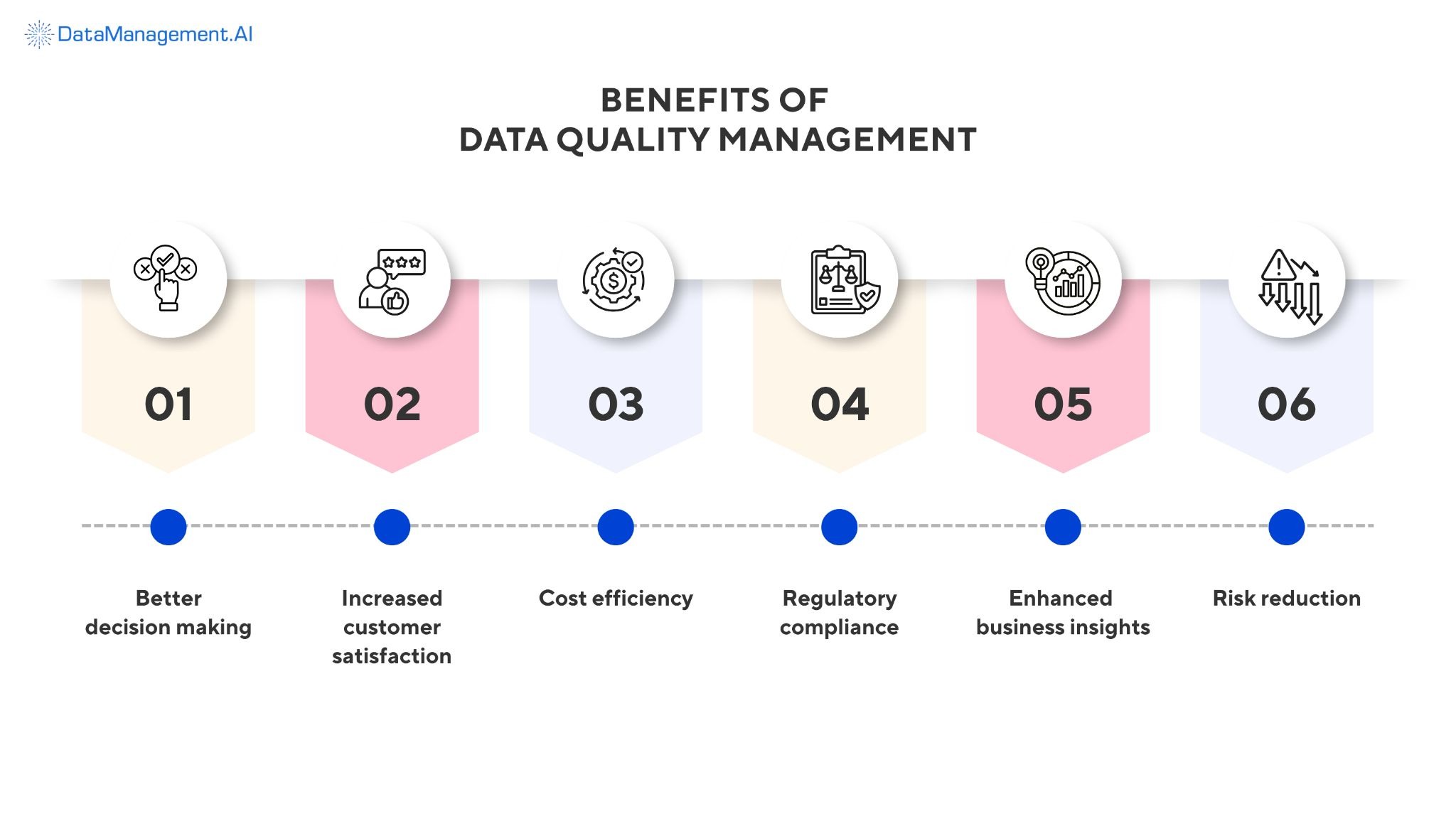
Benefits of data quality management
Beyond risk mitigation, data quality and management also help in driving scale. Reliable data allows automation frameworks to execute without manual overrides.
Organizations looking for how to improve data quality management should focus on establishing standardized governance policies, continuous monitoring, automated validation rules, and data stewardship practises that ensure quality is maintained throughout the data life-cycle rather than corrected after failures occur.
It also enables consistent experimentation because metrics are comparable across time and systems. Lastly, it helps strengthen forecasting models and also reduces reconciliation overhead across departments.
The four Data Quality Management model domains
The foundations of data quality management are not just abstract principles; they’re enforceable architectural controls that are built across governance, execution, and monitoring layers.
Governance domain
This domain formalizes accountability. It defines policies, stewardship models, approval workflows, and quality KPIs aligned with business outcomes.
Governance answers what the goal of data quality management is for each domain, like revenue accuracy, regulatory compliance, risk precision, or operational continuity. It also clarifies the boundary between business rules management vs data quality management.
Business rules define how the business should operate, whereas data quality management ensures that the data satisfies those rules consistently across systems.
Profiling and Assessment domain
Profiling applies statistical analysis to quantify null density, value distributions, cardinality shifts, duplication rates, pattern violations, and schema drift. This domain establishes a clear baseline for what “normal” looks like and flags anomalies across data warehouses, operational databases, and data lakes.
Understanding how a data lake helps in data quality management is especially important here. It’s because data lakes ingest raw and highly varied data from multiple sources, and without embedded profiling engines, structural and semantic inconsistencies can easily slip through in analytical systems.
Cleansing and Standardization domain
This is the execution layer where issues actually get fixed.
Transformation logic corrects defects by normalizing formats, standardizing addresses, resolving duplicate or fragmented entities, and enriching records using trusted reference datasets.
The goal here is not just surface-level cleanup, but a structural correction that stops errors from spreading into downstream reports, models, and operational systems.
Monitoring and Optimization domain
Data quality degrades unless it’s monitored continuously. This domain thus implements automated data quality management through rule engines, anomaly detection, SLA enforcement, lineage-aware impact analysis, and observability dashboards.
Alerts are also integrated with CI/CD pipelines, so new schema changes trigger validation before deployment.
For example, DataManagement.AI’s data quality monitoring capability operationalizes this domain by continuously assessing the health of important datasets such as customer, product, and transaction records.
It also ingests historical error logs and timestamped quality metrics to detect patterns over time. That means, instead of only seeing today’s failure rate, you also get to see trend lines, recurring rule violations, and systemic drift before they escalate.
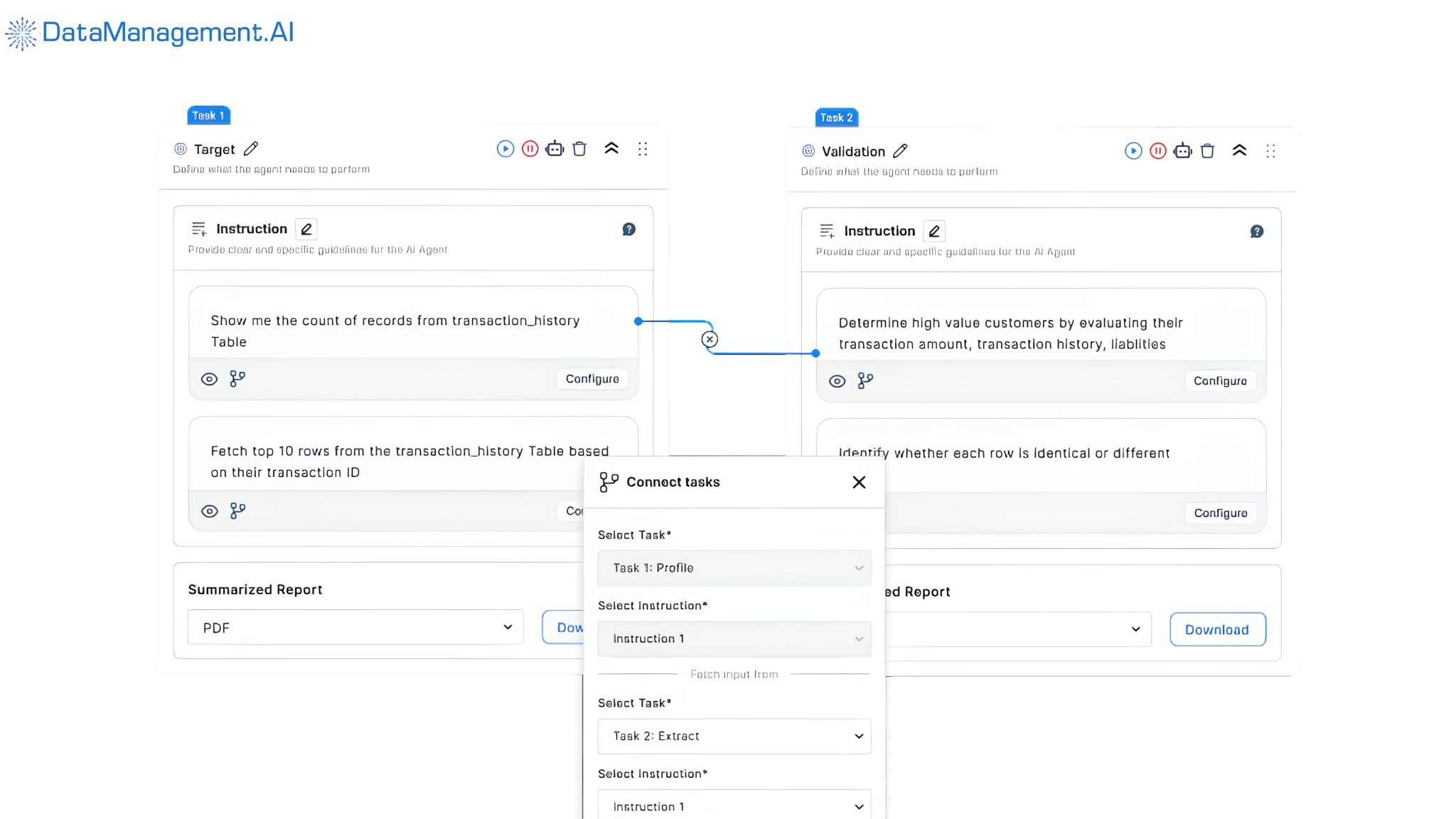
Companies that improve their data quality can avoid over $12 million in losses every year
The outcome is a unified data quality dashboard that surfaces current error rates, pass ratios, and pinpointed validation failures across domains.
When evaluating the best data management platforms, prioritize solutions that unify automated data quality monitoring, metadata management, governance, lineage, and real-time observability, allowing quality issues to be identified, investigated, and remediated from a single control plane.
Thus, compared to traditional approaches that depend on weekly spot checks or ad hoc analyst reviews, automated data quality management enables proactive detection within minutes of pipeline execution.
Managing Data quality: A practical guide
If you are asking how to manage data quality effectively, the answer lies in embedding controls into delivery cycles rather than running periodic clean-up exercises.
Start with base profiling.
Before defining controls, quantify the current state. Measure null ratios, distribution skews, duplicate frequency, referential breaks, and scheme inconsistencies across important datasets. This establishes an objective benchmark and clarifies where data management and data quality gaps exist.
Next, prioritize based on business.
Not all defects need your immediate attention. A formatting inconsistency in a marketing field can be ignored for a bit, but a misaligned customer identifier affecting revenue reporting can’t be.
Once your priorities are sorted, codify validation logic into enforceable rules.
This includes structural checks at ingestion, transformation-level reconciliations during ETL or ELT, and cross-domain consistency validations.
Next, focus on automation. Automated data quality management ensures rule execution scales across distributed systems, cloud environments, and data lakes. This is more important as manual audits cannot support enterprise data quality management at the petabyte scale.
Then comes feedback and remediation.
This is equally important, as when violations occur, root cause analysis must trace defects to source systems, process gaps, or governance failures, as closing the loop will prevent recurrences.
This becomes even more critical in financial data quality management, where inaccurate transactions, inconsistent references, data, or delayed reporting can compromise regulatory compliance, financial reconciliation, risk calculations, and executive decision-making.
Lastly, align with governance. Data governance and data quality management must operate as a single framework, as the former defines ownership and thresholds, whereas the latter enforces them technically.
How to turn data quality into a competitive advantage?
Data quality management is no longer an optional infrastructure. It is core reliability engineering for modern enterprises.
Platforms like DataManagement.AI unify profiling, rule enforcement, monitoring, and lineage into a scalable enterprise data quality management framework.
If you are rethinking how to manage data quality across warehouse, lake house, or multi-cloud systems, schedule a demo and see how proactive, continuous monitoring transforms operational confidence into measurable business trust.
FAQs
How does a data lake help in data quality management?
A data lake supports data quality management by centralizing raw, enriched, and curated datasets within a scalable repository that can ingest data from transactional systems, applications, IoT devices, APIs, logs, and third-party sources.
This architecture enables large-scale data profiling, schema validation, metadata management, and automated data quality management across both structured and unstructured data assets.
How to manage data quality in a project?
To manage data quality in a project, you should begin with baseline profiling to assess data structures, distributions, cardinality, relationships, and existing defects across source systems. Then define validation rules and quality thresholds that are directly mapped to business KPIs, regulatory requirements, and service level objectives.
After that, automate quality checks with ingestion, transformation, and delivery pipelines to continuously evaluate completeness, accuracy, consistency, validity, uniqueness, and timeliness metrics.
Next, implement metadata-driven quality frameworks that support rule versioning, exception management, and automated remediation workflows.
Now integrate governance controls from day one by establishing data ownership, stewardship responsibilities, lineage tracking, and policy enforcement mechanisms.
Lastly, deploy data observability capabilities that continuously monitor schema drift, volume fluctuations, null-value patterns, referential integrity, violations, and statistical distribution changes.
What is operations data quality management?
Operations data quality management focuses on real-time validation, continuous monitoring, and SLA enforcement across transactional and operational systems to prevent downstream disruption.
It ensures that data generated by applications, APIs, ERP platforms, customer interactions, and event streams adheres to predefined quality standards before it propagates across business processes and analytical environments.
How is enterprise data quality management different from basic validation?
Enterprise management integrates governance, metadata, lineage, and cross-domain controls to establish a standardized quality framework across distributed data ecosystems.
It applies centralized policy orchestration, business rule management, and semantic consistency models to ensure that quality requirements remain enforceable across data domains, technologies, and organizational boundaries.
The framework relies on metadata repositories, active lineage graphs, and policy engines to propagate quality standards consistently across hybrid and multi-cloud architectures.
What are the best data quality management options for businesses?
The best data quality management option depends on an organization’s data architecture, regulatory requirements, scale, and analytical maturity. Most Enterprises adopt a layer approach rather than relying on a single technology stack.
Increasingly, enterprises are adopting AI-native platforms like Enterprises are adopting AI native platforms like DataManagement.AI, which combine data quality monitoring, metadata intelligence, lineage analysis, governance controls, and conversational business intelligence within a unified environment.