




Let me start by telling you a hidden truth.
Most companies do not have a data problem, but what they have is a coordination problem.
Most of the time, different teams collect data in different ways, each system follows different rules, and therefore, information starts living in places that are really connected with one another.
This results in inconsistent reports, slow decisions, and endless debates over which numbers are correct.
An enterprise data management strategy is designed to solve this challenge. It creates the structure needed to govern, integrate, and trust data across the business.
Why did your data problem start years ago?
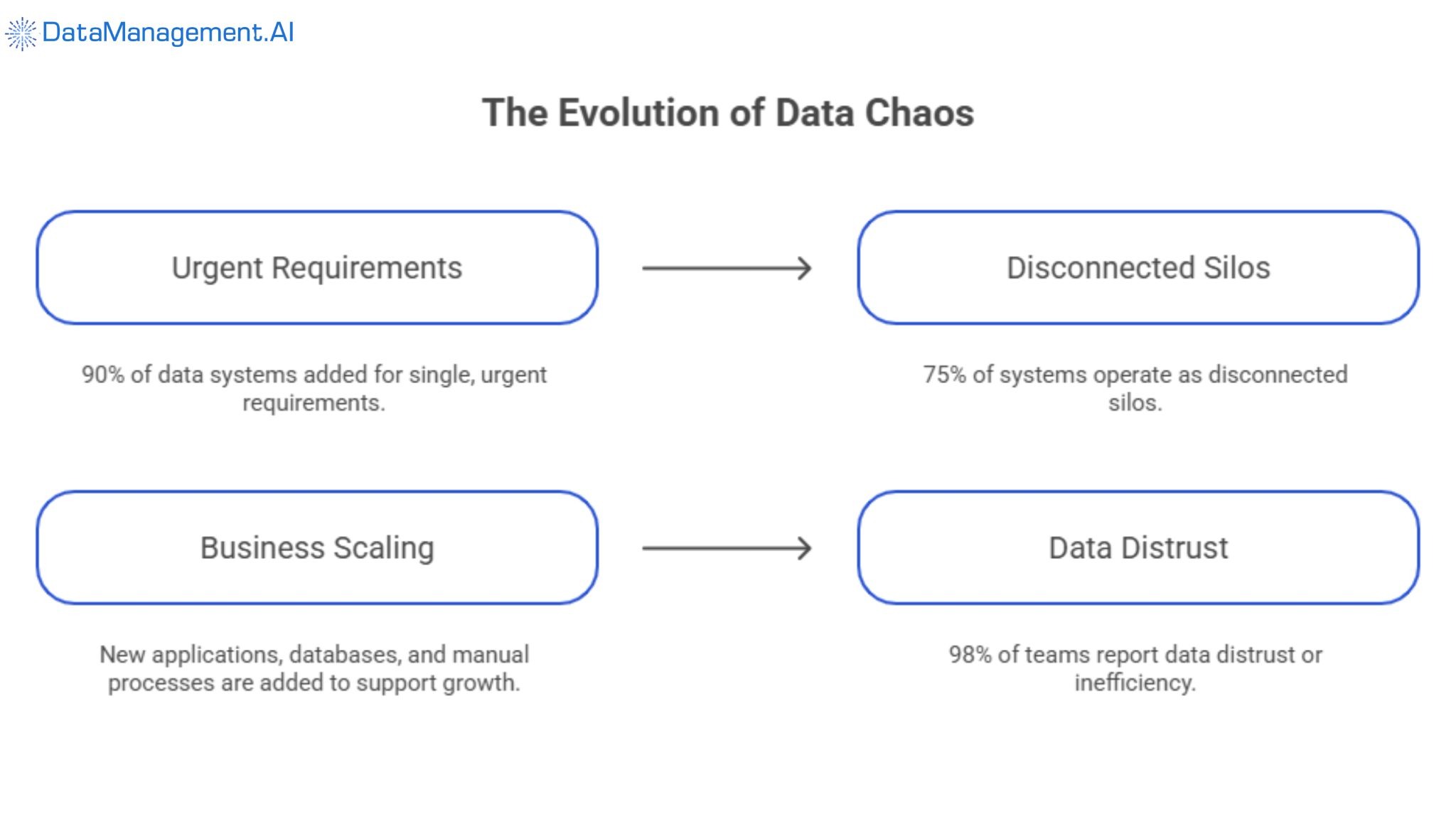
Most organizations do not wake up one day with a data problem. The problem develops gradually as new applications, databases, and manual processes are added to support growth.
While every addition addresses a specific requirement, the cumulative effect is an environment where data exists in silos and becomes difficult to trust.
Research shows that employees spend nearly 30% of their work week searching for information across disconnected systems. This not only costs the team’s efficiency but also leads to slower decisions, inconsistent reporting, and AI initiatives built on unreliable data.
This is why an enterprise data management strategy has become a business priority rather than a technology project. It will give you a blueprint for governing, integrating, and securing data across the organization.
An effective strategy usually combines an enterprise data management framework, which defines processes and responsibilities, with an architecture that determines how data moves between systems and applications.
But, before you think about streamlining your enterprise data management, you need to understand one reality: data chaos is usually the outcome of years of unmanaged growth.
The good news is that it can be fixed with a structured approach.
If you want a deeper understanding of modern enterprise data management, start by viewing your data ecosystem as a connected system, rather than a collection of independent databases and tools.
How to develop an enterprise data management strategy? A step-by-step guide
If you are wondering how to develop a strategy, you should resist the urge to start with technology. Buying another platform will not fix fragmented data. If you do not understand what you want your data to achieve.
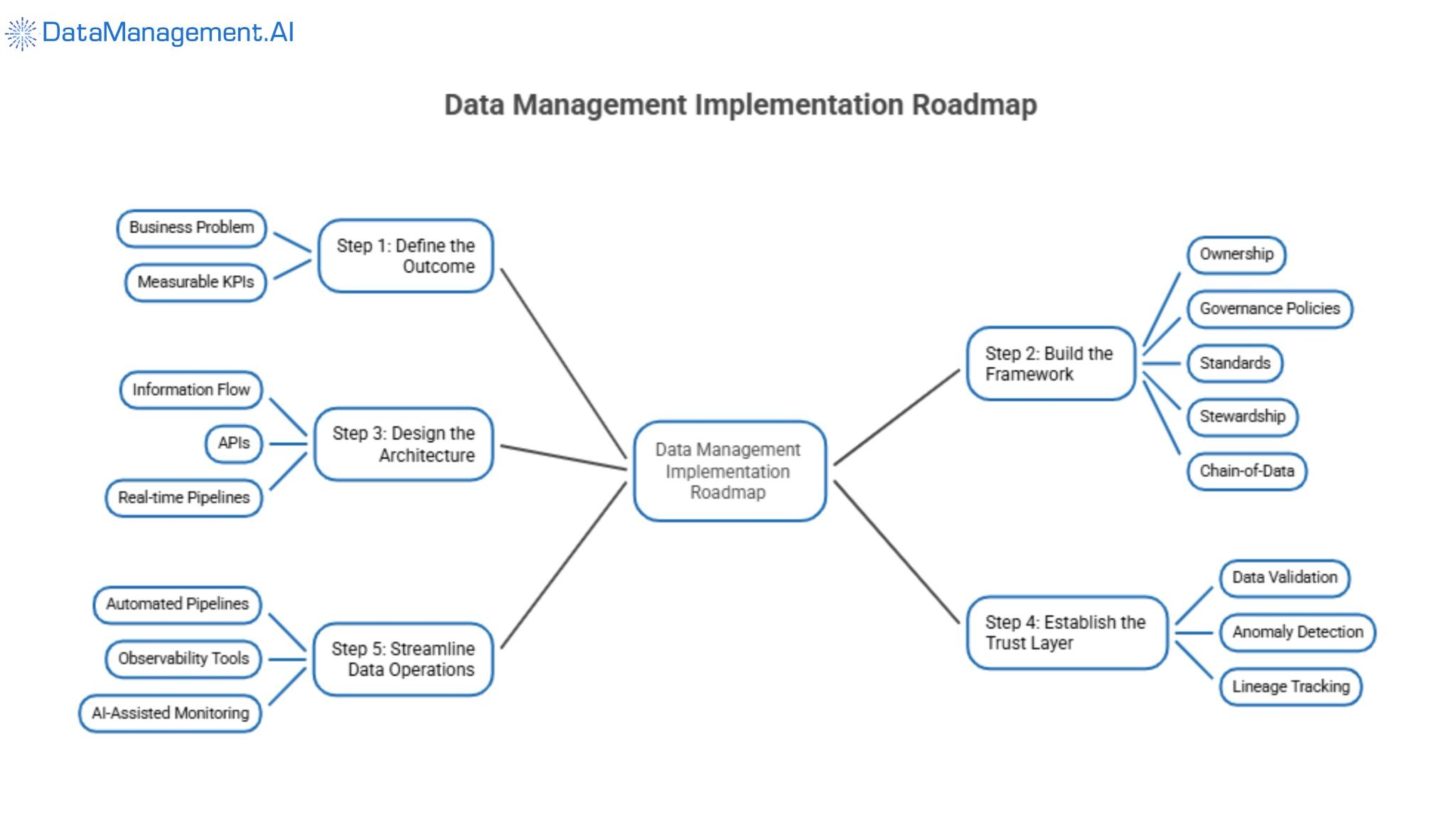
Follow these steps to build an effective enterprise data management framework.
Define the outcome
Before you select a platform or create a new policy, decide what business problem your data initiative is solving.
Are you trying to improve customer analytics, support AI applications, reduce compliance risk, or accelerate reporting?
This exercise will become the starting point of your strategy and will help define what is a plan for enterprise data management in a real business context.
You should also define measurable outcomes, identify stakeholders, and establish KPIs like report, generation, time, data, accuracy, and data accessibility.
Organizations that have clearly defined data objectives are significantly more likely to achieve their transformation goals because every subsequent investment is tied directly to business outcomes.
Build the framework
Once your objectives are clear, establish an enterprise data management framework that defines ownership, governance policies, data standards, and stewardship responsibilities.
Without this, data management becomes a series of disconnected initiatives. Your strategy should clearly define who can create, modify, and access data assets and how data quality issues will be resolved.
Several studies suggest that poor data quality costs organizations millions of dollars annually through operational inefficient season incorrect decisions.
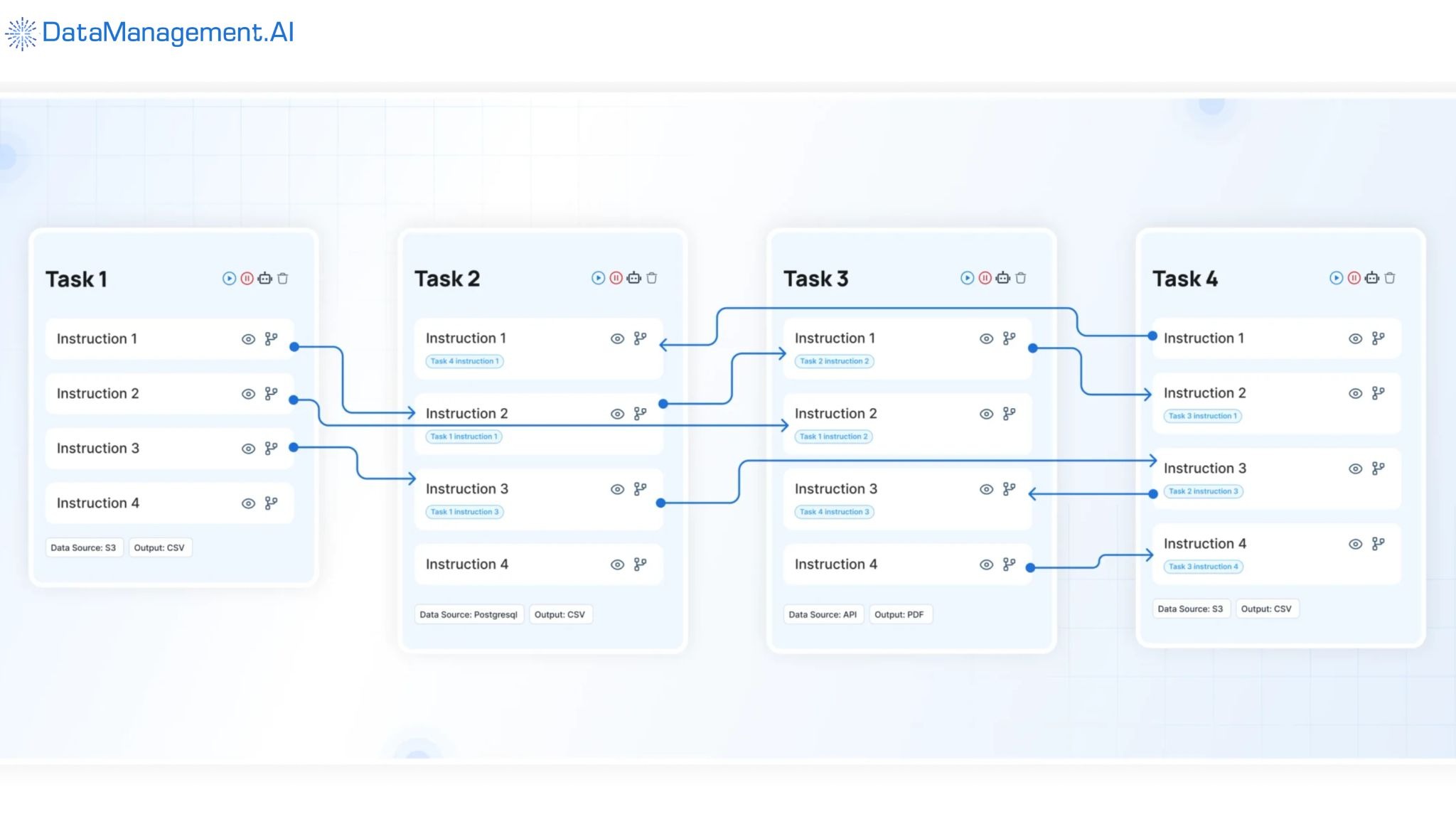
But establishing governance is only one part of the challenge. The harder task is keeping data connected as systems and processes evolve.
To address this, DataMangement.AI developed Chain-of-Data, a solution that links every stage of the data journey into a unified data matrix, making enterprise data operations more efficient, transparent, and cost-effective.
Design the architecture
An enterprise data management architecture determines how information moves across applications, databases, cloud, platforms, and analytical systems. Instead of creating more silos, design integration patterns that support interoperability and scalability.
Modern architecture often combines APIs, metadata management, real-time pipelines, and cloud native services to enable seamless data exchange.
To maximize the value of this, you should complement the architecture with a comprehensive data quality management framework that ensures information remains accurate, consistent, and trustworthy across systems.
By 2028, most enterprise data is expected to be created and processed outside traditional data centers, making scalable architectures increasingly important.
Also, remember your architecture should be designed not only for current requirements, but also for future growth and changing business needs.
Establish the trust layer
Data becomes valuable only when people trust it. This makes governance, metadata, lineage tracking, and quality controls the answer to what are the key elements of enterprise data management EDM.
Your strategy should establish processes for data validation, anomaly detection, and continuous monitoring. Data quality initiatives should be more proactive than reactive.
Streamline data operations
In the final stage, you should focus on streamlining enterprise data management through automation and continuous optimization. Manual data reconciliation processes do not scale in modern environments.
Instead, you should implement automated data pipelines, observability tools, policy-driven governance, and common and AI-assisted monitoring systems.
Continuous monitoring helps identify quality issues early, reduces operational bottlenecks, and improves decision-making speed.
How to develop a strategy that lasts?
A lasting strategy is designed to evolve with the business rather than remain a one-time initiative. Therefore, your data management framework and enterprise data management architecture should support continuous governance, quality, monitoring, and scalable integration as new applications and data sources emerge.
This approach matches the principles of big data and knowledge management, where organizations transform large, distributed datasets into trusted, actionable intelligence that continuously supports business decisions.
Studies suggest that nearly 70% of digital transformation initiatives fall short of their goals, often because organizations failed to establish sustainable data practices.
This is where DataManagement.AI’s Predictive Demand Forecasting capabilities become valuable, bringing together data from sales, supply chain, marketing, and external market indicators to produce a demand forecast that can improve planning accuracy by up to 50% while reducing stockouts and excess inventory.
The companies leading are doing this one thing differently
I have talked to several leaders, and those who are pulling ahead were doing one thing in particular: they are managing data based on decision latency.
Instead of asking, “How much data do we have?” they ask, “How quickly can we trust an act on our data?”
A practice rarely discussed outside mature data organizations is the measurement of “ time-to-trust” as an engineering metric.
Their enterprise data management framework is designed to reduce the time needed to locate, validate, and approve data for use, turning trusted information delivery into a measurable competitive capability.
To operationalize the capabilities, schedule a demo with DataManagement.AI and see how an integrated data platform can accelerate data discovery, automate governance, workflows, and reduce the time required to deliver decision-ready data.
FAQs
What is the difference between data management and data strategy?
Data management focuses on the operational processes and technologies used to collect, store, integrate, govern, and maintain data throughout its life cycle.
Whereas, data strategy is the business blueprint that defines how data will be used to achieve organizational objectives, prioritize investments, establish governance models, and create long-term value.
What is the role of a Chief Data Officer (CDO) in EDM?
The CDO is responsible for defining and executing the organization’s enterprise data strategy.
The role involves establishing data governance policies, overseeing data quality, managing compliance and risk, defining ownership, models, and ensuring the enterprise data management architectures, platforms, and operating processes deliver trusted, accessible, and business-ready data across the enterprise.
How do you build a data-driven culture across non-technical teams?
Building a data-driven culture requires embedding data into everyday workflows rather than treating it as a specialist function.
You should establish common business metrics, provide role-based dashboards, improve data literacy, and implement self-service analytics with governance guardrails.
How does an organization migrate legacy data to the cloud safely?
Organizations can migrate legacy data safely by first profiling and classifying datasets, establishing data quality baselines, and mapping dependencies across applications.
They should also implement phased migration pipelines with automated validation, encryption, access controls, and rollback mechanisms.
How do you automate data quality monitoring at scale?
Automating data quality monitoring at scale requires metadata-driven validation, rules, continuous data, profiling, and observability pipelines that monitor freshness, completeness, consistency, and anomalies in real time.
Integrating machine learning for pattern detection and automated remediation workflow also enables organizations to identify quality issues proactively and enforce data reliability across distributed systems and pipelines.