




It’s December 2024. And LexisNexis just discovered a breach. A breach of 364,000 records being exposed.
Names, social security numbers, and driver’s licences, all compromised.
The damage?
Customer trust shattered and millions gone. Lawsuits impending.
This wasn’t some sophisticated AI attack. It was poor data management.
It’s happening everywhere as you read this.
Your customers won’t forgive you for sloppy data handling. Neither will your regulators.
The good news? The right cloud data management platform that prevents this nightmare.
Today, I’ll show you what are the best data management platforms that you as a decision-maker can actually trust.
These aren’t just tools, but your shield against the next breach.
What is a data management platform and why is it important?
A data management platform definition is straightforward. It’s a unified system that collects, organizes, and activates your data.
It’s like your data’s control center.
The best data management platforms use AI to automate these tasks.
So no more spreadsheet hell or siloed information.
Your team gets clean and trustworthy data every single time.
Think of scattered data as quicksand. You want to personalize customer journeys and optimize supply chains, but your foundation is unstable. It won’t work.
Gartner estimates poor data quality can cost organizations an average of USD 12.9 million a year.
Think about that figure. It’s actual cash burned.
This is the truth of an insufficient data management platform. Without it, your compliance is a gamble.
Need more information on master data management importance, we got you covered.
What are the key functions of a data management platform?
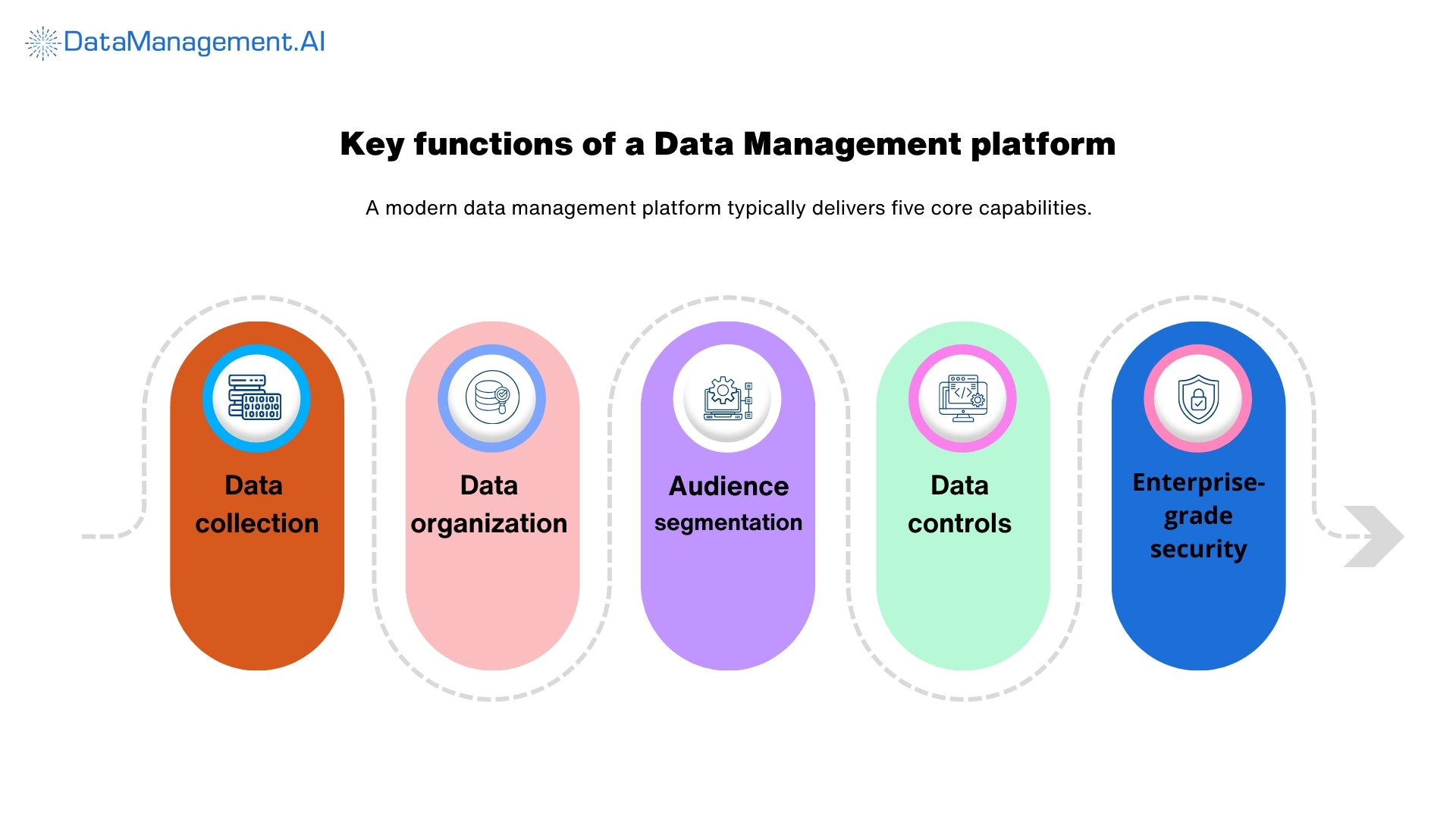
A modern data management platform typically delivers five core capabilities.
- Data collection – The platform gathers information from multiple sources, such as websites, mobile apps, CRMs, and offline interactions. All this pulled into a single coherent system.
- Data organization – The platform next structures and categorizes data. This is grouped into segments based on demographics, behaviours, and other key attributes.
- Audience segmentation – The platform creates distinct customer or user segments that can be targeted for specific campaigns, such as, offers and outreach.
- Data controls – The platform automatically fixes common issues, such as duplicate records and inconsistent formats, going beyond basic validation to offer data enrichment.
- Enterprise-grade security – The platform builds end-to-end encryption that are required for a complete audit trail for real-world use. This allows your teams to collaborate efficiently.
Which are the common types of data management platforms?
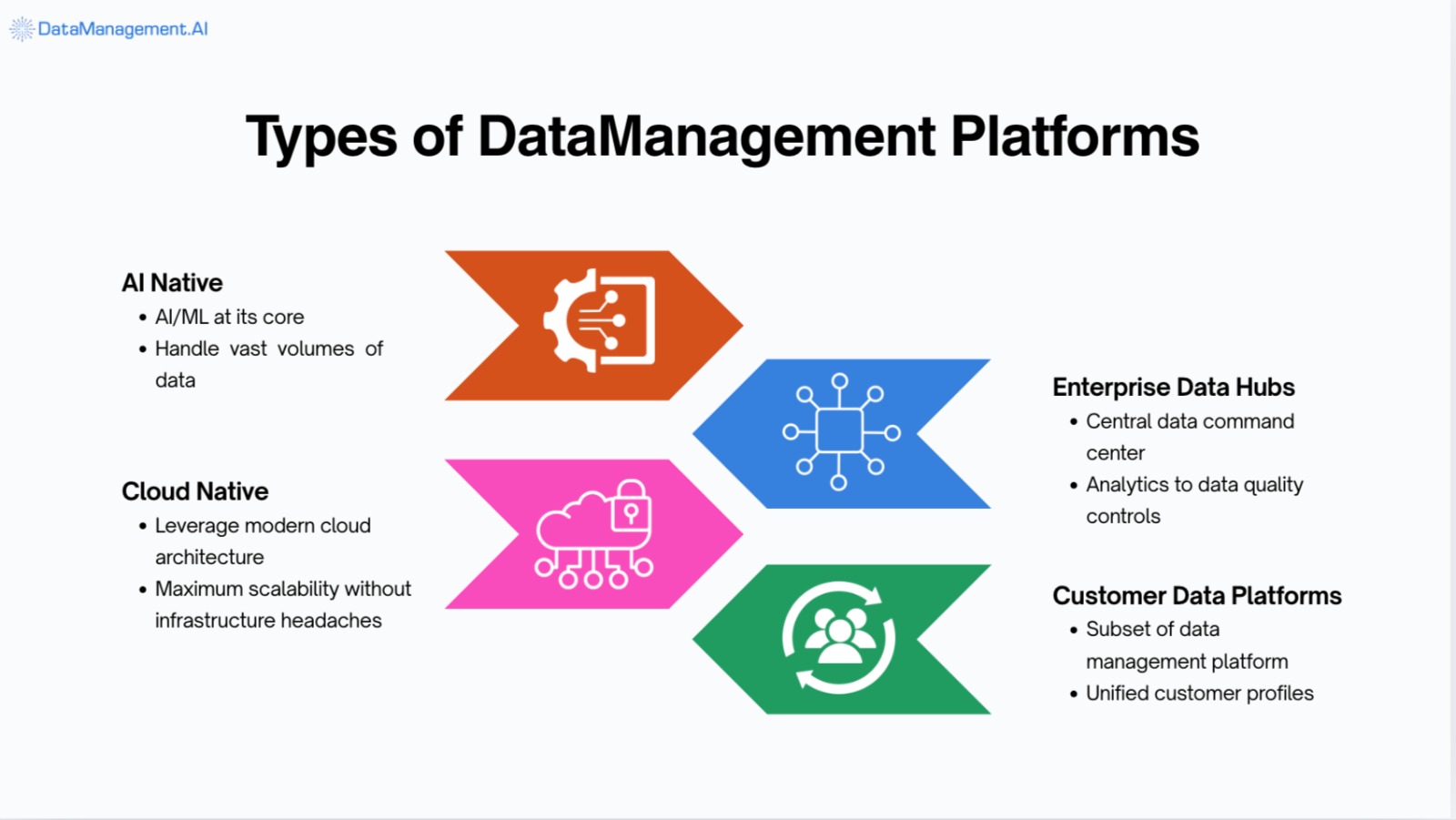
There are a total of five data management platform types. Each has benefits and limitations. Selecting the right one is up to you, but an AI-native one is usually the best.
- AI-native DM platform – An AI-native data management platform is built from the ground up with AI/ML at its core. They offer scalable, dynamic, and automated data unification.
- Cloud-native DM platform- Cloud-native DM platforms leverage modern cloud architecture to power cloud environments. They scale automatically and integrate smoothly with cloud services.
- Enterprise Data Hubs- Enterprise data hubs aim to become your organization’s central data command centers.
- Customer Data Platforms (CDPs) – CDPs are a subset of data management platforms that specialize in managing customer interactions and data.
- Open-source Frameworks – These platforms give you complete control over your data infrastructure.
They are suited for organizations with strong technical teams.
Complete guide to the best data management platforms
I will now show you what are the best data management platforms in no particular order. Being AI-native is the top criterion when choosing the best master data management tools for your organization.
DataManagement.AI
DataManagement.AI isn’t just a data management tool, it’s a complete paradigm shift.
No extraction needed.
No replication needed.
Just direct, secure access.
DataManagement.AI revolutionizes your data management through autonomous AI agents.
The platform provides you with intelligent data quality assessment, along with predictive data governance and automated metadata management.
Our ‘Chain-of-Data’ and ‘Agentic Workflow’ approaches focus on automation, operational efficiency, and speed.
Another approach that’s unique to DataManagement.AI is Context Cloud.
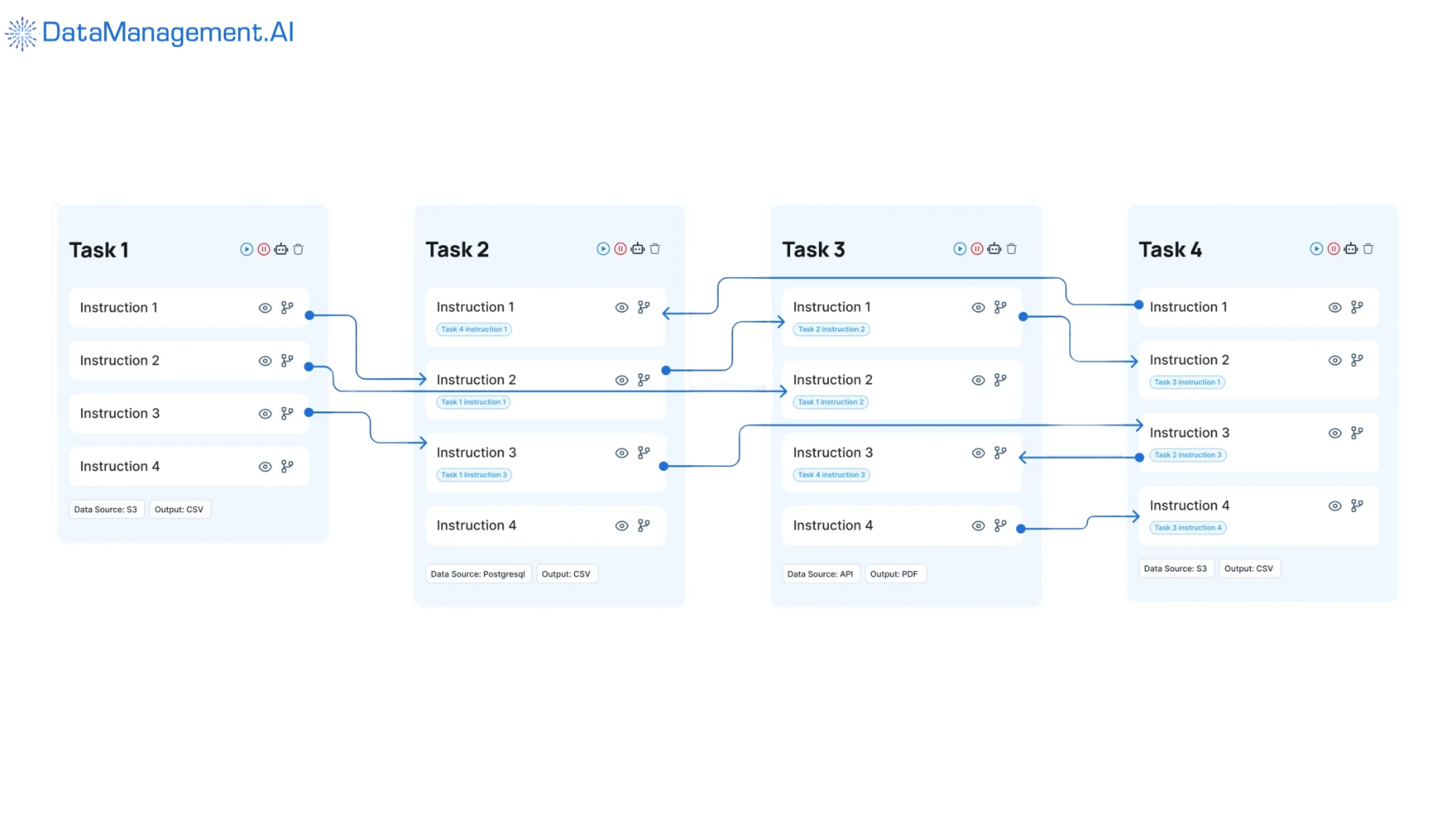
Our Chain-of-Data architecture connects every piece of your data ecosystem.
It connects all your data points. It adds missing information. It makes data complete. It understands relationships. This creates a ‘chain-of-data.’
This chain enriches data. It reconciles data. It governs data effectively. Your data becomes smart. It gains deep understanding.
This is not just an approach, it’s an intelligent layer. This layer sits over your systems.
It connects them all seamlessly. Agents ingest your data by gathering it from sources. They bring it into one place.
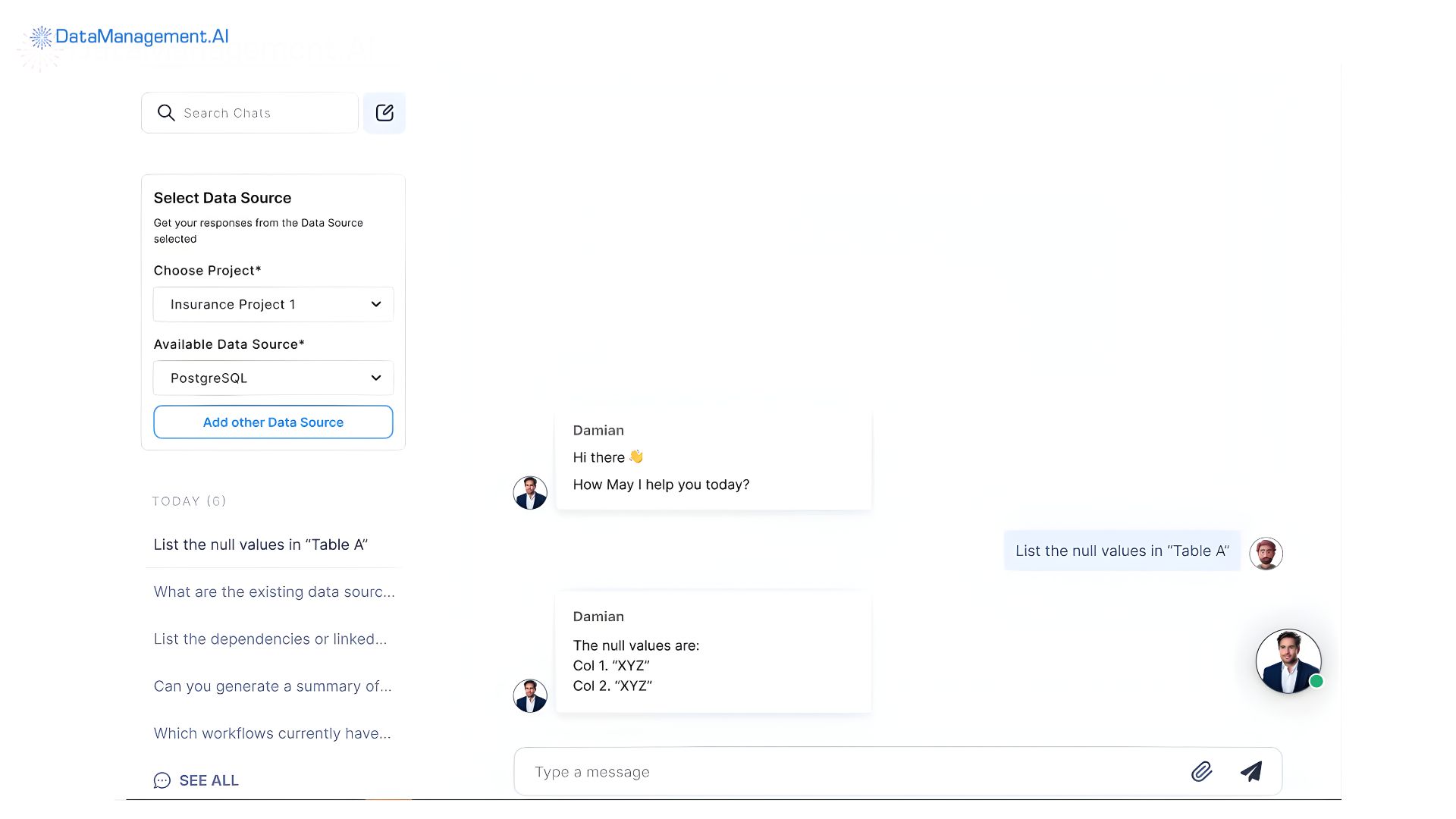
Data gets contextualized. It is cleaned and organized. It is prepared for use automatically.
AI agents, such as ReconcileAI, CleanseAI, and ProfileAI allow users to query, govern, and analyze data directly from source systems.
No time-consuming data replication or extraction. DataManagement.AI is built to eliminate all your data bottlenecks, deliver real-time insights, and significantly reduce operation and infrastructure costs.
It transforms how you manage data. It is a powerful data management platform with intelligence. We address the complexity the other platforms often leave you to solve manually.
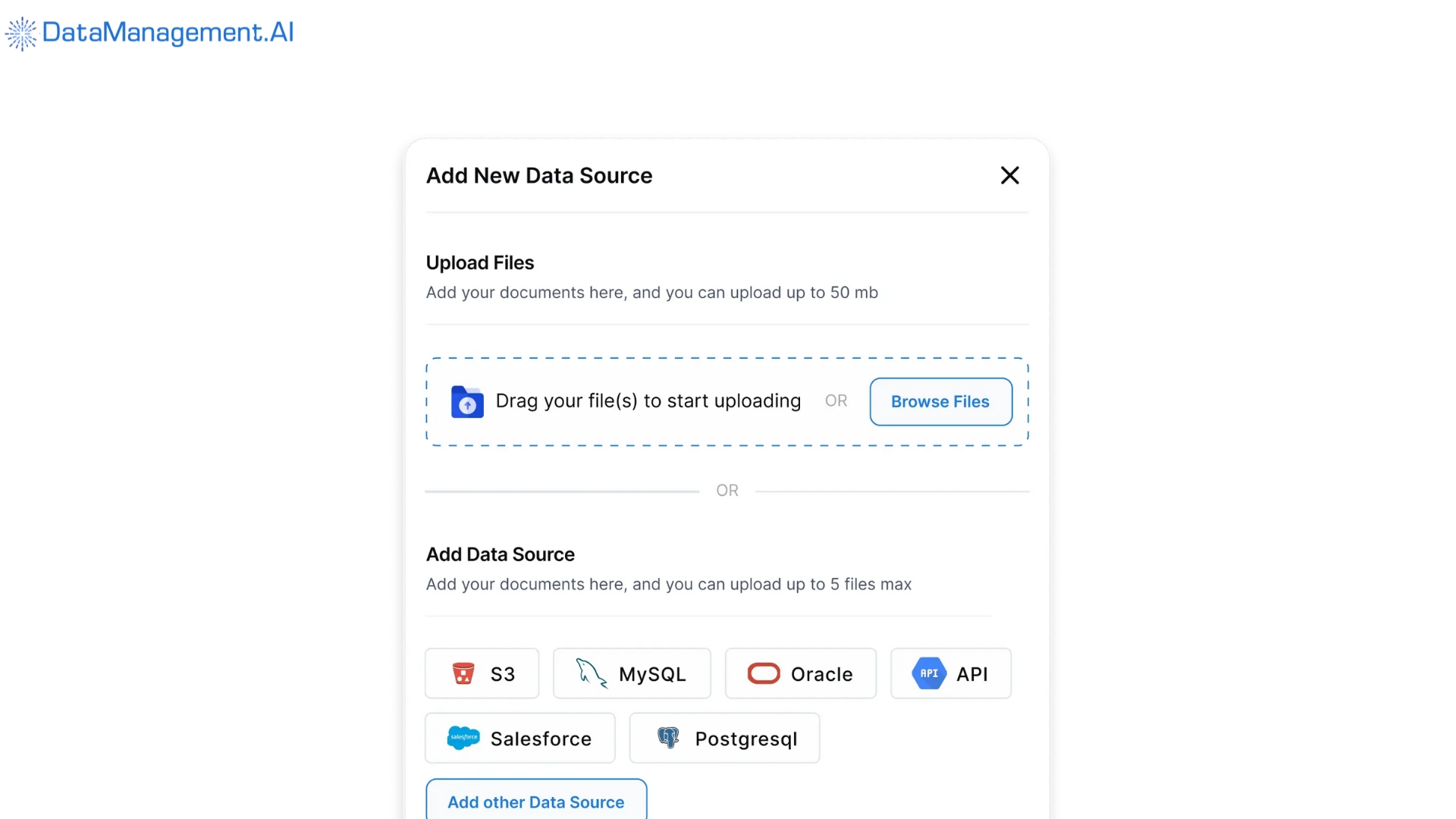
This is the ultimate evolution of the cloud data management platform. It allows you to operate at 10x lower cost. You gain 20x productivity.
| Core Features |
|
|---|---|
| Key Strengths |
|
| Pricing Model |
|
| Best Suited For | DataManagement.AI is suited for organizations looking specifically for autonomous data management with minimal human intervention. |
| Deployment Strategy | A cloud-native architecture with API-first design. It enables rapid deployment across hybrid environments. |
| Integration & Scalability | The high rating reflects its core pitch of instant integration. Also, high scalability through in-place data access (no replication needed). |
Databricks
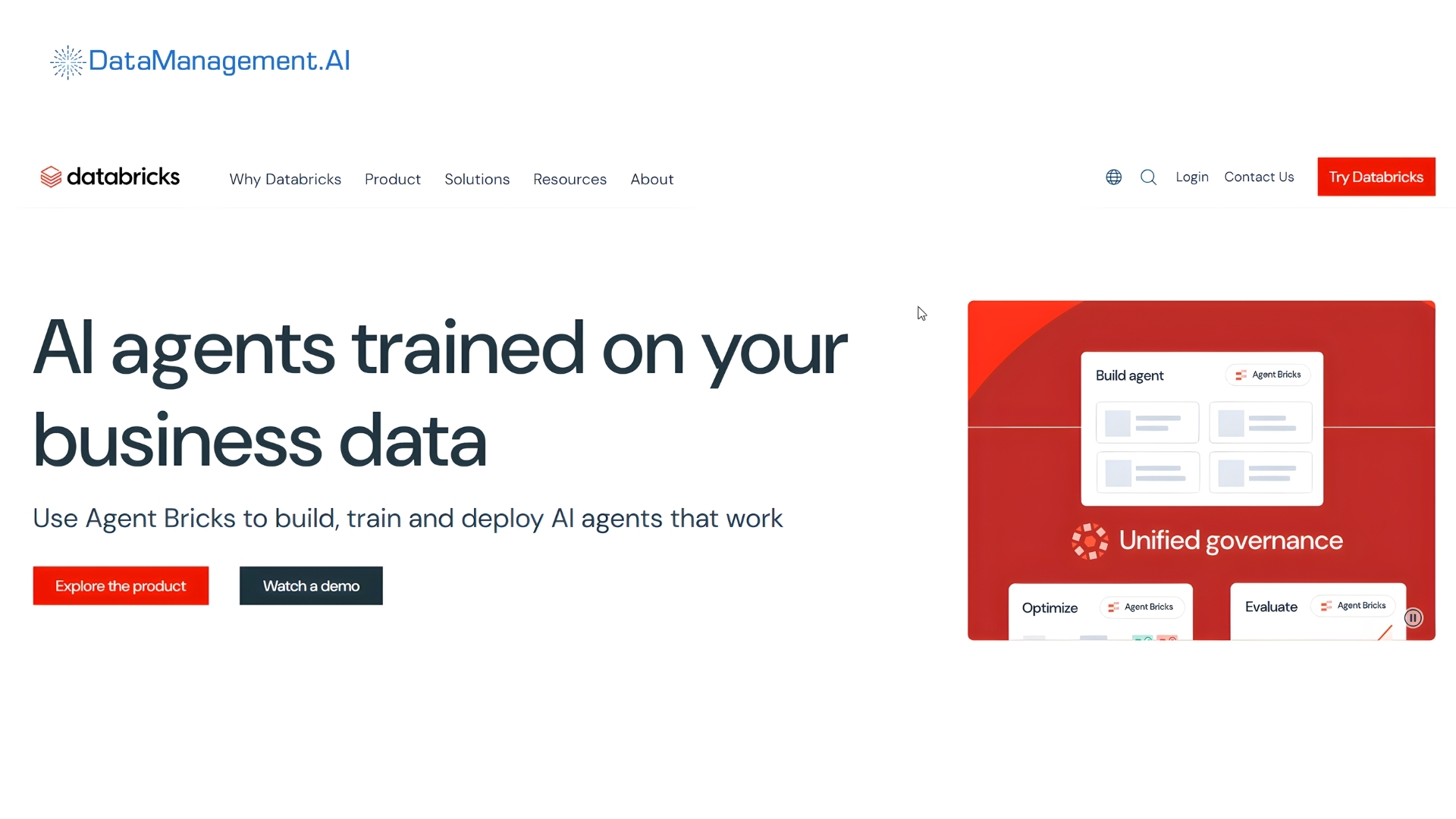
The Databricks Lakehouse data management platform is robust.
It can build and operationalize MDM solutions to leverage unified architecture. It integrates the governance and reliability of your data warehouse.
The platform is built on Delta Lake. This allows it to provide features such as ACID transactions and schema enforcement.
Unity Catalog is central to governance – allowing it to offer a metadata layer, data lineage, and fine-grained access control.
Databricks’ integrated machine learning tools help leverage advanced entity resolution and deduplication.
| Core Features |
|
|---|---|
| Key Strengths |
|
| Weaknesses |
|
| Pricing Model |
|
| Best Suited For | Organizations building custom MDM on lakehouses who require high levels of control and flexibility |
| Deployment Strategy | Platform-based with custom MDM development that focuses on providing the required infrastructure |
| Integration & Scalability | Massively scalable using Apache Spark engine. It can be optimized for semi-structured or unstructured data volumes. |
Snowflake
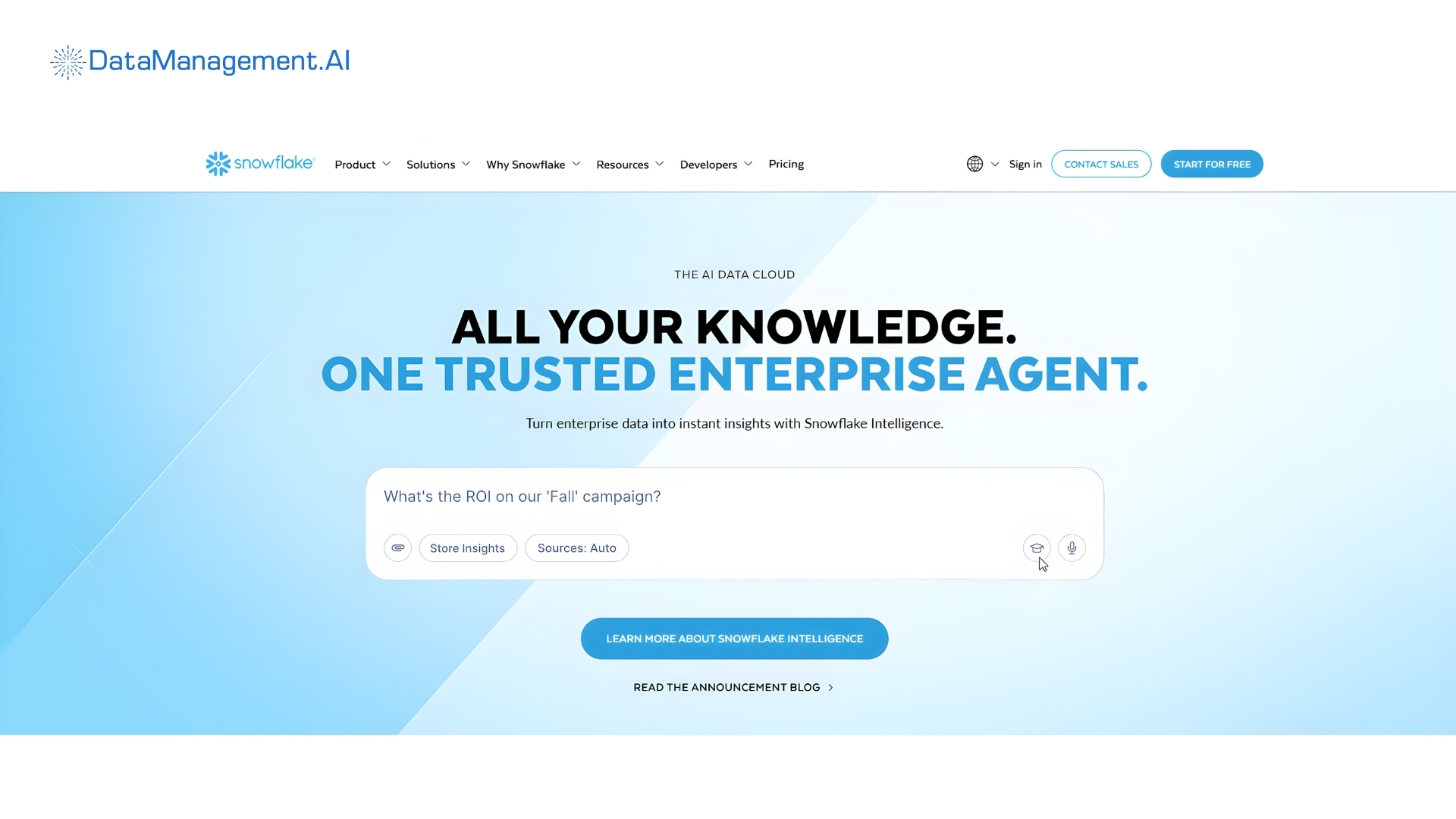
The Snowflake AI Data Cloud data management platform is a scalable platform that’s integral to your DM strategy.
It serves as a central data repository for high-quality and unified data – acting like a singular source of truth.
Snowflake’s architecture separates storage and compute, enabling data management solutions to perform your data matching, data quality, and deduplication processes with scalability.
Other data management tools such as those from Semarchy, Profisee, and Informatica, offer solutions that integrate tightly or run natively within the Snowflake Data Cloud. Data management logic and stewardship workflows execute directly within Snowflake, eliminating the need to constantly move data for governance.
| Core Features |
|
|---|---|
| Key Strengths |
|
| Weaknesses |
|
| Best Suited For | Organizations with cloud-first data strategy who prioritize agility and external collaboration over building an on-premise architecture |
| Deployment Strategy | Platform-centric with DM partner integration focuses on a core cloud engine for end-to-end data lifecycle control |
| Integration & Scalability | Infinitely scalable with a pay-as-you-go model which is apt for ecosystem integration. Close to zero administration overhead. |
Microsoft Azure
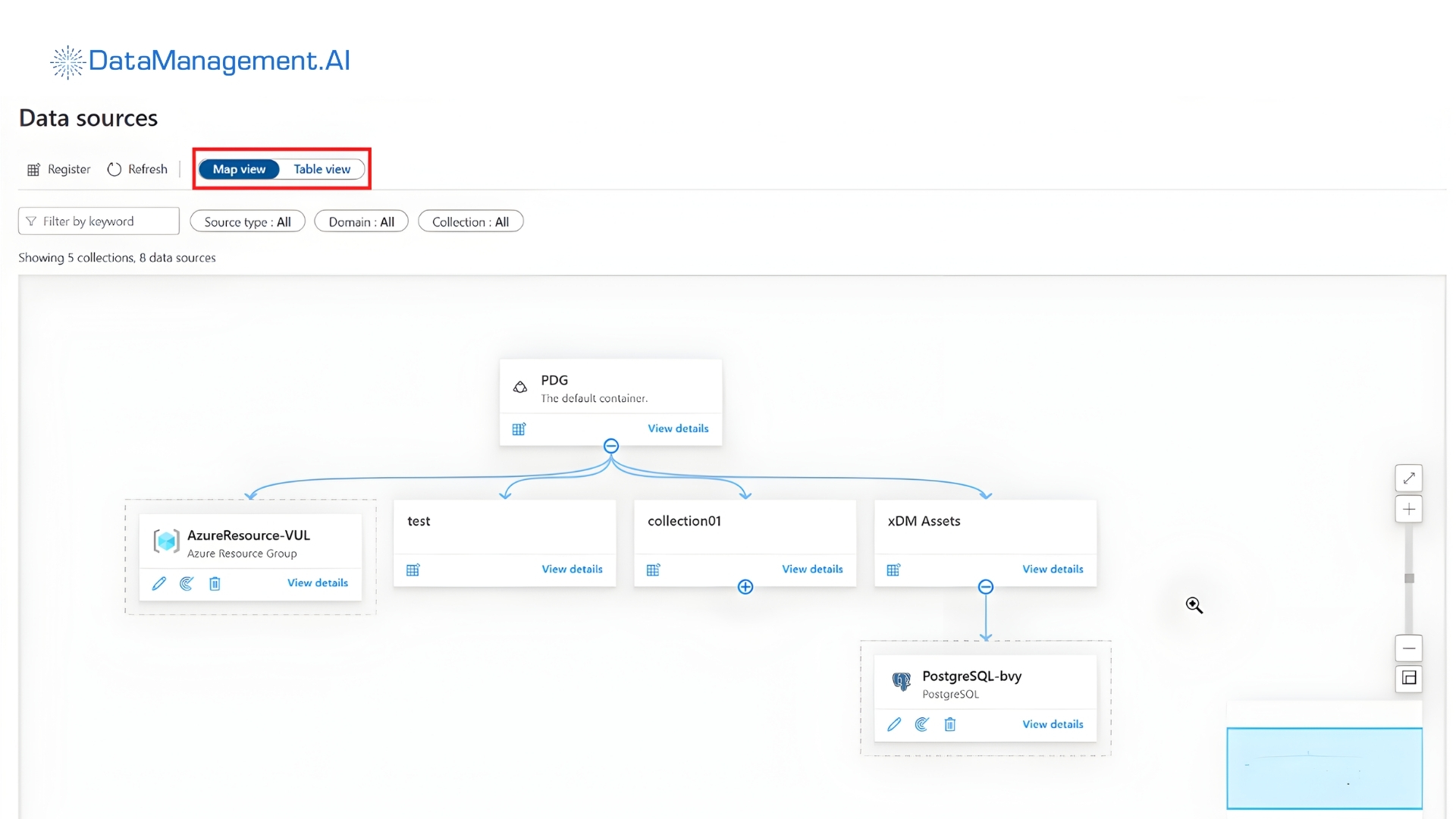
The Microsoft Purview Data Map is a cloud-native engine that powers the Microsoft Purview unified data governance solution.
It scans and catalogs metadata from data sources across your organization’s multi-cloud environments.
Data Map uses built-in classifiers and Azure API to detect and label sensitive data. The Data Map is not a standalone MDM tool, but acts as a central metadata repository for your data governance.
It also integrates successfully with partner MDM solutions, such as Semarchy and Profisee to unify data governance efforts.
| Core Features |
|
|---|---|
| Key Strengths |
|
| Weaknesses |
|
| Pricing Model |
|
| Best Suited For | Microsoft-centric organizations requiring high degree of oversight and regulatory governance |
| Deployment Strategy | Governance-first with Azure integration focuses on building your clear data map and policy framework |
| Integration & Scalability | Deep native scanning and lineage tracking for data that resides within the Azure ecosystem. Simplifies risk management and compliance by delivering a centralized lineage view of sensitive data assets in Azure. |
Talend
Qlik acquired Talend in 2023. Its data management tool is part of the Qlik Talend Cloud Data Fabric, tightly coupling it with ETL/ELT data integration tools.
It creates a ‘golden record’ across domains – suppliers, customers, and products. It leverages its data integration engine to handle your data from disparate sources.
Their custom ‘Talend Trust Score’ provides a measurable assessment of data quality.
| Core Features |
|
|---|---|
| Key Strengths |
|
| Weaknesses |
|
| Pricing Model |
|
| Best Suited For | Organizations preferring open-source foundations and those who value the ability to customize your data infrastructure |
| Deployment Strategy | Open-source pilot with enterprise upgrade path. This lets you prove the concept before following an enterprise upgrade path for production-grade support |
| Integration & Scalability | Cloud-agnostic but built for real-time and high volume batch processing. Comes with a library of connectors and components. Good for horizontal scalability for data processing tasks. |
Target’s fragmented data hassle
Here’s a quick case study about Target and how they used an unified data management platform to drive indirect revenue through improved inventory forecasting.
The problem that Target faced was that of fragmented data and inaccurate demand forecasting. They historically struggled with disparate data silos across stores.
This also was the case for e-commerce and their supply chain divisions. This led to frequent stockouts of popular items and overstocking of slow-moving items.
They lost sales and faced increased mark-down costs. They struggled to deliver a seamless and personalized customer experience across all their channels.
The solution they came up with included a unified cloud data platform for predictive analytics. Target implemented a modern cloud-based data management platform.
They integrated data from their POS, e-commerce behaviour, and customer loyalty programs. This unified view enables the creation of sophisticated predictive analytics models for personalized demand forecasting.
The implementation of a data-driven inventory and recommendation system led to measurable business improvements.
Competitors noted that Target’s ability to quickly identify changing customer demand and shift inventory allowed them to grow sales by close to 20% even during the pandemic.
Ketch
Ketch is a data management platform that focussed on data permissioning as a feature.
They are focused on solving global data piracy problems and consent complexities. The platform automated compliance by enforcing user content and preferences.
This is done from the website to the data warehouse. This method is called Programmatic Privacy. This approach minimized the risks and responsibly mobilizes first-party data to fuel marketing campaigns.
| Core Features |
|
|---|---|
| Key Strengths |
|
| Weaknesses |
|
| Pricing Model | Pricing is tiered based on the number of unique users who see the Ketch privacy experience monthly. |
| Best Suited For | Companies looking to maximize first-party data collection and activation while turning privacy into an advantage. |
| Deployment Strategy | Cloud-hosted that deploys a lightweight JavaScript tag on digital properties and connects to backend systems via SDKs and APIs. |
| Integration & Scalability | Offers pre-built, no-code integrations with all major cloud service, marketing platforms, and data warehouses. Its asynchronous APIs allow it to scale effortlessly to handle millions of DSRs. |
Oracle Cloud Infrastructure
Oracle data management tool is a multi-domain enterprise-level data management platform. Initially introduced as a standalone DM platform, it’s now embedded with cloud applications.
It consists of several solutions designed to collect and standardize your Data-as-a-Service (DaaS) of the application.
| Core Features |
|
|---|---|
| Key Strengths |
|
| Weaknesses |
|
| Pricing Model |
|
| Best Suited For | Oracle-centric enterprises who possess substantial database investments and wish to leverage their existing infrastructure |
| Deployment Strategy | Gradual domain expansion with database-centric deployment which starts with one master data domain before scaling to others |
| Integration & Scalability | Good scalability and robustness. Comes with pre-integrated capabilities for Oracle cloud application suite. It uses a modern REST API and a unified data model. |
SAP Data Intelligence
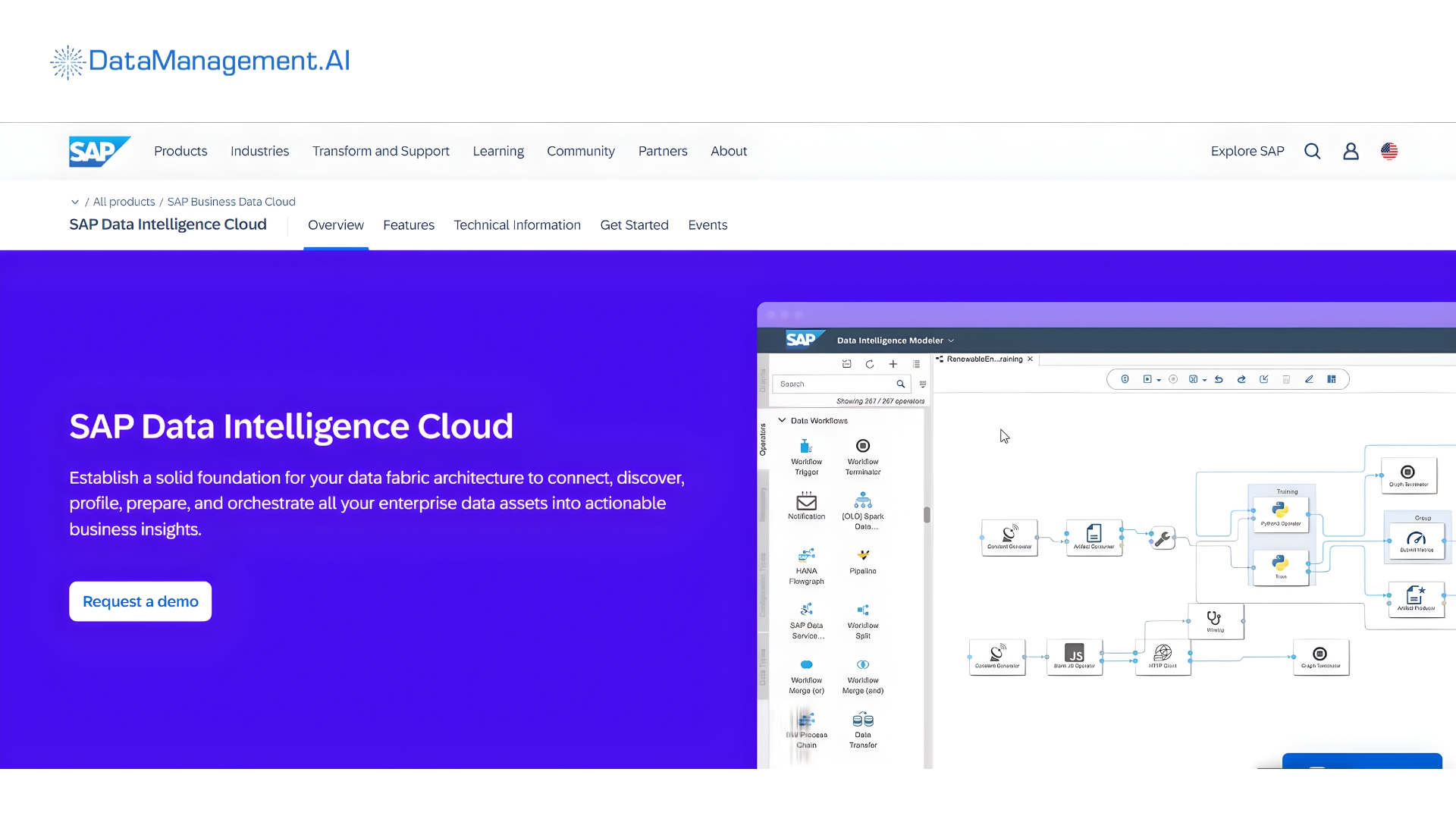
SAP Data Intelligence is a data management tool that runs primarily within the SAP S/4HANA or SAP Business Technology Platform (BTP) ecosystem.
Its core strength is centralized governance for your data – including customers, suppliers, financials – all leveraging the existing SAP model, security configs and business logic.
It relies on integrating data governance directly into core business processes, such as Procure-to-Pay or Order-to-Cash. This ensures data compliance and accuracy before data is used in transactional applications.
| Core Features |
|
|---|---|
| Key Strengths |
|
| Weaknesses |
|
| Pricing Model | Licensing starts at USD 1,200 per user annually. |
| Best Suited For | SAP-centric organizations that require a tight ERP integration to maintain a single version of the truth |
| Deployment Strategy | On-premises or SAP cloud with phased rollout approach to minimize operational disruption |
| Integration & Scalability | Excellent integration with SAP products. High scalability on the HANA platform. Strong ecosystem support. |
Dell Boomi
Dell Boomi is now Boomi Data Hub (BDH). It’s a data management tool that’s part of Boomi Enterprise Platform. It’s a cloud-native, unified solution for data management, data integration, and automation.
BDH moves beyond centralized data management systems by delivering a lighter, cloud-based architecture.
It establishes ‘golden records’ – a singular and accurate version of your critical data.
It synchronizes this data across integrated applications, accelerating business processes, and ensuring data readiness.
| Core Features |
|
|---|---|
| Key Strengths |
|
| Weaknesses |
|
| Pricing Model |
|
| Best Suited For | Mid-to-large enterprises seeking an agile, multi-domain data management solution that prioritises connectivity and speed |
| Deployment Strategy | Cloud-native with decentralized connectors managed by Atoms (runtime engines) which serve as a lightweight runtime engine |
| Integration & Scalability | Natively built on Boomi’s Integration Platform as a Service (iPaas). Scalable performance and access to a vast connector library. |
Amazon Web Services
The AWS Glue Data Catalog is a centralized data management tool that operates as a Hive-compatible metastore.
The Catalog stores schemas, table definitions, and data locations for data residing in data lakes, databases, and data warehouses.
It allows services like Amazon Redshift Spectrum, Amazon Athena, and Amazon EMR to query data without needing to manage the underlying infrastructure.
The Data Catalog acts like a foundation for MDM capabilities to integrate broader AWS Glue ETL features.
Features such as automated schema discovery via schema versioning and Crawlers, help maintain consistent metadata.
| Core Features |
|
|---|---|
| Key Strengths |
|
| Weaknesses |
|
| Pricing Model |
|
| Best Suited For | AWS organizations with ETL-centric needs where they want to build scalable data lakes with minimal management overhead |
| Deployment Strategy | ETL-integrated with catalog automation lets you populate the catalog as a foundational first step |
| Integration & Scalability | Core foundational service for the entire AWS ETL and data lake stack. Provides the essential metadata backbone for running cost-effective, large-scale serverless ETL jobs on AWS. |
Google Cloud
Google Cloud Data Catalog is a data management platform that fully manages your metadata and data discovery management.
Its core function is to automatically scan, index, and organize metadata from data assets across the Google Cloud environment.
Unlike a traditional data management tool, Data Catalog does not perform direct data cleansing, de-duplication, record matching, or ‘golden record’ creation.
It provides a business glossary to define consistent policies and technology that are prerequisites for data management programs.
When combined with Dataplex, it supports automated data quality features to validate and profile data against defined rules.
| Core Features |
|
|---|---|
| Key Strengths |
|
| Weaknesses |
|
| Pricing Model |
|
| Best Suited For | Google Cloud organizations requiring metadata management that is easy to deploy and natively integrate |
| Deployment Strategy | Cloud-native with metadata focus. It prioritizes the creation of searchable and centralized inventory of all data assets |
| Integration & Scalability | Native, seamless integration with all Google Cloud data services. It’s also a serverless architecture. Accelerated data search and discovery for data scientists and analysts that operate primarily within the GCP environment. |
The future is cloud-based data management agility
Quite simply, data chaos is revenue loss.
Add to that competitive failure and regulatory fines.
Investing in a robust, intelligent, cloud data management platform is not a luxury, but a mission-critical requirement.
I have shown you the 11 best data management platforms. I have shown you the future with DataManagement.AI’s agentic approach.
Consider your specific needs. Are you heavy on transactions? Do you need a strong finance-based data management platform? Or is hyperpersonalization your need?
The tool that covers all of this is right in front of your screen. Stop managing your data. Let our AI agents manage it for you.
Schedule a demo with our team to gain a 20x productivity and cut costs by 50%.
Frequently Asked Questions (FAQs) on Data Management Platforms
The following FAQs will clear all your doubts about choosing the best data management platform or software.
Q. What is a Data Management Platform?
A. A data management platform is a centralized platform that collects, organizes, and analyzes large volumes of your data from various sources (online, offline, and mobile). Its primary purpose is to create audience segments and profiles that are then used to inform targeted advertising campaigns and content personalization efforts.
Q. What is the main difference between a data management platform and a CRM?
A. A CRM (Customer Relationship Management) system focuses on managing interactions with known, identifiable customers (name, email). A DMP focuses on managing data for anonymous audiences by using cookies and device IDs to build segments for advertising and media buying.
Q. What are the key benefits of using a data management platform?
A. The core benefits of a data management platform include improved marketing ROI through better targeting, gaining a deeper understanding of anonymous audience behavior, and achieving cross-channel consistency in messaging. It also helps in identifying which third-party data sources are most effective for segmentation.