




Okay imagine this.
Your company is quietly losing 25% of its annual revenue and you don’t even realize its happening.
Sounds impossible? It’s not.
MIT Sloan dropped a bombshell in 2024.
Poor data quality had cost numerous companies close to 25% of their annual revenue.
We’re talking about USD 3.1 trillion lost in the US economy alone.
Let that sink in.
They also discovered that they were paying the same vendor three different prices across their divisions.
Why? Duplicate vendor records.
The same vendor appeared in their system multiple times. This isn’t just data chaos, it’s profit bleeding from gaping wounds.
If you’re a CTO or Procurement Manager, this scenario should sound familiar.
Inaccurate vendor data isn’t a minor inconvenience. It’s a hidden liability draining your bottom line every single day.
The fix? Vendor Master Data Management best practices.
These aren’t complicated theoretical frameworks. They’re immediate, strategic actions that can stop the bleeding. The goal is simple.
An unified, governed, and trusted vendor data that prevents fraud and eliminates costly duplication.
But here’s the thing, you can’t achieve this with spreadsheets and manual processes. You need modern Vendor Master data management solutions built for exactly this challenge.
Today, I’ll walk you through how to implement them. Let’s get started.
What is Vendor Master Data Management (VMDM)?
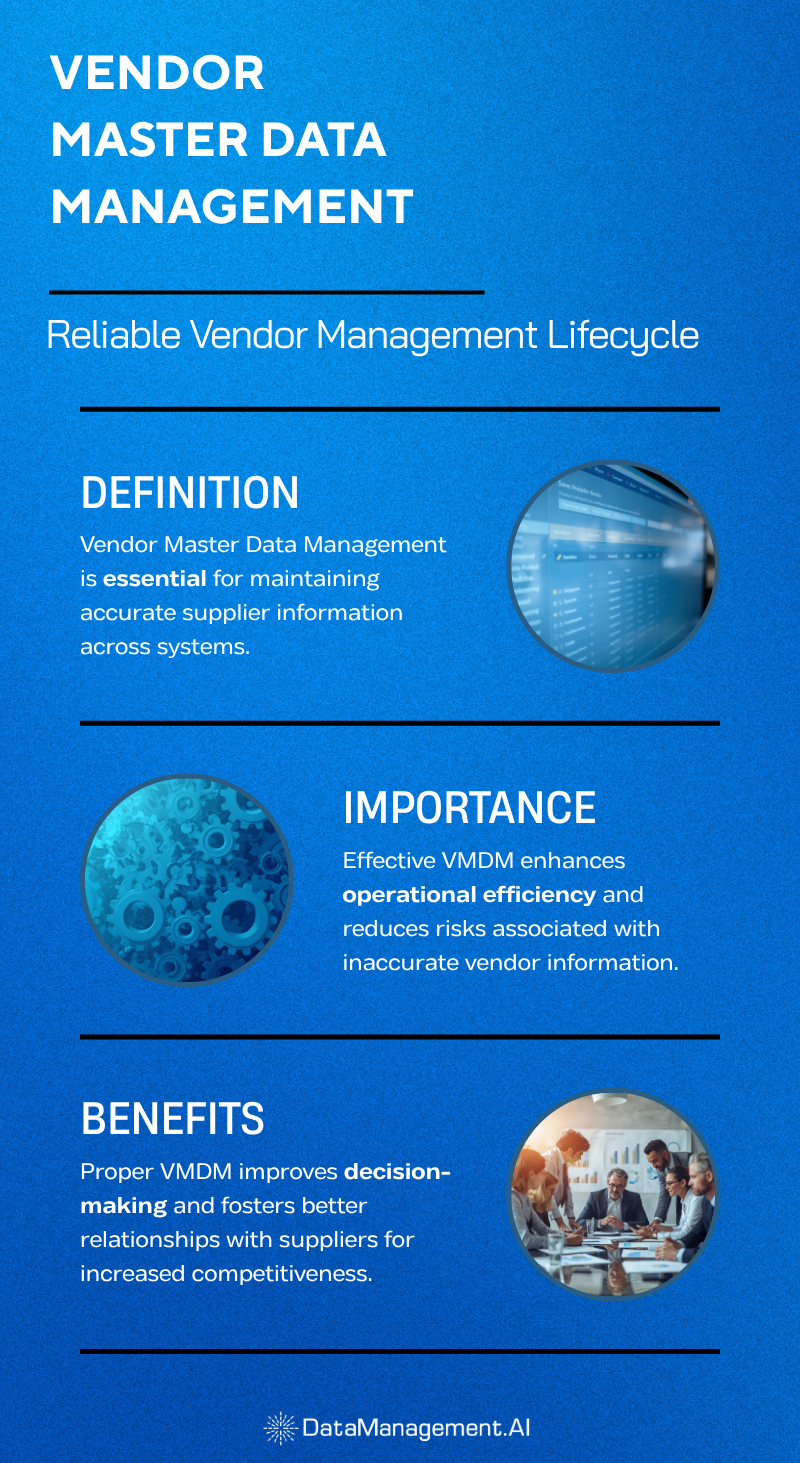
Vendor master data management creates a singular source of truth for vendor information.
It consolidates vendor records across all systems into one authoritative database.
You need this. It isn’t optional anymore. Organizations usually work with 50,000+ vendors on average. Without centralized vendor management, there will be chaos.
Reliable master data management vendors should deliver you with,
- Performance metrics and compliance data
- Complete payment and banking details
- Unified supplier profiles across all locations
- Standardized vendor naming conventions
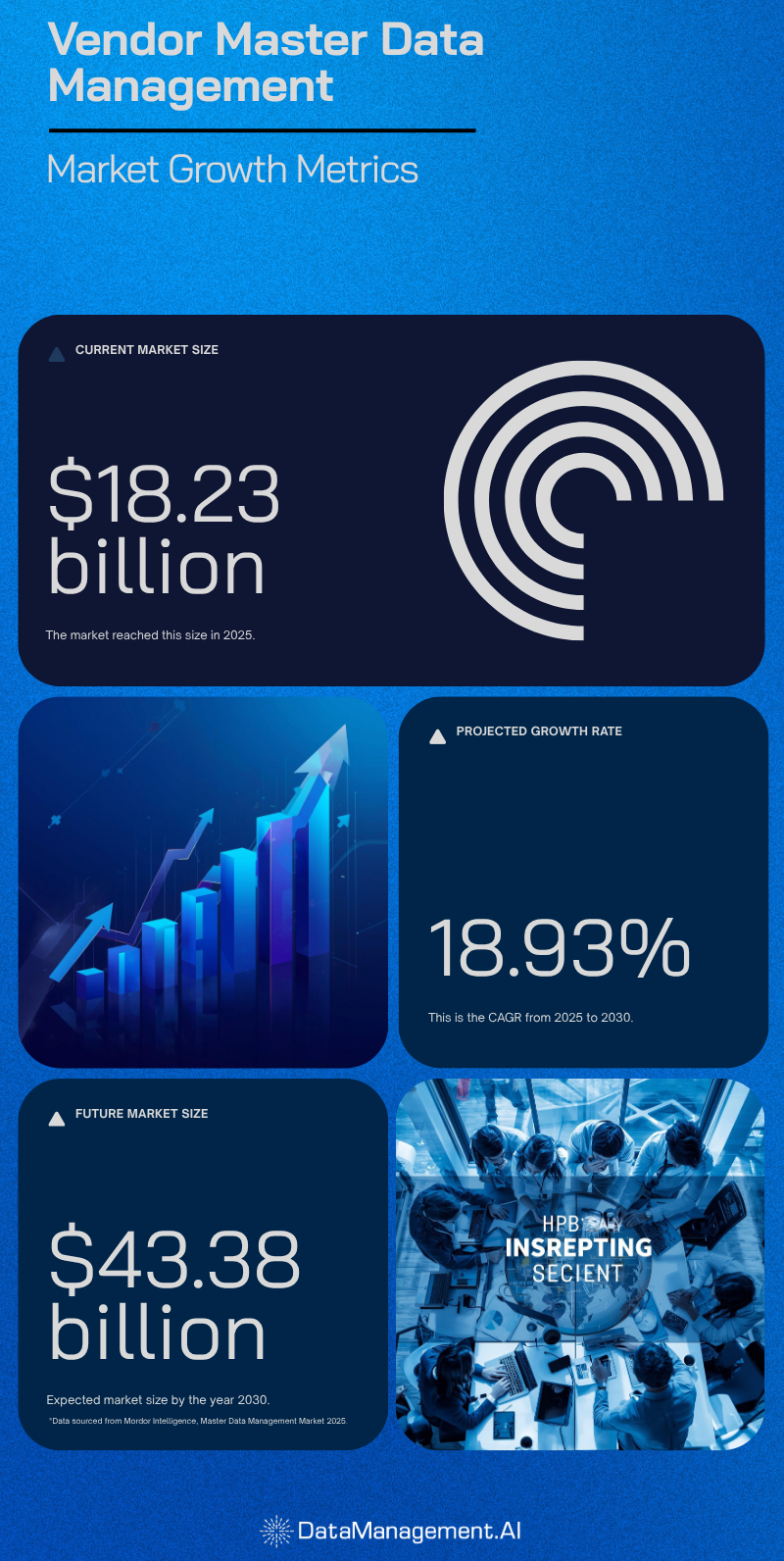
The financial impact of poor vendor data creates massive financial damage. Duplicate payments can happen and price negotiations fail.
Plus, contract leakage occurs.
Gartner estimates that organizations lose close to USD 15 million annually from poor data quality. For vendor data, the impact multiplies across your procurement operations.
Vendor Master Data Management Process
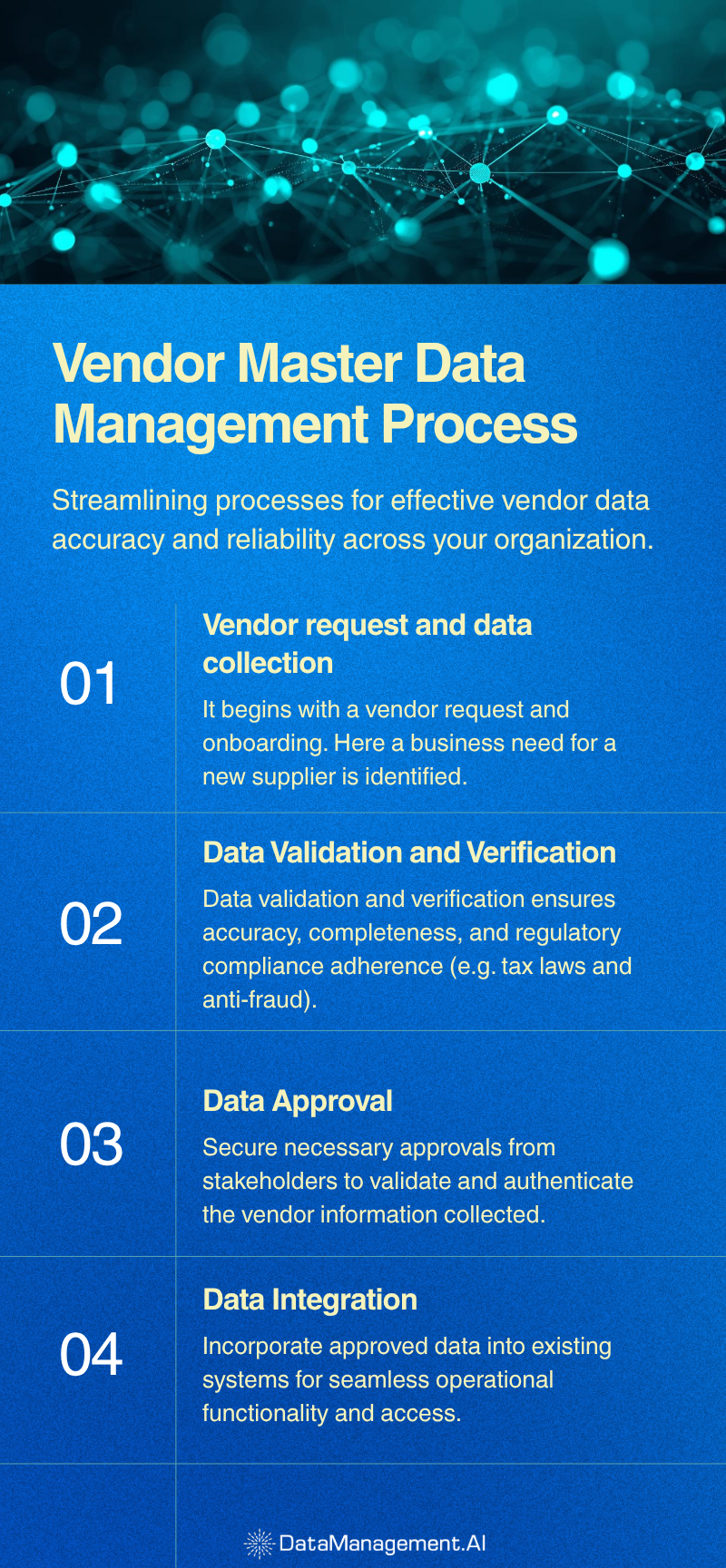
The vendor master data management process is the maintenance of accurate and consistent data about vendors.
Vendor request and data collection
It begins with a vendor request and onboarding. Here a business need for a new supplier is identified.
This triggers the data collection step, where detailed information such as, legal name, address, banking details, tax IDs, and contact information is gathered.
Validation and verification
Data validation and verification ensures accuracy, completeness, and regulatory compliance adherence (e.g. tax laws and anti-fraud).
De-duplication is a key step in this phase as it checks against any existing vendor master data to prevent duplicate vendor records to maintain integrity.
Approval and creation
The approval workflow is a multi-level process involving different departments such as legal, finance, and procurement.
The vendor record is formally created and activated in the core finance or ERP system.
Maintenance and governance
Ongoing management is a continuous cycle of data that remains active.
Data cleansing involves correcting errors. Enrichment is the updation of information such as performance metrics and certifications.
Auditing and monitoring is the tracking of data changes to ensure compliance and measure data quality.
The ultimate goal of maintenance is to ensure all transactional systems such as accounts payable and purchasing are referenced by a single source of truth.
Vendor Master Data Management Solution
A vendor master data management solution outlines a detail-oriented plan to maintain the consistency, accuracy, and compliance of all your vendors.
The usual vendor master data management job description or main functionalities include:
- Data cleansing and auditing activities to identify and correct data quality issues and inconsistencies.
- Enforcing data governance policies and standards across all systems and business units.
- Monitoring and reporting on key data quality metrics.
- Ensuring all vendor data processes adhere to regulatory requirements.
- Managing sensitive information such as payment data and bank details.
- Collaborate closely with various departments towards resolving data related issues.
What are some Vendor Master Data Management best practices?
The following vendor master data management best practices are crucial for risk mitigation and operational efficiency.
Establishing a centralized and unified vendor data record
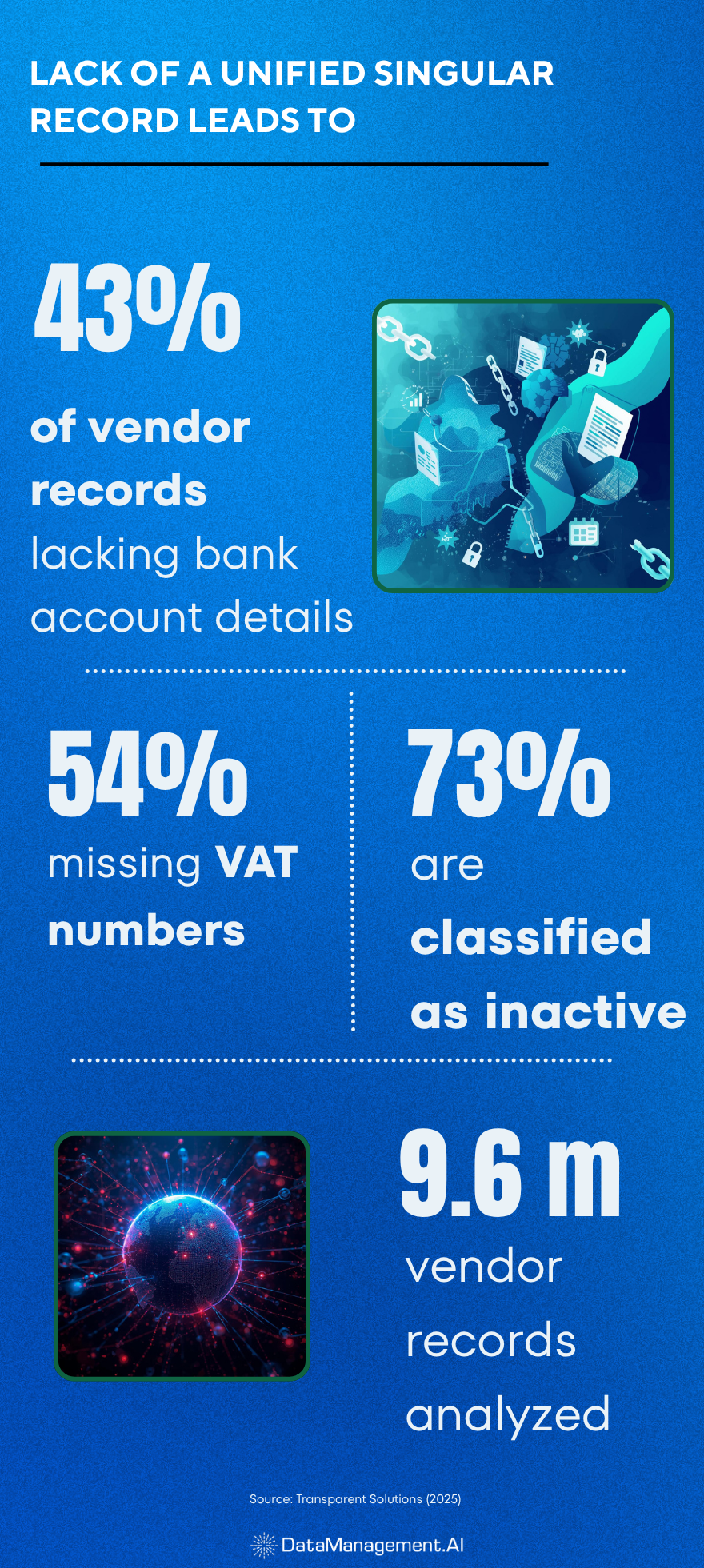
A fundamental best practice is to create a centralized, single, and unified vendor record. This means that all your systems i.e. ERP, accounts payable, and procurement, pull information from one authoritative source.
By maintaining a single source of truth, you eliminate data duplication, inconsistencies, and manual reconciliation efforts.
This unification is achieved through a dedicated VMDM or a central hub. This ensures that when your data is updated, say for example a vendor’s bank details, it is reflected everywhere across all systems.
This practice reduces payment errors and improves financial accuracy, safeguarding you against compliance issues or frauds.
You can easily maintain a singular source of truth through DataManagement.AI’s. Schedule a demo to see how.
Implementing a robust data governance and stewardship
Data governance is the cornerstone of high-quality VMDM.
This practice includes defining your data procedures, policies, and responsibilities for managing vendor master data.
Here a data steward is assigned who is accountable for integrity, quality, and data compliance for vendor data.
Governance covers data definitions (which fields are compulsory), data standards (naming conventions), and vendor onboarding process.
Strong governance ensures that data is correctly entered, validated, and maintained according to internal regulatory requirements (e.g. W-9/W-8).
This practice also establishes necessary controls to maintain trustworthiness of data over time.
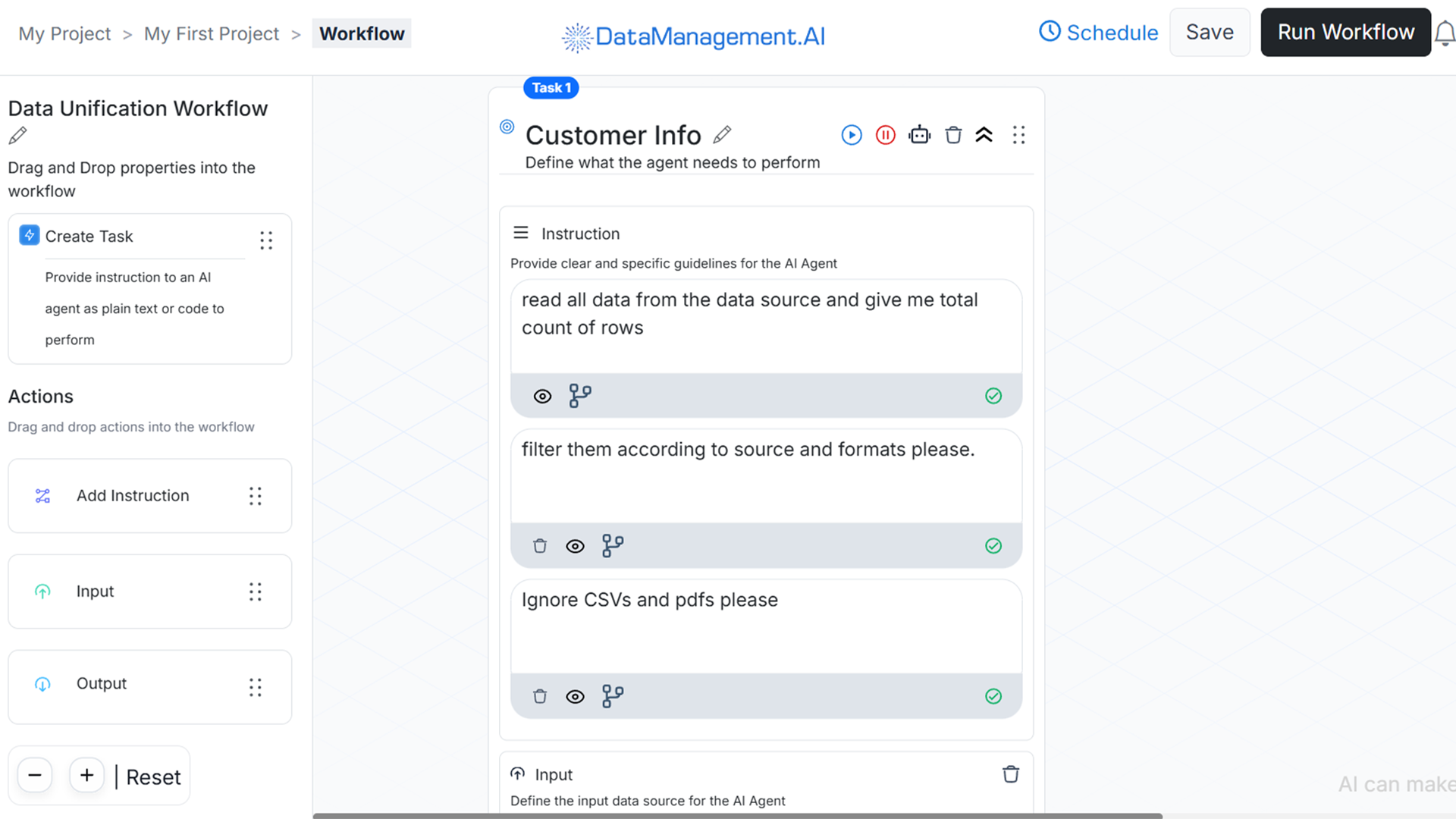
Enforcing standardized onboarding workflows
The vendor onboarding process is the first point of data entry.
This best practice, hence dictates implementing an automated, standardized, and enforced workflow.
This workflow should be designed to collect all possible required data fields in a structured manner (these are mostly through dedicated vendor portals).
Key steps include automated validation checks e.g. matching tax IDs with government records, segregation of duties, and internal approvals.
Automating this process using a vendor master data management tool accelerates the time-to-transact with a new vendor and also ensures complete or compliant data from the start.
Prioritising continuous data quality monitoring and enrichment
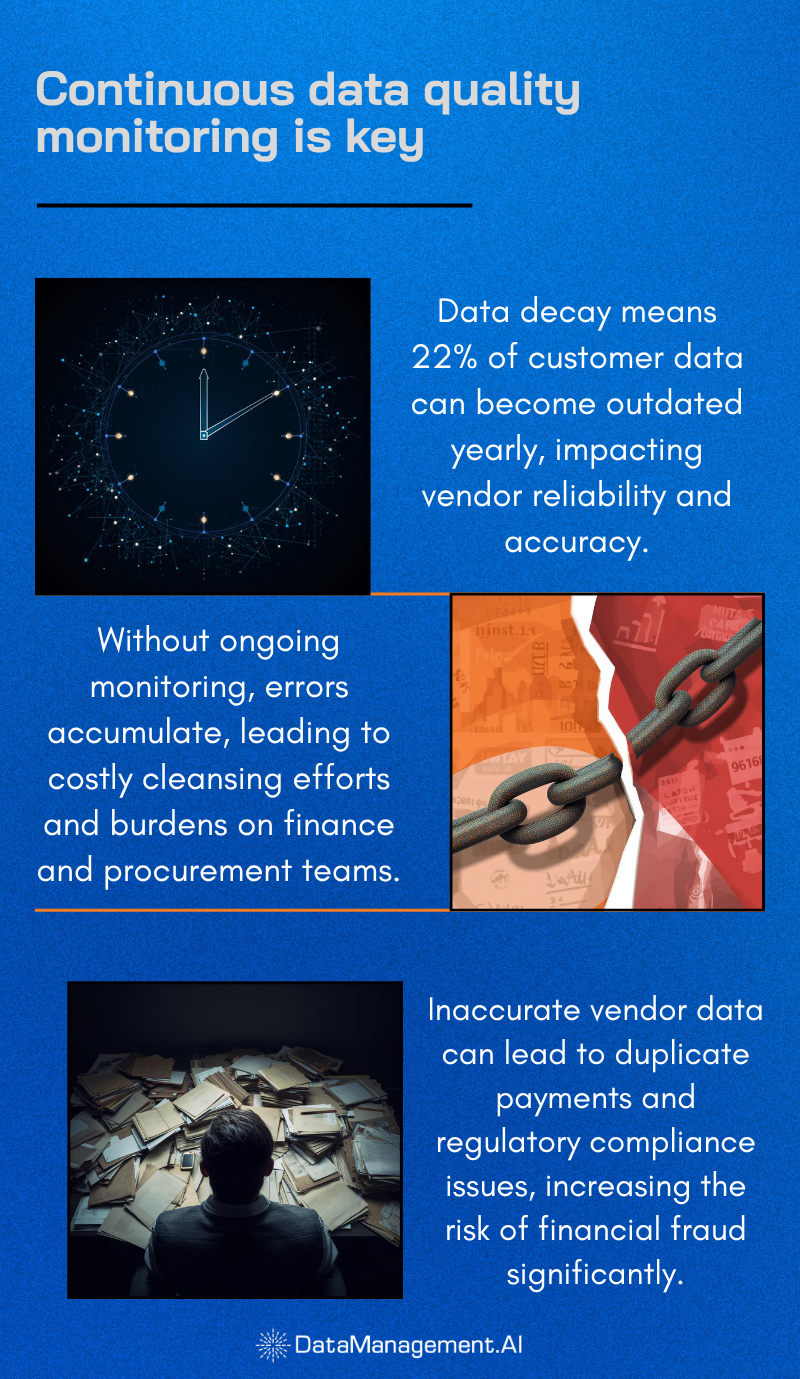
Data quality improvement is not a one-time fix. It requires continuous monitoring and proactive enrichment.
Even with a standardized onboarding process, vendor data will inevitably degrade due to numerous business changes you make.
This best practice involves using automated quality tools to periodically scrub and validate existing vendor master data.
This includes checking for duplicate records, verifying key details such as vendor addresses or legal statuses, and identifying incomplete or obsolete information.
Data enrichment involves appending external valuable information such as compliance flags, financial health metrics, and risk scores.
This practice ensures that master data remains up-to-date, reliable, and accurate.
Implementing a security and audit data trail
Given how sensitive personal or financial data is, robust security measures and complete audit trails are important.
The access to view, create, and modify vendor fields must be controlled through role-based access control (RBAC).
Only authorized personnel can make changes or modify with all changed information captured in the audit log.
This log should detail ‘who’ made ‘what’ changes, and when. This practice is key for compliance with regulations such as Sarbanes-Oxley (SOX), fraud prevention, and internal controls.
A detailed audit trail allows you to quickly investigate suspicious activity and ensure the integrity of financial transactions is maintained.
What are some vendor master data management benefits?
The following benefits undermine why needing a vendor master data management software is essential for your organization.
Reduced financial risk and fraud prevention
A crucial benefit of VMDM is the significant reduction in financial risk and enhanced fraud prevention.
By establishing strict protocols, such a centralized master record, you can ensure that vendor payments are made to correct and legitimate entities.
A proper VMDM prevents common fraud traps such as ‘ghost vendors’ or unauthorized changes to banking information.
Implementing segregation of duties and audit trails on key fields such as a change being logged, reviewed or approved, makes it harder for internal or external personnel to divert funds.
This protection is massive when safeguarding your company assets and maintaining financial integrity.
Improved operational efficiency and automation
High quality vendor master data is the foundation for automating core procurement and account payable processes. This leads to operational efficiency.
Accurate and standardized vendor master data reduces manual effort across the procure-to-pay cycle.
With clean data, tasks such as purchase order creation, invoice matching, and payment processing can be executed seamlessly.
VMDM eliminates time wasted on resolving errors, manually correcting bad data, and reconciling discrepancies.
This allows finance and procurement teams to shift their focus from reactive data correction to strategic tasks.
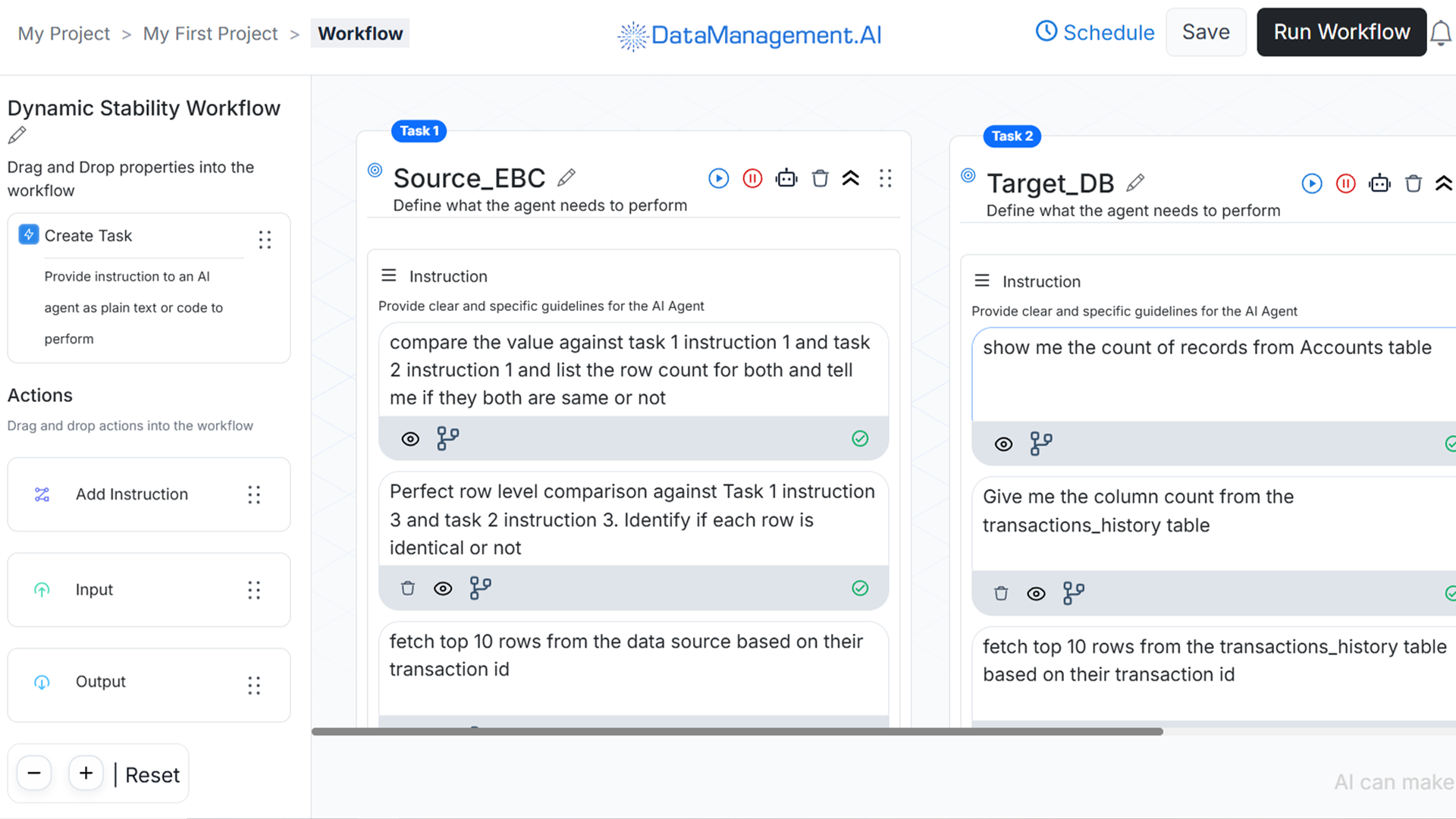
With a tool like DataManagement.AI, you can automate every workflow to ensure sustained efficiency.
Enhanced audit readiness and regulatory compliance
Vendor master data management is key to maintaining regulatory compliance with international or local laws.
This makes your organization audit-ready. Vendor data must comply with various mandates, including tax reporting, anti-money laundering regulations, and sanctions list screenings.
A good VMDM system ensures all your required compliance documentation is captured and verified during the onboarding phase of the vendor lifecycle.
This systematic approach allows companies to quickly provide your auditors with accurate and comprehensive documentation. This aspect provides due diligence, legal issues, reputational damage, and minimizing risk of fines.
Negotiation leverage and spend analysis
Accurate and complete vendor master data provides you with the firm foundation for effective spend analysis.
This translates directly into better negotiation leverage and cost savings.
By having a single and unified view of all your spending aggregated under a consistent vendor name, you can identify total spend with a supplier (this including various departments and subsidiaries).
This visibility helps uncover opportunities for volume discounts, rationalising your supplier base, and contract consolidation.
Without clean master data, spend analysis can become fragmented. This causes companies like yours to miss out on significant cost-saving opportunities.
Optimized supplier relationships
Managing your supplier relationship becomes easier and effective when leveraging high-quality vendor master data.
VMDM provides a reliable and comprehensive profile of each supplier.
Your vendor master data record should consolidate all key information such as contract details, performance metrics, primary contract information, and risk scores.
This holistic view enables better internal communication and ensures a consistent approach when dealing with your supplier.
By having accurate supplier data within your vendor master data record, your business fosters stronger relationships, reduces conflicts, and improves overall collaboration.
All this together leads to better innovation, service, and reliability of your supplier base.
Which are some good vendor master data management softwares?
The following are a list of vendor master data management tools that can help you lower operational costs and improve real-time supply chain visibility.
Selection criteria and vendor master data management implementation
When choosing the right vendor master data management solution, consider the following criteria.
- Scalability requirements
- Total cost of tool ownership
- Implementation timeline fitting your business needs
- Industry-specific functionality
- AI-native platform
The most common challenges while implementing a vendor master data management software are:
- Data migration complexity wherein there is decades of inconsistent vendor data.
- Your team’s resistance towards changing already set vendor management workflows
- Integration difficulties as vendor information is scattered across numerous spreadsheets and systems
- Ongoing maintenance as vendor data quality degrades without continuous attention
DataManagement.AI
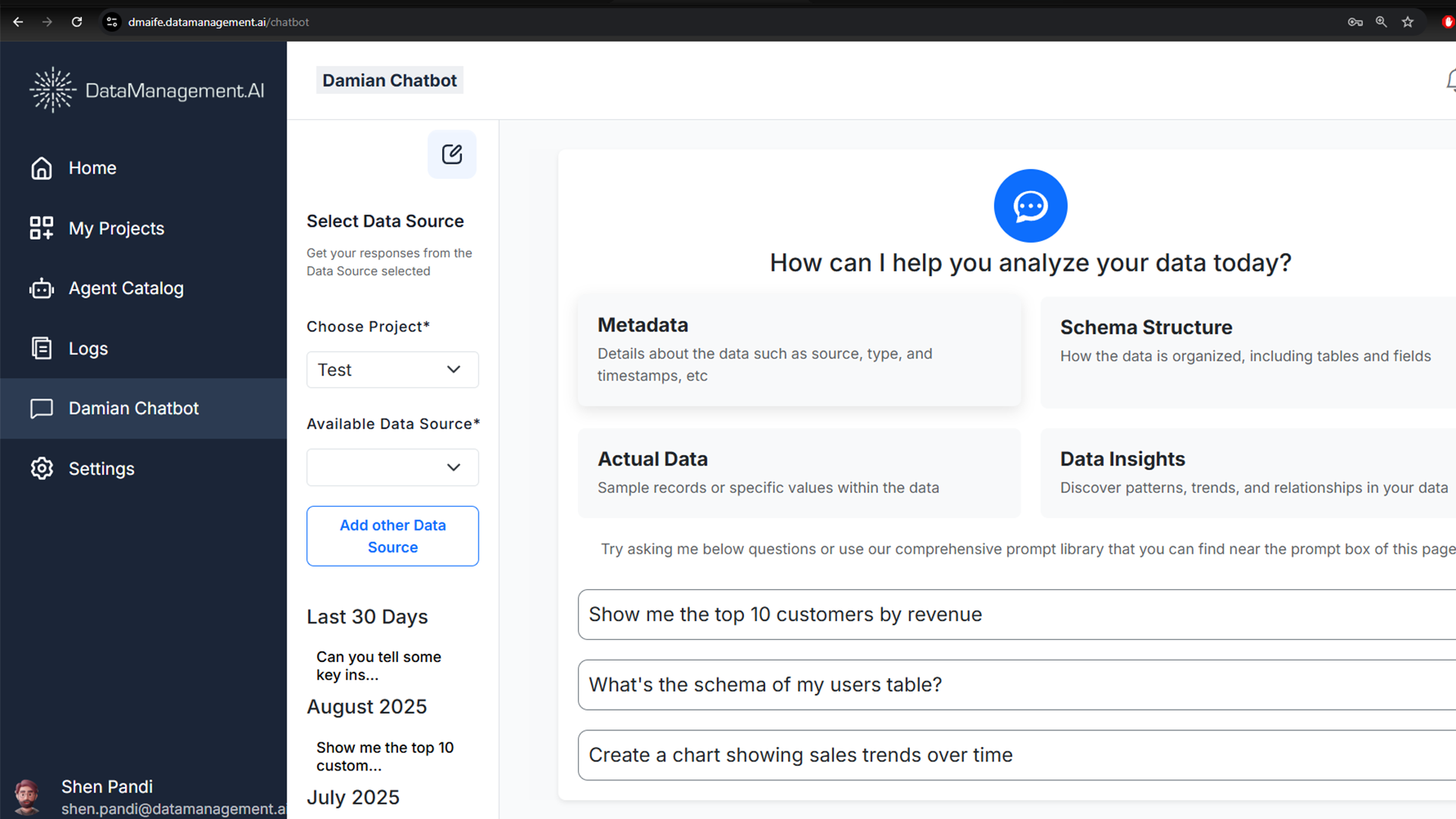
We at DataManagement.AI transform chaotic vendor data into business strategic assets. Our AI-native vendor master data management solution addresses your specific business challenges.
The three key transformative benefits of DataManagement.AI are:
- Lowered operational costs – Our intelligent AI agents automate your vendor data. We cleanse and validate this data to help you reduce manual intervention. Your team now focuses on strategic vendor relationships
- Productivity gains going up – Automated workflows handle vendor onboarding, deduplication, and updates allow your team to spend less time on fixing errors. This extra time goes for vendor performance optimization.
- Real-time supply chain visibility – Our platform connects your entire vendor landscape. You now gain insights on compliance risks, spending patterns, and vendor performance.
The following table shows you the key things to consider when selecting the best vendor master data management tool.
| Core Features | Seamless integration in connecting every part of your data – from collection to insights. Enables querying and analyzing data in its source system with no extraction, prep or delays. Links every step of your data journey into one efficient data matrix. Delivers real-time data flow to help you adapt to trends and make informed decisions. Automates repeatable tasks with intelligent agents that detect and recover from failures when optimizing compute resources. Design complex pipelines in minutes via a drag-and-drop Visual Canvas. Work with built-in governance via end-to-end lineage, audit logs, and compliance by design. Enable matching, mixing, or swapping data sources, platforms, and instructions while preserving total flexibility. Secure every request with granular policies, built-in compliance, and continuous authentication |
| Key Strengths | Workflows with zero-touch quality restoration 30% quicker issue detection than manual reviews Automated regulatory compliance Autonomous capabilities that are enterprise-grade |
| Weaknesses | A newer platform with a growing ecosystem Initial AI training period for the tool just like for any tool |
| Pricing Model | Starter – USD 2,999/month (up to 10 data sources) Professional – USD 7,999/month (unlimited sources) Enterprise – Custom pricing with dedicated support |
| Best Suited For | DataManagement.AI is suited for organizations looking specifically for autonomous data management with minimal human intervention. |
| Deployment Strategy | A cloud-native architecture with API-first design. It enables rapid deployment across hybrid environments. |
| Integration & Scalability | The high rating reflects its core pitch of instant integration. Also, high scalability through in-place data access (no replication needed). |
Reltio Vendor MDM Platform

Reltio is a vendor master data management software that makes use of a graph database. This graph manages complex relationships in real-time.
This custom model allows Reltio’s VMDM tool to understand vendor hierarchies and complex corporate ownership structures.
The following table shows you its core features and key strengths.
| Core Features | Real-time processing AI-driven matching Relationship insights Cloud-native architecture |
| Key Strengths | Cloud scalability AI capabilities Relationship focus Modern architecture |
| Weaknesses | Cost considerations Implementation complexity Platform maturity Newer market presence |
| Pricing Model | Subscription-based with data volume pricing. |
| Best Suited For | Organizations requiring a relationship-centric VMDM. |
| Deployment Strategy | Cloud-native with relationship analytics. |
| Integration & Scalability | True cloud-native multi-tenant SaaS architecture with excellent real-time API capabilities. |
Stibo Systems VMDM

Stibo Systems’ VMDM solution is part of its STEP platform. It consolidates, cleanses, and governs all vendor-related data into a source of truth.
It streamlines critical procurement processes such as vendor onboarding and automates workflows to reduce setup time.
The following table shows you its core features and key strengths.
| Core Features | Digital asset management Multi-channel publishing Workflow automation Product Information Management |
| Key Strengths | Multi-channel support Strong PIM capabilities Rich product modeling Industry-specific focus |
| Weaknesses | Steep learning curve Complex customization Limited product domain High implementation costs |
| Pricing Model | Contact them for industry-specific pricing. |
| Best Suited For | Manufacturers and retailers managing complex product catalogs. |
| Deployment Strategy | Product-centric implementation with channel expansion. |
| Integration & Scalability | Built for enterprise scale with centralized architectures. Successfully deployed for its flexible APIs (REST/GraphQL) and pre-built connectors. |
“Vendor master data is the foundation of digital transformation. Without accurate, unified vendor information, organizations cannot achieve operational excellence or make data-driven decisions. vendor master data management best practices aren’t optional – they’re fundamental to competitive advantage.”
— Wendy Batchelder, VMware
Vendor master data management for the win
Your window to tactical and non-siloed vendor data now open.
Enterprise resilience requires strategic vendor master data management. The unification of vendor data is the backbone for compliance, growth, and fraud prevention.
DataManagement.AI offers you an AI-native platform that provides a foundation for procurement excellence.
Our AI agents automate vendor data management, integrate seamlessly with your existing systems, and gain real-time insights.
Schedule a demo to discover how you can achieve flawless vendor data integrity and productivity.
Frequently Asked Questions (FAQs) on Vendor Master Data Management
Q. What is vendor master data management and why is it critical for me?
A. Vendor master data management is the system and governance. It centrally defines and maintains the Golden Record for every supplier entity. This includes legal, banking, and tax data. This is crucial for procurement. It ensures accurate sourcing, contracting, and payment processes.
Q. How do I select the right vendor master data management software for my organization?
A. When evaluating vendor master data management software, consider factors such as automated data cleansing capabilities including name normalization and address standardization, advanced fuzzy matching algorithms with multilingual support for duplicate detection, integration capabilities with your existing ERP, P2P, and SRM systems, and workflow automation features for vendor onboarding and approvals.
Q. How do modern vendor master data management tools handle integration with legacy systems?
A. Modern vendor master data management tools use API-first, service-oriented architectures. They are designed for flexibility. This allows them to integrate non-intrusively with legacy ERP systems. The vendor master data management software acts as a centralized hub. It receives, cleanses, and synchronizes data.
Q. What is the typical vendor master data management job description for a VMDM?
A. The vendor master data management job description for you is pivotal. You are the operational data owner. You are responsible for enforcing defined quality rules. You manage the complex data creation and change request workflows. You oversee the manual review of potential duplicate records flagged by the system.
Q. What are the benefits of vendor master data management to me?
A. The benefits of vendor master data management are substantial. Some benefits are clean data ensures accurate tax reporting. It prevents costly duplicate payments and unauthorized spending. By utilizing top master data management vendors solutions, finance gains a reliable audit trail. This simplifies internal and external audits significantly.
Q. Why should we choose an AI-native platform over traditional master data management vendors?
A. Traditional master data management vendors often rely on rigid, rules-based systems. These require constant, manual updates. An AI-native vendor master data management solution uses machine learning. It automatically adapts to new data patterns and standards. It performs entity resolution with higher accuracy and speed.
Q. How does a clear vendor master data management process mitigate the risk of vendor fraud?
A. A vendor master data management process introduces control gates. It enforces multi-level approval workflows for critical changes. This is especially true for bank account details. Vendor master data management best practices include separating duties. This ensures the person creating the vendor cannot approve payment details.
Q. What is the typical vendor master data management process from start to finish?
A. The vendor master data management process follows five structured stages – Data Collection, Data Cleansing, Data Enrichment, Data Governance, and Continuous Monitoring (tracking quality metrics like completeness, accuracy, and consistency while addressing issues proactively). This cyclical process ensures vendor data remains accurate and valuable over time.