



Let’s be real for a second.
Nobody wakes up one day and says, “You know what? Let’s mess up our data.”
It usually starts small.
Someone exports a spreadsheet just for now. And fast forward a year, the same product, customer, or location exists in five different systems, all slightly different in some way, yet all claiming to be correct.
This happens everywhere.
Healthcare, retail, finance, HR, pharma. I would say no industry is immune. Even companies we look up to struggle with this quietly.
That’s where learning how to implement Master Data Management becomes important.
Not as some heavy enterprise concept, but as the thing that keeps your business from tripping over its own information.
I’ll show you how master data management isn’t a nice-to-have anymore. It is your survival kit. Let’s dive into 12 technical use cases across every major sector.
Master Data Management Use Cases
Poor data quality costs organizations an average of USD 12.9 million annually, according to Gartner’s 2023 research. But 87% of CDOs say data quality is their biggest barrier to digital transformation.
When I ask organizations why they’re interested in master data management, responses like ‘we need good data’ or ‘we want a 360-degree customer view’, often signal trouble.
While those goals may sound logical, they don’t provide measurable outcomes.
For master data management to create a sustainable and impactful program, it’s not just about getting the data right, it’s about getting the data right for a purpose.
Healthcare Master Data Management
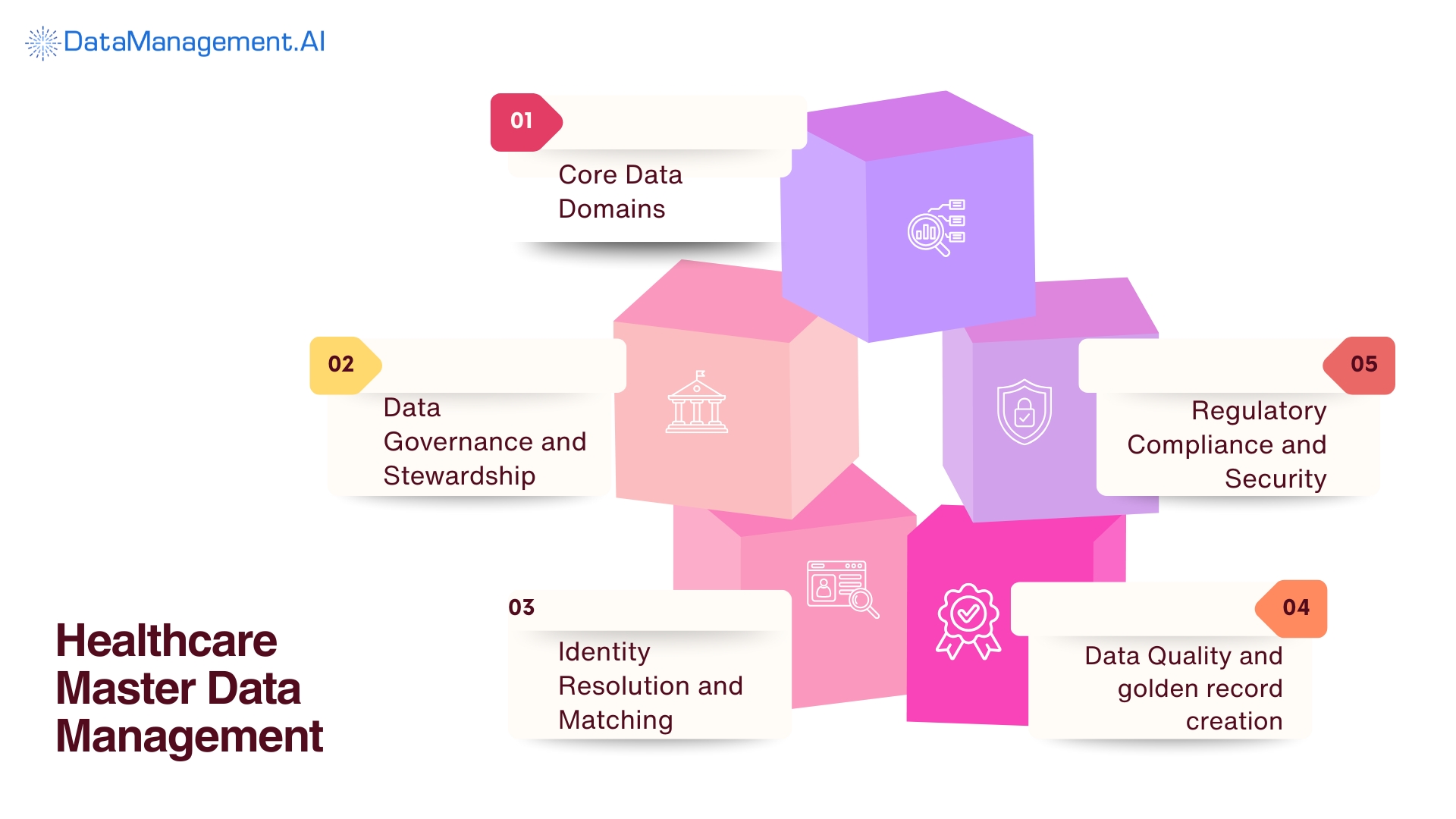
A successful use case for healthcare master data management here involves the creation of a unified 360-degree patient view.
Healthcare master data management links records across electronic health records (EHR), pharmacy systems, and insurance claims.
This prevents medical errors caused by duplicate records and ensures providers have a complete clinical history for accurate diagnosis and billing.
Healthcare data doesn’t usually fail in dramatic ways, it falls in small annoying ones. For example:
- A patient gets registered twice because their name was spelled differently.
- A doctor shows up as “inactive” in one system but is still seeing patients in another.
- A clinic location looks fine in the EHR, but billing can’t recognize it.
That’s the gap healthcare master data management fills.
It keeps patient, provider, facility, and service information in sync across EHRs, lab systems, billing tools, and partner networks.
Mayo Clinic implemented enterprise-wide healthcare master data management in 2019. The results were staggering.
They unified patient records across 250+ locations. Duplicate patient records dropped by 94%. Medical errors from data inconsistencies? Cut by 67%.
Mayo Clinic’s health care data management use case by numbers:
- 94% reduction in duplicate records
- 67% fewer data-related medical errors
- USD 2.3 million annual savings in administrative costs
Retail Master Data Management
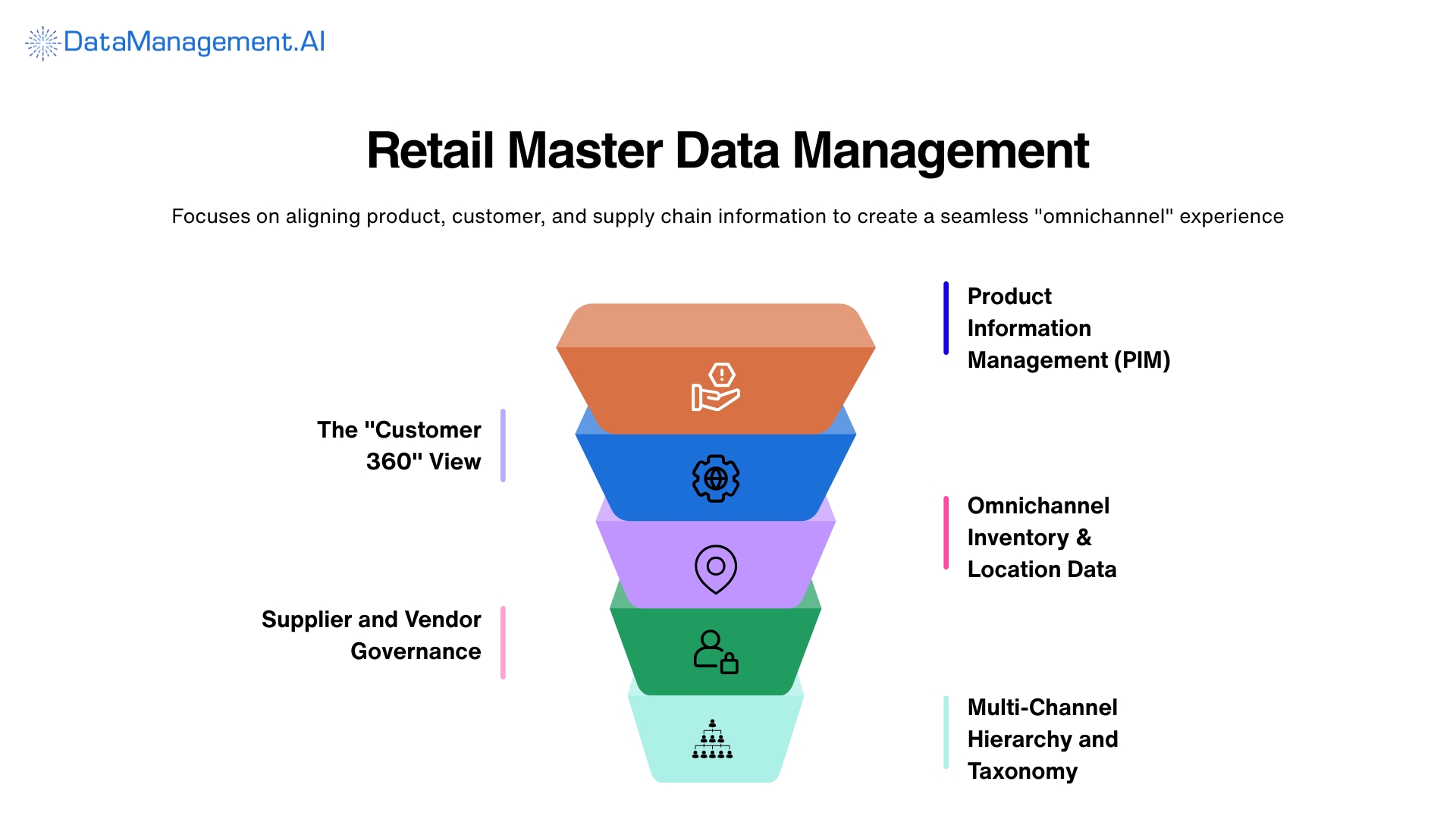
Retail master data management enables omnichannel commerce by synchronizing product information.
Add to that pricing and inventory across physical stores, mobile apps, and e-commerce websites.
Retail master data management allows retailers to provide personalized loyalty programs by linking customer purchase history across all touchpoints.
The retail game? It’s won with data precision. Not gut feelings.
That’s exactly what Walmart did by adopting a retail master data management strategy. Walmart’s retail master data management system processes 267 million items daily. Across 11,000+ stores worldwide.
Their retail master data management platform synchronizes product data in real-time. This enables dynamic pricing and inventory optimization.
Here is Walmart’s retail master data management use case by numbers:
- 18% reduction in out-of-stock incidents
- 35% improvement in supply chain efficiency
- USD 1.2 billion annual cost savings
Finance Master Data Management
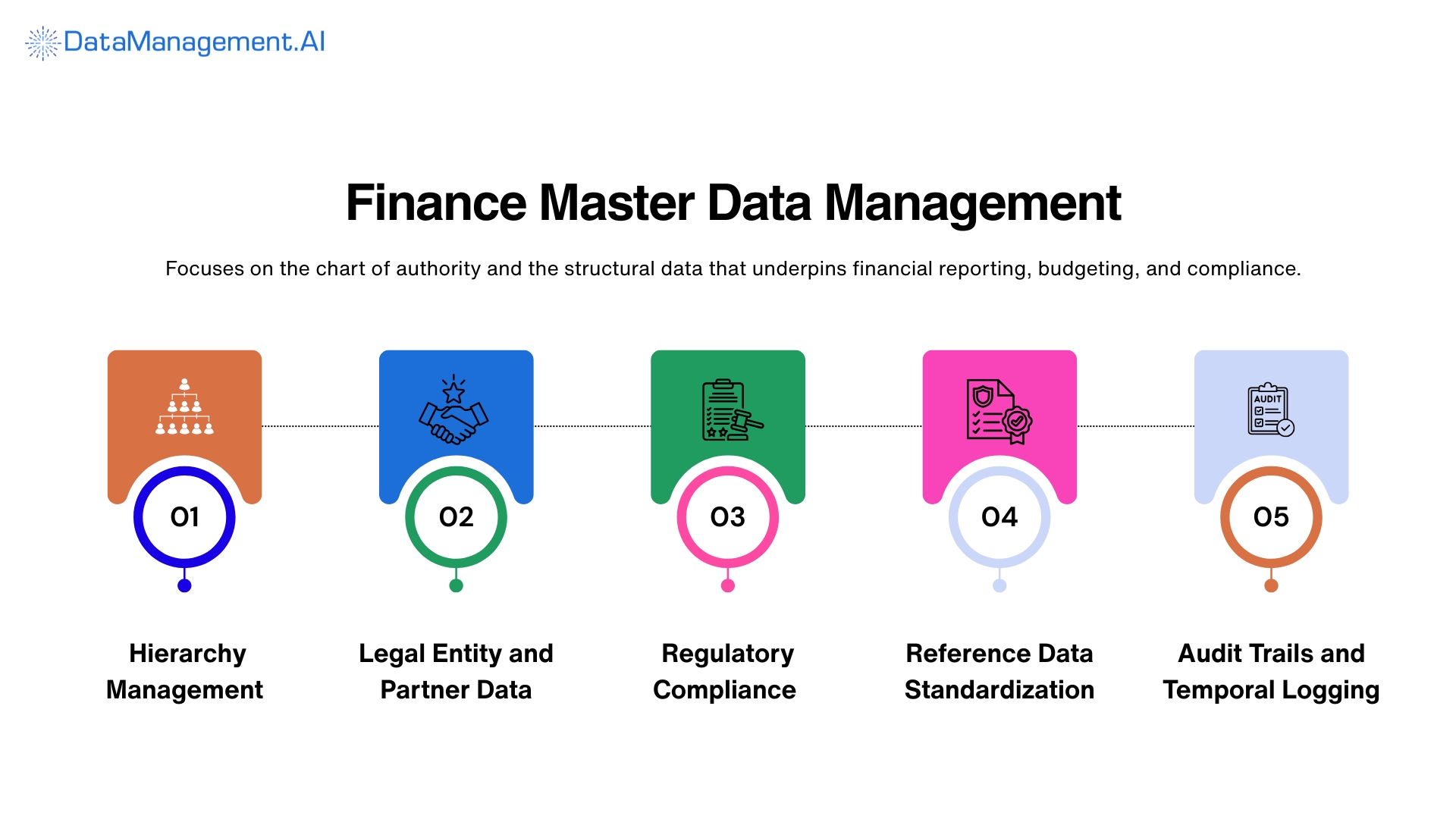
Finance master data management streamlines regulatory reporting and period-end closing. It does so by maintaining a consistent Chart of Accounts (CoA) across global entities.
It helps organizations manage golden records for legal entities, reducing the risk of manual entry errors in consolidated financial statements.
Understanding data governance frameworks is critical for financial institutions today.
JPMorgan Chase deployed their finance master data management solution post their 2008 crisis. They needed a single source of truth for regulatory compliance.
Their system now manages 50+ million customer records. Across 60 countries and multiple regulatory frameworks.
JP Morgan Chase’s finance data management use case by numbers:
- 99.9% data accuracy for regulatory reporting
- 45% faster compliance audits
- USD 500 million in avoided regulatory penalties
Location Master Data Management
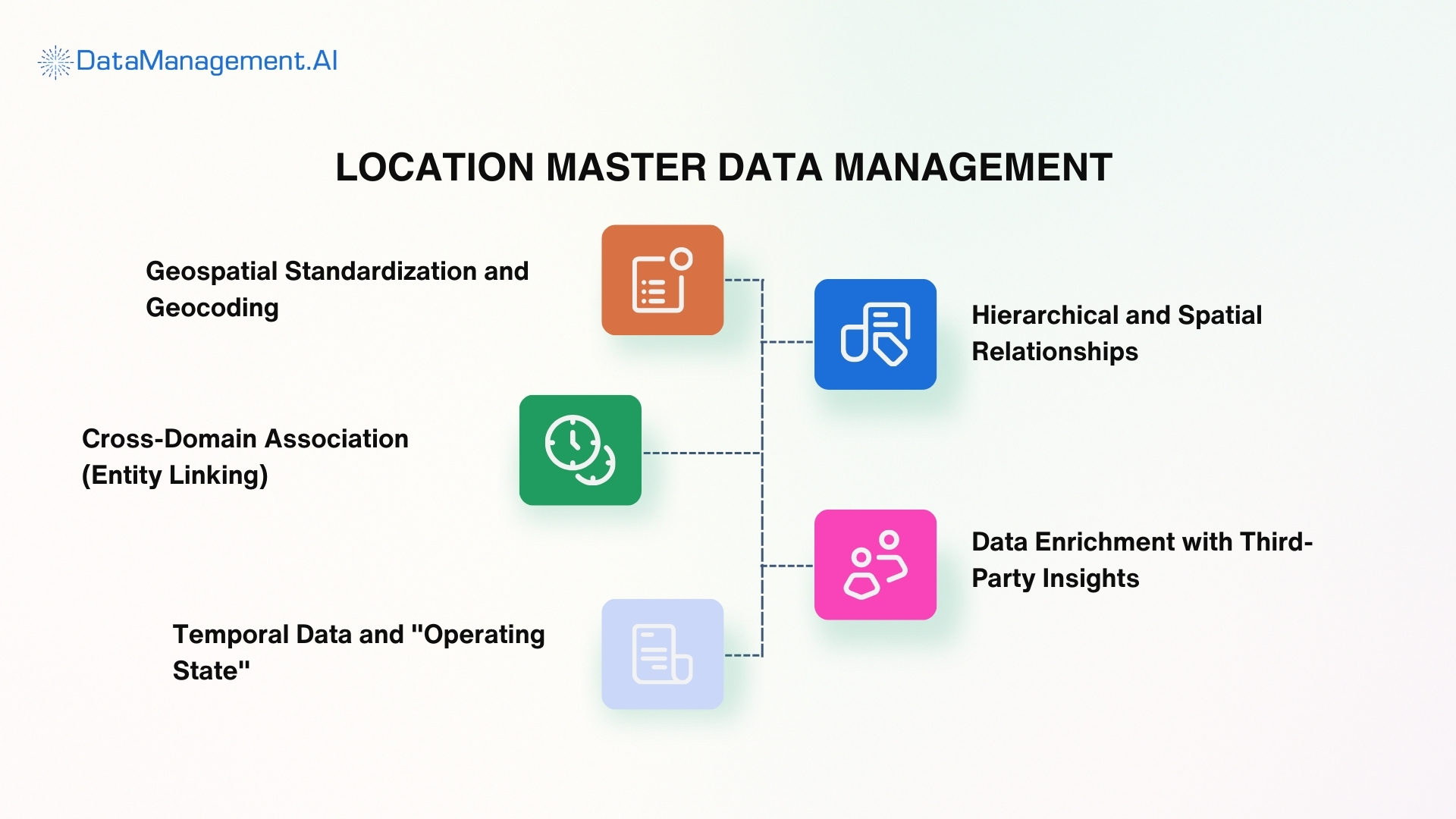
Location master data management supports logistics and site selection by providing geocoded.
They also verify addresses for warehouses, storefronts, and delivery hubs.
With location master data management, you can route efficiency and ensure that tax jurisdictions are correctly applied based on precise physical boundaries.
A location master data management use case can be seen with UPS. They process 6.3 billion addresses annually through location master data management.
UPS’ ORION system location master data management solution optimizes routes using geocoded master data. This saves 10 million gallons of fuel yearly.
UPS’s location master data management use case by numbers:
- 100 million miles reduced annually
- USD 400 million in fuel savings per year
- 100,000 metric tons less CO2 emissions
HR Master Data Management
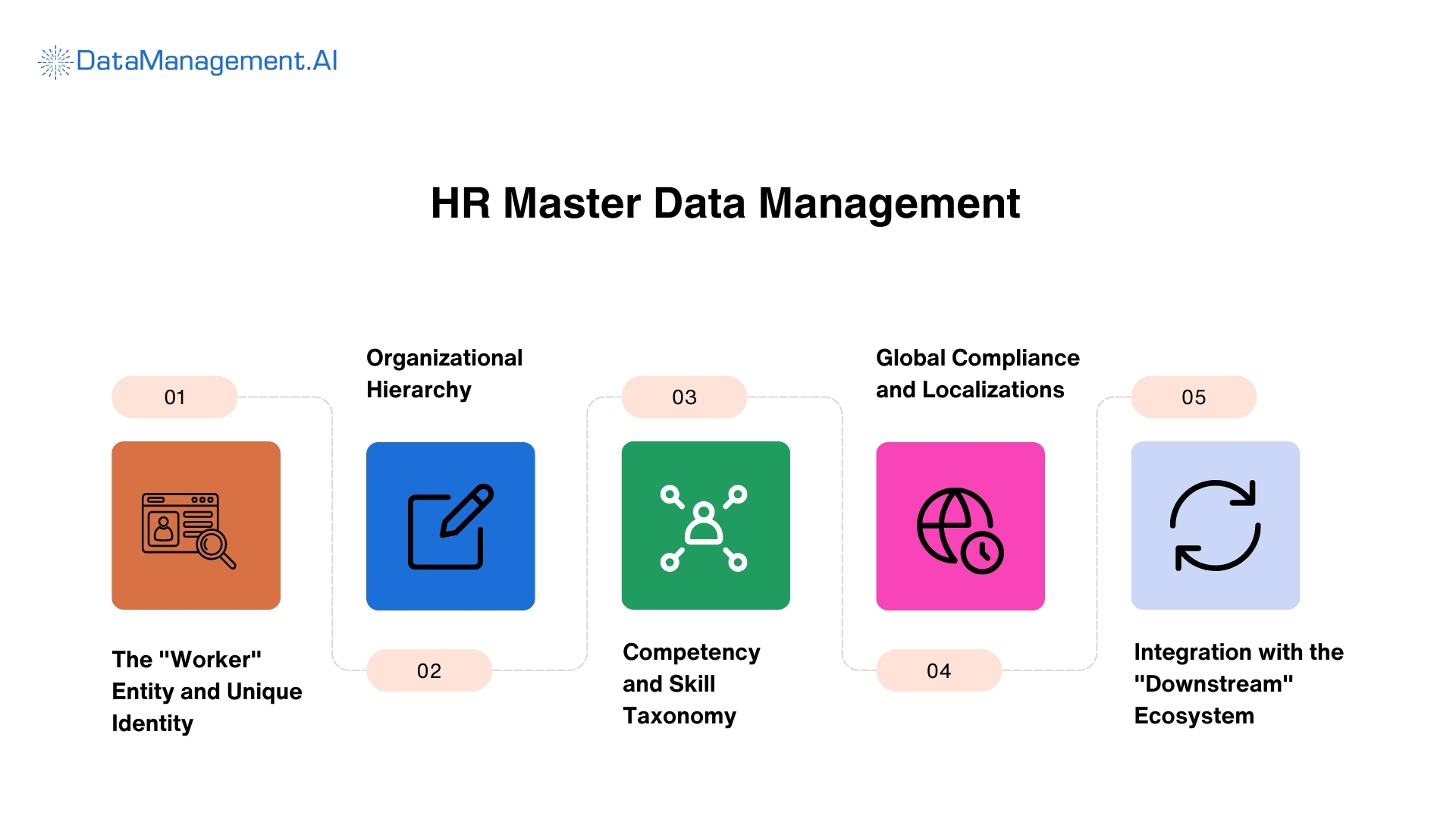
With HR master data management, you can manage the entire employee lifecycle from recruitment to retirement.
This is done by syncing identity data between payroll, benefits, and IT provisioning systems. The HR MDM ensures that when an employee is promoted or leaves, their access permissions and organizational hierarchy are updated automatically everywhere.
Unilever’s HR master data management use case sees them consolidate 155 HR systems into one HR master data management platform.
They unified data for 149,000 employees across 190 countries. The transformation took 18 months.
Unilever’s HR master data management use case by numbers:
- 70% reduction in HR system maintenance costs
- 40% faster employee onboarding
- Single employee record across all geographies
Service Master Data Management
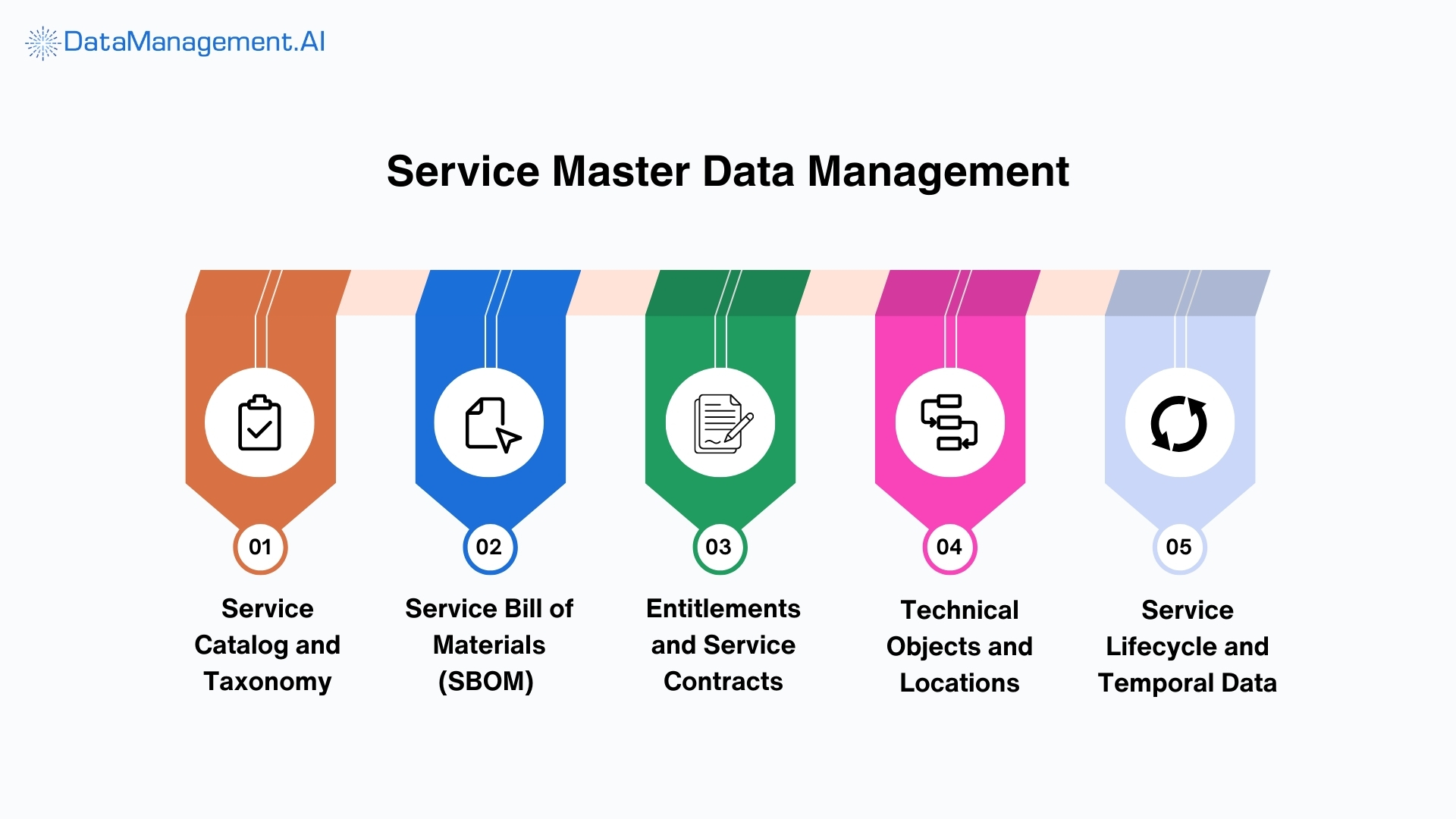
Service master data management centralizes and standardizes information regarding the intangible offerings an organization provides.
Unlike physical products, services often have complex, variable pricing and multi-layered service level agreements (SLAs) that are difficult to track across different business units.
Service master data management automates the contract-to-pay lifecycle by ensuring that service descriptions on invoices perfectly match the master record.
Service excellence starts with knowing your customer completely. Not partially.
Service master data management brings everything back to the same page. As a matter of fact, data governance is different from data management.
Instead of letting each system describe services in its own way, it locks in a single definition that everyone works from.
What the service includes, how it’s priced, who’s eligible for it, how long it’s valid, and what commitments come with it, all of that is clearly defined once and shared everywhere.
A relatable use case for service master data management is that of Fujitsu.
- Before implementing a centralized MDM, they struggled with several structural issues such as:
- Scattered service descriptions
- Inconsistent naming conventions that made impossible to track performance
- Staff spending hours manually to match records and
- Duplicate service IDs existing across multiple sources.
Post the service master data management implementation, there was reduced duration in their call-to-order, revenue accuracy improved, their supply chain efficiency went up, and their leadership gained a 360-degree-view of which services were profitable.
DataManagement.AI serves as a comprehensive AI-driven ecosystem that’s designed to simplify your complexities through a specialized suite of agents.
Our platform’s core features revolve around an agentic workflow where, for example, CleanseAI automates data deduplication and standardization.
ReconcileAI resolves conflicts across your disparate source to create a golden record.
GovernAI enforces data policies and maintains end-to-end lineage.
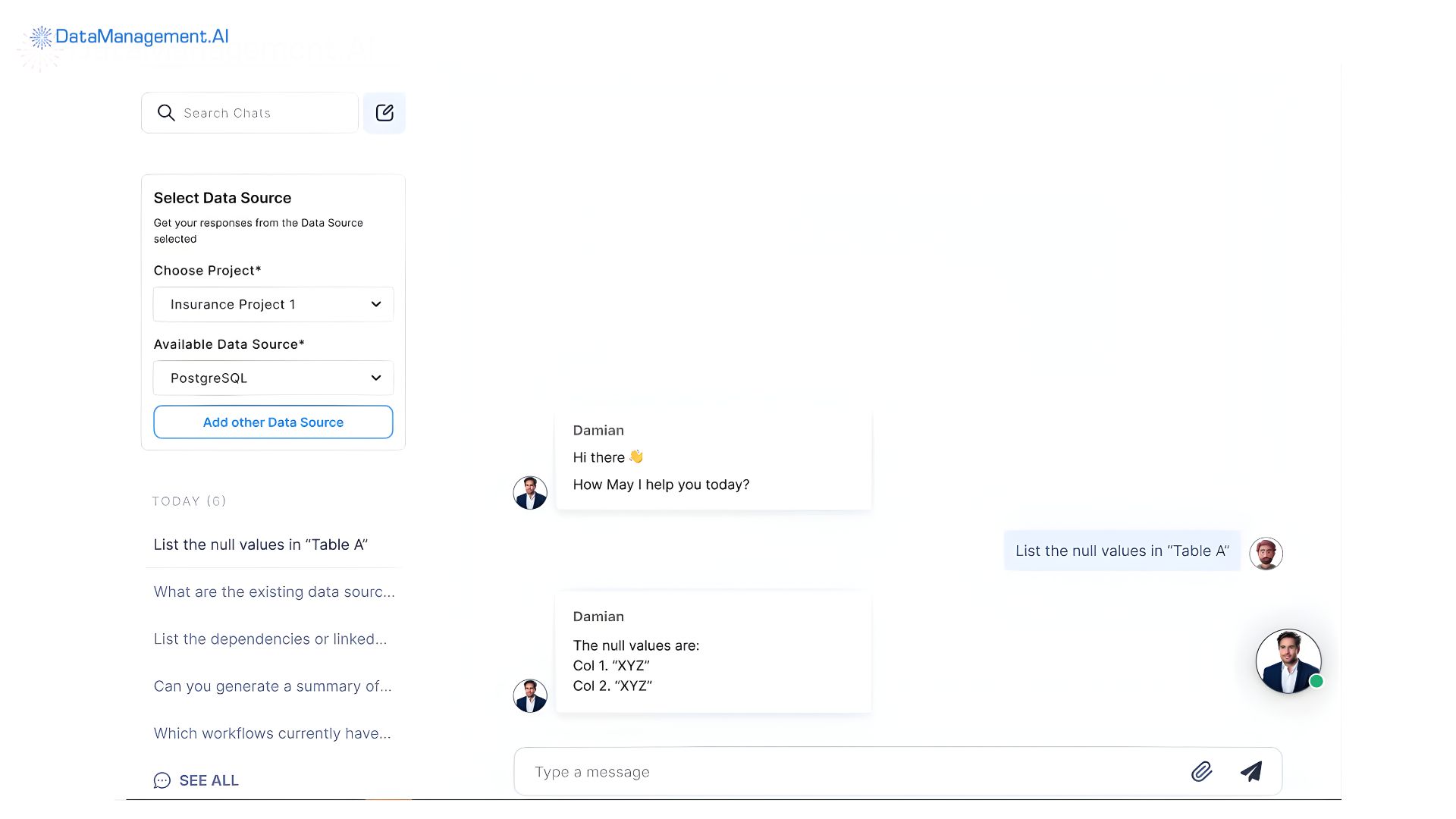
Our master data management software is best suited for mid-to-large scale enterprises in data-intensive sectors such as healthcare, finance, and retail.
Here you maintain a single, accurate version of truth for products, customers, and suppliers.
Our platform offers a flexible deployment strategy that supports cloud-native, on-premise, and hybrid environments.
Add to that, integration and scalability is boosted by a robust API-first architecture and pre-built connectors that allow it to seamlessly ingest data from your legacy systems and modern warehouses.
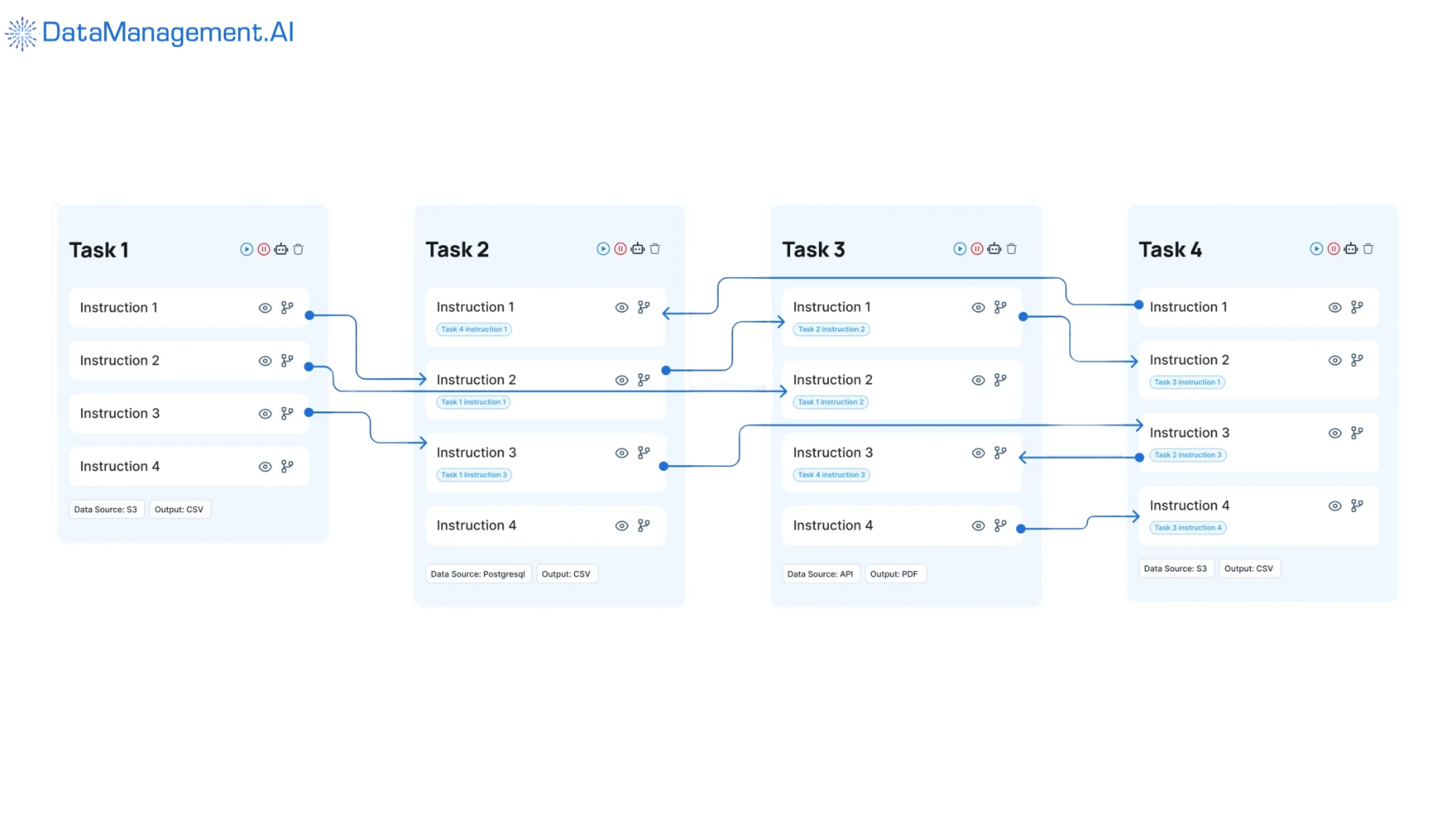
DataManagement.AI simplifies enterprise master data management with AI-powered automation. Our platform delivers three critical benefits:
- 10x Lower Implementation Costs – Our AI agents automate data quality workflows. You save 90% on deployment costs.
- 20x Faster Time to Value – Deploy in weeks, not years. Our intelligent agents learn your data patterns. They auto-configure governance rules and quality checks.
Real-Time Data Synchronization – Never work with stale data again. Our system maintains consistency across all connected applications. Updates propagate instantly.
Material Master Data Management
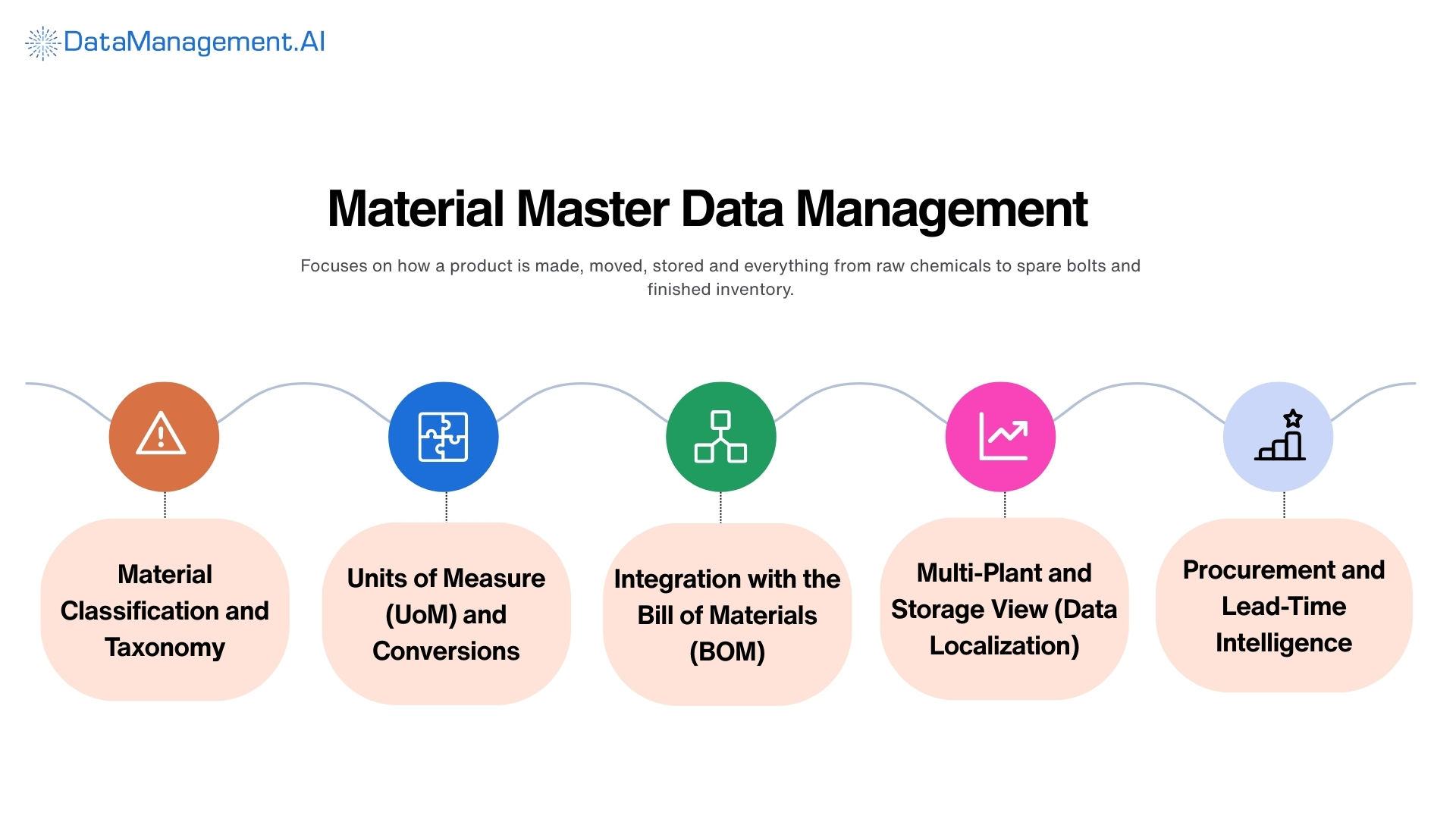
Material master data management optimizes the supply chain and procurement by eliminating duplicate part numbers and standardized descriptions.
This allows companies to aggregate their spending to negotiate better bulk-purchasing discounts and prevents production delays caused by missing stock that is actually in the system under a different name.
A quick material master data management use case that comes to mind is of Boeing, who managed 5 million parts through systematic material master data management.
Each 787 Dreamliner contains 2.3 million parts. One wrong part number?
Production halts. Costs skyrocket.
GDPR Master Data Management
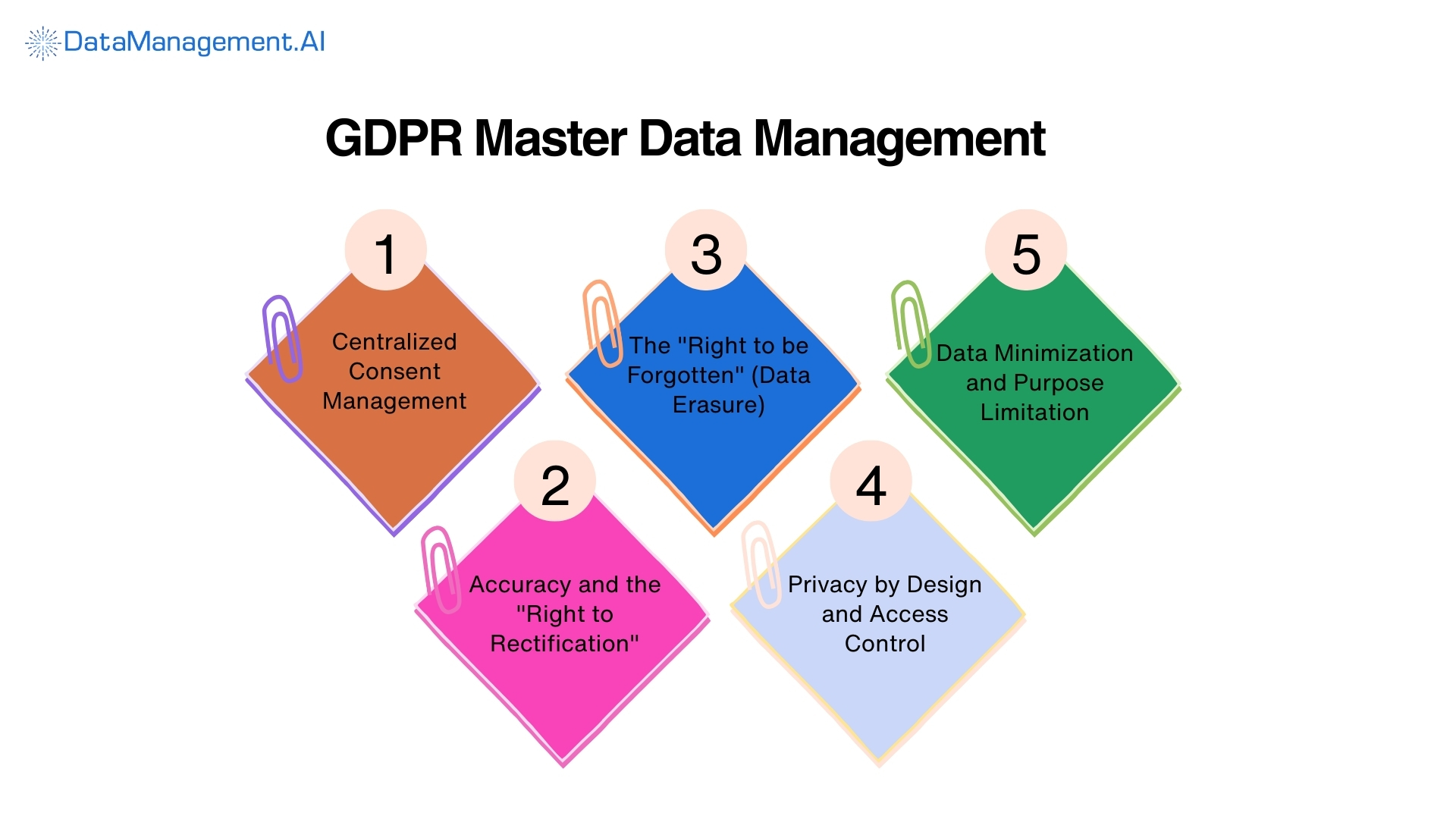
GDPR or General Data Protection Regulation is an European Union law that strengthens and harmonizes data privacy laws across the EU.
It gives individuals more control over their personal data, while imposing strict requirements on organizations that process this data.
GDPR master data management acts as a foundation for privacy compliance and ‘Right to be Forgotten’ requests.
By mapping every location where a customer’s personal data resides, your organization can instantly identify, export, or delete that data across the entire enterprise to meet strict legal deadlines.
Siemens implemented GDPR master data management across 200+ legal entities. They needed consent management for 400,000 customers.
Now, with GDPR master data management, Siemens tracks data lineage and consent across systems. Real-time compliance monitoring became a reality.
Siemen’s GDPR master data management use case by numbers:
- 100% GDPR consent tracking accuracy
- Zero data breach penalties since implementation
- 60% faster data subject access requests
Asset Master Data Management
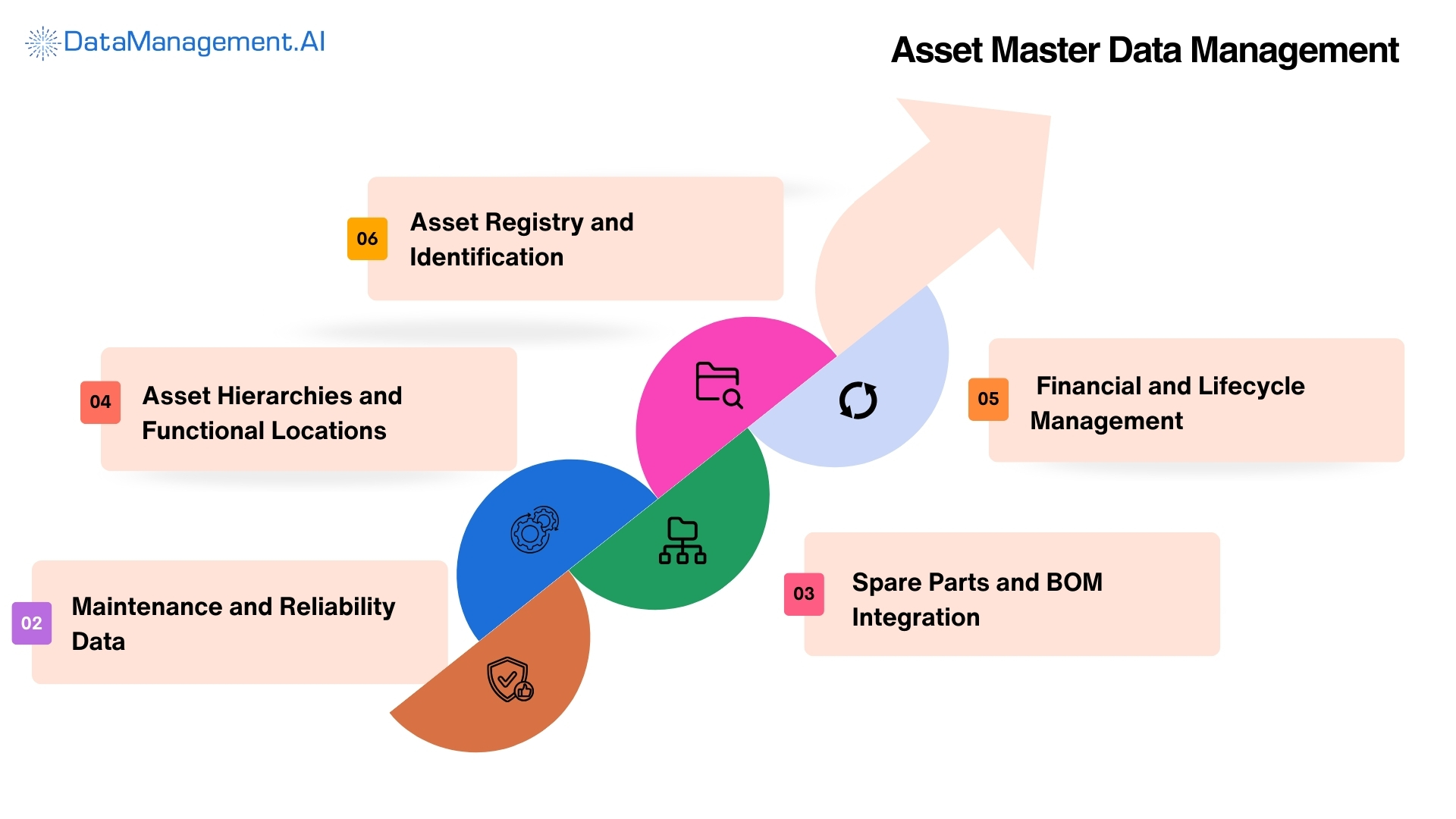
Asset master data management is critical for predictive maintenance and lifecycle management of physical infrastructure.
This includes manufacturing machinery or power grids.
By maintaining accurate data on asset location, age, and repair history, companies can reduce downtime and optimize capital expenditure.
A good use case of asset master data management is that of Shell.
Shell manages USD 80 billion in physical assets through asset master data management.
Their system tracks 50,000+ pieces of equipment across 90 countries. Maintenance scheduling and lifecycle management run on accurate asset data.
Shell’s asset master data management use case by numbers:
- 30% reduction in unplanned downtime
- USD 150 million annual maintenance optimization savings
- 25% extension of asset useful life
Multi Domain Master Data Management
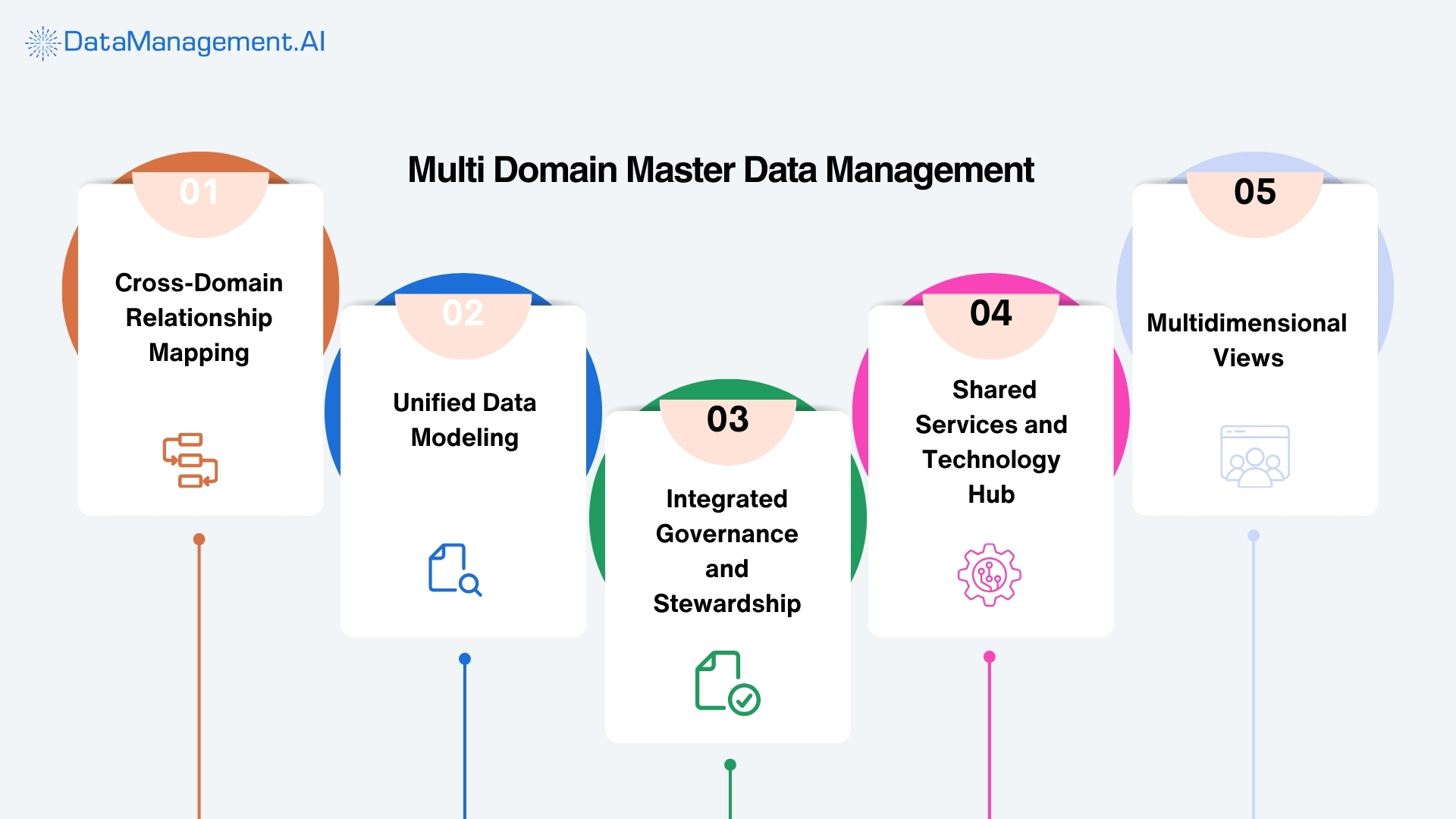
Multi domain master data management solves complex business problems.
They link different data types, such as connecting customer data to product data and location data.
This allows for advanced analytics, such as identifying which specific customer segments in a certain geographic region are buying a particular product line or driving highly targeted business strategy.
Coca-Cola implemented a multi domain master data management strategy in 2020. They unified customer, product, location, and supplier data.
One golden record for 200+ markets worldwide. Consistency across 4 critical domains.
Coca Cola’s multi domain master data management use case by numbers:
- 4 master data domains unified
- 85% reduction in data integration time
- USD 50 million saved in duplicate system maintenance
“Master data management is not a technology initiative. It’s a business transformation that requires executive commitment and cultural change.”
- Peter Aiken, Data Management Expert and Author
Commercial Pharma Master Data Management
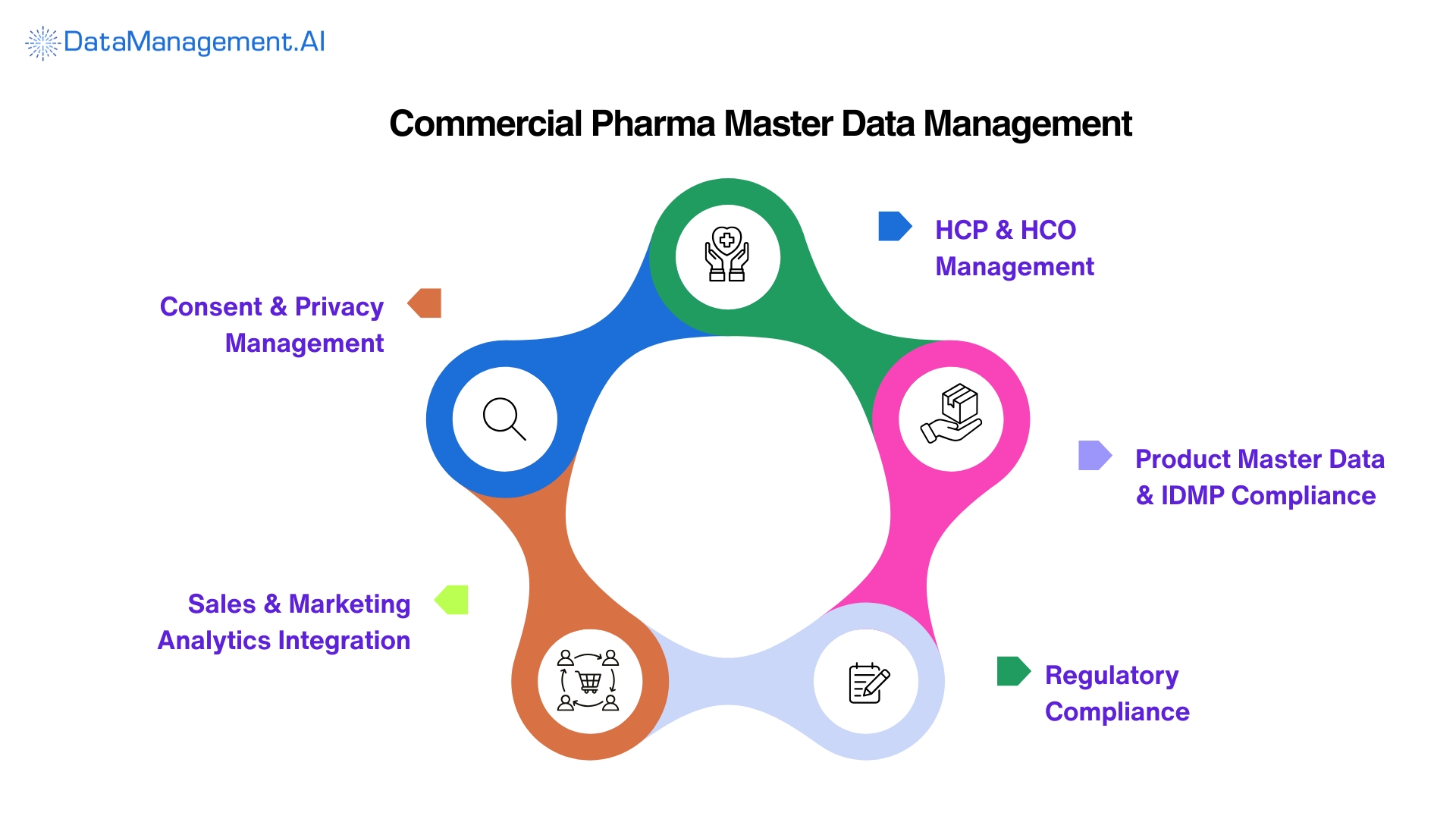
Commercial pharma master data management facilitates compliance and physician targeting by managing complex data on healthcare providers (HCPs) and organizations (HCOs).
It ensures that your sales teams follow Sunshine Act reporting requirements and that marketing efforts are directed toward the right specialists based on verified credentials.
Pfizer uses commercial pharma master data management for physician and HCP data.
They maintain accurate records for 800,000 healthcare professionals. This enables compliant sales and marketing operations.
Pfizer’s commercial pharma master data management use case by numbers:
- 800K HCP records with 98% accuracy
- 55% increase in sales rep productivity
- Zero compliance violations in data usage
Pega Master Data Management
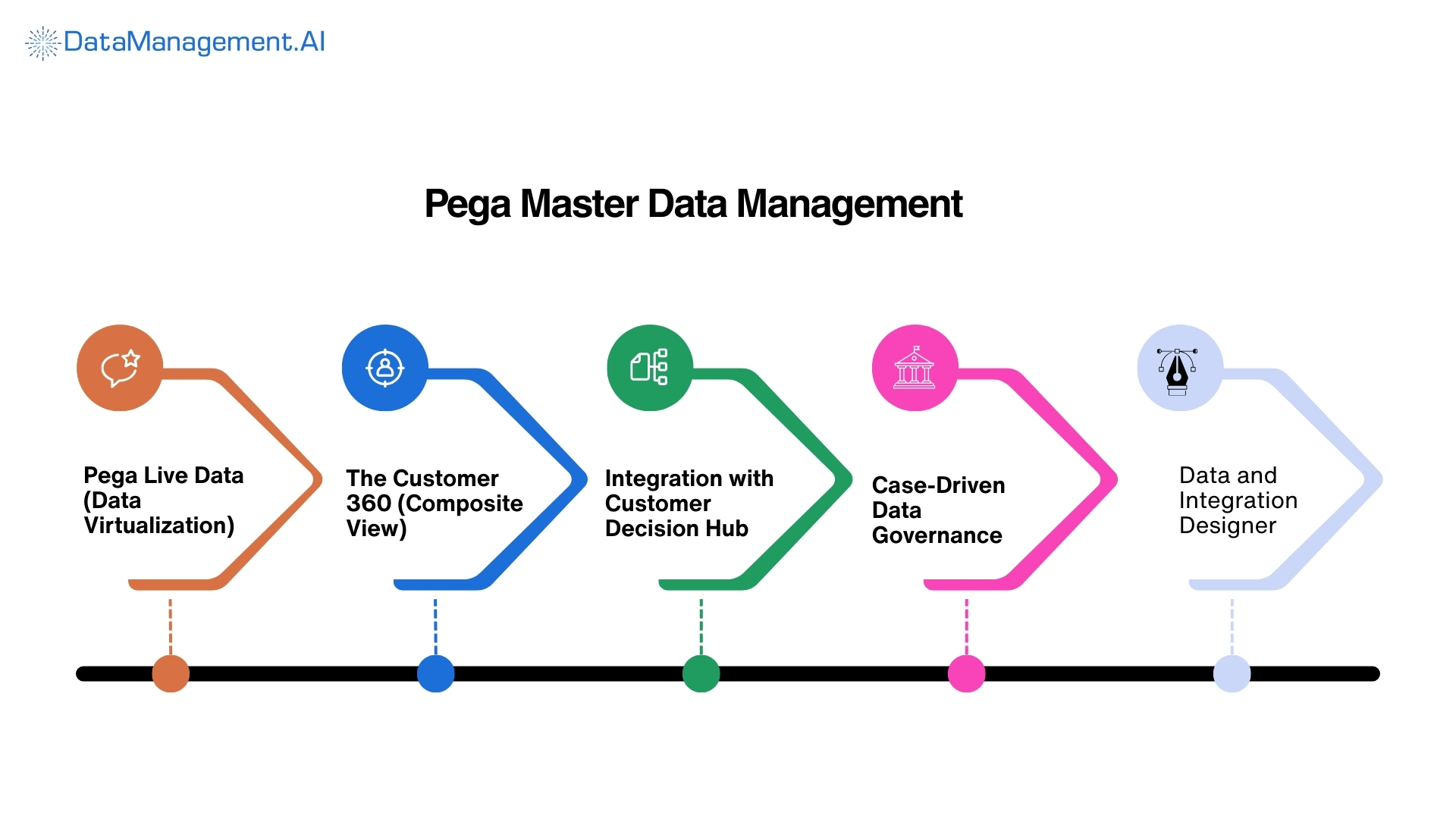
Pega master data management leverages intelligent case management and automation within the Pega ecosystem.
By feeding clean master data into Pega’s Next-Best-Action engine, your organization can trigger automated customer service workflows that are highly personalized and contextually aware.
T-Mobile leveraged pega master data management within their CRM ecosystem.
Pega’s platform integrates with their customer data hub. Real-time decisioning uses master customer profiles.
T-Mobile’s PEGA master data management use case by numbers:
- 40% improvement in next-best-action accuracy
- 28% increase in customer lifetime value
- 50% reduction in data latency
Time to choose an industry-agnostic data clarity
You’ve seen 12 real companies transform operations through master data management use cases.
British Airways, Mayo Clinic, Walmart, JPMorgan Chase…they’re not special. They just acted while competitors waited.
Your data won’t fix itself. Every day without proper master data management costs money.
Lost opportunities, compliance risks and frustrated customers.
But here’s the good news. Modern master data management isn’t the 3-year nightmare of the past.
With an AI-native MDM platform like DataManagement.AI, you can deploy in weeks.
Not years, not months, but weeks.
Schedule your demo with DataManagement.AI and see how our intelligent agents can transform your master data in 4-6 weeks. Not 4-6 months.