




As a retailer, your worst nightmare would be if a loyal customer gets treated like a stranger because your system failed to recognize them.
This is a classic example of having bad customer data in your system.
Oh, and it’s never just one customer!! Bad data is like a pandemic.
Data proves that companies lose up to 20% of their revenue every year because of this.
This is why having Customer Master Data is now a requirement.
It isn’t just about having the right info like names, emails, addresses, etc. Having master data is like having a foundation that connects every customer interaction with the brand, whether during marketing campaigns or support calls.
To protect this foundation from falling apart, every company should invest in Customer Master Data Management.
Today, I’ll tell you how to get there, what best practices to maintain, and what mistakes to avoid. Let’s start!
So what we gather is that having master data management tools integrated into your workflow is important, but having customer master data management solutions is more important.
What, why, and how, let’s delve into it!
What is Customer Master Data Management?
Customer Master Data is the core and unchangeable information that helps every system recognize a customer in a particular way. It’s an official record, and it has to stay accurate and consistent across every platform.
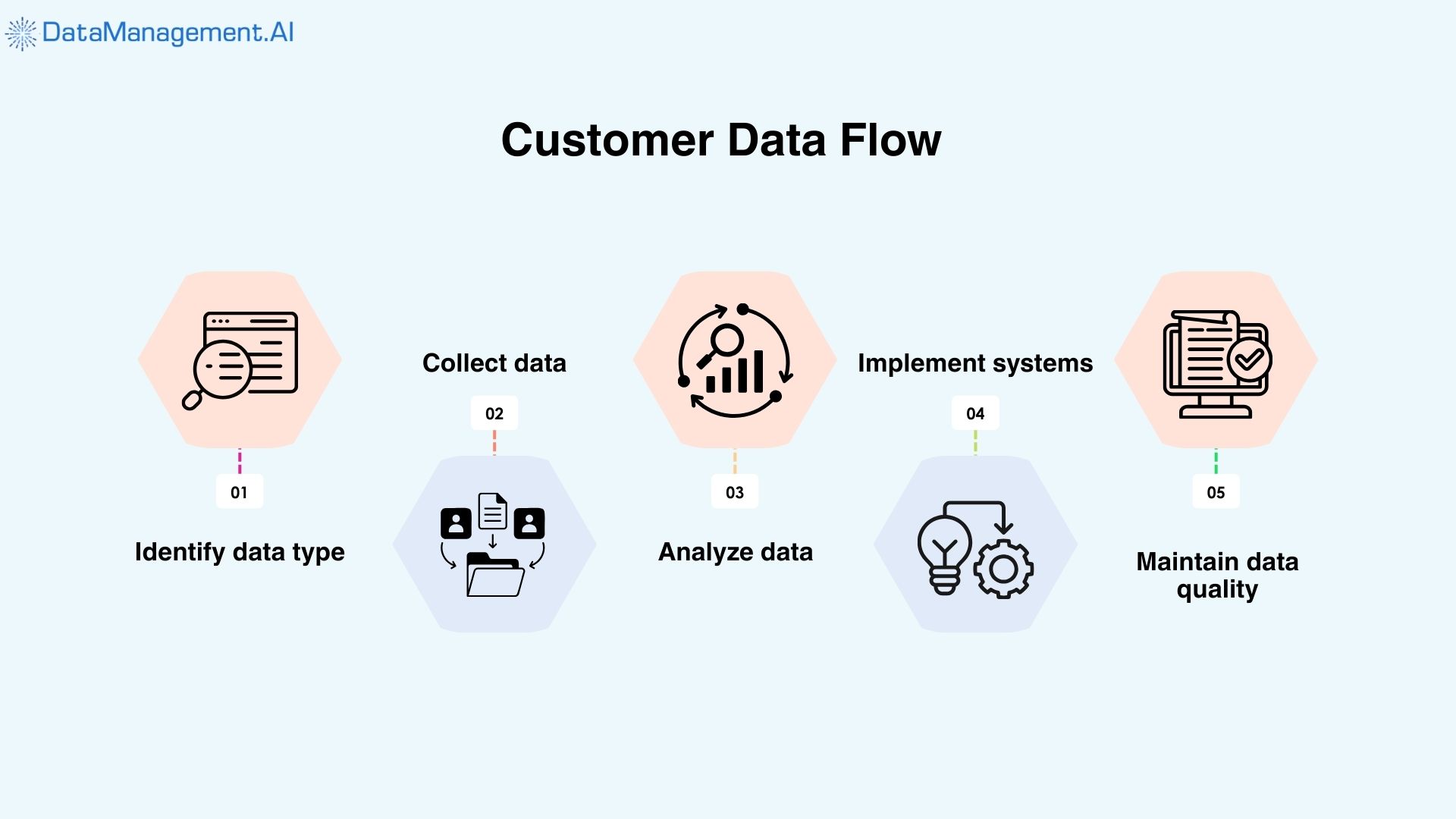
But, instead of directly diving into “mastering” your customer data, you should first know what kind of data we are about to deal with.
You may think that all the data about your customer is the same, but no, it’s not. There are different kinds of data, like behavioral, attitudinal, identity, and descriptive data.
Behavioral data includes the customers’ interactions with the brand, like their purchase history, website visits, and communication with support teams.
Attitudinal data explains the ‘why’ behind the behavioral data. A look at it would give you an idea about why a particular customer chose a specific variant of a product.
Identity data is the one that captures all the basic info about customers, like their name, address, phone number, etc.
Lastly, descriptive data contains a bigger picture of the customer, like their demographics via their location, or their lifestyle via their age, gender, etc.
Now, the bigger question arises. If there’s a clear definition and demarcation of the different kinds of data, why do they need to be managed, or why is there a need for a master data, while the chances for overlapping look slim?
I have already addressed the 2nd question above.
Now, the 1st question.
Benefits of Customer Master Data Management
As a founder, you should understand that bad data not only looks bad, but it also costs you money and reputation.
Here are some more reasons why CMDM is needed.
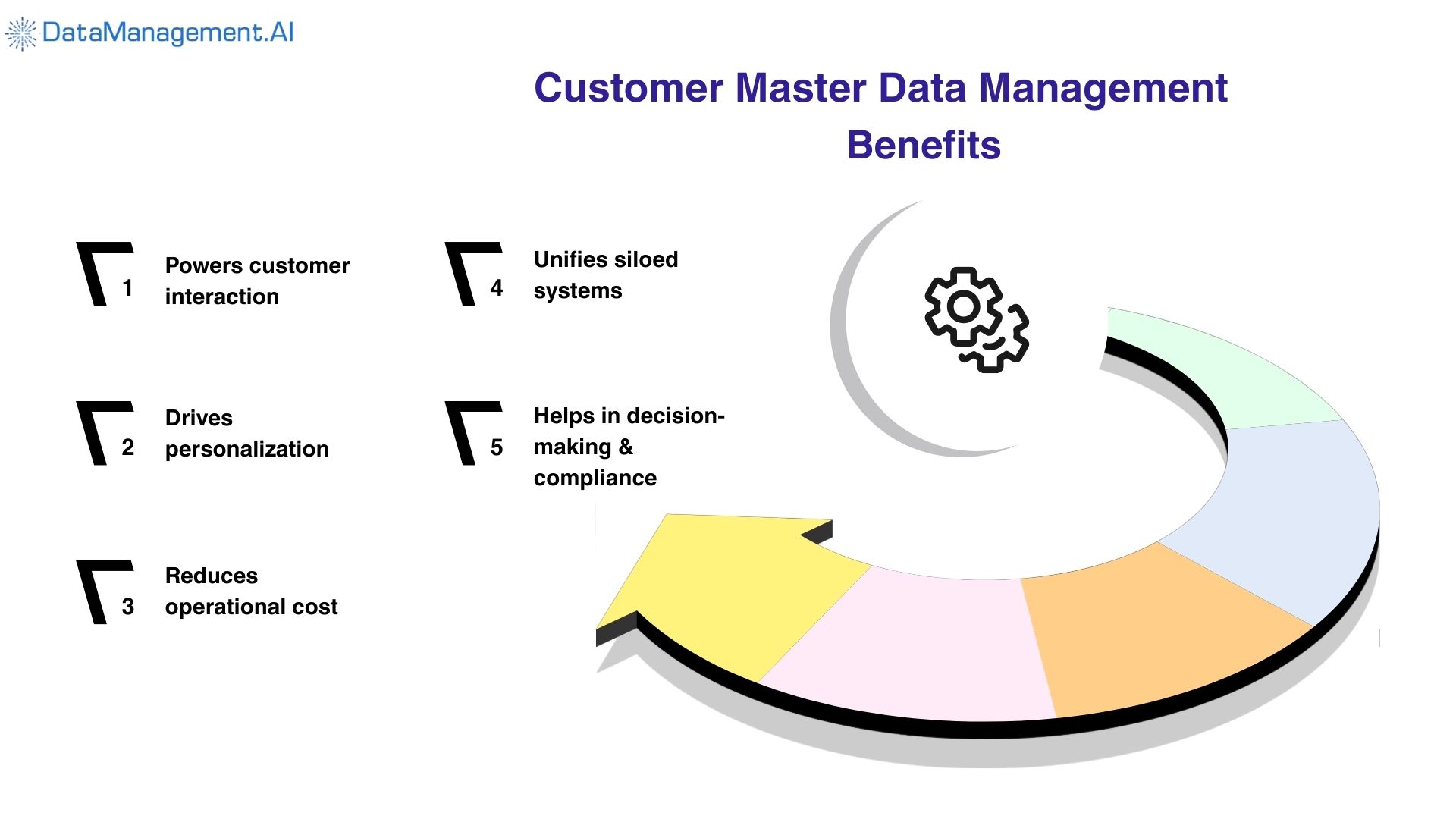
It powers customer interaction
Every campaign you run, invoice you print, delivery you make, or support ticket you resolve depends on customer data. If and when that data is wrong, everything downstream gets wrecked too.
This leads to wrong deliveries, failed payments, duplicate emails, and eventually loss of customer trust.
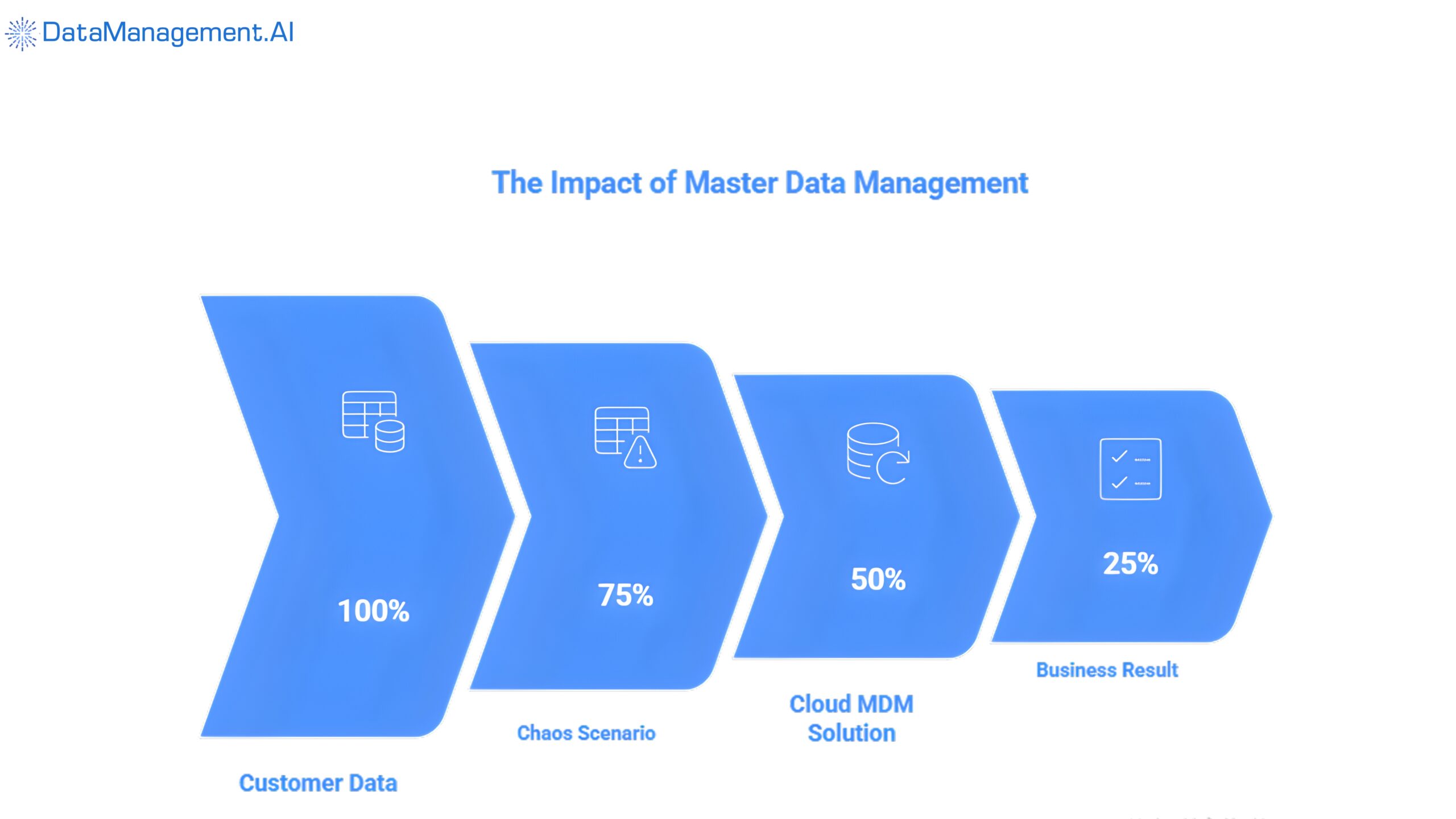
But, if you have a cloud master data management solution in place, there will be no scattered data or missing info, and customer preferences won’t also change once the data moves from one system to another.
It drives personalization
In this era, an app or website is boring if it’s not showing personalized recommendations.
One of the best ways to do so is by having proper customer master data management solutions in place. These tools will remember past purchases, saved items, and other interactions.
Without it, your marketing tools will literally have no context, only data that’s now useless.
It reduces operational cost
Poor data quality is eating up more than 25% of some companies’ operational budget.
Let me quickly explain how:
So, duplicate entries lead to unnecessary campaigns. Then, billing errors lead to payment delays or failures. Oh, and lastly, one wrong entry would cost someone their entire day, during which they were supposed to focus on something more important.
But all this can be avoided if you have a Customer Master Data Management tool in place; all this can be taken care of automatically by your systems.
It unifies siloed systems
Businesses are meant to grow, and when they do, layers of tools get added. First, you get a CRM, then a marketing platform, then a billing software, then a supporting portal, and many more.
Now, if each of these platforms has a separate version of the same data, the final outcome would be ruined.
A Customer Master Data Management platform would act as a glue and would keep all these platforms synchronized, so that the data looks the same everywhere.
It helps in decision-making
A customer master data management tool ensures every report is built on accurate, consistent customer data, so leaders can trust the numbers they use for strategy.
When customer details differ across systems (like mismatched IDs or outdated profiles), metrics such as churn, CLV, or retention become unreliable. CMDM fixes this by creating one clean customer record.
It protects the brand’s trust and compliance
Customer Master Data Management tools keep customer data organized and traceable, essential for proving compliance and staying trusted under strict privacy laws.
When data is scattered across systems, it’s nearly impossible to show where it came from, who accessed it, or whether consent rules were followed. That weakens audit readiness, breaks transparency, and risks both regulatory penalties and customer trust.
Now, let’s go through the key practices of Customer Master Data Management.
Best practices for Customer Master Data Management
Leading organizations are doing one thing right. They’re managing their customer master data the right way: consistently, securely, and at scale. Here’s how:
Implement data governance processes
A good data governance system should define ownership, standards, and workflows for how data is created, modified, and shared. So, it’s not just about assigning responsibilities; it’s about giving your teams visibility and control.
Here’s what that usually looks like in practice:
- Data ownership: Every field in your customer record should have an owner who will be responsible for its accuracy, updates, and usage.
- Standardization: There should be set naming conventions, formatting rules, and validation logic for all customer data fields across systems. So, there will be no more “Keony Clerk” in one system and “Cleark, Keanu” in another.
- Workflow clarity: It should be defined what happens when there are data conflicts between systems. “Which platform takes priority?” “Who approves the overrides?” – There should be no confusion with questions like these.
- Regular audits: There should be regular reviews of how policies are applied as new tools, regulations, and data types are added to the system.
But a challenge still exists. And its visibility.
Most companies don’t know where their customer data actually goes once it enters the system. It passes through ETL pipelines, transformations, APIs, and reports, and tracking that manually is almost impossible.
That’s why DataManagement.AI exists.
Its ‘Data Lineage & Governance’ feature makes it easy to trace every data element from origin to consumption.
It automatically:
- Retrieves metadata from ETL pipelines and job schedules
- Fetches transformation logic (SQL queries, scripts) for each processing step
- Tracks schema changes and version histories
- Captures data access logs like who viewed what, when, and from which table
- Pulls business rules and classification labels into one visual dashboard
It then gives a navigable lineage graph that shows how each customer field flows across systems.
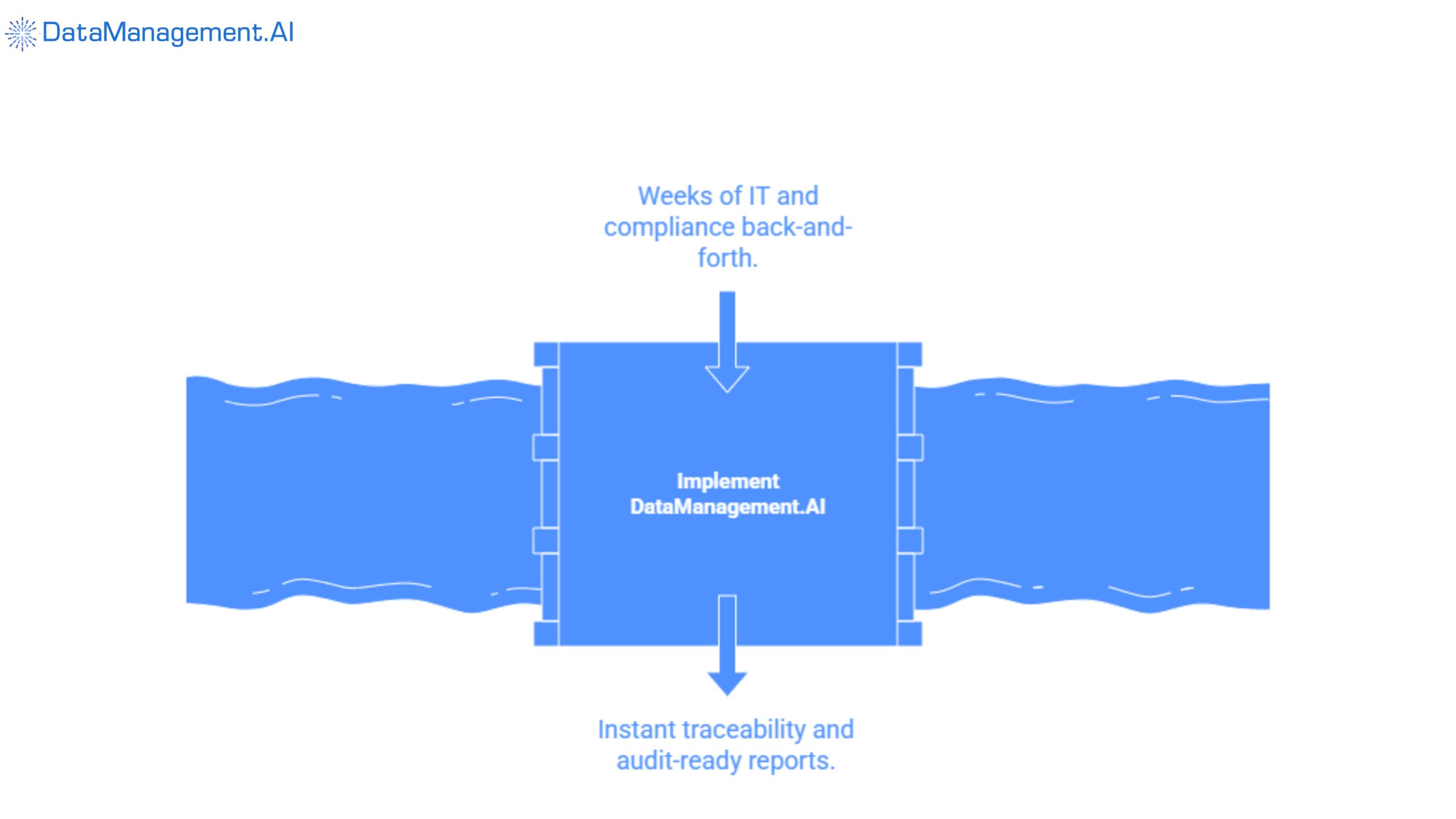
This way, governance reports are generated instantly, making audits faster and compliance processes easier.
Compared to the traditional approach that takes weeks or months of back-and-forth between IT and compliance teams, DataManagement.AI’s lineage approach gives you instant traceability, visibility, and faster impact.
Regularly maintain and update customer data
Every customer’s data has an expiry date, but most teams realize this when their operations are affected.
Outdated customer data means invoices go to wrong addresses, marketing emails bounce, and sales reps waste time calling numbers that are no longer in use.
To prevent that, you can:
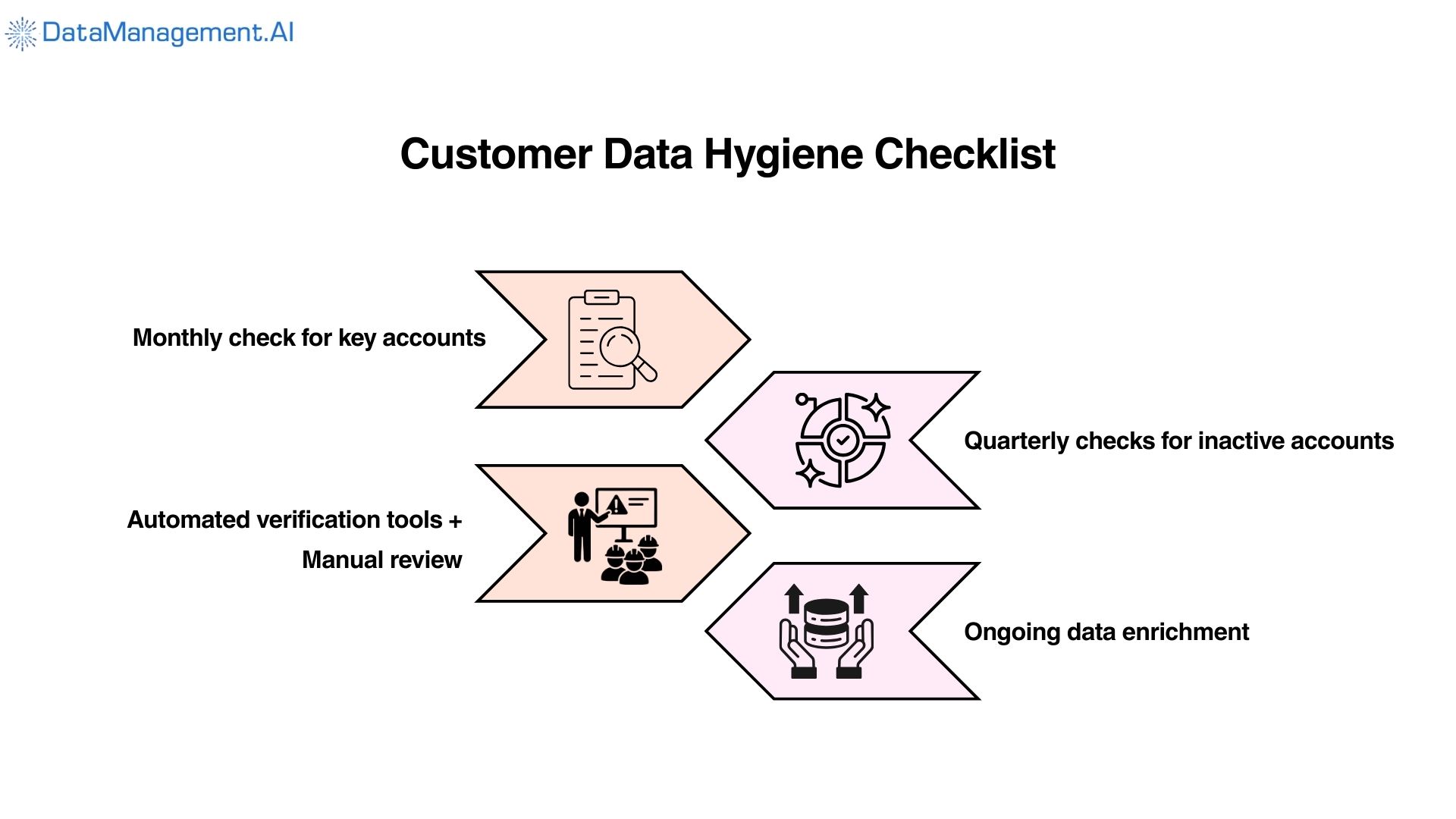
- Set update schedules: Run regular data hygiene checks (monthly for important accounts, and quarterly for inactive ones).
- Automate updates: Use tools like DataManagement.AI that verify addresses, phone numbers, and domain changes automatically.
- Remove duplicates: Duplicates should be your biggest enemy. They create confusion, skew analytics, and are really frustrating to fix. Deduplication tools can help, but you should combine them with manual review for important accounts.
- Keep data enrichment active: Integrate with third-party sources that can enrich customer profiles with industry, revenue, or hierarchy data.
In short, regular maintenance is the only thing that can keep your customer insights usable and your systems aligned.
Ensure data security and privacy
Customer master data management strengthens data security, helping you protect trust and avoid compliance or breach risks.
Customer information is sensitive, and mishandling it breaks trust fast. Survey shows 87% of customers walk away if they feel unsafe.
So, with breaches now averaging $4.88 million, data protection can’t sit with just IT.
Here’s what a solid data security and privacy foundation looks like in practice:
- Encryption: Every piece of customer data, whether it’s stored in databases or transmitted between systems, should be encrypted end to end. Yes, like WhatsApp.
- Access control: There should be restricted access to customer master records based on role. Not everyone in your company needs to view, edit, or export every sensitive data. This is why data ownership is needed.
- Security audits: There should be regular internal and third-party audits to uncover vulnerabilities before attackers do.
- Compliance readiness: There should be no compromise in compliance with laws like GDPR, CCPA, and India’s Digital Personal Data Protection Act.
Integrate customer data with other systems
We all know that data is supposed to flow. So, customer data also doesn’t live in one place.
It’s spread across CRM, ERP, marketing tools, billing systems, and support platforms. If those systems are not aligned or synchronized with each other, you’ll never get a full view of your customer’s profile.
| For example: 1) A salesperson viewing an account in CRM should see the customer’s last invoice from ERP. 2) The marketing team should know if a customer has just opened a support ticket, so they don’t send a “rate your experience” email too soon. 3) And, the finance department should automatically get updated billing addresses from the CRM, and should not have to fetch them manually. So, when systems are integrated, error rates drop, teams collaborate better, financial, annual, or other reports become more accurate, and customer interactions can be easily personalized. |
Here are some ways to make this integration sustainable:
- You can use APIs instead of manual uploads.
- You should establish data mapping rules so that all fields match correctly across platforms.
- You should monitor sync logs to catch mismatches before they mess up the entire system.
Implement data lineage and auditing
Do you remember I mentioned that DataManagement.AI creates a “navigable lineage graph that shows how each customer field flows across systems?”
Here we will talk about why that is important.
Data lineage tells you where the data is coming from. Is it from CRM? The customer data spreadsheet you have, or a legacy system.
That clarity is what we call data lineage.
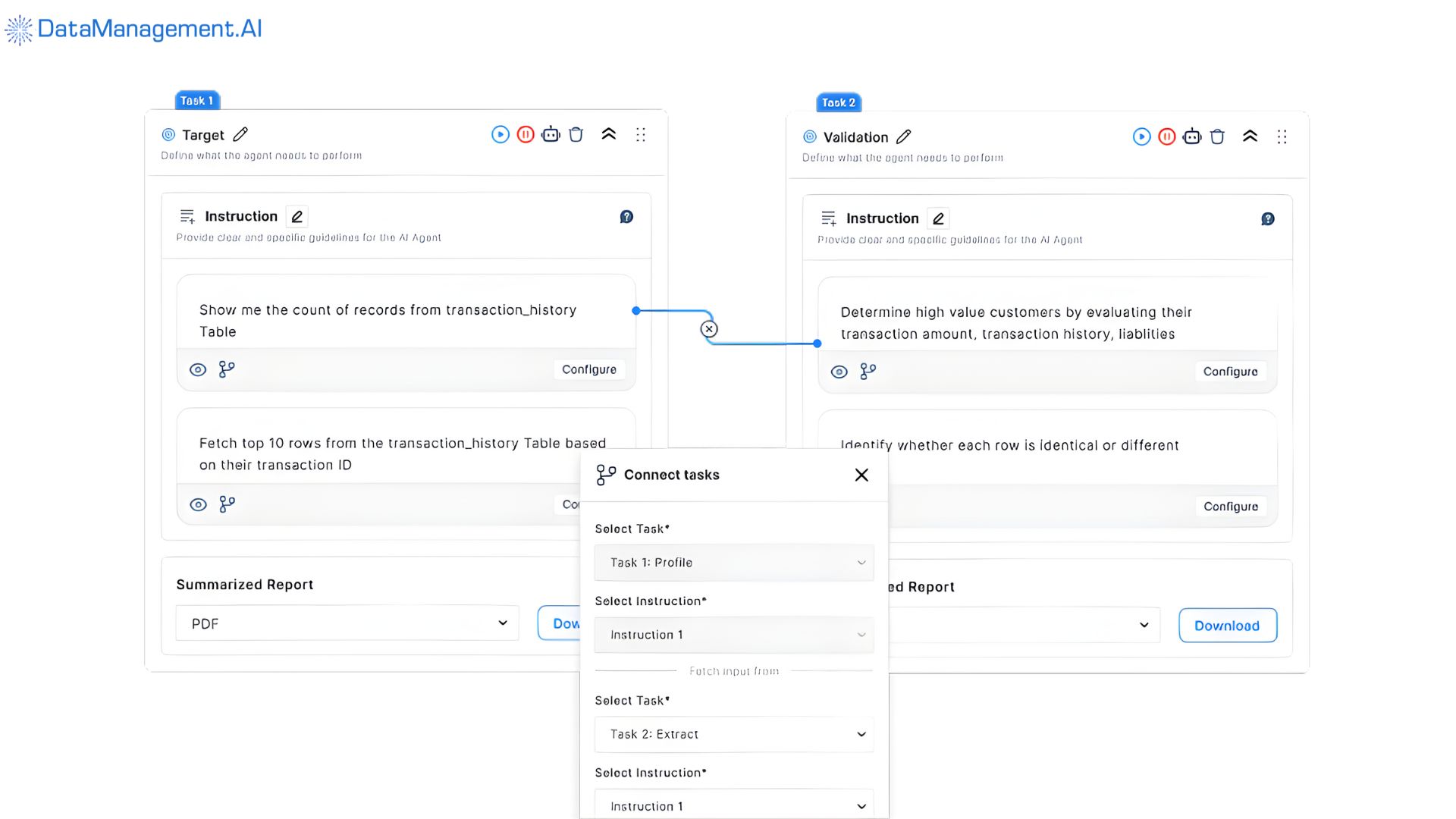
A lineage system tracks the full journey of every data point, like where it originated, how it’s been modified, and who changed it. This level of visibility is crucial when errors appear or compliance checks happen.
But then why do we need regular audits if there’s full visibility?
The thing is, auditing complements lineage by keeping an activity log. This is where it’s revealed who viewed, added, or deleted data. So, this helps maintain accountability along with transparency.
Provide self-service capabilities for customers
Self-service data management gives customers the ability to update their information, like addresses, phone numbers, and payment preferences, without needing to go through support or account managers.
Okay, this may sound insane, but one of the best and most underrated ways to maintain accurate customer data is to let customers do it themselves. I mean, they’ll obviously not mess it up.
But why do you need it at all?
- It improves data accuracy: Customers are most likely to keep their details current when they control them directly, so you won’t have to double-check.
- The support team’s workload drops: They get fewer “update my email” tickets, which can honestly be frustrating and really boring for anyone.
- It enhances customer experience: People like to be in control of their profiles. Oh, and it is also a quick, easy way to create a sense of transparency.
And, what can you do to make this self-service feature work well?
- Keep interfaces simple and mobile-friendly.
- Add validation checks to prevent incorrect inputs.
- Sync updates instantly across systems so every department stays aligned.
This approach works especially well for subscription-based or e-commerce businesses, where personal details often change. It’s one of those small operational shifts that many may miss, but it will bring long-term accuracy.
Regularly evaluate and improve your management processes
Your business, your customers, and your systems never stay the same, and if your CMDM doesn’t evolve with them, your data will slowly drift out of sync.
That alone is the biggest reason continuous improvement matters.
Here are a few ways to stay sharp about this:
- Conduct internal audits: You should regularly review how data flows across systems and identify bottlenecks.
- Seek stakeholder feedback: Your sales or support teams often spot inconsistencies before analytics teams do, so be in touch with them more.
- Use analytics: You should measure KPIs like data accuracy, duplicate rate, and update frequency more regularly than you are right now.
- Stay updated with industry trends: Data laws and technologies change overnight. So, every team and leader of your company should keep themselves updated.
- Test improvements in pilots: Lastly, before overhauling your system, you should test small fixes in a controlled environment to cut operation costs.
Common pitfalls & fixes
Let’s debunk the myth – “CMDM is the shortcut to success.”
No, even the most well-maintained Customer Master Data Management (CMDM) projects can fail.
And it’s almost never because of technology, but because of people and their priorities.
In my experience, these two mistakes show up repeatedly:
Overcentralizing without buy-in
Overcentralizing happens when one team tries to control every customer data decision without involving the people who actually use that data every day.
This idea may sound logical that as there is one system, there should be a single version of truth as well.
But in reality, when sales, marketing, or customer success teams aren’t part of that decision-making process, they end up distrusting or bypassing the system altogether.
So, these also can lead to silos – it’s just that they’ll now be more disguised.
The fix is simple.
Involve every stakeholder early, not just in design, but in defining what “clean data” means for their workflows. Let them shape governance rules, validation logic, and even interface design.
This will help them learn to take ownership.
Then comes…
Ignoring edge channels
It is the leak in every MDM strategy that anyone barely notices.
Edge channels usually include chatbots, partner portals, in-store systems, and third-party integrations that also capture customer data but often sit outside the main governance scope. If these aren’t synchronized, your “master” data will also get messy quickly.
The fix is to build connectors or validation checks for every data-entry point, no matter how small. Every channel that contains customer information should feed into, or validate against, your master data model.
Also, both pitfalls have one thing in common: they stem from a lack of visibility. You can’t fix what you can’t see.
How to fix this?
That’s where you need DataManagement.AI. Its lineage tracking, governance dashboards, and multi-system connectors give you visibility into every data touchpoint from core CRMs to overlooked edge systems.
You can trace, audit, and align data without micromanaging teams or workflows.
Ready to see what that looks like in action?
Schedule a free demo with DataManagement.AI and discover how your customer data can finally work with you, not against you.
FAQs
- How does CMDM differ from CRM?
CRM helps a team manage customer interactions, sales leads, and communication, while CMDM makes sure customer data is accurate, standardized, and consistent across systems.
- What is the difference between customer master data management software and CDP?
Marketing teams primarily use a customer data platform (CDP) to track customer behavior in real time and personalize campaigns.
But the whole team can use a customer data platform (CDP). It helps to keep data consistent across teams like finance, operations, supply chain, etc.
- What is the primary role of the customer master data team?
Their role is to create and maintain a single, accurate source of truth about customers. They make sure that every customer has one consistent profile with correct IDs, contact details, etc., across all systems and departments.
- How often should you audit customer data?
To give you an idea, every data point decays at a rate of 25% every year, so you should conduct regular audits and continuous monitoring.
- What are the top three benefits of CMDM?
The top three benefits include personalization, efficiency, and risk mitigation.