




Here’s a story that will change how you think about data strategy.
Takeda Pharmaceutical moved close to 96% of their data onto the cloud.
This wasn’t some impulsive tech upgrade. They projected a 40% productivity gain and nailed it.
But here’s what made it work. They consolidated 10 separate MDM systems onto a unified platform.
Sounds straightforward, right?
Wrong.
The true secret to success lies not just in managing master data, but in understanding the crucial difference between reference data and master data management (MDM).
Most organizations fail by confusing these two domains, leading to costly broken analytics and failed integrations. Ignoring the distinction between reference data and MDM creates systemic risks that affect every data process.
Reference data and master data are distinct yet interdependent. Treating them identically guarantees failure. When you understand how they work together, you unlock enterprise-wide consistency.
Grasping this separation is fundamental to mitigating risks and positively impacting your bottom line.
Today, I’ll break down exactly what separates them and why it matters for your bottom. Let’s dig in!
Reference Data vs Master Data
Understanding the difference between Reference Data and Master Data is critical for effective data management and integration.
While both are essential, they serve distinct functions within an organization’s data ecosystem.
Master data represents the core, non-transactional entities fundamental to the business operation. These are the unique nouns of the enterprise, such as Customer, Product, Employee, Asset, and Supplier.
Master Data is complex. It often changes over time (e.g. a customer’s address or a product’s price), and requires a robust master data management (MDM) strategy to ensure consistency and accuracy across all systems.
Master data must be reconciled and consolidated to create a single, trusted view of a core business entity.
Reference data provides the set of values used to classify, categorize, or standardize other data fields. It acts as the necessary vocabulary for the organization.
Examples here include country codes, currency codes, units of measure (UOM), standard industry codes (SIC), and calendar/date standards.
Reference data is typically more static and has high stability. Its primary function is to enable interoperability and provide context, ensuring that different systems interpret category fields consistently.
In essence, Master Data references the standardized values defined by Reference Data. Treating these two domains the same leads to systemic data inconsistencies, breaking analytics and integration projects.
Effective governance requires addressing both distinct domains to achieve true enterprise data integrity.
I will talk about both of these data types separately, including showing you a common unified pillar that blends both frameworks efficiently.
What is Reference Data Management?
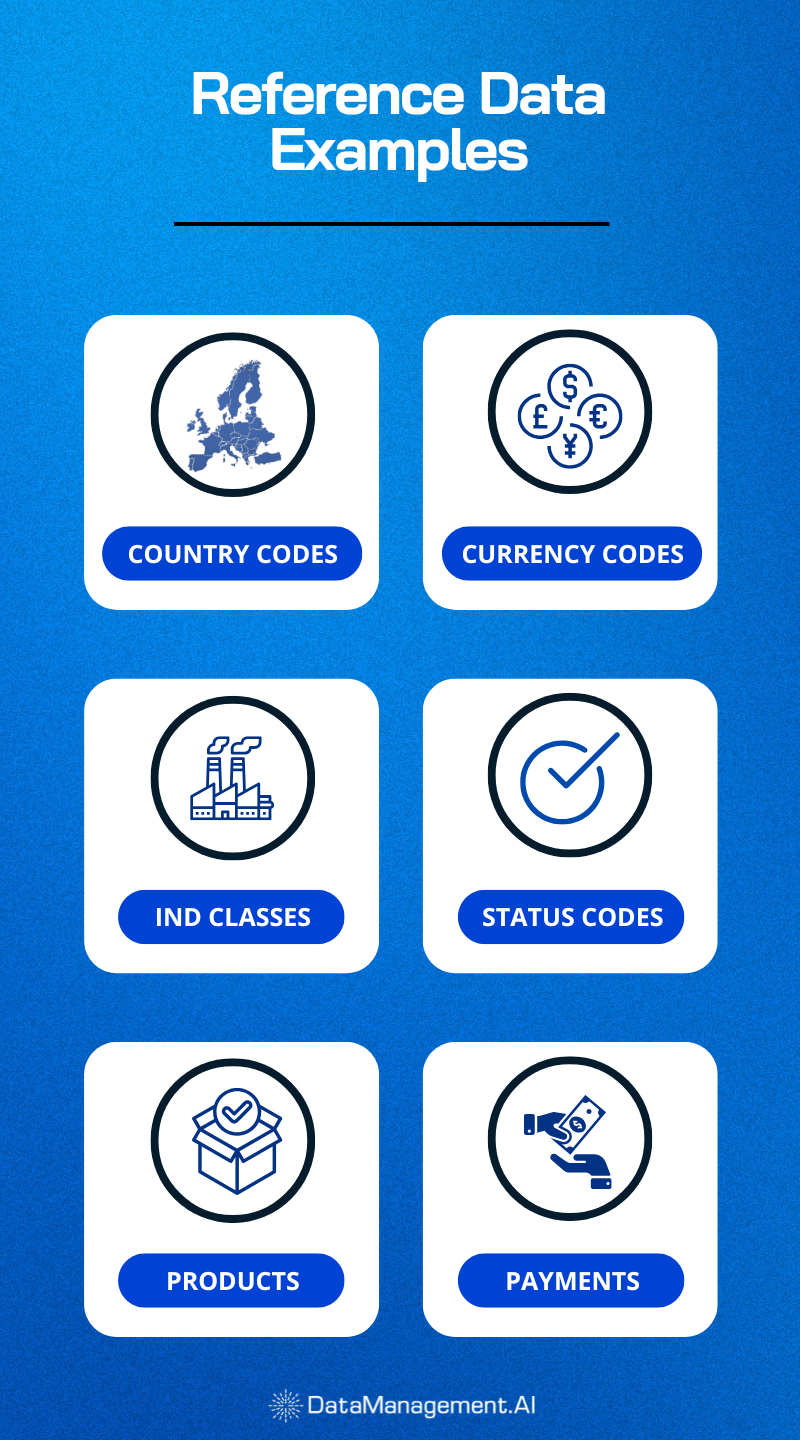
Reference data defines how you classify your information. The discipline of managing and governing this information is reference data management.
The information here could include employee job codes, product categories, currency codes, units of measure, and country codes etc,
The goal of reference master data management is to ensure accuracy and consistency across your apps and systems.
When all your systems use the same, governed set of reference values, let’s call it ‘golden record’, it eliminates errors, ensures regulatory compliance, and improves data quality.
Master reference data management involves centralized stewardship, mapping capabilities, and versioning control to harmonize codes across various systems.
Reference data remains stable over time. It provides the framework for categorising master data. For example, country codes.
ISO 3166-1 defines these standards. They change only 3-5 times yearly on average.
Core components of Reference Data Management
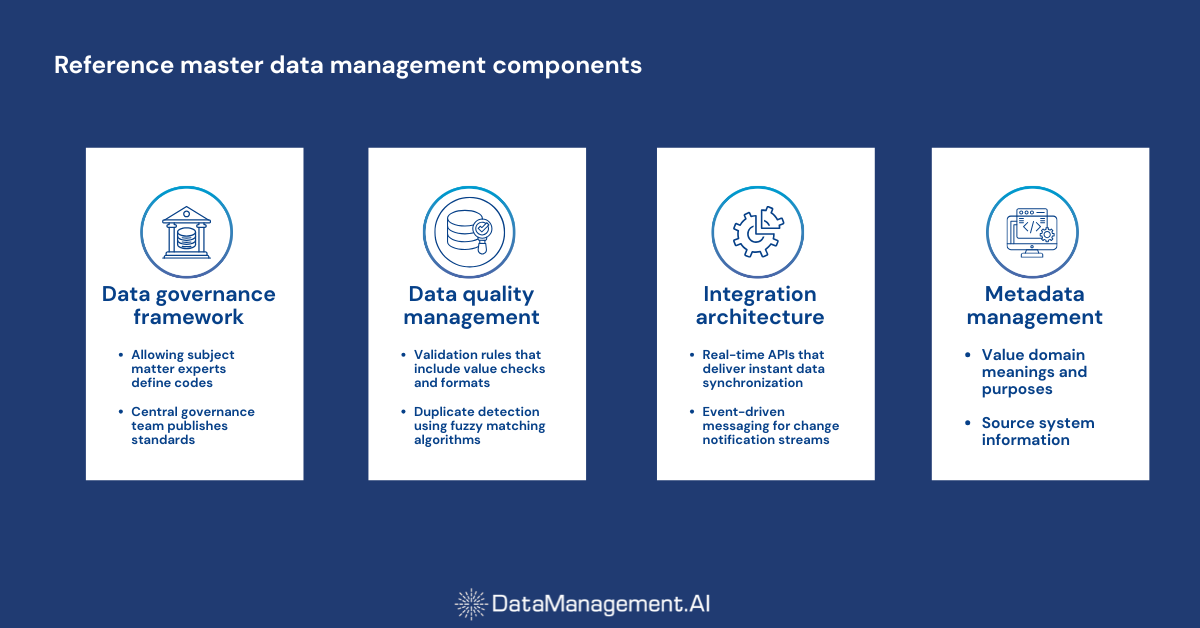
The following are the core components of reference master data management which are essential in understanding how to store or classify your data.
Data Governance Framework
Strong data governance defines ownership and change control processes. Without this, your reference master data management fails.
Reference master data management helps build a data governance framework by:
- Allowing subject matter experts define codes
- Central governance team publishes standards
- Change advisory boards review modifications
- Version control tracks all updates
Likewise, for master data exclusively, data governance frameworks are helped by:
- Business stakeholders owning domain definitions
- IT guys maintaining the technical infrastructure
- Data stewards approve changes
- Automated workflows route approvals
Data Quality Management
Quality management ensures accuracy across all data types. Quality processes here include:
- Validation rules that include value checks and formats
- Duplicate detection using fuzzy matching algorithms
- Completeness checks that require additional field enforcement
- Consistency verification that’s obtained via cross-system validation
Integration Architecture
Reference master data management set up an integration architecture that connects all enterprise systems. Modern architectures use:
- Real-time APIs that deliver instant data synchronization
- Event-driven messaging for change notification streams
- Service-oriented design that’s perfect for reusable integration services
- Cloud-native platforms for elastic scalability
Metadata Management
Metadata provides context for both reference data and master data. For reference data, metadata documents:
- Value domain meanings and purposes
- Source system information
- Version and update history
- Business ownership details
- Usage analytics
- Entity relationship mappings
What is Master Data Management?
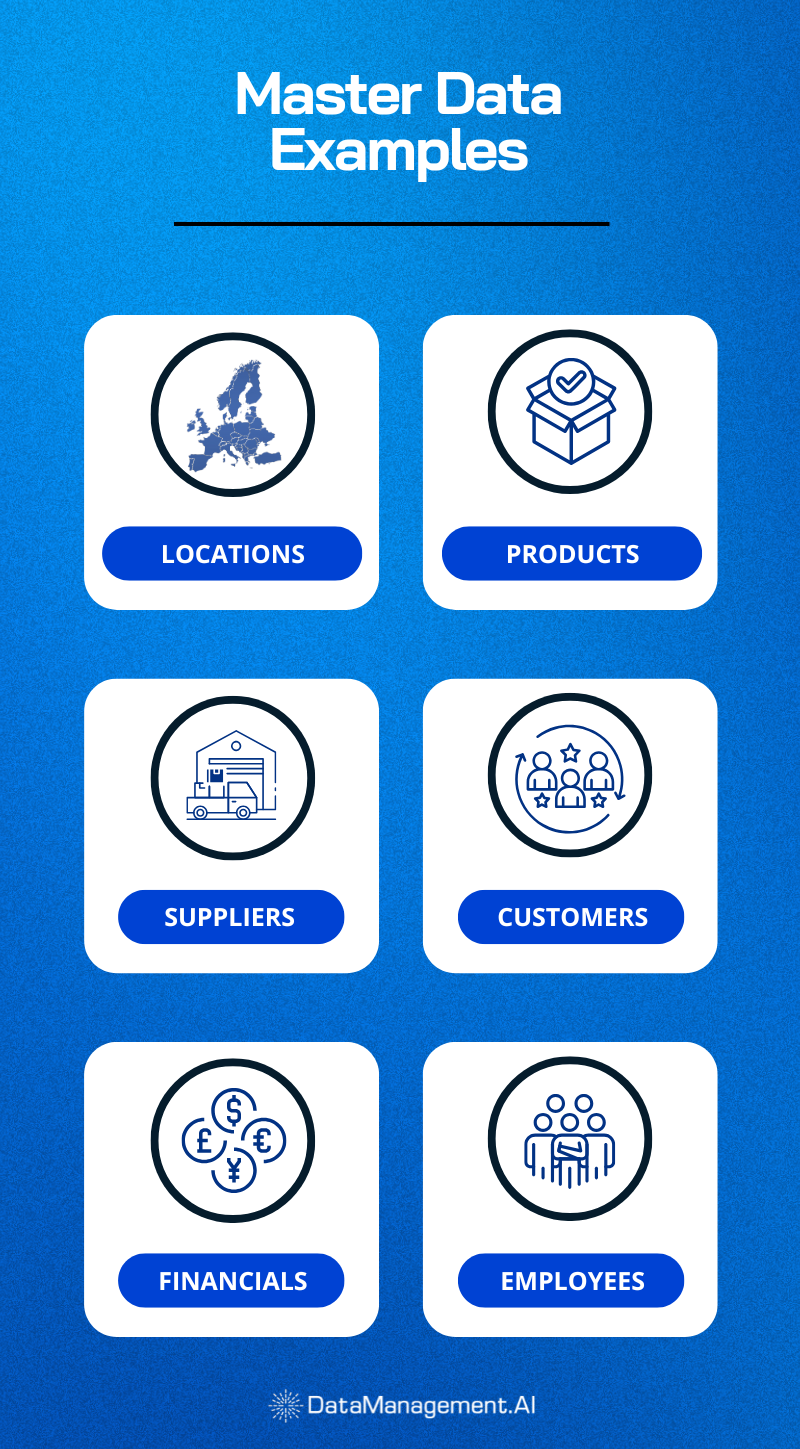
Master Data Management (MDM) creates a single source of truth for your critical business entities.
Modern master data management tools help unify and govern products, customers, suppliers, and employees across disconnected systems, ensuring every team works from consistent, trusted data.
Master data represents your core business objects that frequently change based on your business needs. Master data usually includes:
- Locations – Office addresses or distribution centers
- Products – Specifications, pricing, and inventory levels
- Suppliers – Performance metrics and contract terms
- Customers – Profiles, preferences, and transaction history
- Financials – Account hierarchies and cost centers
- Employees – Roles, compensations, performance data
Core components of Master Data Management
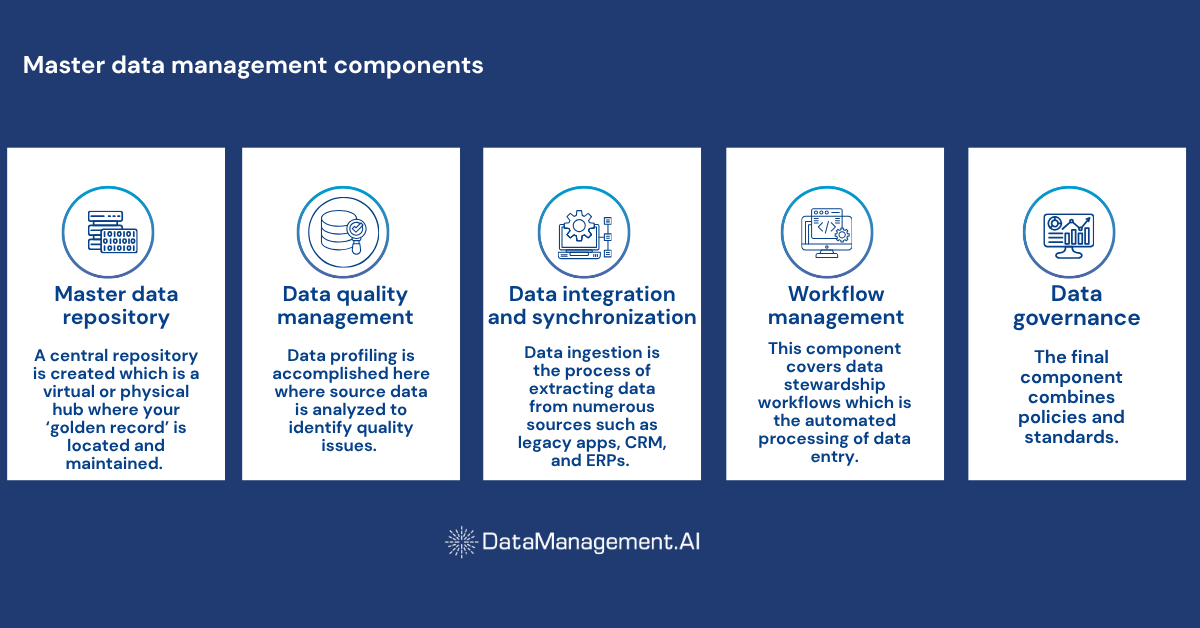
Master data repository/modeling
This component of master data management focuses on designing a canonical and structured model that represents the master data entities (such as supplier, product, or customer) and their relationships in a way that is standard across your enterprise.
A central repository is created which is a virtual or physical hub where your ‘golden record’ is located and maintained.
Data quality management
Data profiling is accomplished here where source data is analyzed to identify quality issues.
Matching and linking is accomplished using algorithms (probabilistic or deterministic) to compare records from disparate source systems.
Merging and survivorship is another aspect of this component where business rules are applied to consolidate matching records into a single ‘golden record’, often through survivorship rules.
Data integration and synchronization
Data ingestion is the process of extracting data from numerous sources such as legacy apps, CRM, and ERPs. This is the first step of data integration.
Then follows data harmonization which includes cleaning, standardization, and transforming source data to fit the canonical master data model.
The last step in this overall master data management component is data distribution which is the synchronization of golden records back out to downstream consuming applications and systems.
Workflow and business process management
This component covers data stewardship workflows which is the automated processing of data entry, change requests, and data validation to route tasks to data stewards for review.
Hierarchy management includes tools and features that help you define, manage, and visualize complex hierarchical relationships between master data entities.
Data governance
The final component combines policies and standards. Here rules, definitions, and procedures are established as to how the master data is to be created and maintained.
Clear ownership for data is defined. These include data owners who are accountable for quality of a data domain and data stewards who oversee the daily management and enforcement of quality rules.
“Reference and master data is the collection of non-transactional data that gives context to transactions and provides connection points between related data in different records, files, tables and storage formats. Understanding this distinction is fundamental to successful data management.”
— Dr. Anne Marie Smith, Data Management Expert & Industry Thought Leader
What’s the difference between reference data management and master data management?
Now that we know what reference data and master data mean, let’s look at clear differences between master data management and reference data management.
It is crucial to distinguish between Master Data Management (MDM) and Reference Data Management (RDM).
They are not synonymous ideas; rather, they are separate fields.
Nonetheless, both are essential pillars of enterprise data quality. Ignoring this distinction results in dysfunctional processes that cost millions of dollars.
Master Data Management (MDM)
Core business entities are the focus of MDM. It creates a single, trusted record for key objects.
Data from all source systems is combined and cleaned by MDM.
A ‘golden record’ for reliable operations is its aim. This data is dynamic and regularly shifts in response to business activity.
Matching, combining, and deduplicating records provide a problem. The who, what, and where of the company are provided by MDM.
- Focus: Core business entities.
- Examples: Customer, Product, Employee, Supplier.
- Volatility: Dynamic, changes often.
- Goal: Single authoritative source.
- Process: Matching, merging, data cleansing.
- Impact: Enables unified customer view, streamlines operations.
Reference Data Management (RDM)
RDM is concerned with standards and classifications.
Codes, lists, and hierarchical structures are all managed by it. RDM guarantees uniform interpretation in every system.
This data either doesn’t change very often or is rather static. For data classification and linkage, its stability is essential. The enterprise’s vocabulary is provided by RDM.
It frequently makes use of external, regulated standards (like ISO). Fundamental business logic is affected by changes made here.
- Focus: Classification, codes, standards.
- Examples: Country Codes (ISO 3166), Currency Codes (USD, EUR).
- Volatility: Static or slowly changing.
- Goal: Standardized, consistent context.
- Process: Versioning, mapping, governance of codesets.
- Impact: Facilitates system interoperability and compliance.
MDM and RDM must cooperate flawlessly.
Reference Data provides context for Master Data. A Unit of Measure code is required for a Product Master Record.
A defined Country Code is required for a Customer Master. Valid input values are provided by reference data. RDM is essential to MDM procedures’ validation.
The accuracy of the aggregated Customer Master is guaranteed by consistent codes. MDM integrity is instantly compromised if RDM is not managed.
For true data mastery, invest in both. Both must cooperate to achieve true data quality. This collaboration creates a solid data base.
But how can you make them collaborate into a unified sub-framework?
DataManagement.AI – A unified solution
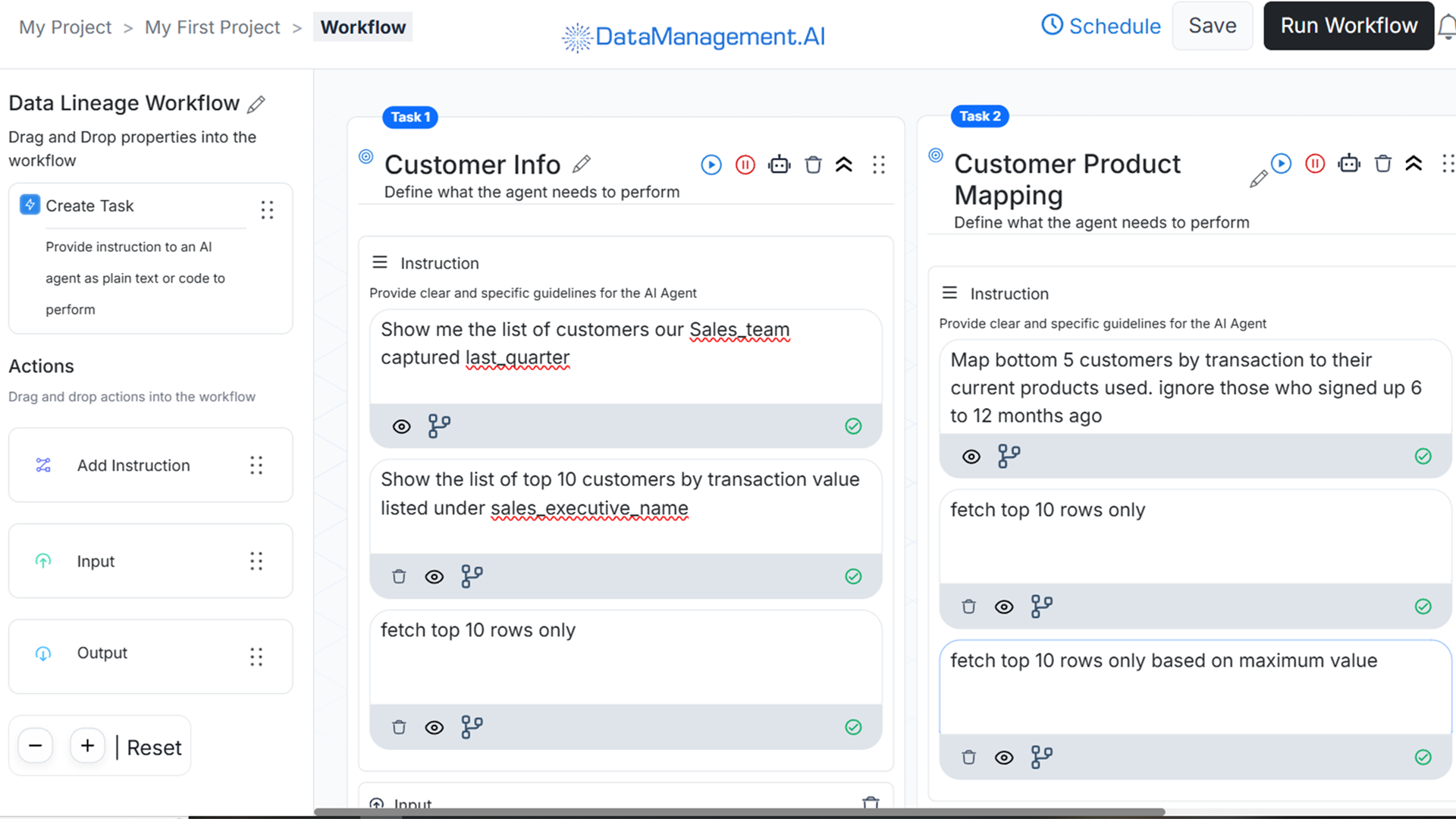
At DataManagement.AI, we solve the complexity of what is reference data and master data management. Our AI-powered platform handles both frameworks seamlessly.
The three game-changing benefits of DataManagement.AI as a unified solution for reference data and master data management are:
Cross-domain validation – Our QualityAI agent continuously monitors integrity. It instantly flags any master data entity.
This happens if it uses a reference code not yet published by the reference data management system. This ensures that only valid codes are used.
Automated reference code distribution – Our platform automates the push/pull of reference data. Once a code is approved, our agents instantly update subscribing systems.
This eliminates the latency risk. This is critical in industries needing immediate master data management reference architecture updates.
Unified governance framework – We provide a single visual canvas. It defines governance policies for both reference and master data.
This removes organizational silos. It ensures the same compliance standards apply to all non-transactional data.
| Characteristic | Master Data | Reference Data |
|---|---|---|
| Purpose | Describe core business entities (Customer, Product). | Categorize and validate master and transactional data. |
Change Frequency | Dynamic, changes often (new customer, updated address). | Static, changes rarely (new country code, new currency). |
| Ownership | Internal Data Stewards, Business Owners (Sales, Finance). | Data Governance Council, often external standards bodies. |
| Complexity | High complexity in matching, merging, and hierarchy. | Low complexity in structure, high complexity in distribution/mapping. |
Reference Data vs Master Data Management – A wasted debate?
Reference data management vs master data management isn’t an either-or-choice. You need both. Together, they create the foundation for actionable and trusted data.
Master data defines your business entities. Reference data classifies and validates them. Our AI agents seamlessly manage both reference and master data.
One governance framework. One integration architecture. Complete visibility.
The concussion between data types is significant, yet solvable. You have to move past siloed management.
An integrated master reference data management framework by DataManagement.AI ensures both core entities are consistently governed.
This delivers the unified, trustworthy data layer required for digital operations.
Ready to achieve unified governance of your master and reference data?
Schedule a demo today!!
Frequently Asked Questions (FAQs) for Reference Data and Master Data Management
Q. What is the fundamental difference between reference data management vs master data management?
A. Reference data management vs master data management is about context versus entity. Master data (customer or product) describes core business entities and is dynamic. Reference data (country codes or currencies) provides context to classify that data. It is static and changes infrequently. What is reference and master data management unifies their governance.
Q. How does reference data management vs master data management impact business operations?
A. Reference data management vs master data management impacts operations differently but complementarily. Master data management creates a single source of truth for business entities, enabling 360-degree views of customers, products, and suppliers. Poor master data causes duplicate records and inconsistent customer views.
Q. What are the key components of a master data management reference architecture?
A. A master data management reference architecture integrates both reference and master data management capabilities. Core components include a centralized data repository managing both data types – data governance frameworks defining ownership and change processes. Modern architectures use cloud-native, microservices-based designs that handle billions of records and thousands of transactions per second.
Q. What benefits do organizations gain from implementing master reference data management
A. Master reference data management delivers measurable business benefits. Data scientists save 45% of their time previously spent fixing quality issues. Regulatory compliance becomes easier with complete audit trails and lineage tracking. Companies typically achieve full ROI within 12 weeks of implementation using modern cloud-based platforms.