




As a procurement leader, imaging watching your company deliver half of what your competition does. Not because of a lack of demand, but because your data is a mess.
This isn’t hypothetical.
In 2024, Boeing delivered only 348 aircrafts. Airbus? 766.
The gap wasn’t just about production capacity. Quality control failures played a major role, and here’s the secret – 49% of procurement leaders pointed to data accuracy as a root cause of industry-wide crises like this.
Boeing’s struggle isn’t an isolated incident. It’s a wake up call.
Without unified supplier and material data, procurement doesn’t just stumble, it fails.
And if you’re a CDO or CTO reading this, you need to act now.
When the same supplier appears a dozen different ways in your ERP system, you’re not just dealing with messy spreadsheets.
You’re bleeding money, missing cost-saving opportunities, and operating with massive supply chain blind spots.
The question isn’t whether you have a data problem. It’s how long you will keep managing data in silos before moving to a unified, intelligent data layer.
That’s exactly why modern procurement requires master data management tools. They don’t just clean up messes, they future-proof your procurement process.
Today, I will show you how to get there. Let’s dive in.
What is Procurement Master Data Management?
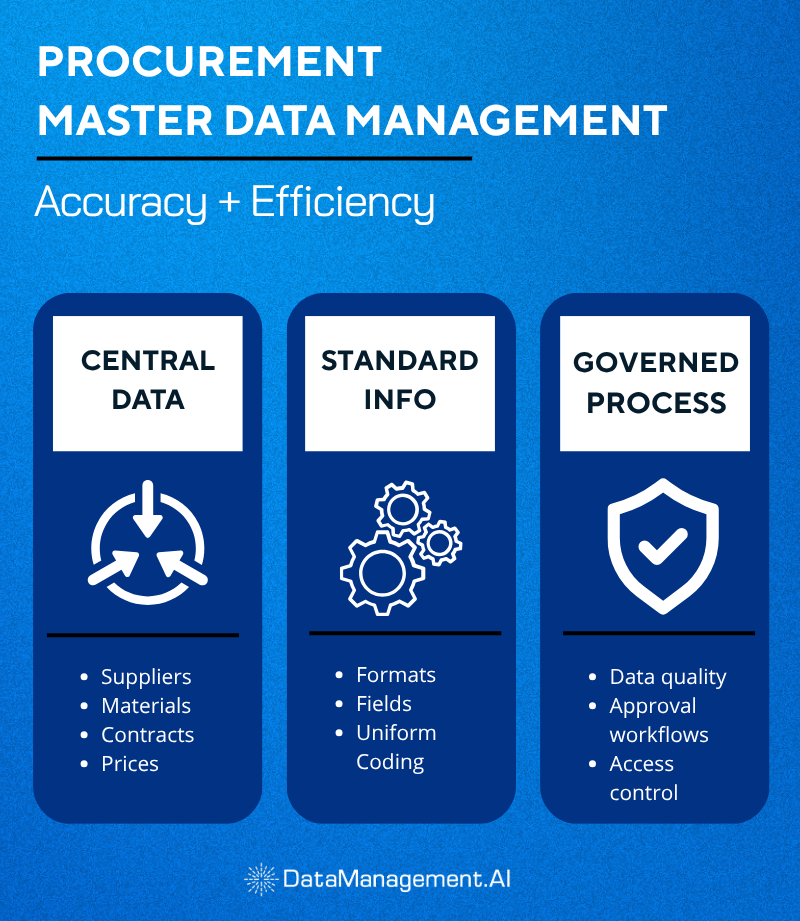
Procurement master data management (PMDM) is the collecting, organizing, and maintaining of key data that’s related to your products, suppliers, contracts, and procurement information.
It creates a single source of truth. It’s like your procurement nervous system. Each purchase order, contract, and supplier relationship depends on it because if this master data fails, operations crumble.
A procurement master data management tool ideally unifies,
- Purchase histories and performance metrics
- Your contract terms and pricing data
- Supplier information across all systems
- Material and service specifications
According to Gartner, poor data should account for USD 12.9 million of your money annually.
This is a massive hole that can leave your ROI in tatters. When procurement data quality fails, your teams waste hours on manual fixes.
This bad data destroys your profitability as discovered by IBM, with US businesses losing USD 3.1 trillion annually only due to poor quality data.
The biggest time-related issues that plague your organization to poor procurement data are:
- Manual data entry rework
- Reconciling conflicting data
- Correction of duplicate vendor records
- Data verification across multiple systems
What are the core components of a good procurement master data management software?
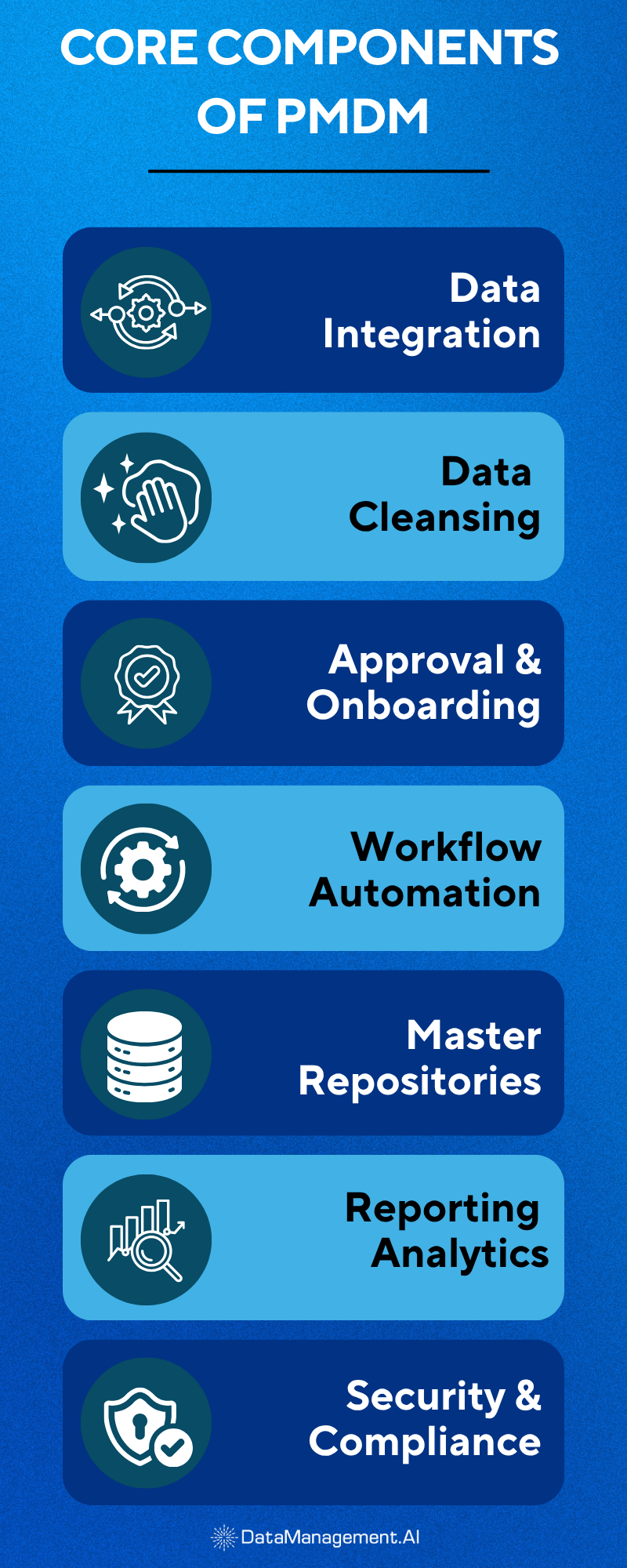
The four major components of a top procurement master data program are:
Data Governance Framework
Data governance defines rules, ownership, and processes. It prevents future chaos by establishing clear standards for your organization.
Without good data governance, your teams will create their own structures. This leads to inconsistency and data fragmentation.
Effective governance for your procurement master data management platform includes:
- Regular audit processes
- Approval workflows for changes
- Standardized data entry protocols
- Clear data ownership roles
Data Quality Management
Quality management ensures consistency, accuracy, and completeness that’s the enforcement arm of your governance policies.
Despite 68% of Chief Procurement Officers investing in GenAI, data maturity is low. This creates an analytics readiness gap, which should otherwise deliver:
- Survivorship logic for conflicts
- Address verification systems
- Duplicate detection algorithms
- Automated validation rules
Master Data Repository
A centralized data repository merges records from all systems. It creates one mastered profile per supplier.
Modern supplies MDM platforms support legal site, entity, and remit-to structures with parent-child hierarchies.
This master data repository is a key facet of a procurement master data management platform because of:
- Historical version tracking
- Multi-domain data structures
- Relationship mapping
- Global attribute management
What are some procurement master data platform strategies?
The following procurement master data software strategies are essential for proactively managing your procurement data to manage a smoothly functioning supply chain.
Setting up of a single source of truth (SSoT)
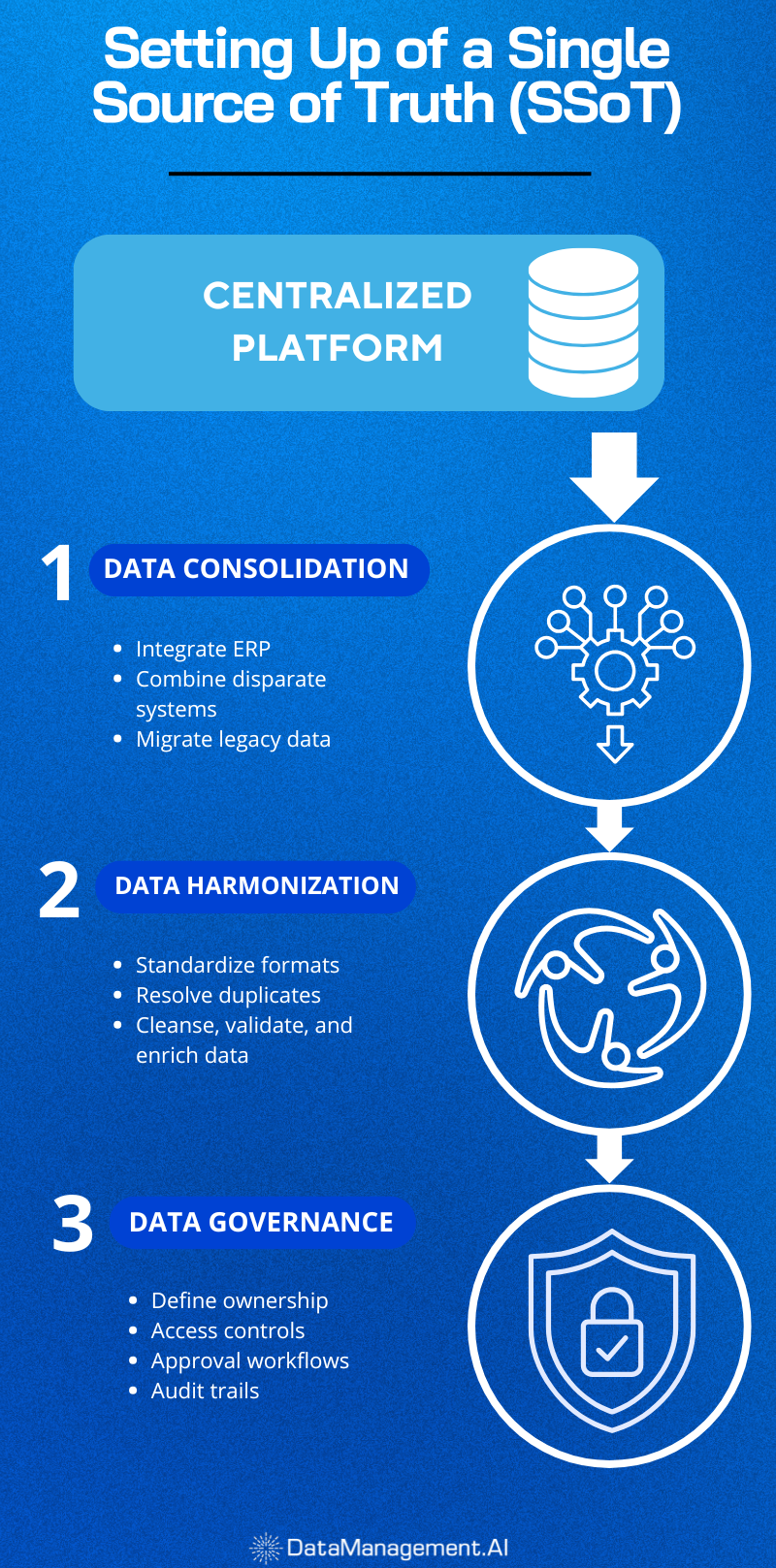
This procurement master data management strategy consolidates material, supplier, and contract data from your disparate systems such as e-procurement tools, spreadsheets, and ERPs to a unified platform.
The goal of SSoT is to remove duplicates, data silos, and inconsistencies. All this ensures that all departments are operating with the same accurate information.
A single source of truth is your foundation for reliable speed analysis, automation, and compliance. You get a holistic view of the organization’s purchasing landscape.
AIMultiple’s real-world example here is for Procter & Gamble (P&G). They deployed a data quality software to improve their master data across its complex and multi-instance SAP landscape.
This centralized automated process reduced the time analysts spent manually. This data from numerous sources minimized data leaks and duplication.
Utilizing master data for risk management and compliance
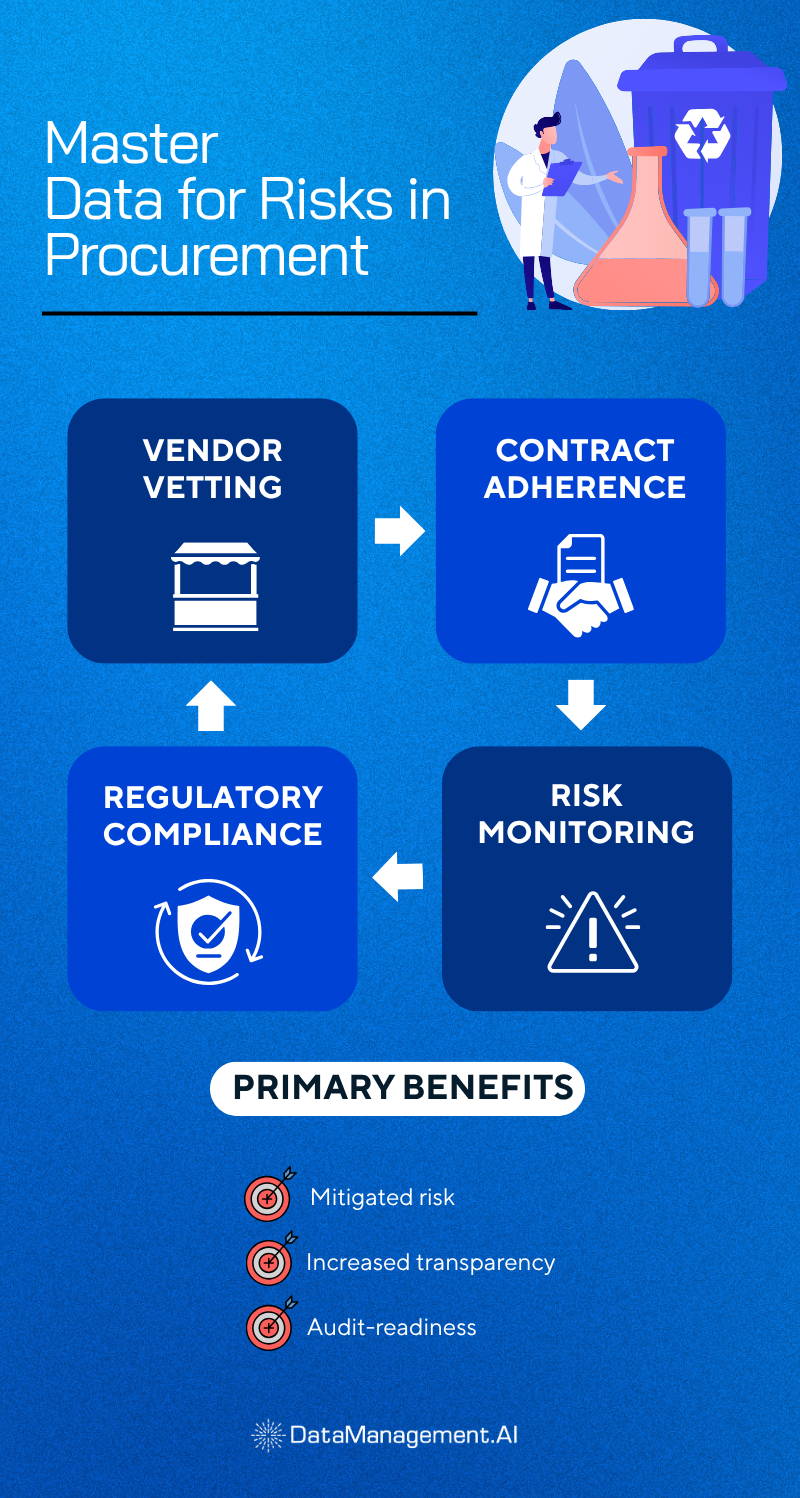
Beyond simple transactional efficiency, a key strategy of a procurement master data management is using enriched master data to manage regulatory compliance.
This involves augmenting your core supplier data with external data feeds. These include financial risk ratings, governmental compliance lists (sanctions), and ESG (environmental, social, and governance) scores.
This strategy turns passive record-keeping into an active risk intelligence tool.
Veridion mentions a real-world example to highlight this strategy.
A large multinational corporation is using their supplier master data to check for risk and compliance. They link the supplier ID in their PMDM to an external risk intelligence service.
Whenever the external feed would flag a key supplier for any financial distress or an updated list entry, the procurement master data management software would change the supplier status to ‘High Risk’.
This would trigger an immediate workflow notification to inform the procurement team to halt any new purchase orders.
Emphasizing on data cleansing and standardization
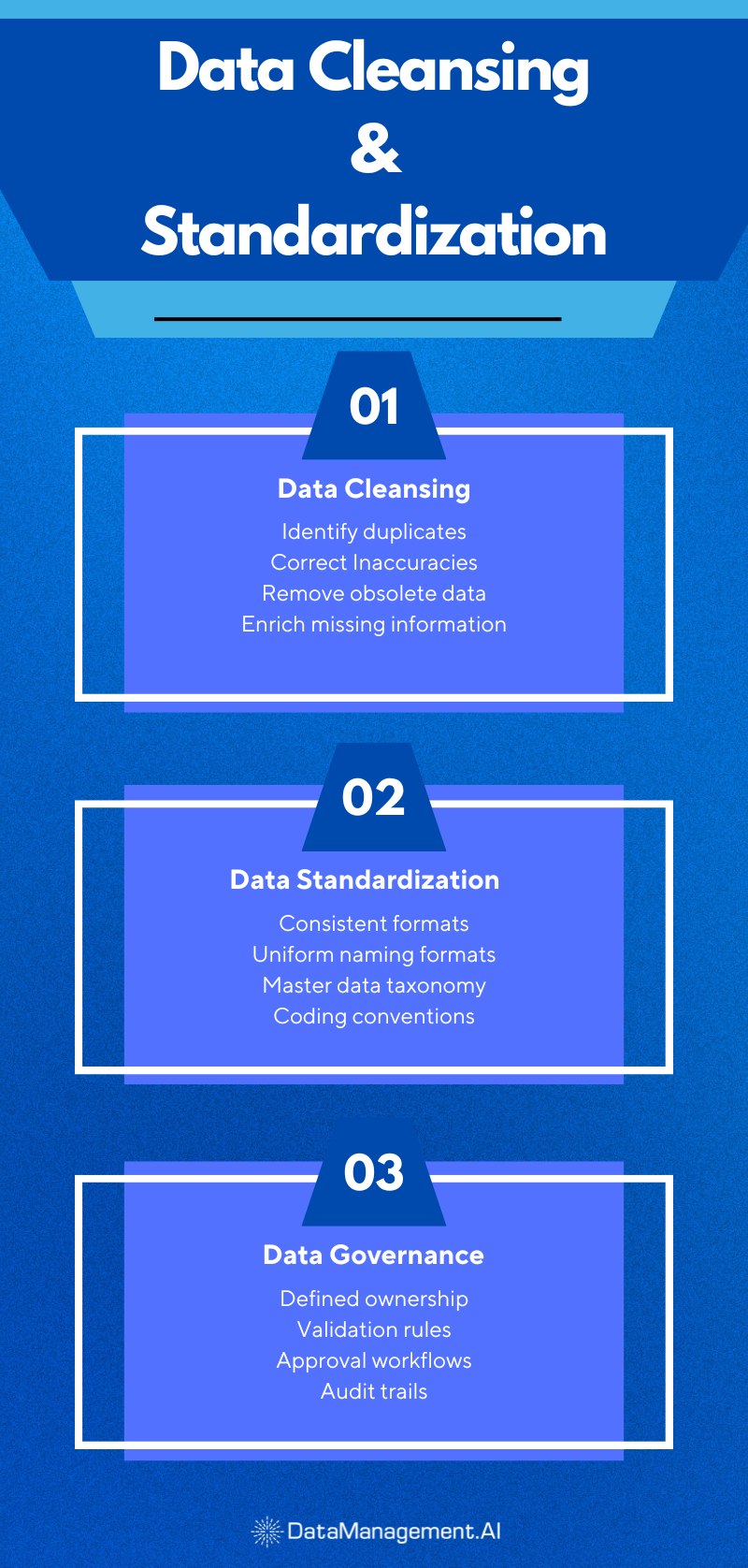
This procurement master data management strategy focuses on improving master data.
The key activities here include:
- Data profiling (assessing the current state)
- Data cleansing (correcting missing values, errors and inconsistencies)
- Data standardization (applying uniform formatting and naming conventions)
High-quality data is key to strategic sourcing, effective analytics, and preventing any operational errors.
ResearchGate’s fictional example shows this strategy clearly. In the maintenance, operations (MRO), and repair sector, a company could adopt a procurement master data management software to tackle catalog data issues.
The procurement master data management tool will automatically standardize various inconsistent descriptions for the same item.
‘Nut, SS ¼’ becomes ‘Nut, Stainless Steel, ¼ Inch’ and gets assigned a Material Code. This eliminates your duplicate part entries.
You now consolidate purchasing volume with a single supplier, which optimises your inventory levels.
If your data is in deep need of data being standardized, we have just the tool for you. Schedule a demo and see how you can optimize your procurement data.
Integrating PMDM with your core procurement systems
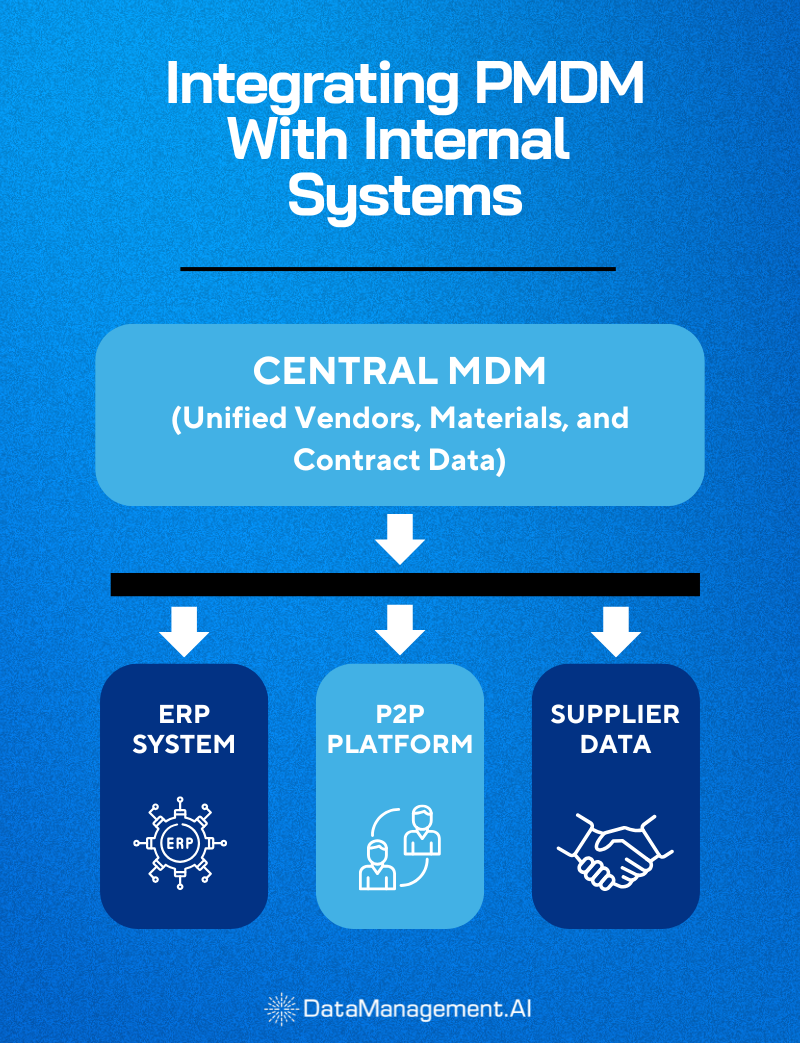
A successful PMDM strategy needs seamless and real-time integration with all consuming systems.
This includes e-sourcing, Procure-to-Pay (P2P) platforms, and your ERP systems. The centralized master data automatically synchronizes updates to downstream systems.
This integration ensures that every transaction of yours, from requisition to payment, is executed using validated and governed procurement master data.
This maximizes efficiency and compliance across your entire procurement cycle.
The example here comes from Zycus. This hypothetical example sees a Category Manager update a contract within their SAP Ariba system with a new price for a material.
The procurement master data management layer ensures this change quickly and validates it in the ERP system.
Now any purchase order generated thereafter in the SAP Ariba system automatically uses the negotiated price, thus avoiding manual price checks.
Implementing a robust data governance and stewardship
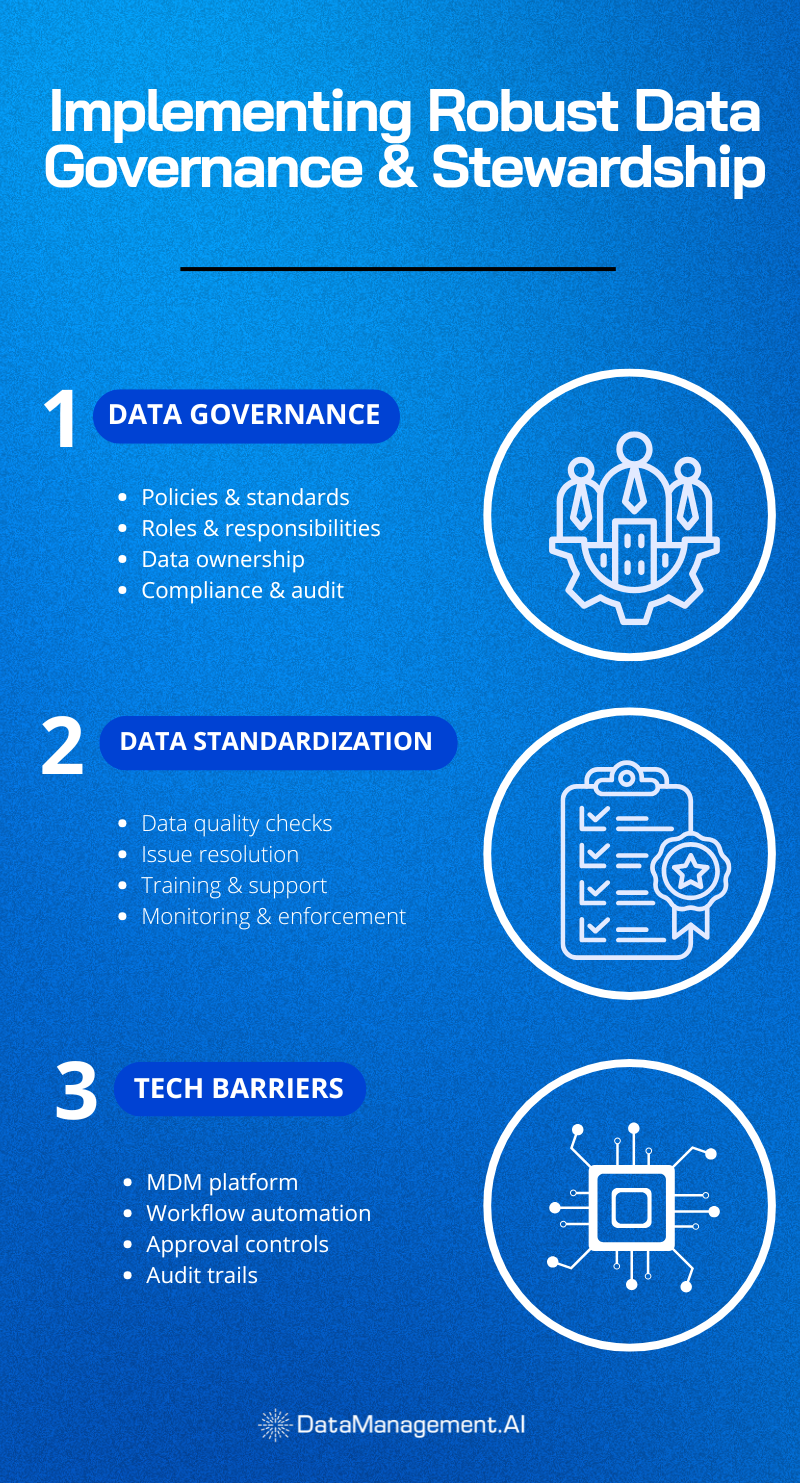
Data governance involves defining procedures, roles, and responsibilities for managing your master data, throughout its lifecycle.
This also includes establishing ‘who owns what data’ and who is responsible for data quality. Then comes the formal process of creating, updating, and retiring your master data records.
A strong governance framework ensures accountability and guarantees that your data adheres to quality standards or taxonomies.
This last example comes from ClearTax, where a large manufacturing company implemented a vendor PMDM to define clear data governance structures.
These structures dictated that only approved Category Managers could initiate a new vendor request. The Finance team handled data accuracy, and a Data Steward validated supplier compliance documents.
Which are some Procurement Master Data Management softwares?
The following procurement master data management software will turn your procurement data into strategic assets.
DataManagement.AI
DataManagment.AI is an AI-native procurement master data management platform. The ‘Chain-of-Data’ and ‘Agentic Workflow’ approaches focus on automation, operational efficiency, and speed.
Another ideology that’s unique to DataManagement.AI is Context Cloud.
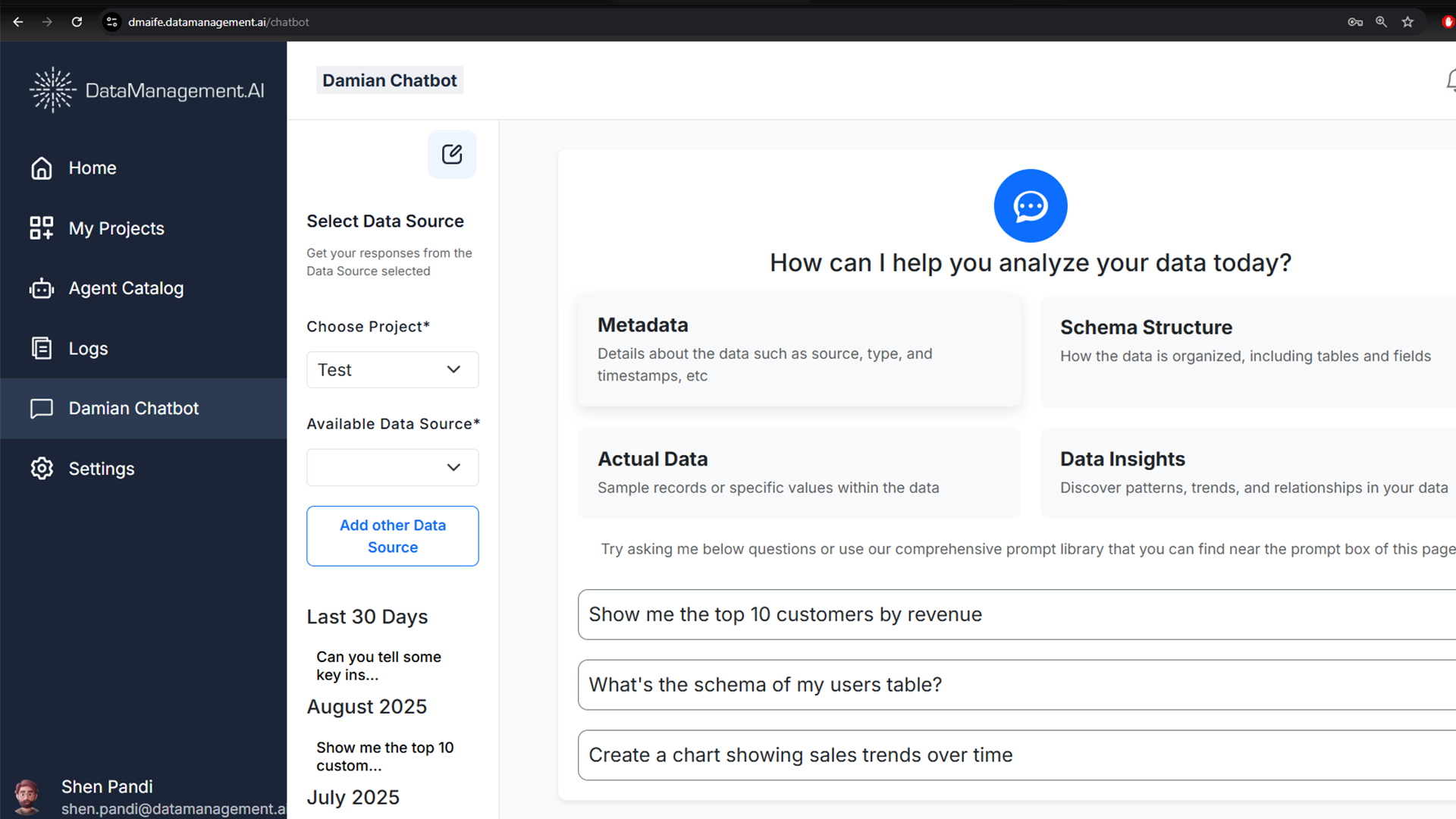
Imagine data with a story. A full, rich story. It connects all your data points. It adds missing information. It makes data complete. It understands relationships. This creates a ‘chain-of-data.’
This chain enriches data. It reconciles data. It governs data effectively. Your data becomes smart. It gains deep understanding.
This is not just an approach, it’s an intelligent layer. This layer sits over your systems.
It connects them all seamlessly. Agents ingest your data by gathering it from sources. They bring it into one place. Then the magic happens.
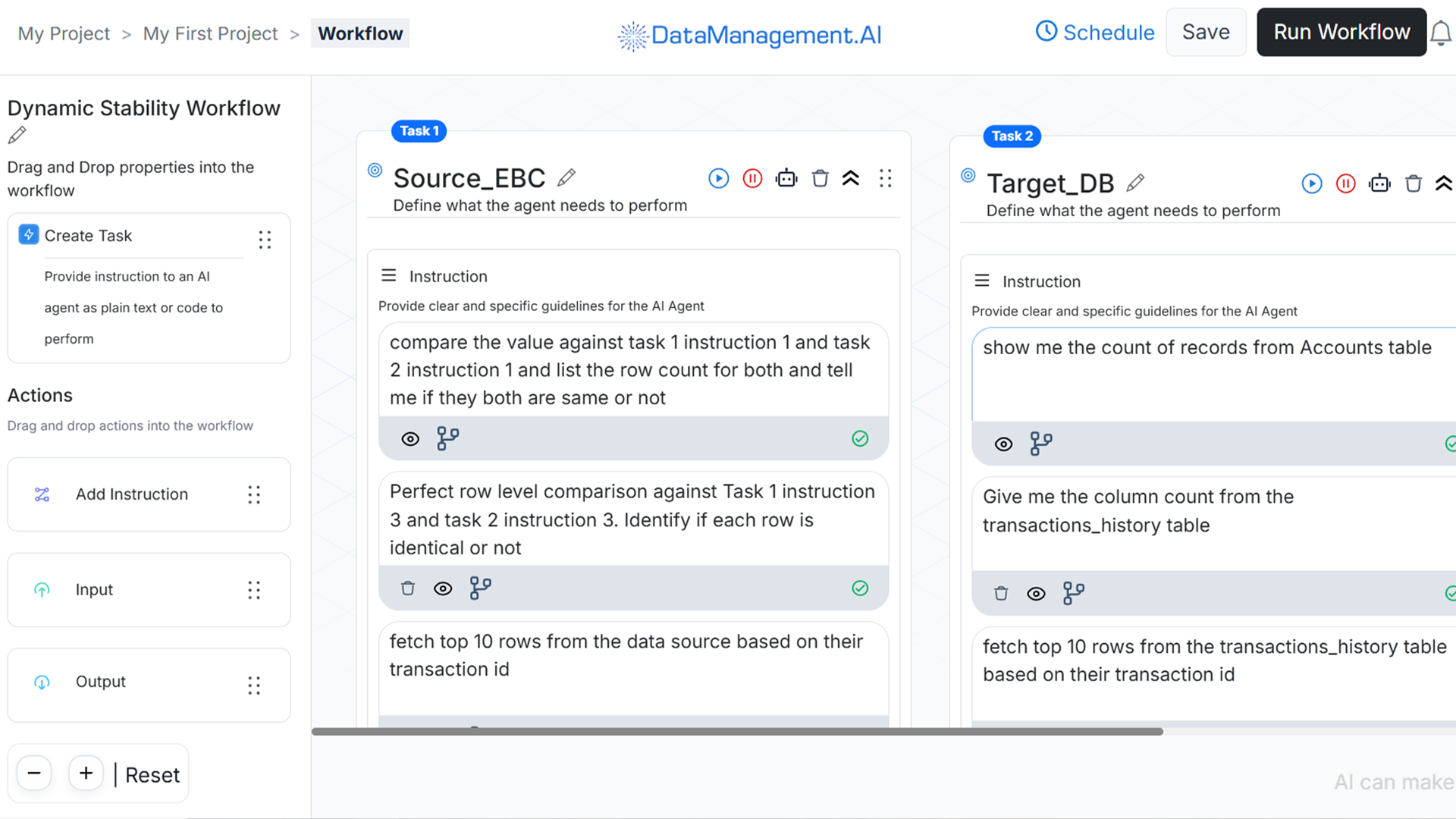
Data gets contextualized. It is cleaned and organized. It is prepared for use automatically. It is highly efficient.
You get the following three benefits adopting DataManagement.AI’s procurement master data management platform.
- Real-time actionable insights – Our SMDM platform connects with your entire data landscape. You gain immediate visibility into spend patterns, compliance risks, and supplier performance.
- Productivity gains – Teams that spend less time fixing data errors get more time devoted to supplier negotiations and strategic sourcing.
- Lowered operational costs – Thanks to AI agents automating your data cleansing and data validation tasks, manual intervention is less and operational overheads reduced.
Speed, flexibility, and AI-driven automation via ‘agentic workflow’ for real-time, in-place data governance and quality.
| Core Features |
|
|---|---|
| Key Strengths |
|
| Weaknesses |
|
| Pricing Model |
|
| Best Suited For |
|
| Deployment Strategy |
|
| Integration & Scalability |
|
Informatica Multidomain PMDM
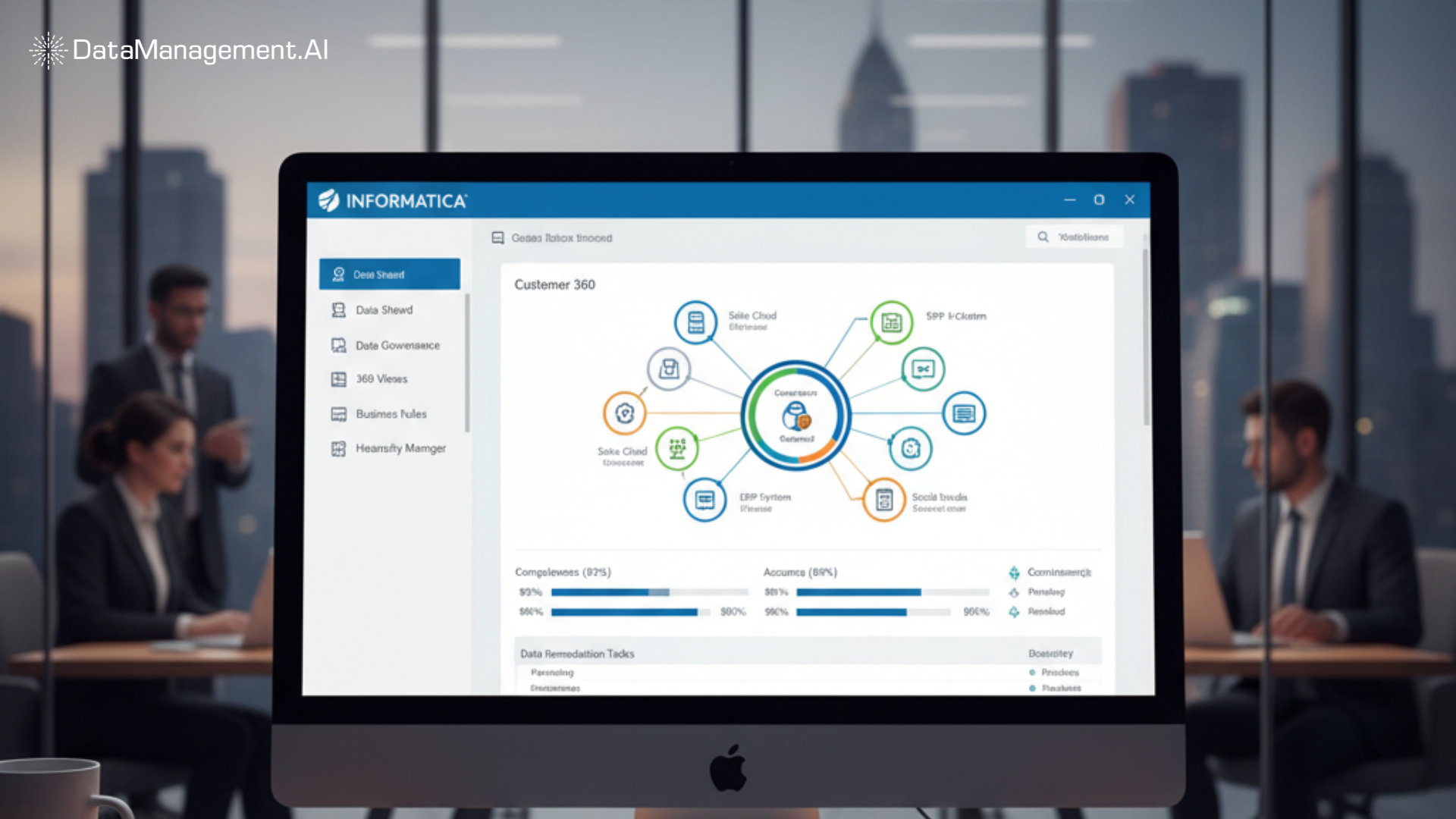
Informatica multidomain is a cloud-native procurement master data management platform that focuses on providing a trusted 360-degree view of critical business entities.
It connects, cleanses, and governs data from disparate sources. Its architecture is designed to handle numerous domains. It’s suitable for organizations with complex procurement environments.
| Core Features |
|
|---|---|
| Key Strengths |
|
| Weaknesses |
|
| Pricing Model |
|
| Best Suited For |
|
| Deployment Strategy |
|
| Integration & Scalability |
|
Stibo STEP PMDM

Stibo STEP PMDM is a platform designed to govern complex and high-volume procurement master data across multiple domains.
Its PMDM tool offers a strong procurement solution that focuses on improving resilience and data transparency across the supply chain.
Their focus is on building complex data workflows for omnichannel commerce and global commerce.
| Core Features |
|
|---|---|
| Key Strengths |
|
| Weaknesses |
|
| Pricing Model |
|
| Best Suited For |
|
| Deployment Strategy |
|
| Integration & Scalability |
|
“Procurement is no longer just a support function – it plays a critical role in driving business value, managing risk, and supporting sustainability goals. Central to this evolution is the quality and governance of procurement master data.”
— Gartner Research, Procurement Leadership Survey 2025
Oracle Cloud PMDM
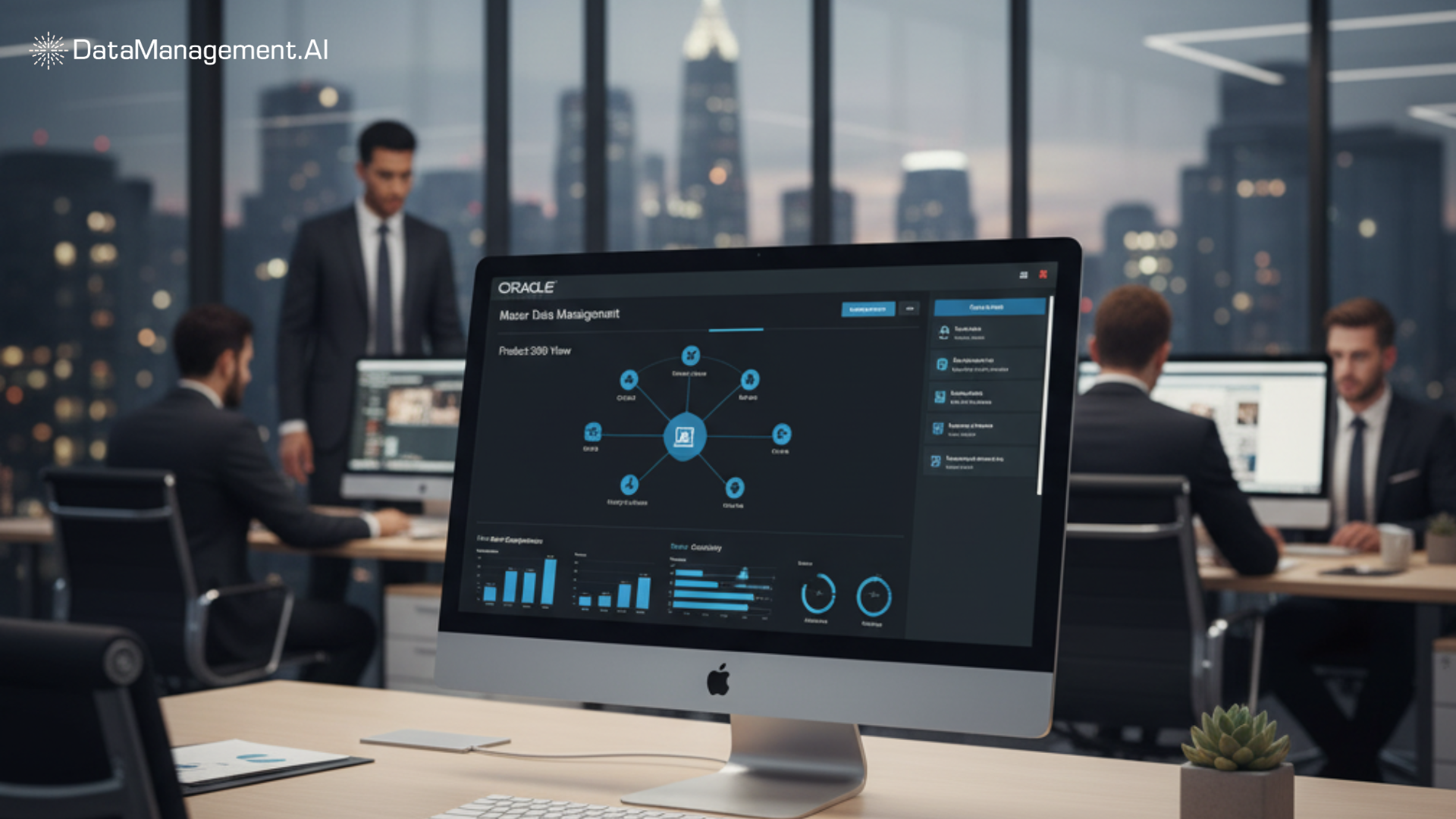
Oracle’s PMDM capabilities are part of its larger enterprise data management portfolio. This is often integrated with its Oracle Cloud ERP and Procurement applications.
Oracle Cloud Procurement Master Data Management is a strategic and enterprise-level solution that standardizes your master data across the organization.
It provides a singular and reliable source for all procurement transactions and analytics.
| Core Features |
|
|---|---|
| Key Strengths |
|
| Weaknesses |
|
| Pricing Model |
|
| Best Suited For |
|
| Deployment Strategy |
|
| Integration & Scalability |
|
Riversand PMDM platform

Riversand’s procurement master data management solution is a cloud-native, multi-domain solution that leverages an AI-powered data fabric to unify your data across the enterprise.
For procurement specifically, it provides supplier and material data management capabilities that focuses on agility and rapid insights to optimize your supply chain.
| Core Features |
|
|---|---|
| Key Strengths |
|
| Weaknesses |
|
| Pricing Model |
|
| Best Suited For |
|
| Deployment Strategy |
|
| Integration & Scalability |
|
Procurement Master Data Management is key for you
PMDM isn’t an option for you anymore.
It’s the foundation towards strategic procurement operations.
McKinsey states that, organizations with clean, centralized master data achieve 10% cost savings through better spend visibility.
Those without it lose millions to blind spots and inefficiencies.
You require,
- Proper software selection
- Executive commitment
- Phased implementation and
- Continuous optimization
To achieve true enterprise-wide data unity. This turns procurement from a cost center to a strategic advantage.
DataManagement.AI provides the intelligence and architecture to manage your data at scale.
Stop cleaning data and start using it.
Ready to transform your procurement data into a strategic asset?
Schedule a demo today to discover how you can reduce cost and increase productivity.
Frequently Asked Questions (FAQs) on Procurement Master Data Management
Q. What is a procurement master data management platform and why is it essential to you?
A. Procurement master data management is the process. It defines, governs, and maintains core data entities. These entities are used across all procurement functions. They include suppliers, contracts, material items, and pricing. It is essential because it eliminates discrepancies. Unified data drives accurate spend analysis.
Q. What are the key differences between general MDM and specialized procurement master data management software?
A. A normal MDM focuses on multiple domains. This includes customer, product, and employee data. Specialized procurement master data management software is domain-aware. It has specific models for supplier hierarchies. This includes supplier onboarding, risk scoring, and contract linking. This domain-specificity is critical for faster deployment and greater ROI.
Q. How long does it take to implement a procurement master data management platform?
A.Typical implementations take 4-6 months for initial deployment with phased rollouts continuing over 12-18 months. Week 1-4 covers assessment and planning. Weeks 5-12 establish governance frameworks and build master repositories. Weeks 13-20 focus on data migration and pilot programs.
Q. How does procurement master data management software differ from regular ERP systems?
A. While ERP systems execute transactions, procurement master data management software governs the data quality feeding those transactions. MDM software ensures the underlying data i.e. supplier names, addresses, banking details, contract terms such as remains accurate, complete, and consistent across all systems.
Q. What security considerations are critical for procurement master data management?
A. Procurement data contains sensitive supplier banking details, contract terms, and pricing information requiring robust security. Essential considerations include field-level encryption for sensitive data, role-based access controls limiting who sees what, SSO integration for secure authentication, and comprehensive audit logging tracking all changes.
Q. What role do AI agents play in modern procurement master data management?
A. AI agents are transformative in procurement master data management. They automate time-consuming, manual tasks. Our agents, like Cleanse AI, use machine learning. They auto-classify materials and services. They suggest master data corrections. They manage complex entity resolution (linking records).