

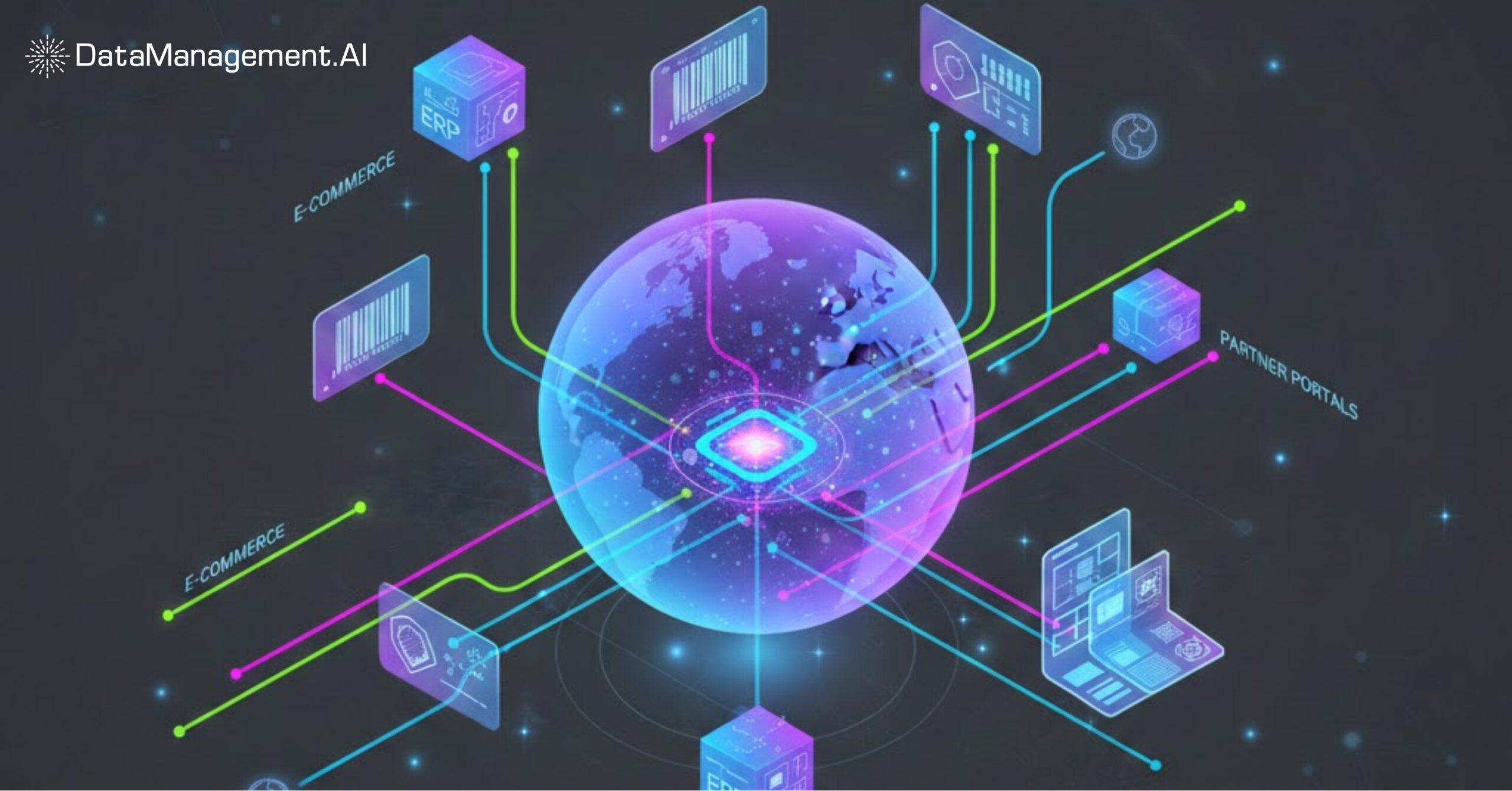


Okay, take a guess.
How many companies do you think are still struggling with product data accuracy?
So, 10%? 20%? No, a recent survey revealed that even in the age of AI, 70% companies still deal with product quality and consistency, and are even losing 15-25% of revenue because of it.
That sums up to companies losing almost $600 billion annually due to bad data.
| But what do we mean by ‘bad data?’ It usually includes outdated pricing details, duplicate entries, missing SKU data, or incomplete supplier or customer info. And these little details may sound fixable, but they usually pile up and lead to poor customer experiences, production delays, and supply chain disruptions. |
That is why Product Master Data Management is required in every company. It won’t be another tool added to your directory; rather, it will act as the foundation for all your product details.
So, let’s learn more about Product Master Data Management or MDM, and how it can transform your operations.
What is Product Master Data Management (PMDM)?
Product Master Data Management is quite complicated. It is a web of data hierarchies, relationships, and context. That is why it is known as the ‘ultimate tech stack’ that makes sure all your product data has been standardized.
Just as Master Data Management (MDM) creates a ‘golden record’ of your entire company’s data, PMDM does the same for each product. So, now all your systems and teams would have access to one trusted version of data.
But there’s still more to it.
The industrial definition of PMDM is “the process of managing and maintaining a single, cohesive view of all product-related data within an organization.” We talked about the managing part, now there’s the maintaining part too.
And it’s much more complicated.
To understand that, we will have to dive deep and learn about what PMDM consists of.
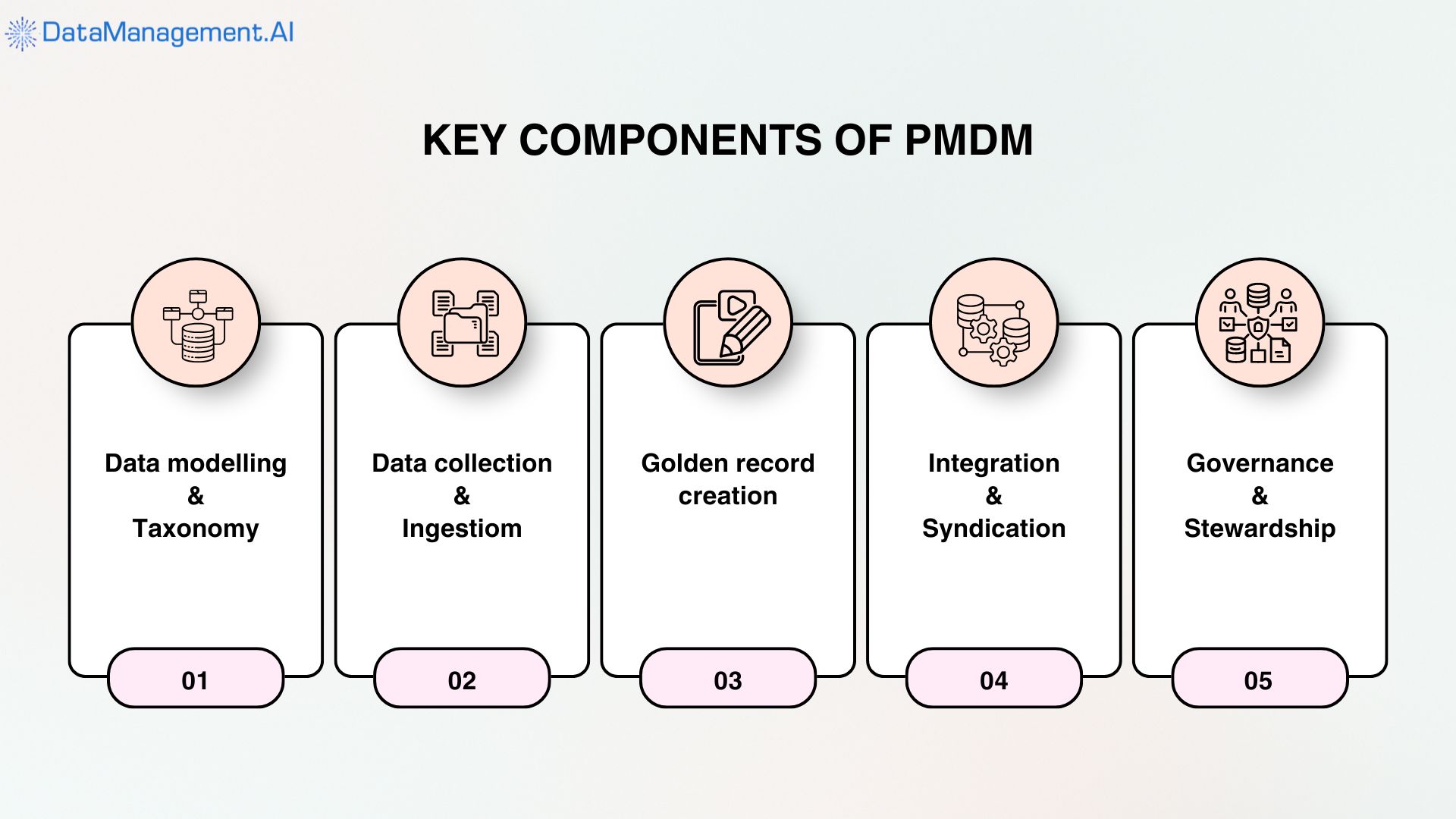
Key components of PMDM
As there’s already ‘Master’ mentioned in the name, you can imagine its vastness. PMDM is like an ecosystem that consists of rules, frameworks, and connections that are required for a company to function smoothly.
And here are the core components that you need to know to understand what Product Master Data Management is.
Data modelling and taxonomy
The core function of a product master data management solution is to make your data make sense. No, I don’t mean that it would analyse it for you, but it would lay out the fundamentals of the structure so that you get the bigger picture.
By that, I mean you can see how each product or its variants fit into your catalog.
You can think of it like a blueprint for your development team, which will help them speed up while maintaining data quality and consistency.
Once that is sorted, the next component is taxonomy.
This part helps in organizing all the parts of your structure, or you can say it creates the hierarchy in the product channel.
| Let’s take IKEA, for example. You must have shopped at least once, right? They have thousands of SKUs across several regions. Now, if there’s no taxonomy, a product may appear as ‘wooden dining chair’ in one branch and ‘comfortable oak seat’ in another. This will not only confuse customers but will also create chaos within the internal team as they won’t know what keyword to search for while checking inventory. |
Data collection & ingestion
When they say a relationship should have a strong foundation, I feel they probably refer to data networks as well.
Before you get into analysing which channel brings in most of your traffic or revenue, you should make sure that you have the right numbers. And this is one of the biggest challenges everyone discusses when talking about Product Master Data Management solutions.
That is why, even before you think about data modelling, make sure that the data collection and ingestion process of your organization is correct.
So, what are they?
Collection is simply the process of gathering all product-related info from supplier feeds, PLMs, spreadsheets sent by vendors, etc.
Ingestion is the process of moving that collected data into your system in a standardized and accurate format for your team to use.
Not a fun fact:
A survey shows that 82% of organizations spend at least one day per week just trying to solve data quality issues that stem from the collection and ingestion process.
So, when this process is done right, it leads to:
- Faster integration or onboarding of new products or suppliers.
- Consistency of data information across all systems.
- And a solid base for automation
Golden record creation
This part might be a bit confusing, as in theory it’s much like the data modelling and ingestion part. But in practice, it’s completely different.
So, if the former tells you how product data should be organized and how they fit together, the latter makes sure that everyone actually follows that standard.
That’s why ‘regular data’ becomes ‘Master data’ in this step.
Data modelling and taxonomy would answer “What should the product map look like?” whereas the golden record would say “Which version is correct?”
What exactly happens during golden record creation?
Here, your internal system starts identifying duplicates, resolving conflicts in product info, filling missing fields, and merging data of each SKU to record a “single source of truth.”
| Suppose you sell an Apple iPhone without a PMDM system in place. This is how your dashboards will look like this: ERP – iPhone 16 Pro Max 256 GB Graphite CRM – Apple 16 Pro Max (Grey) (256 GB) CMS – iPhone 16 Pro Max 256 GB, Dark Grey Distributor’s Excel – IPHI6PM-256-GR But with PMDM in place, every dashboard would reflect something like this: Sold Out – iPhone 16 Pro Max I 256 GB I Graphite I Model A569 I Global SKU: IP16PM256-GR |
So, in short, it streamlines, standardizes, and creates a dictionary for the whole organization.
Integration & syndication to downstream systems
This step is pretty straightforward but obviously crucial.
So, once the product master data management tool is done with ‘Golden Record creation,’ the next step is to deliver the clean and accurate data to every system it needs to be in. Thus, ERP, CRM, CMS, analytical tools, marketing dashboards, and supplier systems will all reflect the same data from the next day.
Here, APIs, event-driven data flows, and orchestration workflows are used.
APIs act like bridges between systems, allowing the steady flow of clean data to platforms like Shopify, SAP, Salesforce, or other internal systems.
Then, event-driven data flows make sure that updates are happening instantly and not in separate batches. So, if a product price changes, it should reflect in every downstream system at the same time.
Lastly, orchestration workflows automate the whole journey of the product, like the validation of product data, approving changes, monitoring, and logging every system etc.
Governance & stewardship with roles, policies
I have been talking about how important clean data is, or what Product Master Data Management is, but I have yet to discuss the backbone of this whole process, i.e., governance and stewardship.
All this would be executed by an automated system, but a human will be controlling the data. The governance step helps decide who that would be.
It will answer these questions:
- Who can edit, approve, or retire product data?
- How a particular data must be validated?
- What rules to follow to ensure compliance and accuracy?
In this step, data ownership roles would also be assigned, so there’s approval of workflows, quality thresholds, and clear escalation paths.
Gartner proved how important this step is, as by 2027, 80% of governance initiatives would fail if they don’t bring in real outcomes.
PMDM use-cases
When I say PMDM is a whole universe, I mean it. If you thought that you already knew where you can use a Product master data management tool, you’re wrong.
There are three aspects to PMDM, and you have to be familiar with all of them to figure out where to implement the software.
So, let’s dig in.
The buy-side
Before the final version of a product exists, there’s obviously procurement of raw materials, technical specs, packaging data, and certifications.
A Product master data management tool standardizes all the supplier data so that your purchasing, manufacturing, and finance systems don’t get 50 versions of the same item.
For example:
If a manufacturer buys steel rods from 3 suppliers, and one refers to it as “Steel Rod 8mm,” another as “8MM Steel,” and the last one as “8-mil rod,” then without a product master data management software in place, your systems would recognize these as three different products.
A Product master data management solution would fix this, and you would only see “Steel (8mm), grade X.”
So, this instantly reduces procurement errors, pricing mix-ups, and wrong inventory stocking.
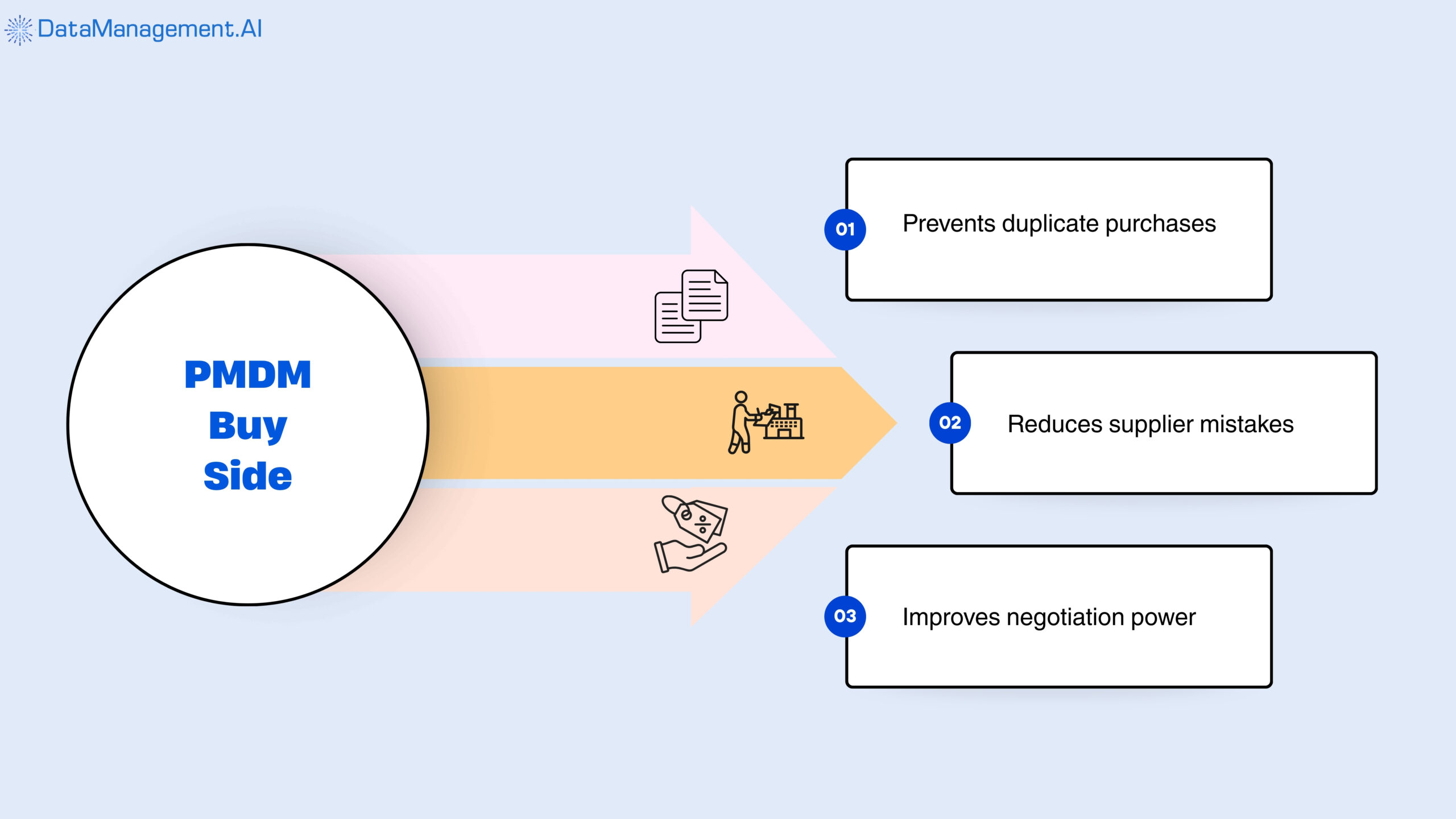
| Pros of PMDM on the buy-side: 1. Prevents duplicate purchase of raw materials. 2. Reduces supplier-related mistakes like wrong deliveries, inconsistent specs, etc. 3. Improves negotiation power by providing better spend visibility. |
The inside
Once the external chaos is under control, you can use the Product master data management tool to prevent mess-ups in your internal systems, too.
And yes, this part is much more complicated, as inside a business, there are a lot of layers that constantly keep evolving, like formula upgrades, packaging changes, regulatory updates, region-specific variants upgrades, and even spare parts inventories.
That’s why following best practices for Product Master Data Management in spare parts is so important.
- Start by standardizing part names, descriptions, and SKUs, so every team from production to maintenance speaks the same language.
- Next, organize parts hierarchically by type, function, or compatibility, making it easy to locate the right component quickly.
- Regular audits and validations ensure nothing slips through the cracks, and connecting data across ERP, inventory, and procurement systems keeps everyone aligned.
With a golden record of data to refer to, your teams might end up creating their own version of the same data. So, now ERP doesn’t know what the QA team is referring to, and your supply chain is broken.
PMDM fixes all this by standardizing or assigning a name to a value to each product and spreading them to all internal systems, and making sure that the same version of data is used at every stage.
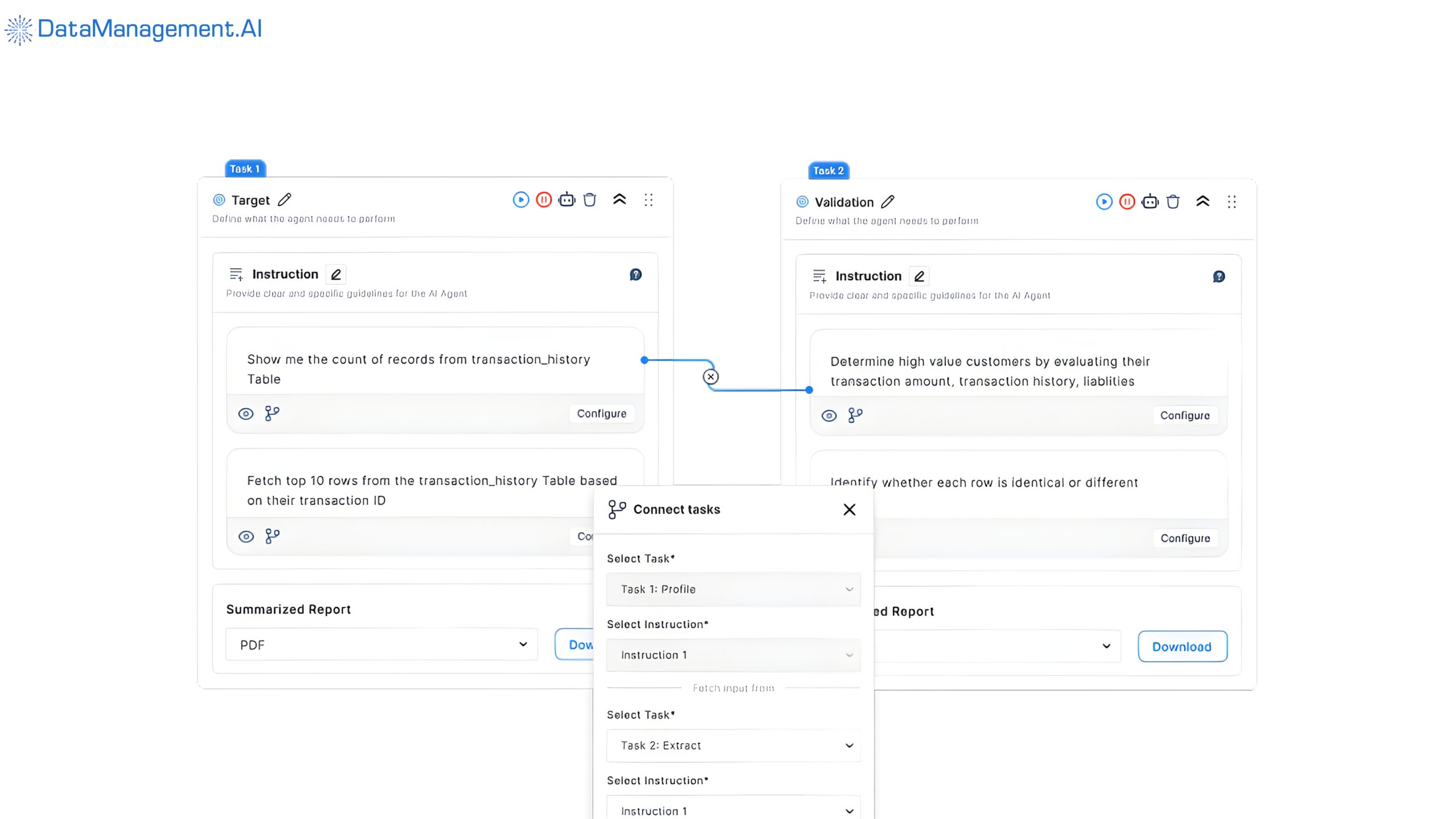
This is where DataManagement.AI truly shines.
Multiple systems, suppliers, and channels produce multiple product versions. It automatically unifies all of them into a single golden record via deduping, merging, validating, pulling reference values, storing change logs, and ensuring every downstream tool works off the same reality.
With DataManagement.AI, every team is aligned, mistakes are reduced, and your internal processes run smoothly.
| Pros of PMDM on the inside: 1. Faster product launches. 2. Higher operational efficiency. 3. Reduced production errors. |
The sell-side
This is the most important part of the whole business; thus, PMDM directly impacts revenue here.
It’s very simple to understand: when product data is inconsistent across channels, listing quality would drop, discoverability would be low, and that in turn would lead to a loss in customer trust, and would ultimately affect sales.
A study discovered that companies with poor data consistency lose up to 12% of revenue.
So, the product master data management solution makes sure that the product identity stays the same.
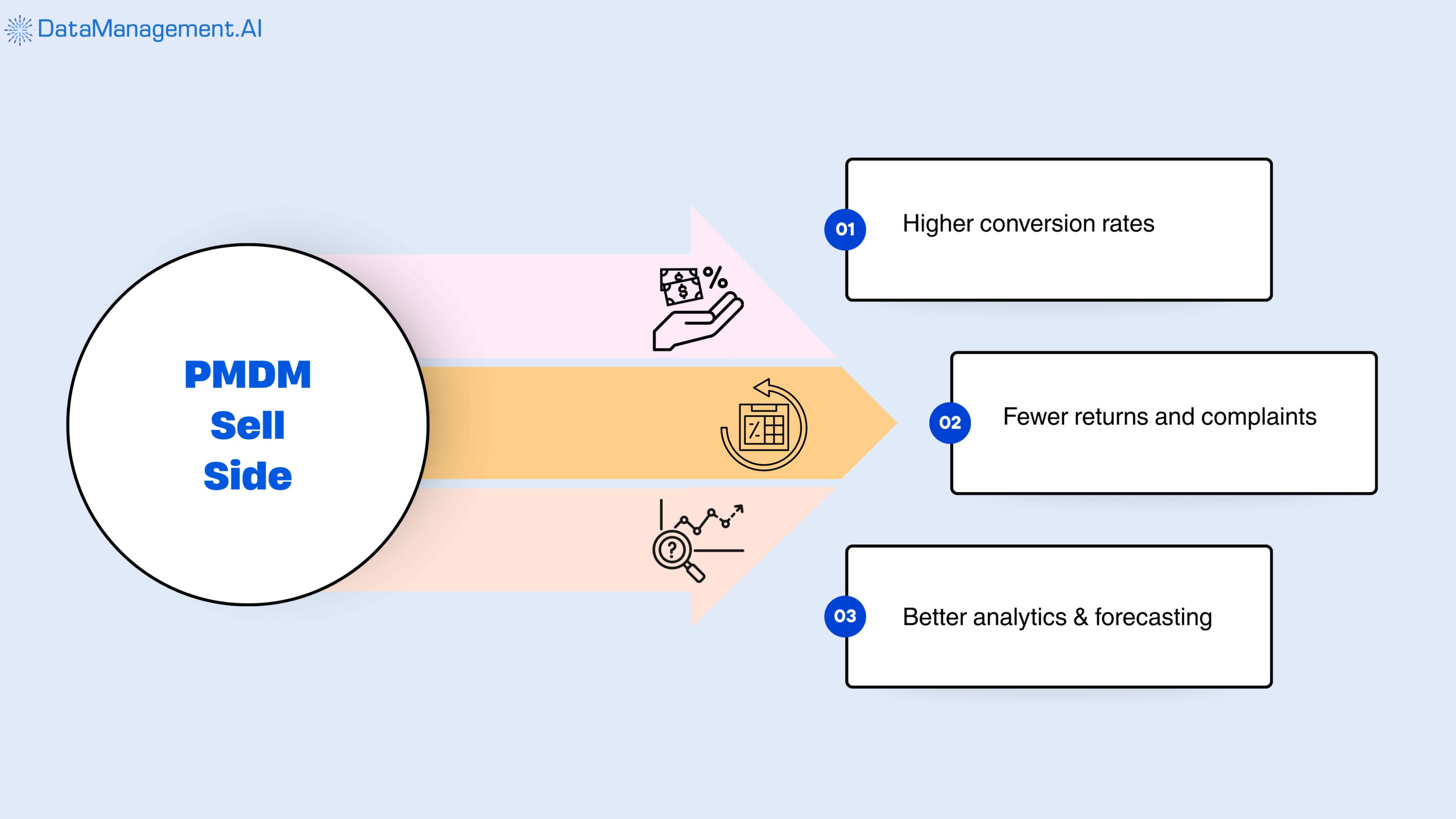
| Pros of PMDM on the sell-side: 1. Higher conversion rates. 2. Fewer returns and complaints. 3. Better analytics and forecasting. |
The future of PMDM
Let me say this upfront.
Product Master Data Management is no longer just about “cleaning SKUs” and pushing catalogs to downstream systems.
That era is over.
Modern PMDM sits right in the middle of supply chain chaos, AI expectations, shifting consumer behavior, regulatory pressure, and thousands of digital touchpoints screaming for consistent product truth.
Let’s break down the two biggest shifts happening right now.
Big data & PMDM
Earlier, a Product Master Data Management’s job was simple: fix messy product fields, remove duplicates, keep naming conventions in check, and move on.
But now enterprises want product intelligence, not just product data.
Because product information is no longer limited to ERP or PLM files. It’s pouring in from:
- Real-time factory sensors
- Supply chain trackers and partner systems
- eCommerce search, click, cart-abandonment data
- Customer reviews, returns, and feedback
- Regulatory feeds
- Sustainability and carbon footprint databases
So, that’s not a product catalog, that’s literally an ecosystem.
And this is exactly where DataManagement.AI steps in:
It helps in automated data quality monitoring.
Instead of quarterly quality scans and “we’ll fix it in the next cycle,” our AI agents check every SKU attribute in real-time, like completeness, formats, taxonomy fits, relationships, referential integrity, and validation rules.
When something is not adding up, it’s flagged instantly, not three weeks later when your marketplace listing rejects it or a factory order fails.
McKinsey has already said that companies that build real-time, data-integrated supply chains see up to a 5% profit-margin uplift and 50% fewer disruptions.
Virtual/Hybrid PMDM approaches
Here’s the thing nobody says bluntly – the “put everything in one MDM hub” thing works only in PowerPoints.
In real life, it slows teams down and kills adoption.
So the new rule is simple:
Move control, not data.
Hybrid and virtual PMDM models are taking over because they:
- Keep product data where it already lives
- Create a unified truth layer without forcing physical consolidation
- Apply governance across systems instead of dragging them into one
- Support multiple domains moving at different speeds
- Also, let marketing, supply chain, and engineering keep their workflows
If there’s one thing this entire conversation makes clear, it’s…
Bad product data isn’t a small operational hiccup anymore. It’s a silent revenue killer.
When 70% of companies are still struggling with product data accuracy and losing real money because of it, this stops being a “data team problem” and becomes a business problem.
Product Master Data Management is what brings order to that chaos.
It gives your teams a shared language, a single source of truth, and the confidence that everyone, from procurement to production to sales, is working off the same reality.
Whether it’s preventing duplicate purchases on the buy-side, reducing internal confusion, or keeping product identity consistent across selling channels, PMDM quietly holds everything together.
But here’s the tricky part: modern product ecosystems move too fast for static rules and manual cleanups. That’s why PMDM today needs to be dynamic, intelligent, and deeply connected to how your business actually works.
This is where DataManagement.AI fits in naturally. Instead of treating PMDM as a one-time cleanup project, it turns it into a living system, continuously deduping, validating, tracking changes, and maintaining a reliable golden record as your products evolve.
The result isn’t just cleaner data; it’s fewer disruptions, faster decisions, and teams that don’t have to second-guess the numbers in front of them.
Schedule a demo with us and sort out all your data problems now!