




Ok, so let me tell you a story.
I was once working with a global retail company that was swamped with messy and inconsistent data. So, like every other ‘data-mature’ organization, they invested quite a lot to fix the issue and use Master Data Management across their systems.
At first, everything looked fine, but a deeper look revealed there were still tons of data duplicates, incomplete fields, missing details, etc.
This is odd given MDM was in place. But I have said earlier that Master Data Management is not just about sorting data. It fixes the complete framework of a company, and if not implemented correctly, it can lead to complexities.
And what would be the cause? A mismatch of MDM value to business value.
In this piece, we will talk about everything you need to know about MDM implementation styles and how to do it right.
Let’s start with the importance of implementation.
Why does Master Data Management implementation style matter?
Because in the world of data, nothing is in a one-size-fits-all format. Every sector, industry, and company demands something unique that caters to its specific needs.
When it comes to implementing Master Data Management, what most founders understand too late is that it is not a technical decision; it’s a strategic one. So, they need to observe and analyse more to find the correct approach.
| The best way to understand this would be to take a look at Houston, Texas’s road layout. People often say that the planning is really poor, as it prioritizes car speed over the safety of pedestrians. Thus, the roads are not safe for non-drivers. The same applies to companies using MDM. They need to implement a format that will help every department instead of just a couple. |
Unilever already went through this nightmare.
As one of the world’s largest consumer goods companies, it has to manage data across 190+ countries. We can only imagine the chaos. So, to manage it, Unilever initially adopted a fragmented and region-first MDM approach.
It means that each market, like Europe, Asia, and Latin America, maintained its own version of master data, and there was no global standardization. But this caused varied vendor and SKU codes for the same product.
This disrupted operations. That’s when Unilever realized that it’s important to build and maintain a relationship between systems.
So, they transitioned into a hybrid MDM implementation style, where local systems were responsible for handling contextual data, but the core data was controlled centrally.
This again emphasises why Master Data Management is not just a process of sorting data.
Anyway, now that we know why the implementation part is important, let’s move on to the different approaches.
The five implementation styles everyone uses
In this section, I will not only make you familiar with the different implementation approaches, but I’ll also tell you which approach is more preferred globally.
Registry style
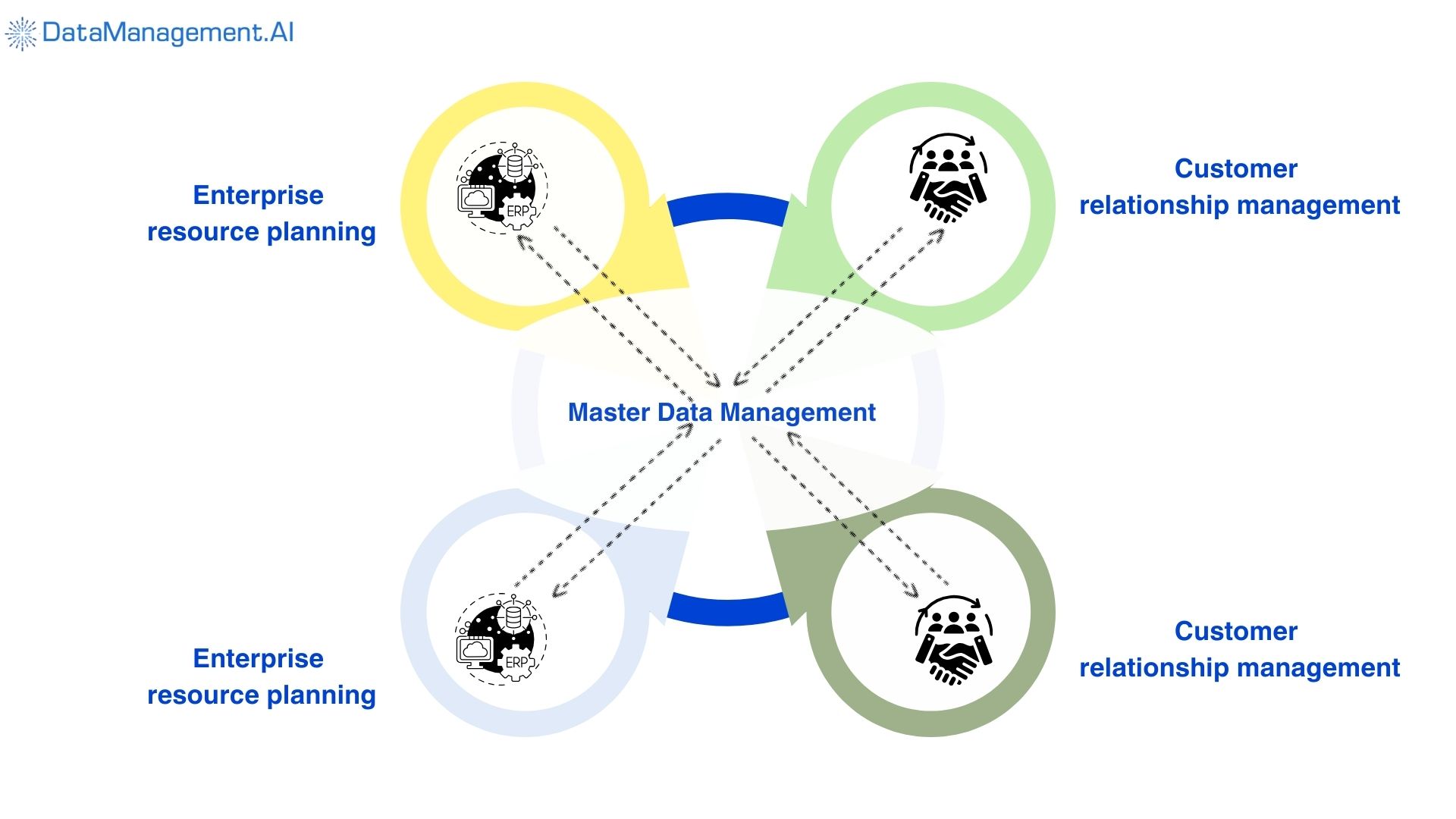
In this approach, the Master Data Management system doesn’t actually store the data. Instead, it acts as an index one can refer to find where the actual data resides. It maintains references, links, and pointers to all data across systems.
DataManagement.AI builds on this model by automatically extracting identifiers, detecting duplicates, enriching attributes, and maintaining the authoritative “golden record.”
This allows the registry to remain lightweight while still providing trusted entity alignment.
This means that a registry-style MDM won’t fetch you the data, but will tell you that “this info lives in CRM,” or “that detail is in ERP.”
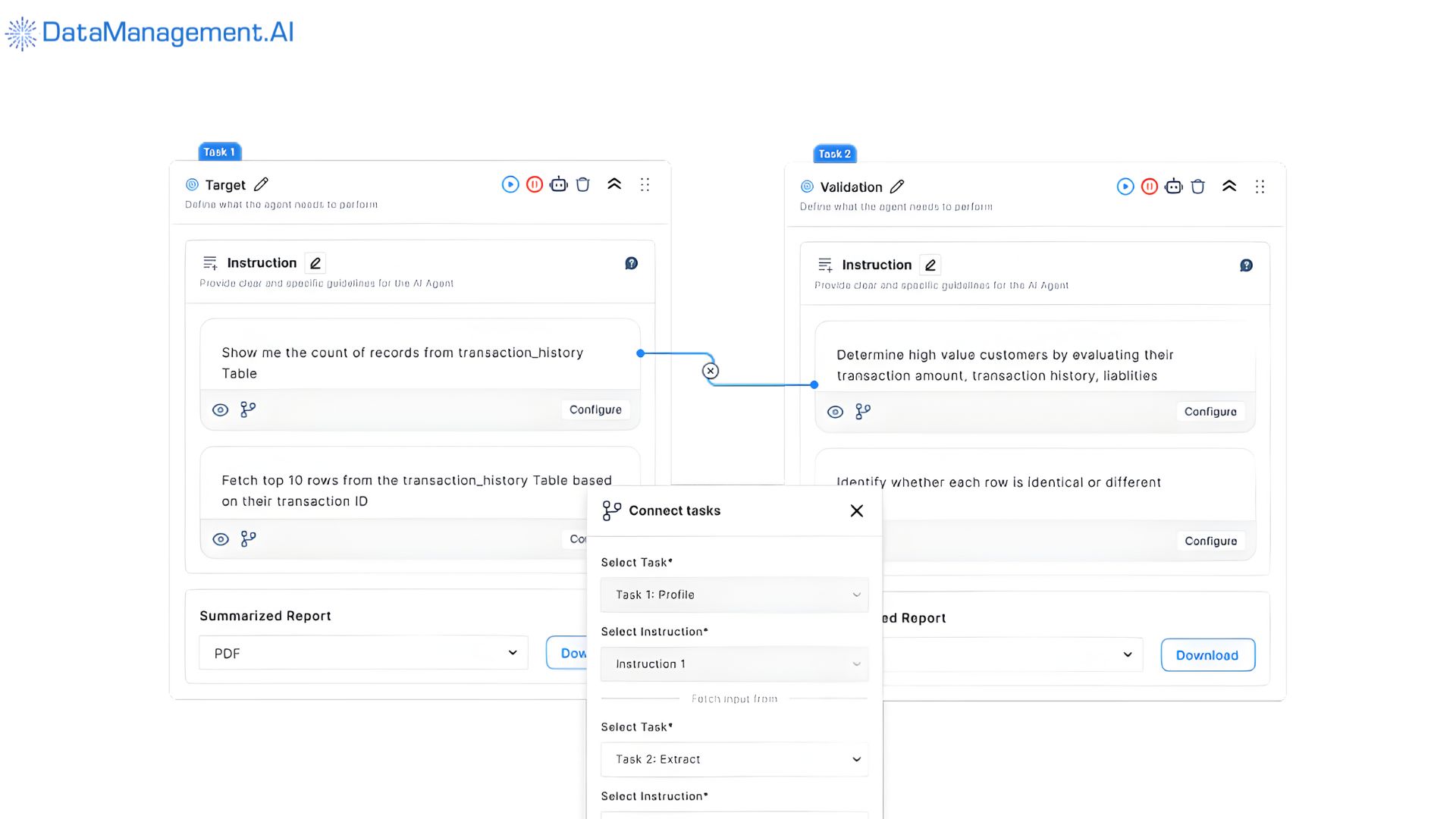
It is because DataManagement.AI has already reconciled records, validated attributes, and mapped relationships across platforms that teams still get a unified view of different entities, which removes the need for data duplication or transfer.
Schedule a demo today!
| So, if a B2C retailer wants a 360° view of customer data to implement personalization in marketing, the MDM system would simply map unique customer IDs instead of pulling millions of customer records from CRM, ERP, and other support platforms. |
| Pros | Cons |
|---|---|
| Minimal disruption to existing systems | Limited control as data stays in the source |
| Faster setup and easier to pilot | Inconsistencies may still persist |
| Requires lighter infrastructure | Harder to enforce quality checks |
| Ideal for low-change data domains | Not suitable for interdependent domains |
Consolidation style
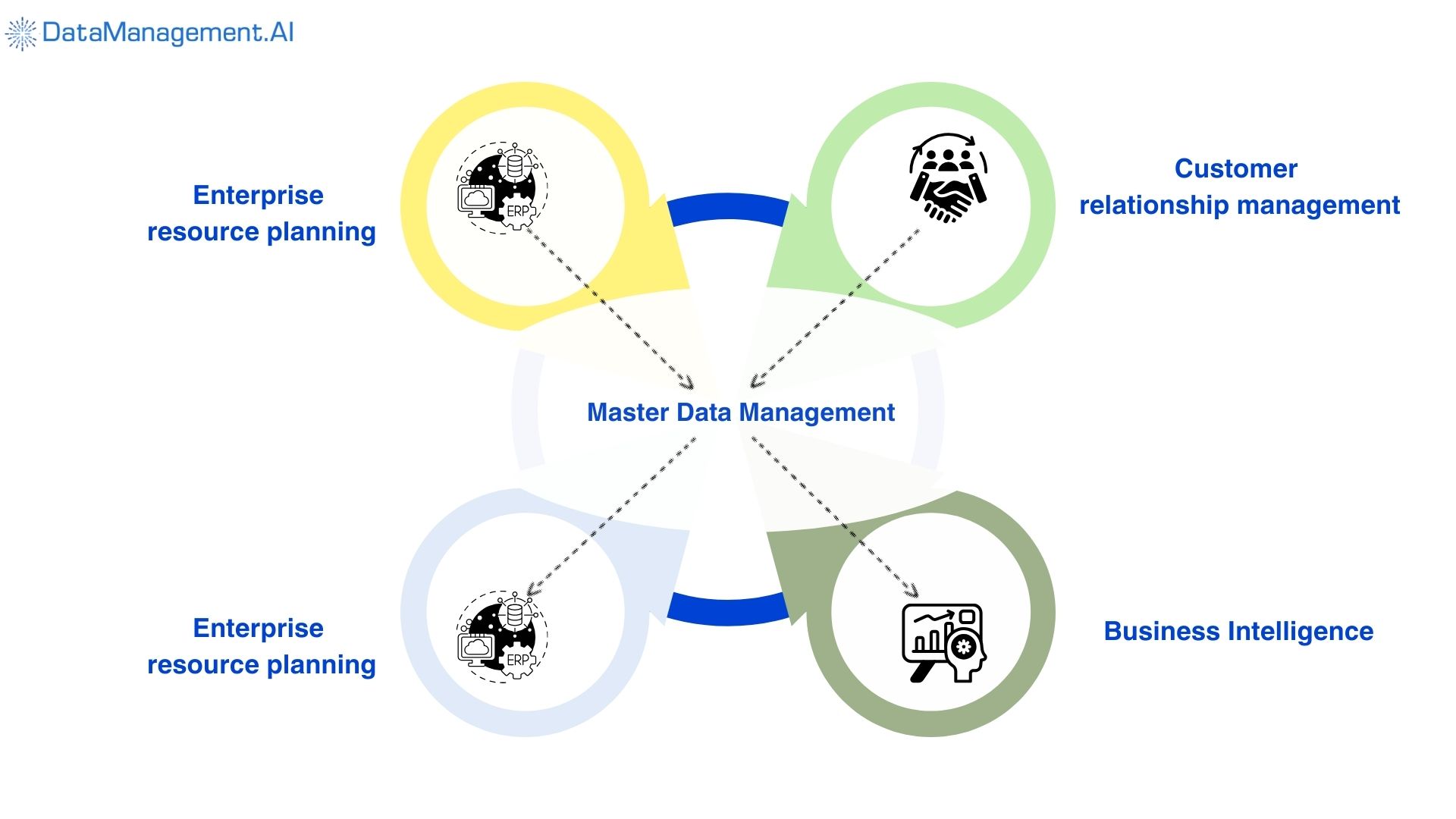
Unlike the registry style, in this one, the Master Data Management system actually stores the data. It ingests master data from different source systems, cleans it, and then merges it.
This approach actually creates the ‘golden record’ of the company’s data. So, now any analytics, reporting, or business intelligence queries draw directly from this hub instead of juggling data from across systems.
| Let’s take the example of a global manufacturing company that operates in 20 countries, with each manufacturing plant having its own ERP system to manage its inventory and data. Now, suppose one factory in Germany lists a product as ‘AX-450 Motor,’ another in India lists it as ‘AX450M,’ and it is called ‘A450 Engine’ in Mexico. So, this will obviously create confusion. But if they implement a consolidation-style MDM system, it will create a standard name for the product and merge the details to prevent any operational delay. |
| Pros | Cons |
| Single source of truth with golden records | High infrastructure and integration cost |
| Enhances analytics and reporting | Longer rollout time |
| Simplifies governance with centralization | May create bottlenecks |
| Reduces duplicate and inconsistent data | Limited real-time sync with source |
Centralized style
Now pay close attention to this: the centralized approach would feel almost the same as the consolidated style.
In this style, the MDM system itself becomes the single source of true data for the company. This means that all creation, updates, and governance happen directly here. Other systems either consume data from it or subscribe to it for updates.
But isn’t that what the consolidation style does? No.
In that approach, data is copied and harmonised from different sources into a central hub for analysis, but updates still happen at the source systems. However, the centralized style completely shifts ownership of the master data to the hub, thus claiming complete ownership.
| Let’s try to understand this better with an example. HSBC operates across dozens of countries and implements centralized MDM for its customer data. This helps the bank’s branches access a single correct version of each customer. The centralized MDM style also helped avoid duplication chances and reduced errors in KYC compliance, while streamlining. On the other hand, there’s Procter & Gamble that uses a consolidated style MDM for its product and supplier data. So, their data from multiple systems is now copied into a central hub for analysis. That means updates still happen in the source systems, and the MDM doesn’t have authority over the data. |
| Pros | Cons |
| Maximum control & consistency across domains | High Implementation cost |
| Easier compliance and auditability | Requires reworking multiple source systems |
| Reduces duplication | Can slow agility |
| Creates one “golden record” | Heavy IT involvement |
Hybrid style
Lastly, we have one of the recently trending Master Data Management styles – the hybrid one. The best thing about this is you don’t have to pick one approach and commit to it.
In this format, the MDM hub would treat certain domains as a registry (meaning it would just refer to the data for analytics without having any control), and would centralize the other data virtually (as in it would be accessible without getting physically copied into the hub).
That is why the hybrid style is also often referred to as virtual master data management.
| Its benefits can be proved with numbers. Experts analyzed that the global MDM market would be $19.9 billion in 2023 and is projected to reach $60.7 billion by 2030. The key external contributing factors are cloud computing and hybrid IT environments, and their principles align with those of hybrid MDM. This proves that this MDM style is set to be adopted by more industries and enterprises. |
DataManagement.AI complements this approach through its ‘Self Service Analytics & Reporting’ service.
Users can retrieve dimensional data such as time, geography, and product hierarchies, fetch fact tables for key metrics like revenue, costs, and transactions, and even pull precalculated aggregate tables or materialized views, all without disturbing the IT team.
With DataManagement.AI’s ability to apply user-defined filters, groupings, and visualization preferences, stakeholders gain true autonomy, answering questions instantly instead of waiting days, while central BI teams see a reduced reporting backlog and higher overall adoption.
| Pros | Cons |
| Adapts different MDM strategies per domain | Requires strong governance to align |
| Enables phased, step-by-step implementation | Linking systems can be demanding |
| Minimizes redundant data copies | Poor coordination can fragment data |
| Accommodates new systems, tools, or data types | Needs advanced IT expertise |
How would you choose the right implementation style?
Now, this is actually the most important part of today’s discussion.
And before you dive into this, remember what I said, that choosing the correct MDM style isn’t a tech decision, it’s a strategic one.
That is why these are some of the factors that you should keep in mind before investing millions in it.
Nature of your data fields
First, you should be clear about what kind of data you’re dealing with. That majorly decides which approach would work best for you.
For example:
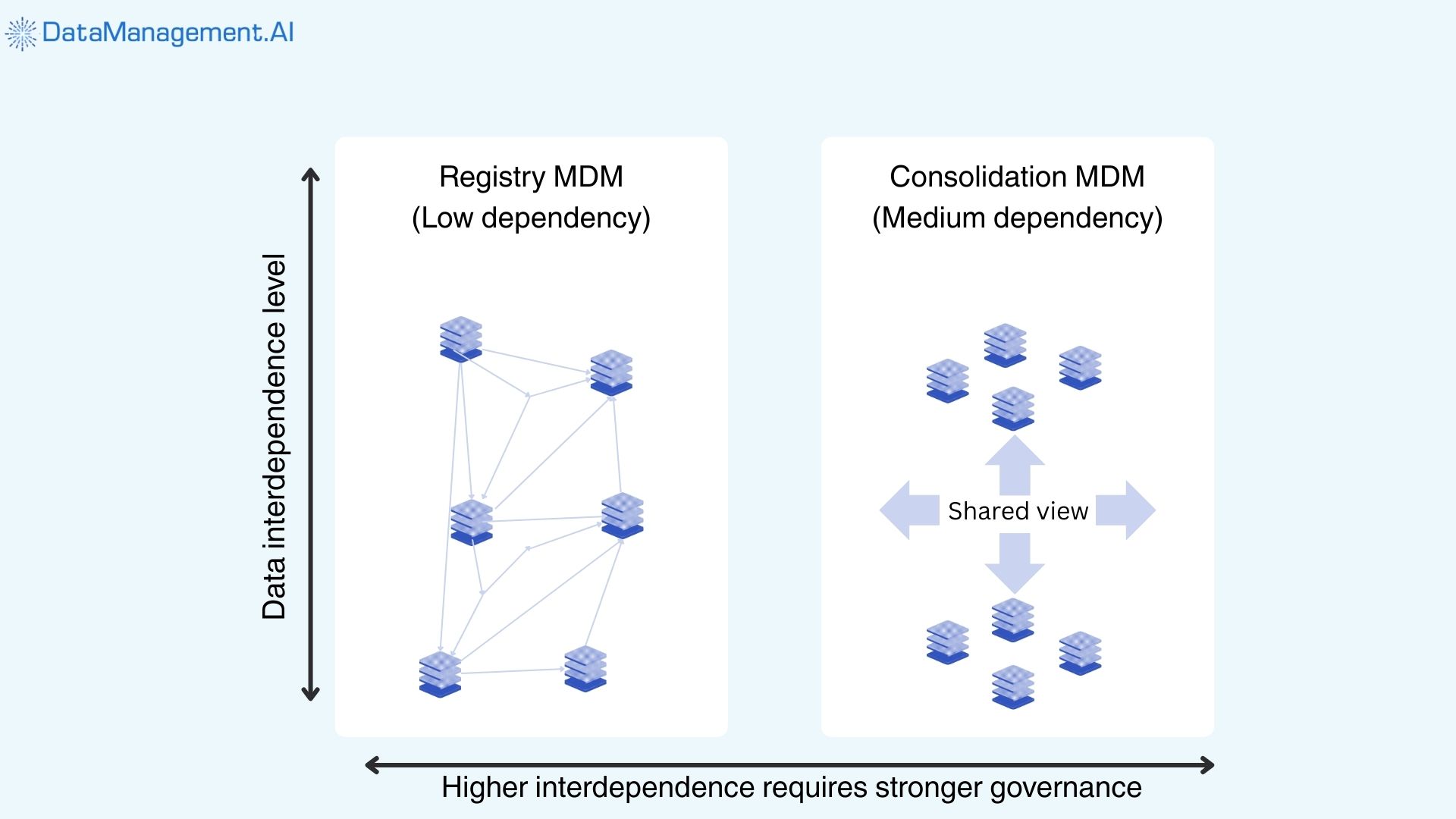
If you deal with highly interdependent fields like customer and product data, where one purchase can influence inventory pricing or delivery schedules, then you should go for Centralized or Hybrid MDM.
It is because your company needs to have a golden record so that a minute change reflects uniformly on all systems.
Next, if you are dealing with moderately interdependent fields like supplier and purchase data, where the supplier may refer to purchased orders, but it doesn’t change how they function, then you can choose Consolidation-style MDM.
This way, there will always be a bridge between all datasets, but central governance isn’t required.
Lastly, if your company mostly works with independent fields like product categories and reference codes, where one change in a data set won’t affect the other, then you should go for Registry-style MDM.
This approach would be best for you, as there’s no need for one dataset to copy another. Thus, choosing other styles would only eat up your space and require more maintenance.
Business goals
Before MDM implementation, you should ask, “Why do you need that data?”
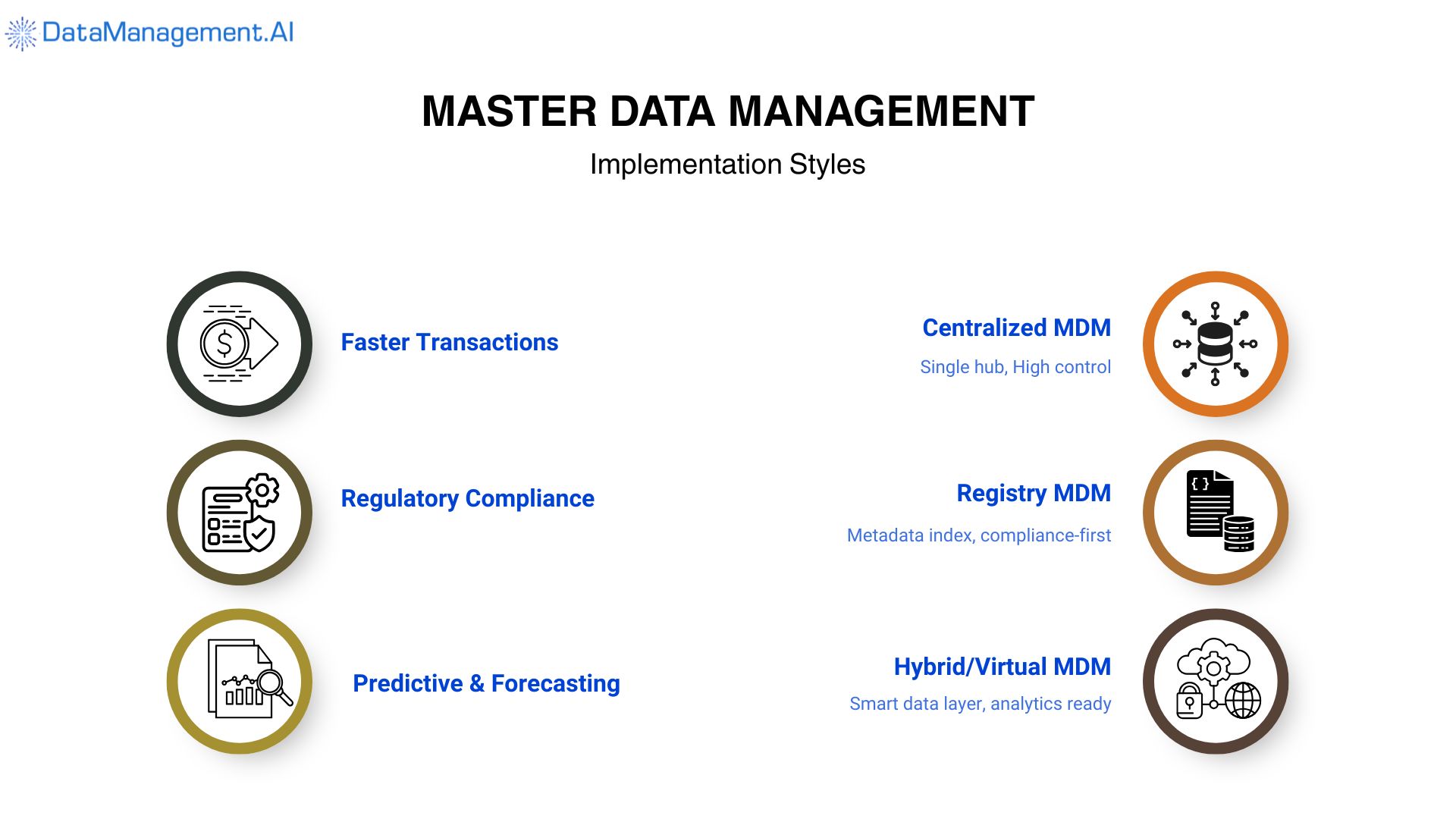
So, if your goal is to make operations more efficient, like making transactions faster and cleaner, then a Centralized-style MDM would work best to make sure that every department interacts with a single customer data.
Next, if you want to automate compliance and governance, like adhering to GDPR, HIPAA, or other state regulations, then the Registry-style would suit you more.
Lastly, if you deal with a lot of analysis and predictive models, then the hybrid or virtual style seems most ideal. This MDM style is built to handle large-scale, diverse datasets without breaking the continuity of the model.
DataManagement.AI enhances this even further by unifying all critical data inputs like historical sales, pricing, promotions, inventory levels, marketing spend, and external indicators into a single smart layer.
With this foundation, we seamlessly run predictive demand forecasting in the background, resolving the common industry challenge of fragmented data and inaccurate manual forecasts.
This makes the hybrid or virtual MDM approach not only scalable, but a powerful, turnkey solution when paired with DataManagement.AI’s forecasting capabilities.
Scalability
If everything in your company is aligned, and now you are only focusing on growing to new regions, domains, segments, etc, then you should go for the hybrid or virtual style MDM.
It will let you expand without ditching your existing architecture. Thus, you will be able to add new domains, data sources, and even business units without reengineering the present MDM hub.
| Let’s understand this with an example. When a company acquires another brand or adds a new product line, and if they implement the hybrid model, it would allow them to quickly virtualize the new datasets into the existing framework while maintaining consistency and governance. |
Master data management is not just “clean data”
To wrap this up, if there’s one takeaway from this entire discussion, it’s that Master Data Management is never about “clean data” alone.
It’s about aligning data decisions with business intent. The retail story we started with is a perfect example of how even well-funded MDM initiatives can fall short when the implementation style doesn’t match how the business actually operates.
Every organization sits at a different point on the spectrum. Some need visibility without control, others need strict ownership, and many need a mix of both.
That’s why understanding registry, consolidation, centralized, and hybrid styles, and knowing exactly when to apply each, is far more valuable than simply following industry trends.
DataManagement.AI makes a real difference here. By supporting hybrid and virtual MDM models, enabling self-service analytics, and unifying fragmented data into a single intelligent layer, DataManagement.AI helps organizations turn master data into something genuinely usable.
In the end, the “right” MDM strategy is the one that grows with your business, empowers your teams, and keeps data working for you instead of against you.
Sign up now and let DataManagement.AI help you.