You can’t protect what you can’t see. That’s why you need data security posture management tools. These aren’t just nice to have, they’re your digital foundation.
Today, I will tell you exactly which data security posture management tools can protect your organization and why they matter more than ever.
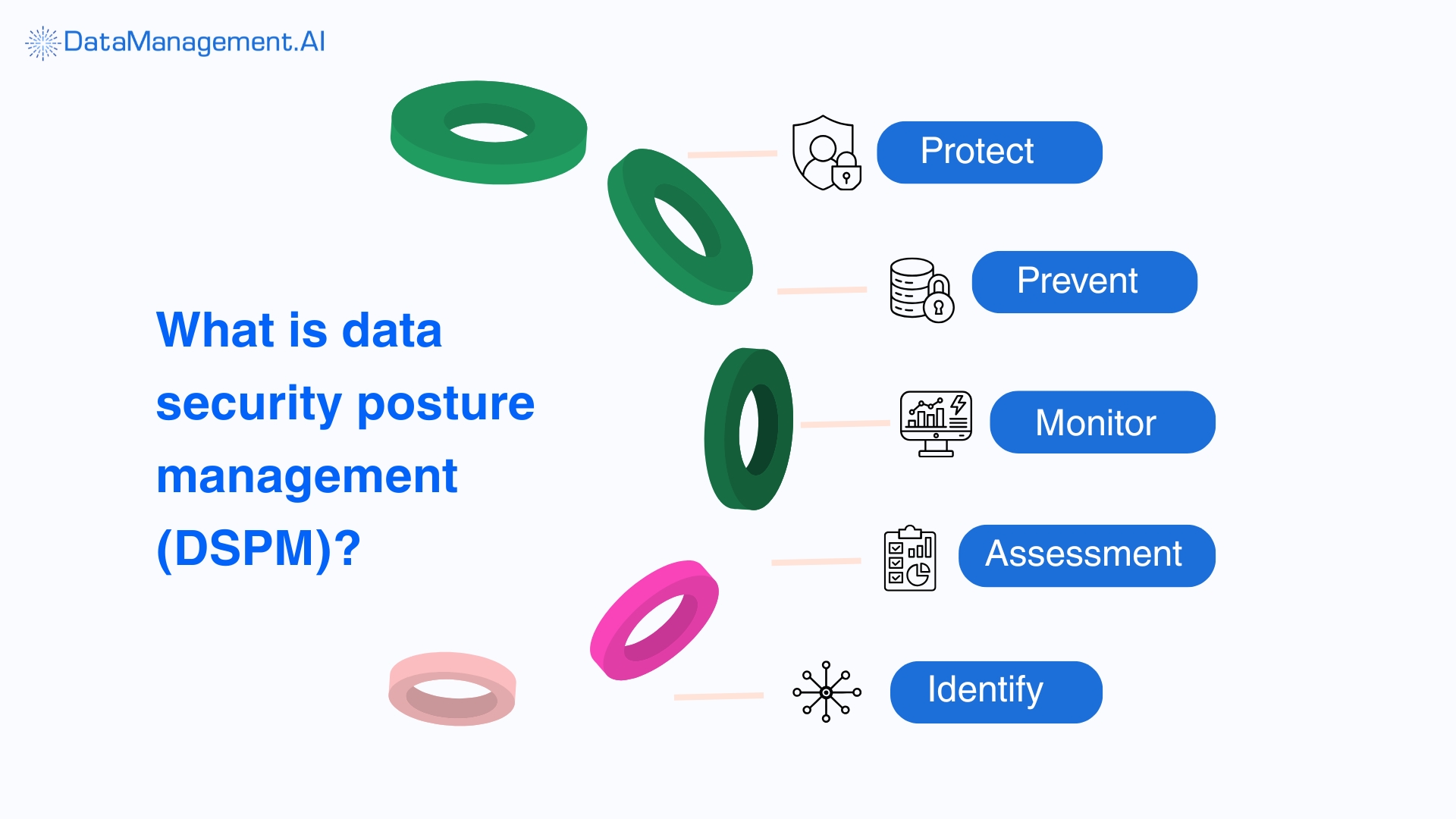
What is data security posture management (DSPM)?
Components of data security posture management.
Think of DSPM as your security health monitor.
It rapidly scans your data landscape. It identifies risks. It flags vulnerabilities. This helps you fix issues before attackers strike.
A data security posture management software does three things:
Cloud storage, SaaS apps, numerous databases, and in legacy systems.
You need visibility and fast.
Why need the best cloud posture management for data security?
Your firewall isn’t enough. Your antivirus isn’t enough.
Traditional data security fails because:
Employees use unauthorized apps. They store data wherever convenient. You lose control here.
GDPR, CCPA, SOC2, and HIPAA, all demand different controls, making manual tracking impossible
Your data lives in 15 different cloud services. Do you know them all? Probably not.
Data security posture management vendors solve these problems. They give you automated discovery, monitoring, and real-time alerts.
Which are the best data security posture management solutions?
The following data security posture management tools will show you exactly how your data moves, where it moves, and how to keep it secure.
DataManagement.AI
DataManagement.AI significantly enhances data security posture management by leveraging an agentic approach.
This approach automates the discovery, classification, and protection of your sensitive information across multi-cloud environments.
But hang on!
Through its core, our agents such as DiscoverAI and GovernAI, provide real-time visibility into your shadow or dark data that often get bypassed via traditional security parameters.
By implementing our content-aware classification, we identify your sensitive entities.
These include PII, PHI or intellectual property.
Datamanagement.AI is the best data security posture management solutions.
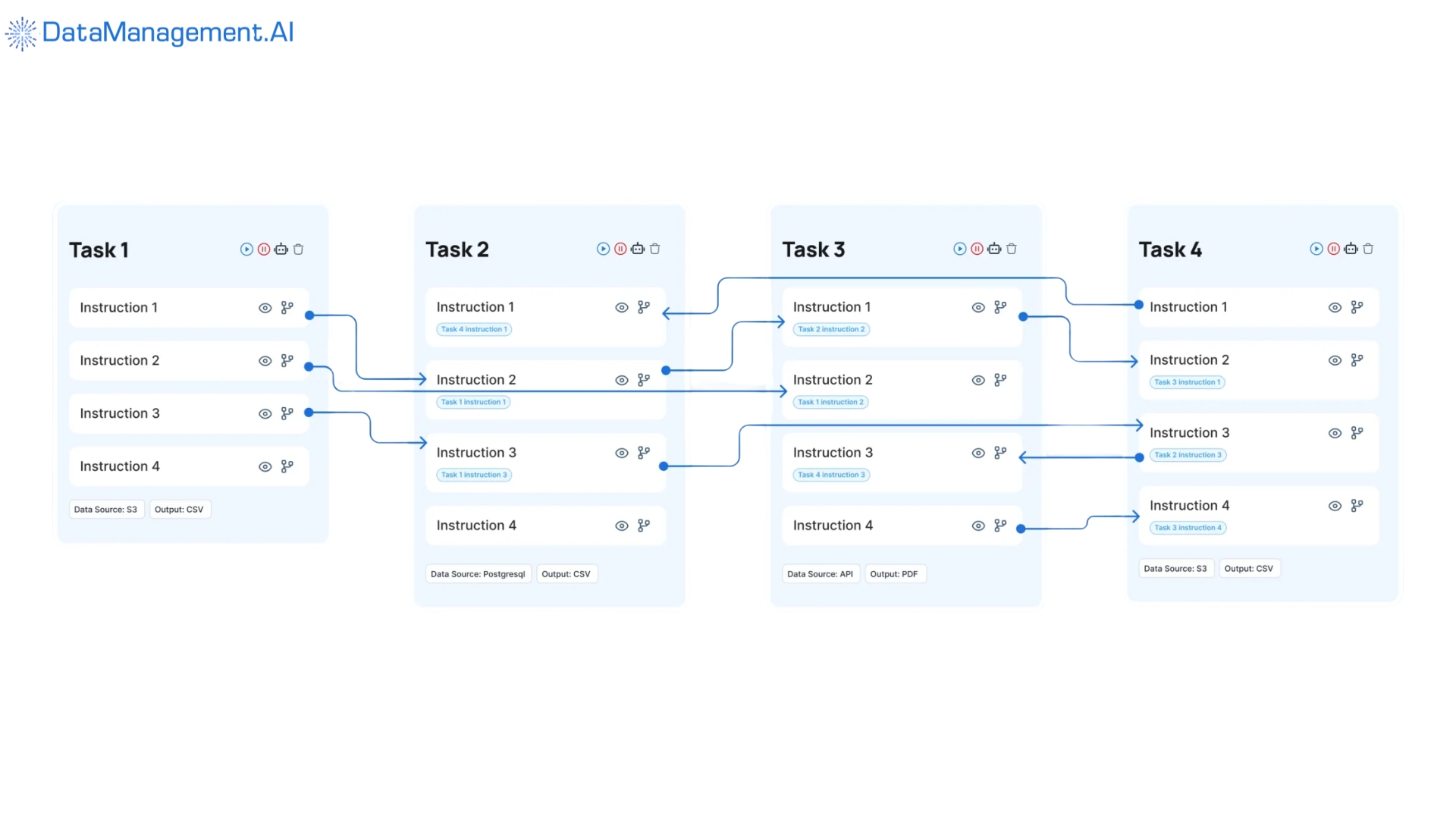
Our top data security posture management solution maps your end-to-end lineage to detect unauthorized data flows or risky configurations.
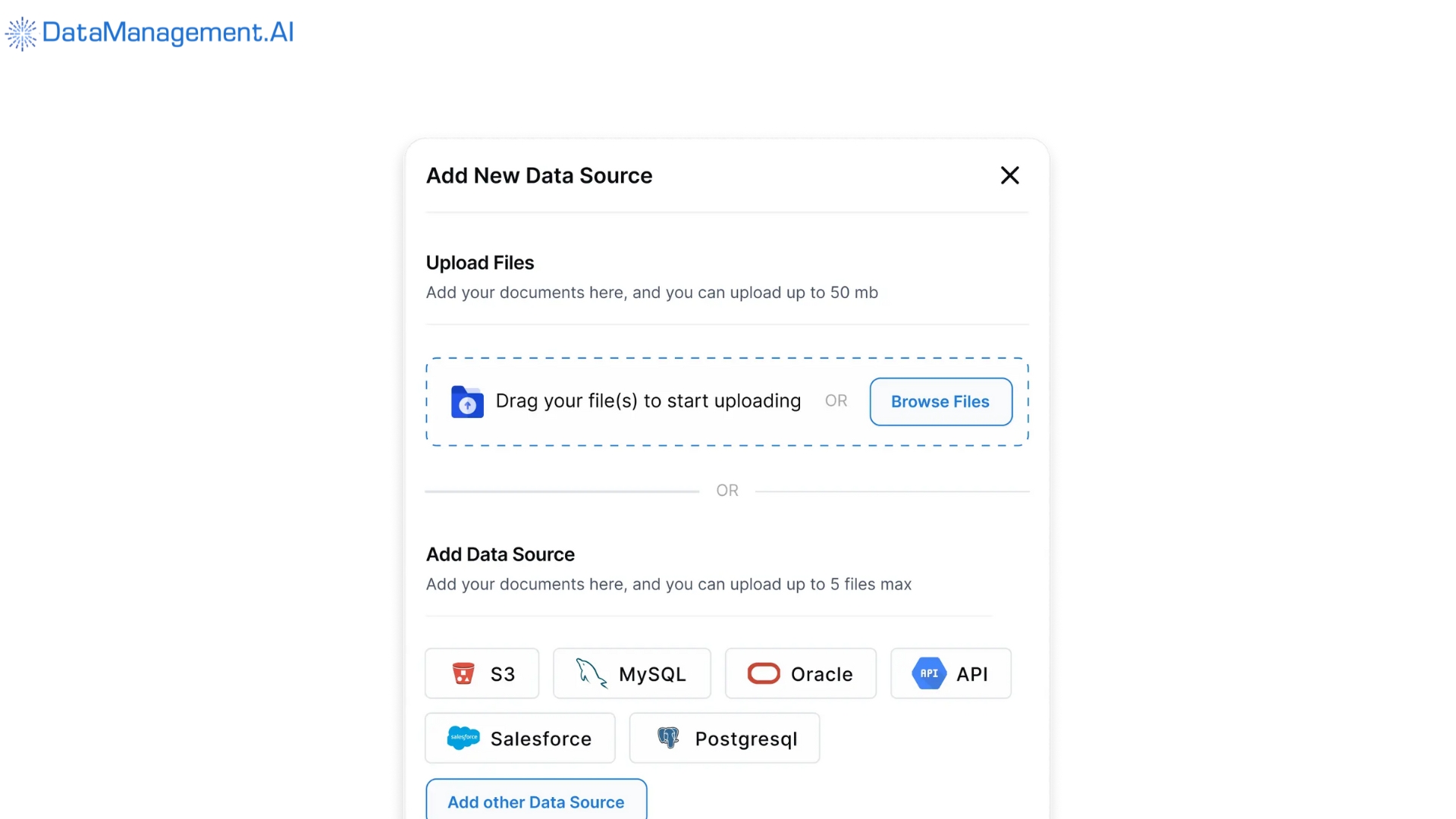
Another standout feature of our data security posture management tool is in-place data interaction.
This allows you to monitor and secure data without moving it from its source. Add to this, our Always-on security framework that enforces granular access policies and continuous authentication.
Datamanagement.AI is the best data security posture management software.
Classifies data based on sensitivity
Applies appropriate security controls
Updates access policies in real-time
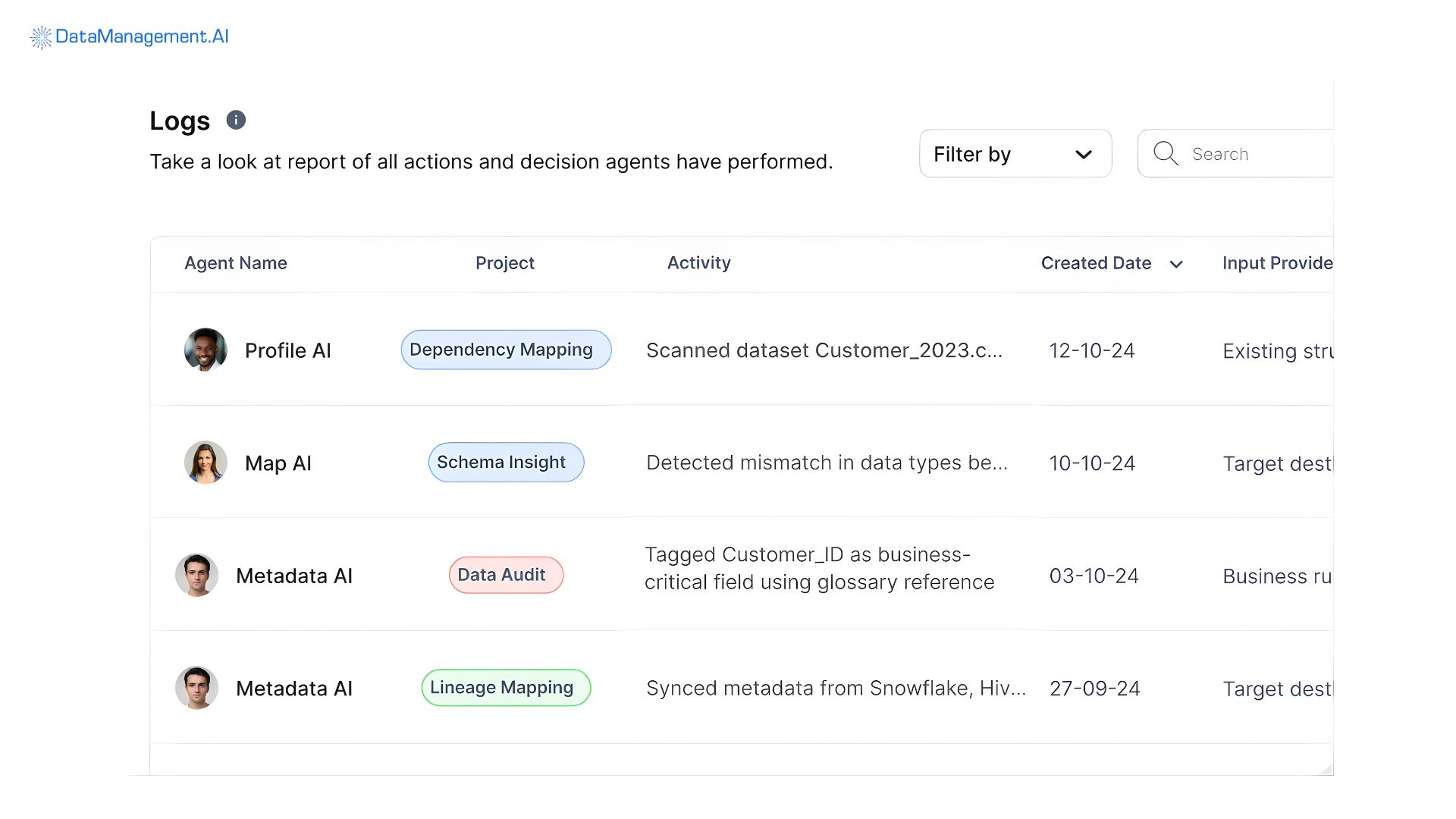
Documents everything for compliance
Traditional DSPM tools react to threats. We predict them.
Datamanagement.ai is the best data security posture management tools.
Data gets contextualized. It is cleaned and organized. It is prepared for use automatically. It is highly efficient.
AI agents, such as ReconcileAI, CleanseAI, and ProfileAI allow users to query, govern, and analyze data security directly from source systems. No time-consuming data replication or extraction. DataManagement.AI is built to eliminate all your data bottlenecks, deliver real-time insights, and significantly reduce operation and infrastructure costs.
The following table covers all the major aspects of this data security posture management software.
Core Features
DiscoverAI- This AI agent automatically scans multi-cloud, hybrid, and on-premise environments to find your dark data without requiring manual credentials.
Agentic classification – Our platform utilizes specialized AI agents to move beyond simple regex, using content-aware ML to identify PII and intellectual property (both structured and unstructured).
Real-time lineage mapping – Our platform continuously tracks data movement to visualize how your sensitive information flows between systems.
GovernAI – This AI agent compares your current data configurations against global regulatory frameworks such as HIPPA, CCPA, and GDPR.
Automated remediation – The platform triggers instant workflows to encrypt your exposed data and revoke over-privileged access.
Key Strengths
Proactive vs Reactive – Unlike your current DSPM tool that audits your logs after an event, our platform monitors the state of your data continuously to prevent breaches.
Contextual Risk Scoring – This prioritizes vulnerabilities by correlating the sensitivity of your data with its accessibility.
In-place interaction – Secures your data at the source. It does not require copying or moving data to a central repository for analysis.
Reduced Alert Fatigue – AI agents filter out noise and false positives. This ensures security teams only focus on verified security risks.
Best Suited For
Highly Regulated Industries – This includes healthcare, finance, and pharma industries. It’s perfect for you if you need continuous compliance with stringent data privacy laws.
Cloud-first Enterprises – Organizations using AWS, Azure, and GCP. These struggle with data sprawl and fragmented security visibility.
Data-Intrusive Tech Firms – Companies that manage large volumes of unstructured data such as logs, images, and PDFs, where manual classification is impossible.
Deployment Strategy
Hybrid-Cloud Native – DataManagement.AI is primarily deployed as a SaaS layer that connects via APIs to cloud providers. We also offer a private instance for organisations that need security metadata to remain within their own VPC (private cloud).
Phased Rollout – We begin with a Discovery Phase, then Classification, and finally Enforcement.
Integration & Scalability
API-First Integration – We plug directly into your security operations center including SIEM tools and IAM providers.
Normalyze
An example of data security posture management solutions is Normalyze.
Normalyze is based out of California and was started by Amer Deeba in 2020. Normalyze maps data flows automatically.
Its ‘data-first’ approach to cybersecurity allows it to see exactly where data moves. No guesswork.
In October 2024, they reached a significant milestone when it was acquired by Proofpoint. This move integrated Normalyze’s AI-powered discovery and risk analysis with Proofpoint’s human-centric security ecosystem.
The following table covers all the major aspects of this data security posture management software.
Core Features
Automatic Data Discovery
Data Access Graph
Monetary Value Assignment
AI-Powered Classification
Key Strengths
Agentless Architecture
In-Place Scanning
Contextual Risk Scoring
Weaknesses
On-Premise Limitations
Market Consolidation
Initial False Positives
Pricing Model
Normalyze typically uses subscription-based pricing.
Teams looking to consolidate DSPM and DLP into one platform
Deployment Strategy
Agentless, API-first approach
Read-Only Access via native cloud APIs (AWS, Azure, GCP)
In-Situ Analysis (scans data within the customer’s environment)
Unified Management through a centralized dashboard
Integration & Scalability
Native integration with existing SecOps tools (SIEM, SOAR, Jira)
Designed for automated remediation workflows
Scalable across multi-cloud and SaaS environments
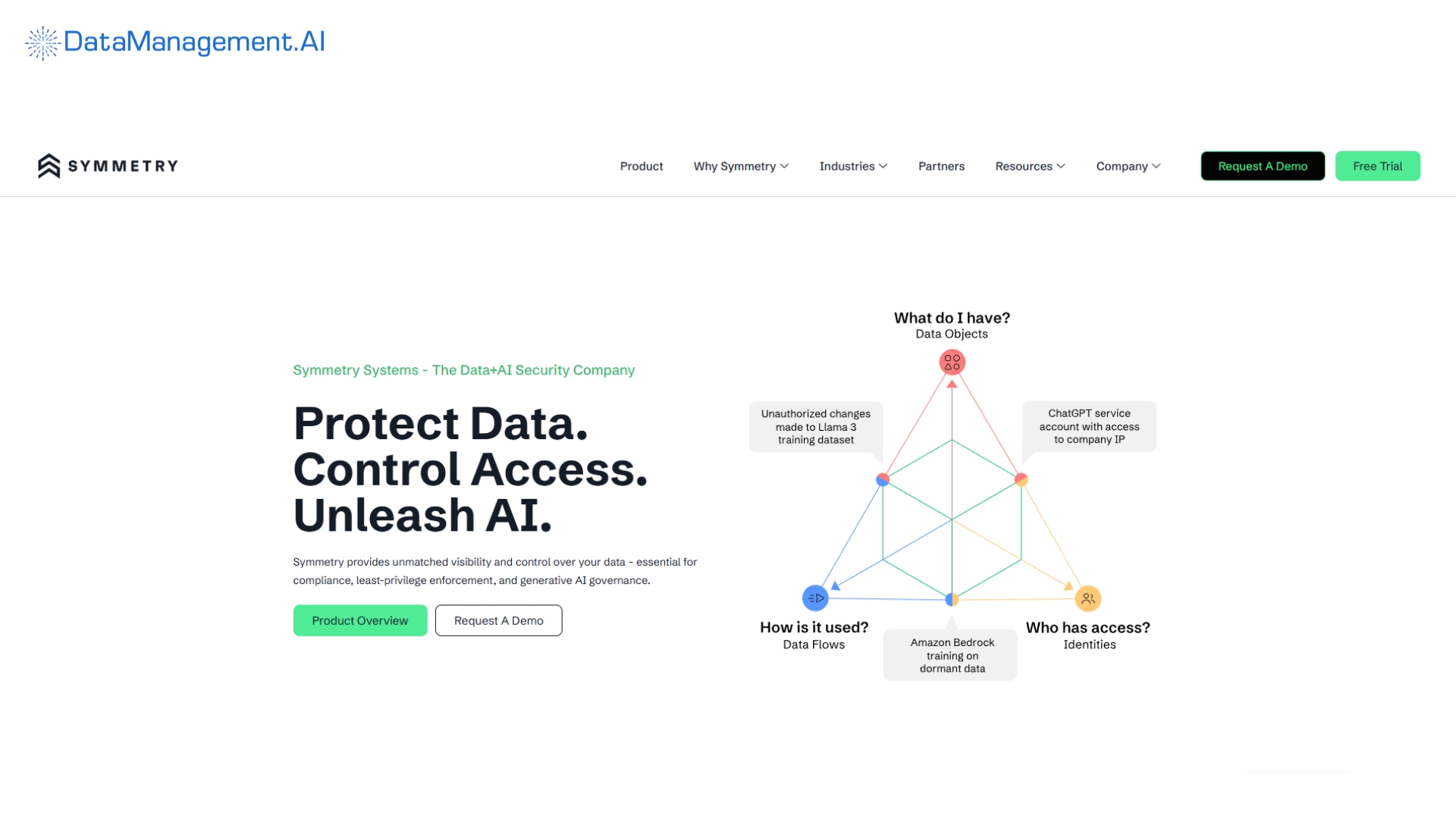
Symmetry Systems (DataGuard)
An example of data security posture management solutions is Symmetry Systems.
Symmetry Systems (DataGuard) prioritizes a ‘data out’ approach to security.
It focuses on the relationship between specific data objects and identities. Their platform ensures sensitive information never leaves the company and maps complex data flows.
The following table covers all the major aspects of this data security posture management software.
Core Features
Identity-to-Data Mapping
Data Object-Level Classification
Data Detection and Response (DDR)
Blast Radius Analysis
Compliance Mapping
Key Strengths
Zero Trust for Data
Hybrid & Multi-Cloud Support
Deep Precision
Internal Data Residency
Weaknesses
UI/UX Complexity
Resource Intensive
Browser Performance
Cost Barrier
Pricing Model
Subscription-based: Annual or multi-year enterprise contracts.
Best Suited For
Highly Regulated Industries: Finance, healthcare, and government agencies with strict data residency requirements.
Large-Scale Multi-Cloud Estates: Organizations managing massive data sprawl across different cloud providers and on-premise servers.
Security-First Teams: CISOs looking to implement least-privilege access and zero-trust architectures at the data layer.
Deployment Strategy
In-Tenant Deployment: Deploys via Docker/Amazon ECR within the customer’s own VPC (Virtual Private Cloud).
Agentless API Integration: Uses read-only service roles (CloudFormation/Terraform) to scan metadata and logs
Three-Phase Onboarding: Involves account identification, log source connection (e.g., CloudTrail), and automated role creation.
Integration & Scalability
Ecosystem Connectors: Native integrations with AWS, Azure, GCP, and Microsoft Purview.
Workflow Automation: Integrates with SIEM/SOAR platforms and Jira to automate remediation of security drift.
Massive Scalability: Proven architecture capable of managing and monitoring yottabyte-scale data environments.
Dig Security
An example of data security posture management solutions is Dig Security.
Dig Security specializes in cloud data security.
Headquartered in Tel Aviv and started in 2021 by Dan Benjamin, the company pioneered the Data Detection and Response (DDR) category.
Palo Alto Networks acquired Dig Security for USD 400 million in 2023, and integrated into the Prisma Cloud platform.
The following table covers all the major aspects of this data security posture management tool.
Core Features
Real-Time Data Detection and Response (DDR)
Shadow Data Discovery
Automated Data Classification
Data Lineage Mapping
Static Risk Analysis
Key Strengths
Real-Time Response
Deep Multicloud Support
Agentless Performance
Platform Integration
Cost for Small Teams
High Alert Volume
Weaknesses
Prisma Cloud Credit System
Data Store Units
Enterprise Scaling
Pricing Model
Large Enterprises: Specifically those on AWS, Azure, GCP, and Snowflake.
Best Suited For
Organizations looking for autonomous data management with minimal human intervention.
Deployment Strategy
Agentless Onboarding: Connects via cross-account IAM roles or Service Principals with no software installation.
Governance Integration: Direct funnels to SOC workflows through Slack, PagerDuty, or Splunk.
Integration & Scalability
Prisma Cloud Ecosystem: Deeply integrated with CWPP, CSPM, and CIEM modules for “Code to Cloud” visibility.
API-First Extensibility: Public APIs allow for custom automated workflows and integration with specialized tools.
Enterprise Grade: Scalable to thousands of cloud accounts and petabytes of data across global regions.
Securiti
An example of data security posture management solutions is Securiti.
Securiti combines privacy and security management.
The company was started by a team of veterans from Symantec and Blue Coat in 2019. They are headquartered in California.
They are known for their ‘Data Command Center’ that unifies privacy, data security, and compliance into a single platform.
The DSPM solution is also recognized for its PrivacyOps roots that helps balance aggressive AI adoption with stricter global regulations such as EU AI Act and GDPR.
The following table covers all the major aspects of this data security posture management tool.
Core Features
Automated Discovery & Classification
AI Security & Governance
Data Access Intelligence
Data Flow & Lineage
Privacy Rights Automation
ROT Data Minimization
Key Strengths
Unified Platform
Pioneering AI Governance
Vast Integration Library
Weaknesses
Breadth vs. Depth
Premium Positioning
Implementation Timeline
Pricing Model
Module-Based Subscription: Modular procurement (e.g., DSPM-only or AI Governance-only).
Consumption Factors: Scaled by the number of connected data systems and total data volume (per TB).
Marketplace Availability: Purchase options through AWS, Azure, or GCP marketplaces for consolidated billing.
Best Suited For
Enterprises with AI Initiatives: Organizations needing to secure GenAI and LLM deployments.
Global Privacy Compliance: Teams requiring automation for DSRs, GDPR, and cross-border data tracking.
Complex Tech Stacks: Firms with highly fragmented data across SaaS, multi-cloud, and on-premise.
Deployment Strategy
Flexible Options: Available as SaaS or Customer-Managed (in-VPC/on-premise).
Agentless Connectivity: Secure API-based connection with zero performance impact.
Federated Remediation: Automated triggers for Jira, ServiceNow, or direct actions like data masking.
Integration & Scalability
1,000+ Native Connectors: Broadest compatibility for diverse cloud and legacy environments.
Scale-Out Architecture: Designed to handle massive, petabyte-scale data estates.
Automated Workflows: Deep integration with IT service management (ITSM) for closed-loop remediation.
BigID
An example of data security posture management solutions is BigID.
BigID focusses on data discovery at scale.
BigDID was founded in 2016 by Dmitri Sirota in New York. Their Data Intelligence Platform integrates data privacy and governance into a single, unified solution.
Unlike point tools that focus on only cloud-native snapshots, BigID is architected for identity-aware discovery across your enterprise landscape,
The following table covers all the major aspects of this data security posture management solution.
Core Features
Identity-Aware DSPM
AI & GenAI Governance
ML-Driven Hyperscan
Agentic Remediation
Data Lineage & Lifecycle
Key Strengths
Hybrid Powerhouse
Identity Correlation
Modular Scalability
Weaknesses
Operational Complexity
Performance Overhead
UI/UX Maturity
Pricing Model
Foundational License: Starts with a “Discovery Foundation” base (approx. $175,000/year for enterprise tiers).
Modular Add-ons: Costs increase based on bundles like Zero Trust, Insider Threat, or Data Minimization.
Volume-Based: Scaled by the number of data source connectors and total data volume managed.
Best Suited For
Large Global Enterprises: Organizations with high-scale, fragmented data across hybrid and legacy systems.
Privacy-Centric Firms: Companies needing automated Data Subject Access Requests (DSAR) and global privacy compliance.
Complex Data Estates: Environments requiring deep, identity-aware context rather than just surface-level visibility.
Deployment Strategy
Flexible Hosting: Available as multi-tenant SaaS, single-tenant cloud, or customer-managed via Docker/Kubernetes.
Remote Scanners: Deploys local scanning nodes to analyze data in-situ, ensuring data residency and sovereignty.
Agentless Discovery: Connects to 200+ sources via native APIs with zero software installation on target systems.
Integration & Scalability
Vast Ecosystem: 200+ connectors including Snowflake, SAP, Salesforce, and major cloud providers.
App Marketplace: First-of-its-kind SDK and marketplace for building custom security and governance apps on the platform.
Enterprise Scale: Microservices architecture designed to handle petabytes of data and thousands of sources.
Varonis
An example of data security posture management solutions is Varonis.
Varonis was started in 2005 by Yaki Faitelson in New York.
Varonis provides a battle-hardened platform that bridges the gap between massive on-premises file systems and modern multi-cloud/SaaS environments.
They are data-first and focus on actual user behaviour rather than just infrastructure settings.
The following table covers all the major aspects of this data security posture management solution.
Core Features
Least Privilege Automation
Data-Centric UEBA
Automated Classification
Managed Detection and Response (MDDR)
AI & Copilot Security
Key Strengths
Active Remediation
Massive Scale
Blast Radius Visualization
Weaknesses
Infrastructure Weight
Legacy Transition
Pricing Complexity
Pricing Model
Annual Recurring Revenue (ARR): Subscription-based model focused on modular licenses.
Per-User/Resource: Typically priced per user count or per managed data source (e.g., per TB or per platform).
Tiered SaaS Packages: Streamlined bundles for cloud customers that combine DSPM, UEBA, and Governance.
Best Suited For
Large Enterprises: Specifically those with massive unstructured data footprints (M365, NAS, SharePoint).
High-Risk Industries: Finance, Healthcare, and Government requiring 24/7 managed threat response.
Microsoft-Centric Shops: Organizations looking to secure M365 environments and AI tools like Copilot.
Deployment Strategy
SaaS-First Onboarding: Agentless API connections for cloud and SaaS (AWS, Azure, GCP, Salesforce).
Hybrid Collector Model: Lightweight local collectors process on-prem data and send only metadata to the cloud.
Phased Scanning: Initial “FileWalk” for permissions mapping followed by deep content classification.
Integration & Scalability
Extensive Security Ecosystem: Native integrations with SIEM (Splunk, Sentinel), SOAR, and AWS Security Hub.
Public APIs: SOAP and REST APIs for custom reporting, entitlement workflows, and data exports.
Cloud Elasticity: Leverages Azure/AWS infrastructure to scale capacity automatically for petabyte-scale growth.
“Data security isn’t just about preventing breaches anymore. It’s about understanding your data so deeply that you can predict and prevent incidents before they happen. That’s the future of DSPM.”
— Satya Nadella, CEO, Microsoft (Microsoft Security Summit, 2024)
Satori
An example of data security posture management solutions is Satori.
Satori was founded in 2019 by Eldad Chai in Tel Aviv.
Satori delivers data security posture management software with a unique approach. Its Data Security Platform (DSP) moves beyond static visibility into real-time enforcement.
In July 2025, Satori was acquired by Commvault, which integrated Satori’s advanced access controls with Commvault’s broader security ecosystem.
The following table covers all the major aspects of this data security posture management solution.
Core Features
Universal Data Access Service
Just-In-Time (JIT) Access
Continuous Discovery & Classification
Dynamic Data Masking
Unified Audit & Lineage
Key Strengths
No Schema Changes
Decoupled Security
Frictionless Self-Service
Weaknesses
Integration Complexity
Performance Latency
Enterprise Learning Curve
Pricing Model
Starter: USD 2,999/month (up to 10 data sources)
Professional: USD 7,999/month (unlimited sources)
Enterprise: Custom pricing with dedicated support
Best Suited For
Per Active Data User: Subscription billed annually based on unique users accessing data through the platform.
Tiered Tiers: Scalable plans (Team, Business, Enterprise) based on data source count and advanced feature needs.
Bundled Resilience: Now available as part of Commvault’s broader Cloud Cyber Resilience suites following its acquisition.
Deployment Strategy
Modern Data Teams: Organizations using Snowflake, Databricks, BigQuery, or Redshift who need rapid data democratization.
DataSecOps Adoption: Teams looking to integrate security directly into the data engineering workflow..
Integration & Scalability
Native Terraform/API Support: Fully automatable infrastructure-as-code integration for DevOps teams.
Multi-Cloud Scalability: Kubernetes-based architecture designed to scale across any cloud or on-prem environment.
Ecosystem Connectors: Seamlessly bridges popular data tools like Snowflake, Looker, and Tableau
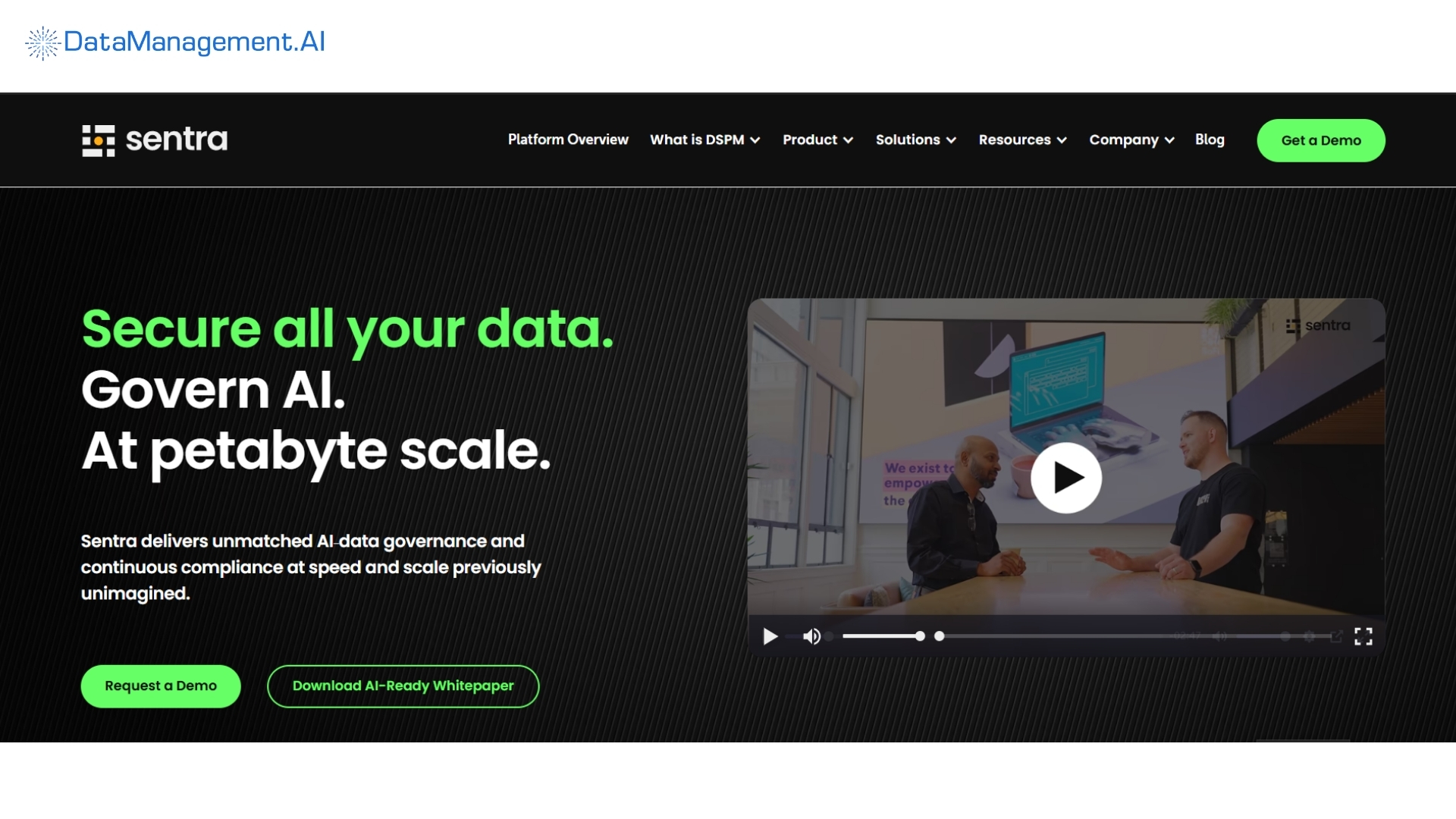
Sentra
An example of data security posture management solutions is Sentra.
Sentra was started by Yoav Regev and his team in 2021. In April 2025, the company secured USD 50 million in Series B funding that let them fuel their expansion into AI-specific data security.
They help companies discover, classify, and protect their sensitive assets across SaaS and cloud environments.
The following table covers all the major aspects of this data security posture management solution.
Core Features
Agentless Data Discovery
AI-Driven Classification
Data Security for AI Agents
Data Detection and Response (DDR)
Posture & Compliance Mapping
Key Strengths
High Precision
AI Safeguards
Data Movement Tracking
Data Sovereignty
Weaknesses
Learning Curve
Integration Overhead
Cloud-Centric Bias
Pricing Model
Tiered Subscription: Options typically range from Standard ($50k/yr) to Enterprise ($500k+/yr).
Custom Enterprise Quotes: Tailored based on data store count, total volume (per TB), and specific feature modules.
Usage-Based Scaling: Predictable budgeting that scales alongside the organization’s cloud footprint.
Best Suited For
Global Enterprises: Companies with hundreds of petabytes across AWS, Azure, GCP, and Snowflake.
AI-Adopting Organizations: Teams needing to secure data used by AI agents and LLMs.
Regulated Sectors: Healthcare, Finance, and E-commerce requiring strict adherence to residency and privacy laws.
Deployment Strategy
Read-Only API Connection: Agentless connection via IAM roles or Service Principals with no software installation.
In-Situ Analysis: Scans data locally within the customer’s VPC to maintain privacy and compliance.
Smart Sampling & Delta Scanning: “One-pass” scanning that only analyzes new or changed data to minimize compute costs.
Integration & Scalability
Massive Scalability: Proven to manage over 1 billion assets while maintaining high query performance.
Ecosystem Connectivity: Deep integrations with SIEM, SOAR, and ITSM tools (e.g., Splunk, Sentinel, Jira)
DLP Enrichment: Automatically tags sensitive data to enhance the effectiveness of existing DLP solutions like Microsoft Purview.
Wiz
An example of data security posture management solutions is Wiz.
Wiz began operations in 2010 from New York.
They are recognized for their Cloud-Native Application Protection Platform (CNAPP) and focus on agentless, graph-based architecture.
The following table covers all the major aspects of this data security posture management solution.
Speed, flexibility, and AI-driven automation via ‘agentic workflow’ for real-time, in-place data governance and quality.
Core Features
Agentless Discovery
Deep Data Classification
The Wiz Security Graph
AI Data Security
Continuous Compliance
Key Strengths
Speed to Value
Contextual Risk Prioritization
Unified Platform
Market Dominance
Weaknesses
High Cost
Cloud-Centric Focus
Feature Complexity
Pricing Model
Starter: USD 2,999/month (up to 10 data sources)
Professional: USD 7,999/month (unlimited sources)
Enterprise: Custom pricing with dedicated support
Best Suited For
Large Enterprises: Organizations with massive, complex multi-cloud infrastructures.
Regulated Industries: FinTech, Healthcare, and SaaS companies managing high volumes of PII/PHI.
Fast-Scaling Startups: Companies requiring security to keep pace with rapid DevOps and CI/CD cycles..
Deployment Strategy
100% Agentless: Connects via read-only API access (IAM roles) without software installation.
SideScanning Technology: Analyzes disk volumes out-of-band to ensure zero impact on live application performance.
Continuous Monitoring: Recurring scans to detect “shadow data” or new misconfigurations in real-time.
Integration & Scalability
Vast Ecosystem: Native integrations with SIEM (Splunk, Sentinel), SOAR (Cortex XSOAR, Torq), and Ticketing (Jira, ServiceNow).
Shift-Left Security: Integrates into CI/CD pipelines (GitHub, GitLab, Jenkins) to scan IaC and code for data exposure.
Proven Scale: Architecture built to handle hundreds of thousands of cloud accounts and petabytes of data.
Single Policy Engine: Consistent security and compliance enforcement across diverse multi-cloud environments.
Data security posture management tools are part of the solution
So there you have it. A list of the top data security posture management tools.
But data breaches will not slow down. They will in fact accelerate further.
The solution is the bigger picture, with these DSPM tools only being a small part.
You need tools, strategy, integration, and continuous improvement.
DataManagement.AI brings all the above aspects together. Our intelligent, AI-native platform simply doesn’t monitor your data security, but actively improves it.
Schedule a quick demo to stop reacting to breaches and getting the prevention up and running.
Your data deserves better than a prayer. Give it intelligent, automated security.
<a href=”#”>h</a>
Recommended Blogs
Dive into expert blogs on data management trends, strategies, and tools.
Role of Big Data and Knowledge Management for Enterprise
Your enterprise no longer competes on data volume. The real edge is now knowing how effectively you can convert distributed…