




In 2020, Citigroup was in a spot of bother.
They were fined USD 400 million.
The reason was their poor data governance and data management systems. They struggled to generate close to 11,000 regulatory reports accurately.
Up until last year, they were still being penalized close to USD 82.8 million.
For me that’s not a compliance problem. It’s the misunderstanding of how data governance and data management differ.
It’s massively important to understand the difference between data management and data governance. Citigroup’s fragmented data governance led to operational failures that ruined its core business operations.
Understanding the distinction between data management and data governance is important. The core question for an industry leader like you is “how is data governance different from data management”.
They are not competing functions. One sets the rules, the other plays the game. I will try and build an understanding for you about what is the difference between data management and data governance.
How is data governance different from data management?
Discovering what is data governance and data management requires seeing their symbiotic relationship.
62% of organizations state that data governance was the biggest hindrance to AI advancement due to their issues with data quality, privacy, and lineage.
This stat reveals the integration gap. Strong data management without governance creates hiccups. Robust governance without operational management remains simply theoretical.
Let’s look at each of them separately.
Data Management – The operational layer
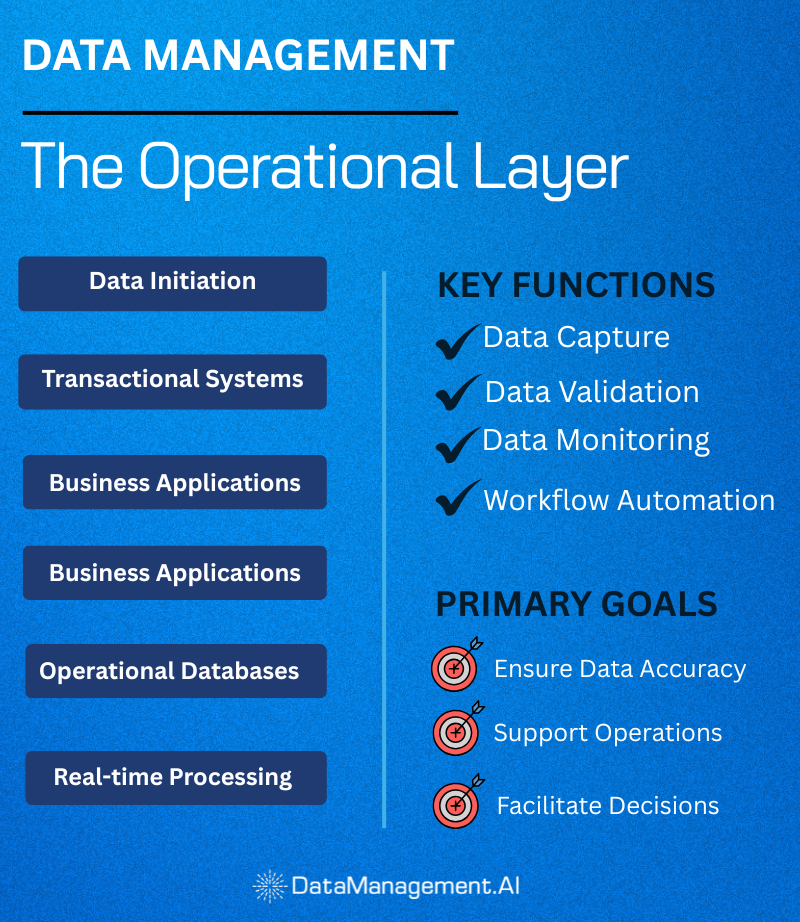
Data management is the operational discipline.
It includes the boring technical tasks that cover your data’s lifecycle. It’s like your data’s execution arm.
It focuses on data quality. It handles large storage and data security. Integration efforts are handled under data management.
The scope of data management vs data governance is wide. So wide that data architecture also falls under data management. Database administration and warehousing tasks also fall under data management.
Data stewards work with data management. They implement the rules that form the foundation of effective data management.
Data management covers everything from data collection, storage, integration, processing, and data analytics.
The key functions of data management are:
- Performance optimization
- Database administration
- ETL/ELT operations
- Data architecture design
- Data integration workflows
- Analytics implementation
Data management is the broad operational practice of organizing, collecting, and utilizing your data throughout its data lifecycle.
Its ultimate goal is to ensure that data is available, trustworthy, and cost-effective, to be used for driving business outcomes.
If you’re on this page, and looking at the differences between data management and data governance, then I assume you are thinking about adopting a tool that either delivers on both fronts or negates the other.
Let me make it easier for you by suggesting a solution that can deliver effective data management solutions along with the benefits of data governance as well.
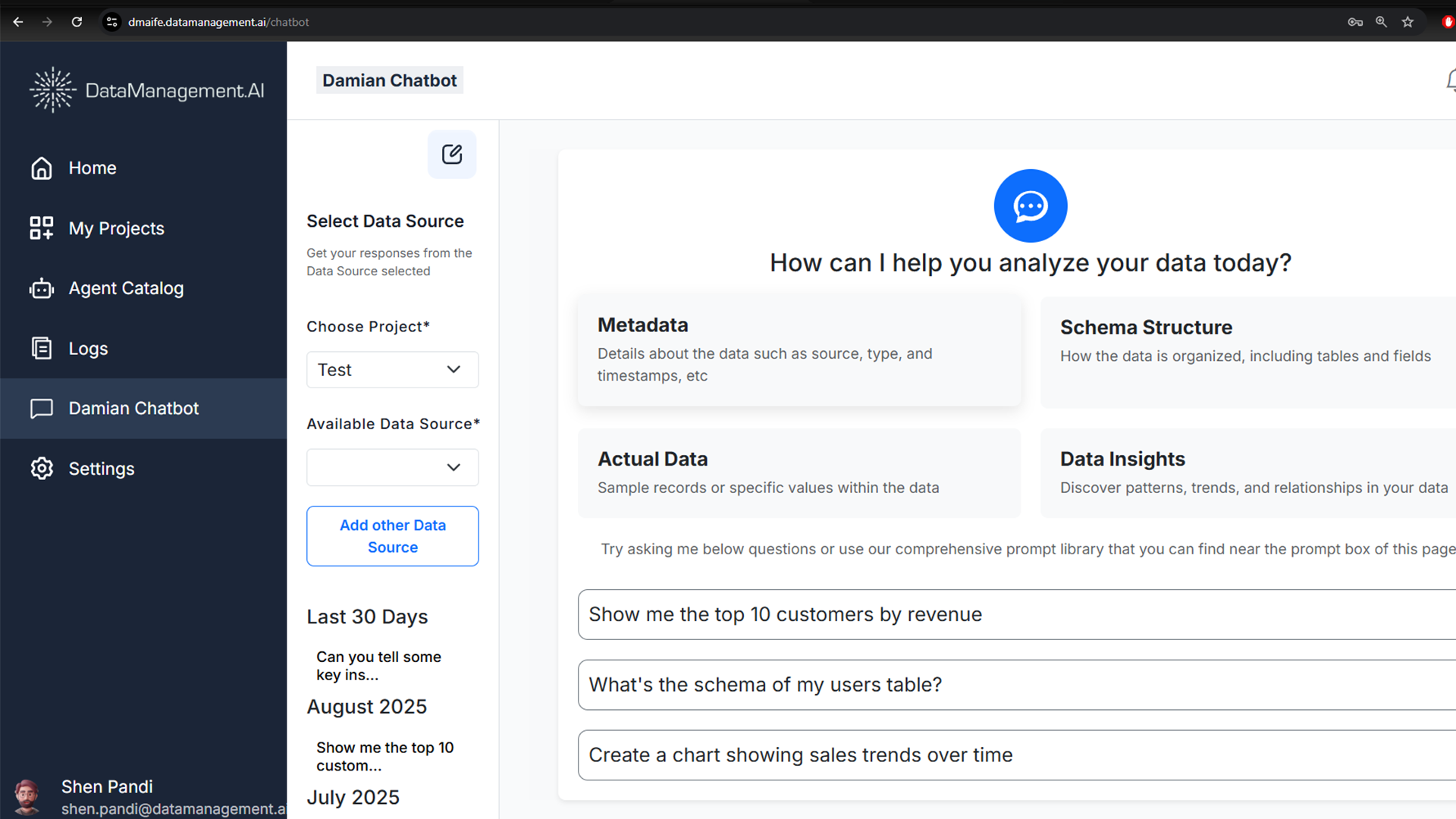
DataManagement.AI revolutionizes your master data management through autonomous AI agents.
The platform provides you with intelligent data quality assessment, along with predictive data governance and automated metadata management.
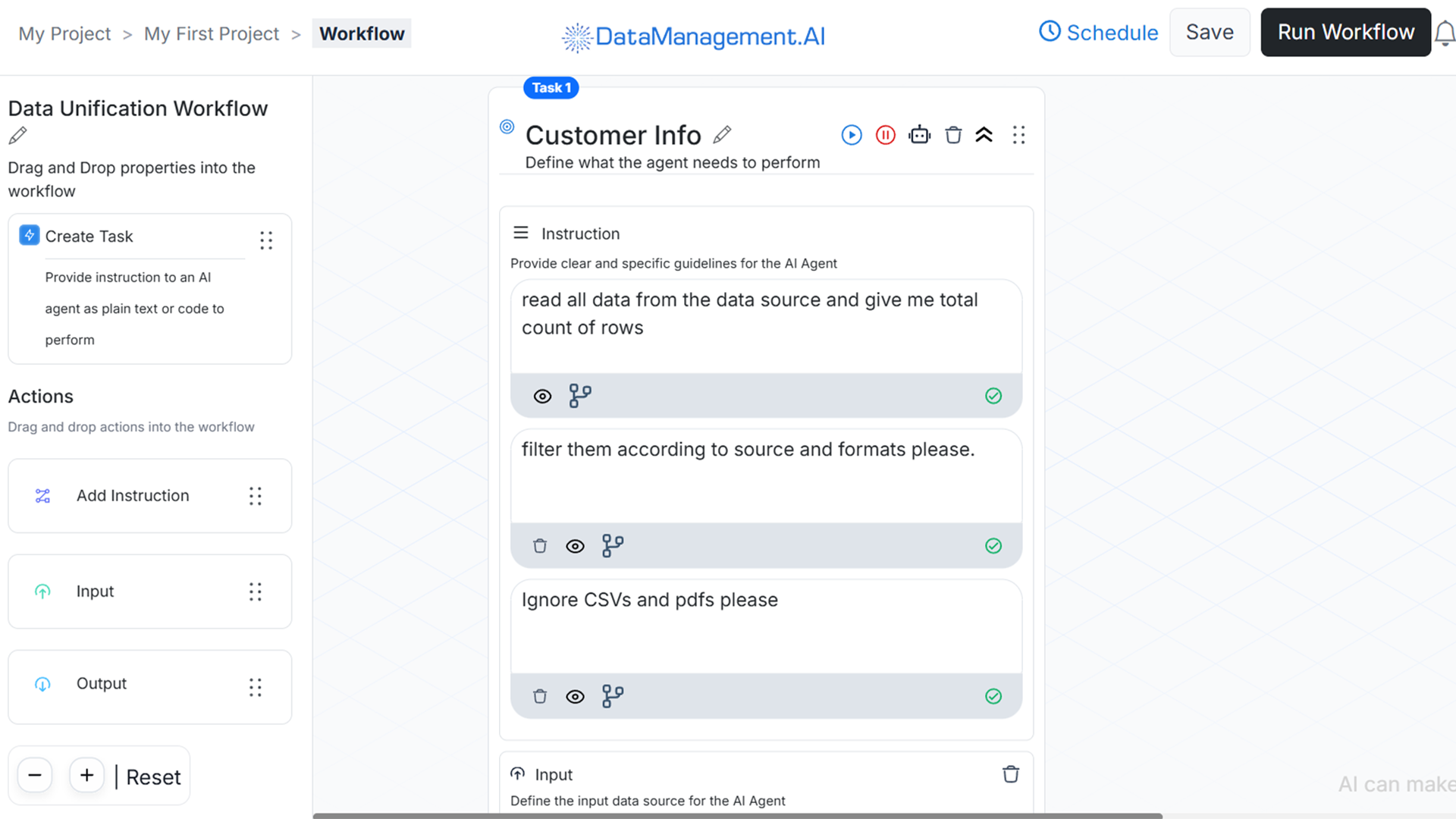
DataManagment.AI is an AI-native data management platform. The ‘Chain-of-Data’ and ‘Agentic Workflow’ approaches focus on automation, operational efficiency, and speed.
This is not just an approach, it’s an intelligent layer. This layer sits over your systems.
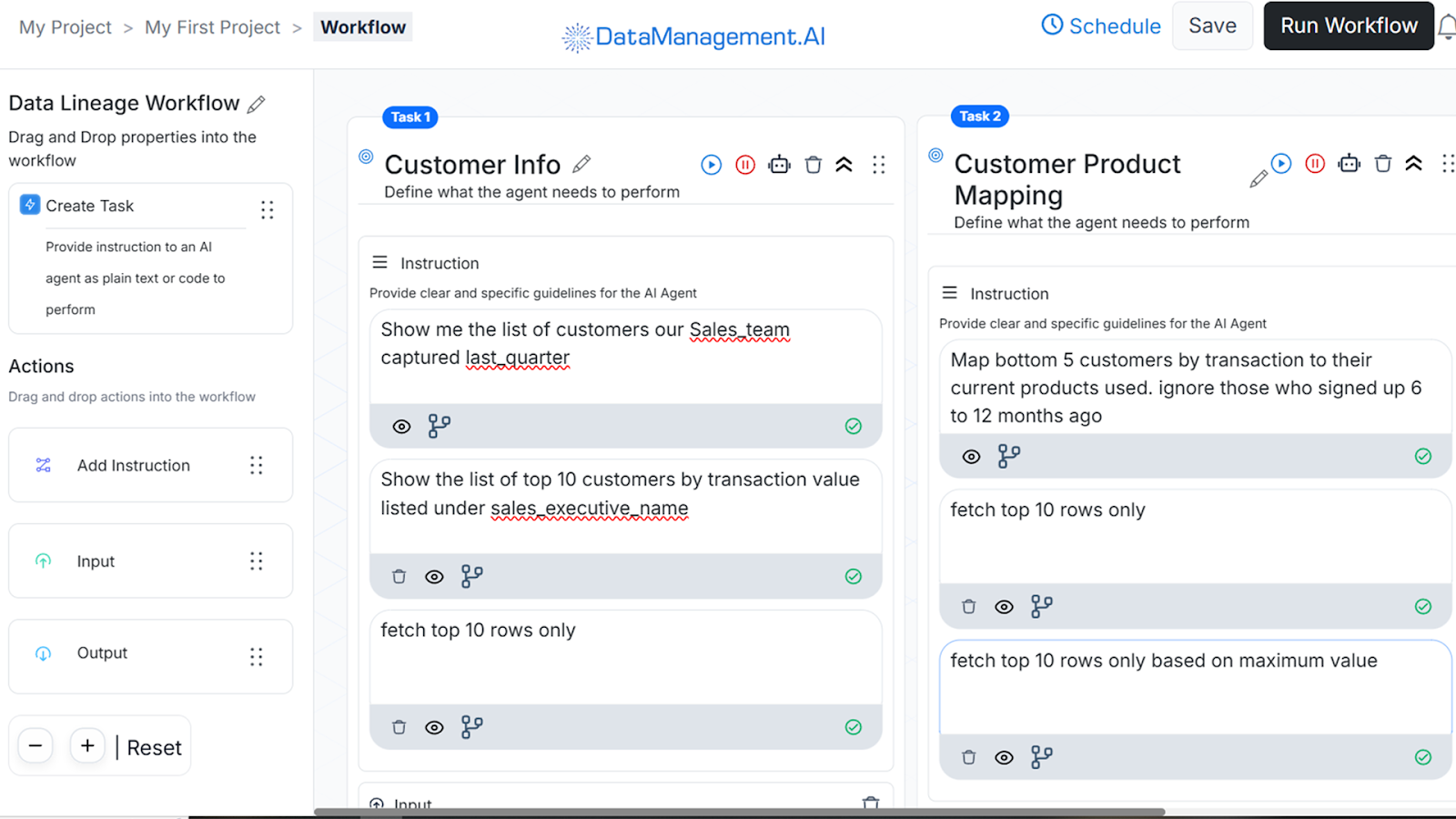
It connects them all seamlessly. Agents ingest your data by gathering it from sources. They bring it into one place. Then the magic happens.
Why not schedule a demo with our data management experts. We can also help you set up a good master data management solution, if need be.
Key functions of data management
Data management is an operational discipline that covers numerous specialized areas of your data lifecycle.
| Function | Description |
|---|---|
| Data Architecture | Designing the overall structure of an organization’s data assets, including how data systems are built and interact. |
| Data Storage & Operations | Managing the physical and virtual systems (databases, data warehouses, data lakes, cloud storage) where data is kept, including ensuring high availability and disaster recovery. |
| Data Integration | The process of combining data from disparate sources (e.g., CRM, ERP, and web logs) and transforming it into a consistent, unified view for analysis. |
| Data Quality Management | Defining, monitoring, and enforcing standards to ensure data is accurate, complete, consistent, and reliable. |
| Data Security | Protecting data from unauthorized access, corruption, or theft through techniques like encryption, access controls, and regular audits. |
| Master Data Management (MDM) | Creating and maintaining a single, trusted version of core business data (like customer, product, or supplier information) across the enterprise. |
| Metadata Management | Collecting and managing “data about data” (e.g. source, format, last update, owner) to help users find and understand the data. |
| Data Warehousing & Business Intelligence | Managing the systems and processes used to store, query, and analyze data to generate insights and support reporting. |
Data Governance- The strategic framework
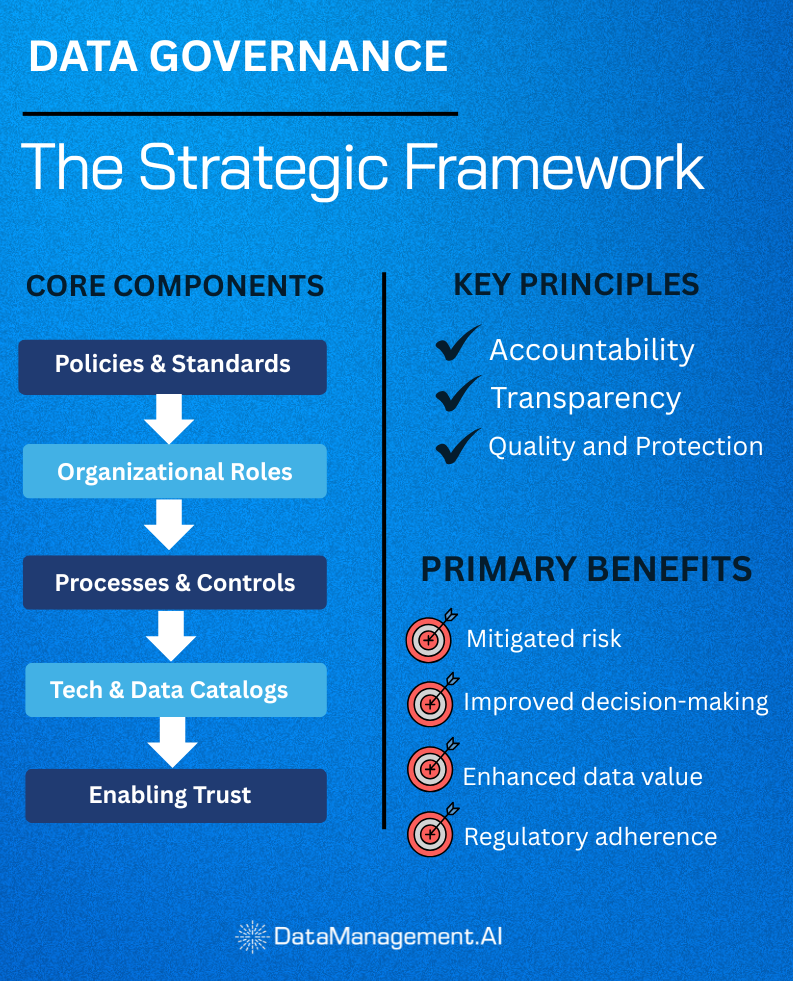
Data governance is the oversight function of your business.
It builds policy. It defines the roles and procedures. It dictates who does what. Data alignment as a strategy is built via data governance.
Governance provides the context to the ‘why’ behind all the actions.
But data governance as a framework dictates standards. It covers privacy and security. Data governance defines the quality rules. Data governance is cross-functional in nature.
It covers business, legal and IT focusing on enterprise-wide risks. Data governance is a set of processes, roles, policies, and standards that you implement to ensure the secure use of data.
Data governance establishes rules to ensure your data is:
- Compliant to adhere to internal policies and external regulations.
- Private and secure to be protected from unauthorized misuse or access
- Available and accessible to be easy for the right people to find and use.
- Accurate and of high quality so that that data can be trusted upon for key decisions.
Key functions of data governance
- Risk mitigation
- Quality standards
- Data stewardship
- Policy formulation
- Access control frameworks
- Compliance management
| Benefit | Description |
|---|---|
| Improved Decision-Making | Ensures business leaders use accurate, consistent, and reliable data for strategic planning and operations. |
| Regulatory Compliance | Helps meet legal requirements (like GDPR, HIPAA, CCPA) and avoid massive fines and reputational damage. |
| Risk Management | Reduces the risk of data breaches, data misuse, and security incidents by establishing strict access controls. |
| Data Quality Management | Defining, monitoring, and enforcing standards to ensure data is accurate, complete, consistent, and reliable. |
| Increased Efficiency | Eliminates confusion and time wasted on reconciling conflicting data, leading to a “single source of truth.” |
| Better Data Quality | Establishes processes to consistently monitor and improve the accuracy and completeness of data. |
How is data governance different from data management in its goals? – Data governance minimizes legal and reputational risk, while data management maximizes operational value.
How is data governance different from data management in reporting? – Data governance reports to you, the higher-up, while data management is handled by their respective role owners.
How is data governance different from data management in its mandate? – Data governance sets the ethical rules, while data management is built on those rules/protocols.
Quick comparison table between data governance and data management.
| Aspect | Data Management | Data Governance |
|---|---|---|
| Focus | Operational execution | Strategic oversight |
| Scope | Technical implementation | Policy & compliance |
| Team | Data engineers, architects | Data stewards, CDOs |
| Output | Data pipelines, systems | Policies, standards |
| Metrics | Performance, availability | Compliance, quality |
| Timeline | Continuous operations | Framework evolution |
Master Data Management – The Third Pillar
Is master data management part of either data governance or data management?
A debatable question, but it actually sits at an intersection.
Master Data Management (MDM) requires both management operations and governance frameworks to perform well.
It’s so important that the global market size for MDM solutions is reaching USD 43.83 billion by 2030.
Master data is the core, non-transactional information that’s key to running your business. It’s the persistent data that describes the entities your organisation interacts with.
The most common master data domains include:
| Domain | Examples |
|---|---|
| Customers | Names, addresses, contact details, account numbers, and relationships (B2B or B2C). |
| Products | SKUs, descriptions, specifications, pricing, packaging, and product hierarchies. |
| Suppliers/Vendors | Names, tax IDs, banking information, and service agreements. |
| Locations | Corporate offices, stores, manufacturing plants, and distribution centers. |
| Chart of Accounts | Financial classifications used in the General Ledger. |
MDM is a subset. It lives under the broader data management umbrella.
MDM focuses on the core enterprise data such as vendor, location, product, or customers. MDM’s goal is to create an authoritative and singular view called ‘the golden record’. This ensures consistency across all your systems.
The scope of master data management vs data governance is specific.
MDM is a tech solution set. It uses tools for matching and merging records. It resolves duplicates proactively and uniformly.
A common data governance master data management challenge is synchronization. The golden record must be governed.
Is master data management part of data governance directly? No. It’s a technical execution.
Is master data management part of data governance’s oversight? Yes. All MDM is overseen.
Is master data management part of data governance for rule setting? No. Data governance sets the rules.
Key benefits of master data management
- Support digital transformation – It provides you with reliable and clean data foundation towards new initiatives such as machine learning, AI, and advanced analytics.
- Improved decision-making – All departments base their analysis on the same accurate MDM data.
- Enhanced customer experience – A single view of the customer enables personalized service, marketing, and cross-selling opportunities.
- Regulatory compliance – MDM helps ensure critical data is managed and secured consistently across the enterprise.
- Streamlined operations – MDM reduces manual reconciliation and duplicate efforts in marketing and sales.
Quick Comparison of Data Governance vs. Data Management vs MDM
While often confused, data management, data governance and master data management represent the three distinct layers of your organization’s data strategy. The following table shows their differences clearly.
| Discipline | Focus (What is it?) | Scope (What data?) | Approach (How is it done?) |
|---|---|---|---|
| Data Governance | The Strategy & Oversight (The rules of the road and accountability). | All Data (e.g. Master, Transactional, Metadata, Reference). | Defines policies, standards, roles (like Data Stewards), and metrics for quality, security, and compliance. |
| Data Management | The Execution & Implementation (The “building of the road” and physical care). | All Data (The entire data lifecycle). | A broad umbrella that includes Data Governance and MDM, covering data storage, security, architecture, integration, and warehousing. |
| Master Data Management (MDM) | The Specific Tool/Process (Creating the “single source of truth” for core entities). | Only Master Data (Customers, Products, Suppliers, Locations). | Uses specialized tools and processes (consolidation, cleansing, matching) to build and maintain the “golden record.” |
DataManagement.AI – The one that unifies the three pillars
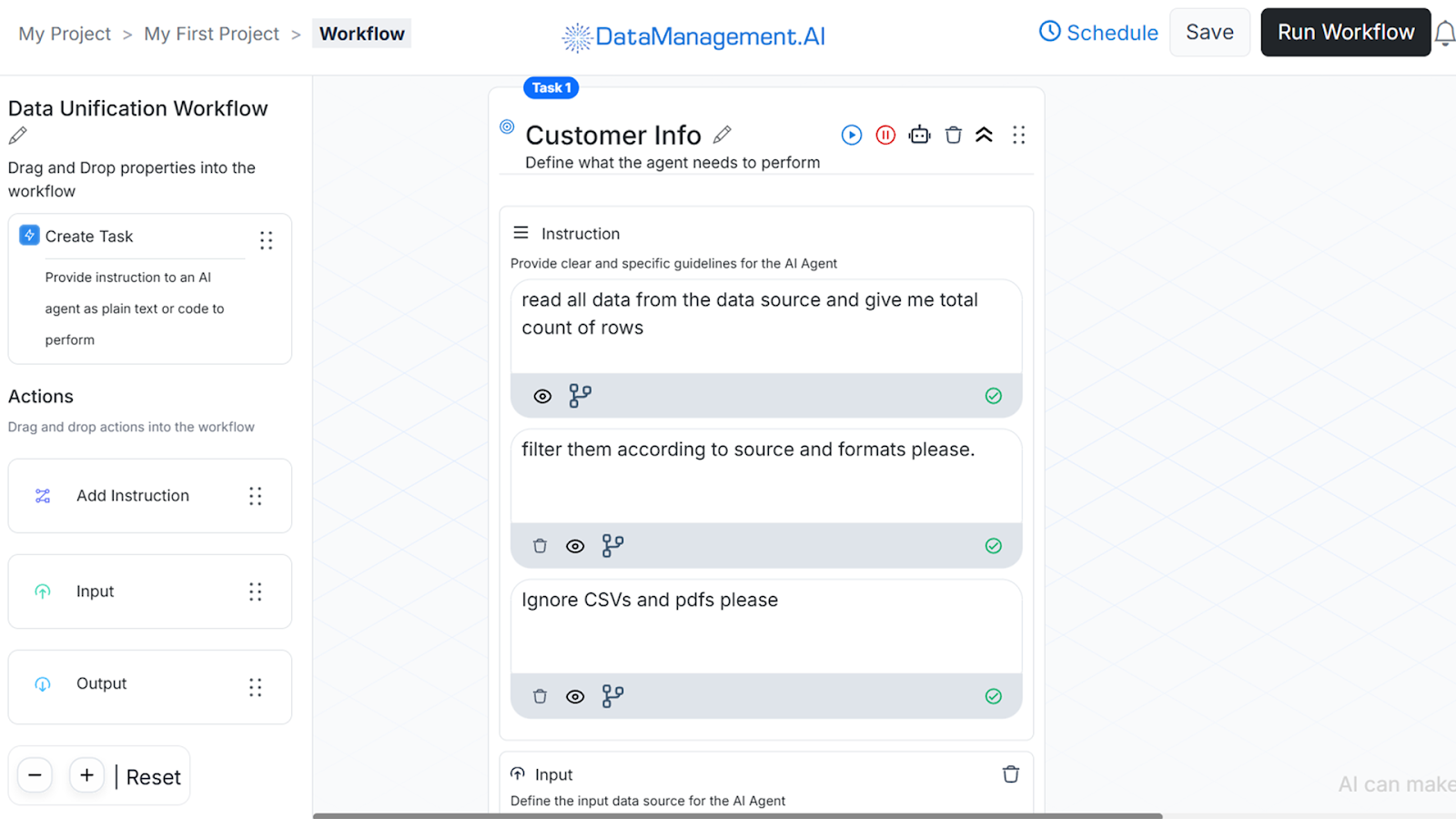
The data landscape is vast and presents both opportunity and risk.
This risk demands robust frameworks. The core question that you need to answer is how is data governance different from data management?
Now that we understand the key differences between data management, data governance, and MDM, consider how you as a modern enterprise are handling integration challenges?
DataManagement.AI represents the convergence of data governance, data management, and MDM.
The platform provides you with intelligent data quality assessment, along with predictive data governance and automated metadata management.
No time-consuming data replication or extraction. DataManagement.AI is built to eliminate all your data bottlenecks, deliver real-time insights, and significantly reduce operation and infrastructure costs.
Key benefits of DataManagement.AI
DataManagement.AI revolutionizes your master data management through autonomous AI agents. The three key benefits for you related to data governance and MDM are:
Intelligent Data Management Operations
AI agents handle your complex data management tasks with ease for e.g. ProfileAI analyzes data patterns, CleanseAI fixes quality issues, and TransformAI executes complex workflows. All these are done under governance boundaries.
Unified Data Governance Framework
DataManagement.AI’s Chain-of-Data architecture embeds data governance at every workflow step. No separate tools needed. No integration headaches. Policies are enforced automatically across all data operations.
Integrated MDM
DataManagement.AI treats master data as a first-class citizen. All your product, customer, and supplier data are managed with built-in data quality checks, compliance controls, and lineage tracking.
Our platform eliminates the traditional friction between management execution and governance frameworks.
Still confused about data governance and data management?
Understanding what is the difference between data governance and data management transform data strategy.
Governance provides direction while management executes operations. MDM ensures critical data quality.
Data governance vs data management defines your organizational structure.
Your choice is to integrate or struggle. An AI-native platform like DataManagement.AI eliminates traditional friction between data management and data governance.
Don’t let fragmented governance and management hold you back.
Schedule a demo with our MDM experts to discover how your unified data operations can accelerate compliance and control.
Frequently Asked Questions (FAQs) about the difference between Data Management and Data Governance
The following FAQs will answer your most commonly asked questions about Data Management and Data Governance.
Q. What is the difference between data management and data governance in terms of ownership?
A. Data governance defines who owns the data. It assigns a clear data owner and data steward. These roles define accountability. Data Management owns the process and technology used to handle the data. One is a strategic, human role. The other is an operational, technical function. This separation of duties ensures necessary checks and balances exist.
Q. How is data governance different from data management regarding risk?
A. Data governance is primarily focused on minimizing enterprise risk. This includes compliance risk (GDPR, CCPA), privacy risk, and reputational risk. Data Management focuses on operational risk. This means minimizing downtime, data loss, and data quality errors that hinder business operations. Therefore, governance is about the right use of data.
Q. Is data governance part of data management according to industry standards?
A. Most modern data frameworks, like DAMA-DMBOK, treat them separately. Data Management is the overarching function with eleven knowledge areas. Data Governance is the structural foundation for all those areas. It is the rule-setter, not one of the rules. Governance provides the necessary authority and organizational structure.
Q. Is master data management part of data governance?
A. No. MDM is a specific discipline within the Data Management body of work. MDM focuses only on core, non-transactional data consistency. Data Management is the broader practice covering MDM, quality, storage, and security. Governance sets the policies for MDM. For example, Governance defines the acceptable quality score. MDM implements the tool to achieve that score.
Q. How is data governance different from data management in their required skills?
A. Data governance requires strong soft skills: negotiation, policy-making, and communication. These roles bridge business, legal, and IT departments. They deal with organizational politics and rights. Data management requires technical skills: engineering, architecture, coding, and database administration. They implement the technical infrastructure. The governance team is the committee.