




In 2024, Takeda Pharmaceuticals made a key decision.
They moved 96% of their data infrastructure onto the cloud.
The result?
A massive 40% gain.
They did this by consolidating ten existing MDM solutions into one cloud master data management platform.
Gartner states that the cloud master data management market grew by 42% in 2024. Despite this surge, 76% of MDM programs failed miserably.
Why?
There was a lack of understanding in how master data management is to be implemented in the cloud.
Cloud master data management is the only reliable path towards data agility and data compliance. In this article, we look at what cloud master data management means and how this reliability can be achieved through proper cloud based master data management.
What is the meaning of cloud master data management?
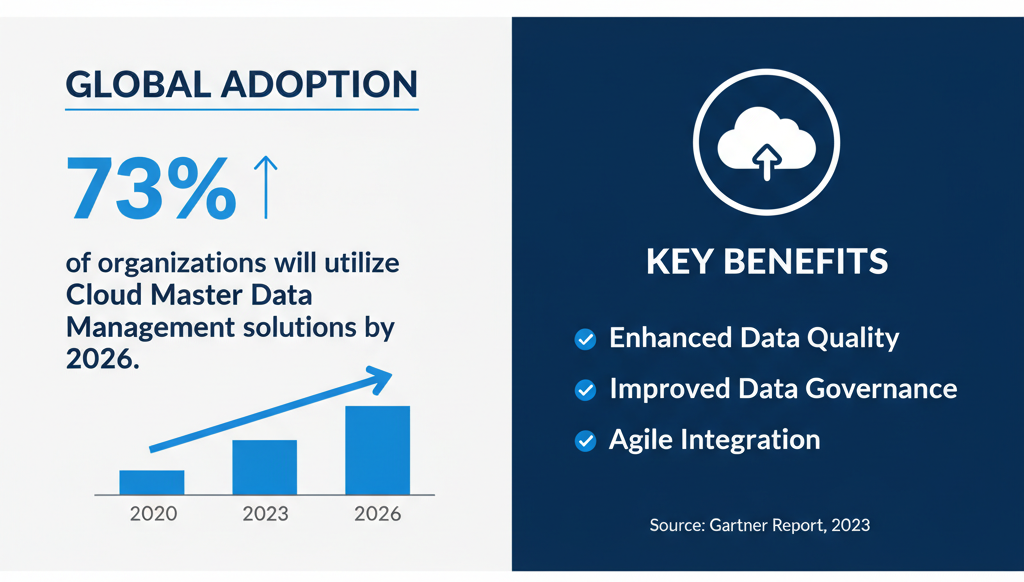
The modern digital economy runs on good quality data.
Data integrity becomes a fundamental requirement for building this modern digital economy.
Let’s understand with a hypothetical example. Imagine a major bank is hit by a USD 200 million fine due to lack of data lineage and risk aggregation methods.
Their legacy MDM system has failed. It failed to provide a consistent view of risk exposure. This makes cloud master data management essential for its evolution from legacy to modern.
Cloud master data management (CMDM) is the process of centrally managing your critical business entity data. This core data includes your products, assets, customers, and storage locations.
It runs on a cloud-native/cloud-hosted platform. Although, a more advanced, AI Agents-powered solution is now gaining prominence.
Cloud master data management shifts the burden of your data infrastructure from an on-premise server to an elastic cloud one. This essentially transforms your data governance.
What is the ideal cloud master data management architecture?
Traditional Master Data Management (MDM) systems are rigid.
They struggle to cope with distributed and high-velocity data. That’s why modern enterprises operate across clouds.
The complexity of SaaS applications and disparate data sources make it complex to maintain a single source of truth. CMDM provides a solution that delivers real-time synchronization at scale.
Every application references the same trusted data which impacts your bottom line positively.
The cloud master data management stack consists of three layers.
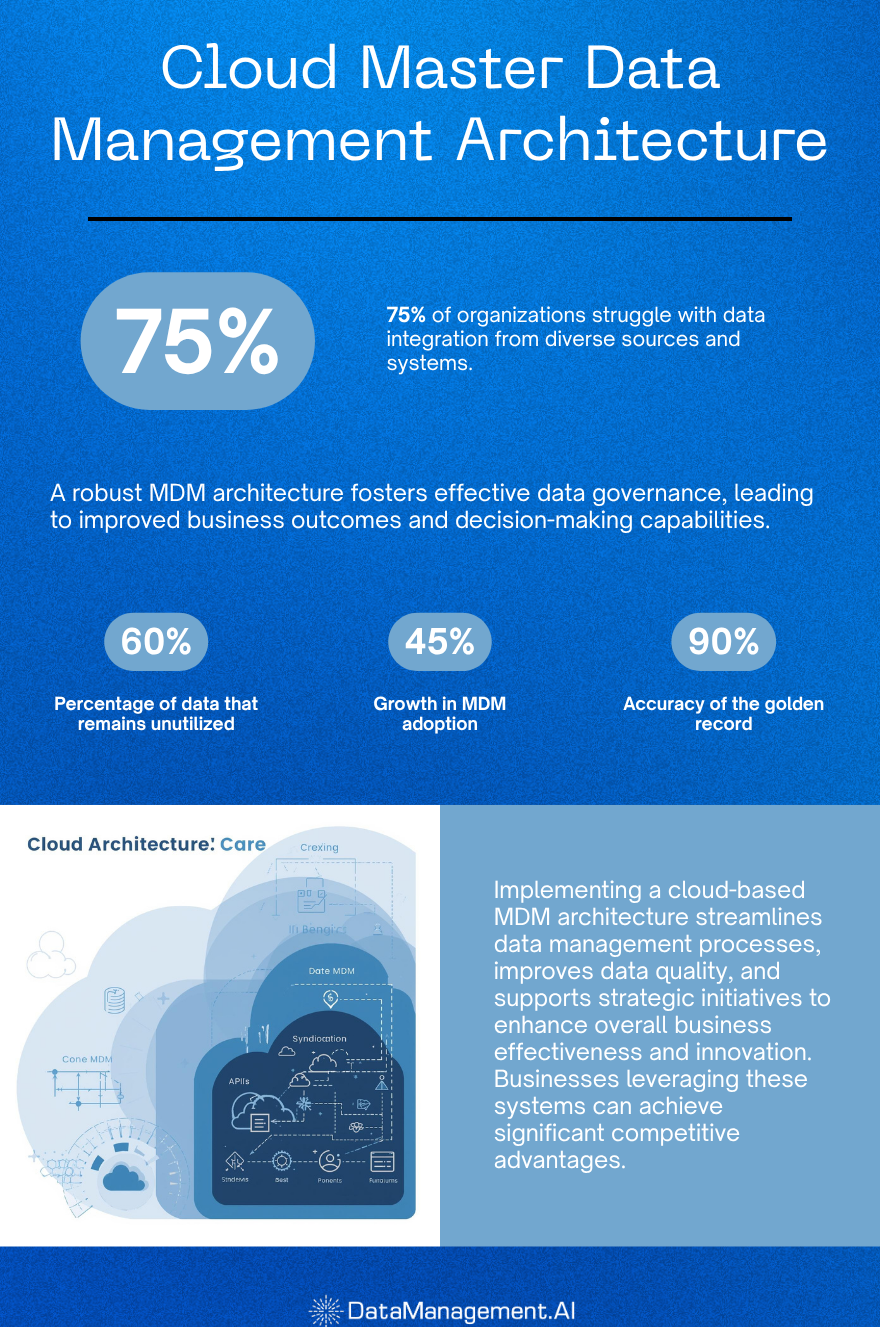
- Integration/Ingestion Layer – This layer handles your data flow from varied sources. It uses cloud message queues (e.g. Kafka) and APIs.
- Core MDM Layer – This is your master repository layer. It houses the merging, matching, and survivorship logic. It is typically powered by cloud databases. Your CMDM resides here.
- Syndication/Consumption Layer – This layer delivers the ‘golden record’ to downstream systems. This uses streams, APIs or data visualization.
A robust cloud master data management architecture supports multi-domain MDM.
It handles customers, suppliers, products, and asset data simultaneously. This approach eliminates your departmental data silos.
How does cloud master data management differ from on-premises master data management?
Cloud Master Data Management (MDM) and on-premises MDM solutions differ significantly in their deployment, cost, maintenance, scalability, and control.
The following table shows you how cloud master data management and on-premises master data management differ.
| Feature | Cloud MDM | On-Premises MDM |
|---|---|---|
| Deployment & Hosting | Hosted on vendor’s cloud servers (public, private, or hybrid). | Installed on the organization’s internal servers/data center. |
| Cost Model | Subscription-based (Operating Expense, OpEx). Lower initial costs | Requires significant upfront investment in hardware and software (Capital Expense, CapEx). |
| Maintenance & Updates | Handled automatically by the vendor. Reduces burden on internal IT staff. | Responsibility of the internal IT team, including patching, upgrades, and troubleshooting. |
| Scalability | Highly and instantly scalable (up or down) by adjusting the subscription. | Limited by physical infrastructure; scaling requires buying and configuring new hardware. |
| Deployment Speed | Fast (minutes to hours), as no physical hardware setup is needed. | Slow and complex, requiring hardware procurement, installation, and configuration. |
| Control & Customization | Less direct control over infrastructure; customization is limited by vendor’s features. | Maximum control over infrastructure, security, and deep customization to meet unique needs. |
| Security & Compliance | Security managed by the vendor, often with robust, up-to-date protocols. | Security is fully controlled by the organization; easier to meet strict data residency/compliance rules (e.g., in finance or government). |
| Accessibility | Accessible from anywhere with an internet connection, supporting remote work. | Primarily accessible from within the internal network; remote access usually requires a VPN. |
What are the advantages of cloud master data management over on-premises master data management?
As cloud master data management has so many advantages over conventional on-premises solutions, its adoption has surged. These benefits mostly center on lower IT overhead, agility, and cost effectiveness.
Cost and Financial Flexibility
- Reduced Upfront Costs (OpEx Model) – Because Cloud MDM uses a subscription-based business model (OpEx), there is no need for a sizable upfront capital investment (CapEx) in physical data centers, software licenses, or hardware.
- Decreased Total Cost of Ownership (TCO) – TCO is frequently reduced because the seller covers the expenses of hardware replacement, electricity, cooling, and infrastructure upkeep.
Deployment and Time-to-Value
- Faster Deployment – Compared to on-premises systems, which take months to implement and need hardware acquisition, installation, and thorough configuration, implementation is far faster, frequently taking only a few weeks.
- Quick Time-to-Value – Because of the deployment’s quickness, companies may begin managing their data and reaping the rewards (such as better data quality and quicker reporting) much sooner.
Maintenance and IT Overhead
- Zero Infrastructure Management – All underlying infrastructure, including servers, storage, networking, and security, is under the control of the cloud provider.
- Automated Patching and Updates – The supplier takes care of software patches, security updates, and new feature releases automatically, keeping the system up to date without using internal IT resources.
How can master data management be implemented in the cloud?
The process of deploying cloud master data management requires precision.
This process follows a structured and technical methodology. The initial steps involve data profiling. Data quality gaps are identified along with source system redundancy.
Cloud master data management implementation follows a structured approach. The phases are as follows.
Phase 1 – Platform selection and planning
Choosing a genuine cloud-native platform is an essential first step in Cloud Master Data Management (CMDM).
In order to guarantee high agility and automated scaling in a public cloud environment, this platform needs to be specially designed utilizing technologies like microservices, serverless computing, and containers.
The conventional MDM cost and operational paradigm is radically altered by opting for cloud-native.
The platform removes significant upfront capital expenditures and reduces human infrastructure administration by leveraging the cloud’s built-in compute, security, and storage capabilities.
Organizations of various sizes can now afford sophisticated MDM thanks to this method, which also guarantees that the master data environment can grow with the company.
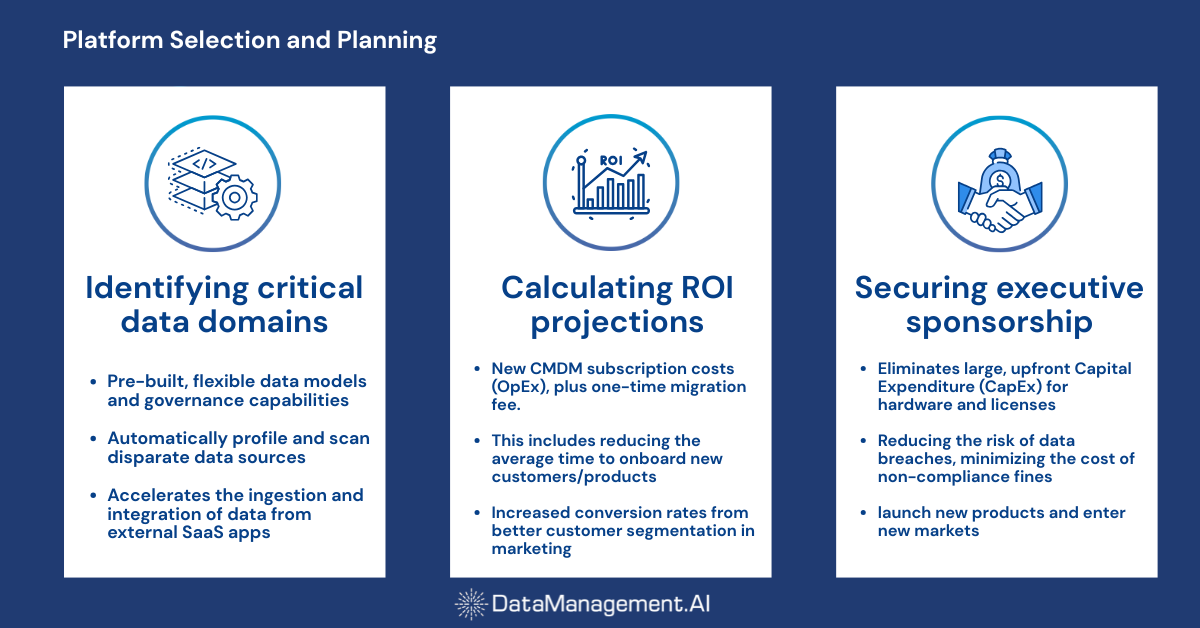
Key aspects of this phase
- Identifying critical data domains
- Calculating ROI projections
- Securing executive sponsorship
90% of organizations fail to collect KPIs for their MDM program. Don’t be part of this statistic.
What if I tell you there is an MDM solution that sits above the CMDM layer.
DataManagment.AI is an AI-native data management platform.
AI agents, such as ReconcileAI, CleanseAI, and ProfileAI allow users to query, govern, and analyze master data directly from source systems.
No time-consuming data replication or extraction. DataManagement.AI is built to eliminate all your data bottlenecks, deliver real-time insights, and significantly reduce operation and infrastructure costs.
Some major benefits of DataManagent.AI’s Cloud Master Data Management solution are,
- Integration in connecting every part of your data – from collection to insights.
- Querying and analyzing data in its source system with no extraction, prep or delays.
- Linking every step of your data journey into one efficient data matrix.
- Delivering real-time data flow to help you adapt to trends and make informed decisions.
- Automating repeatable tasks with intelligent agents that detect and recover from failures when optimizing compute resources.
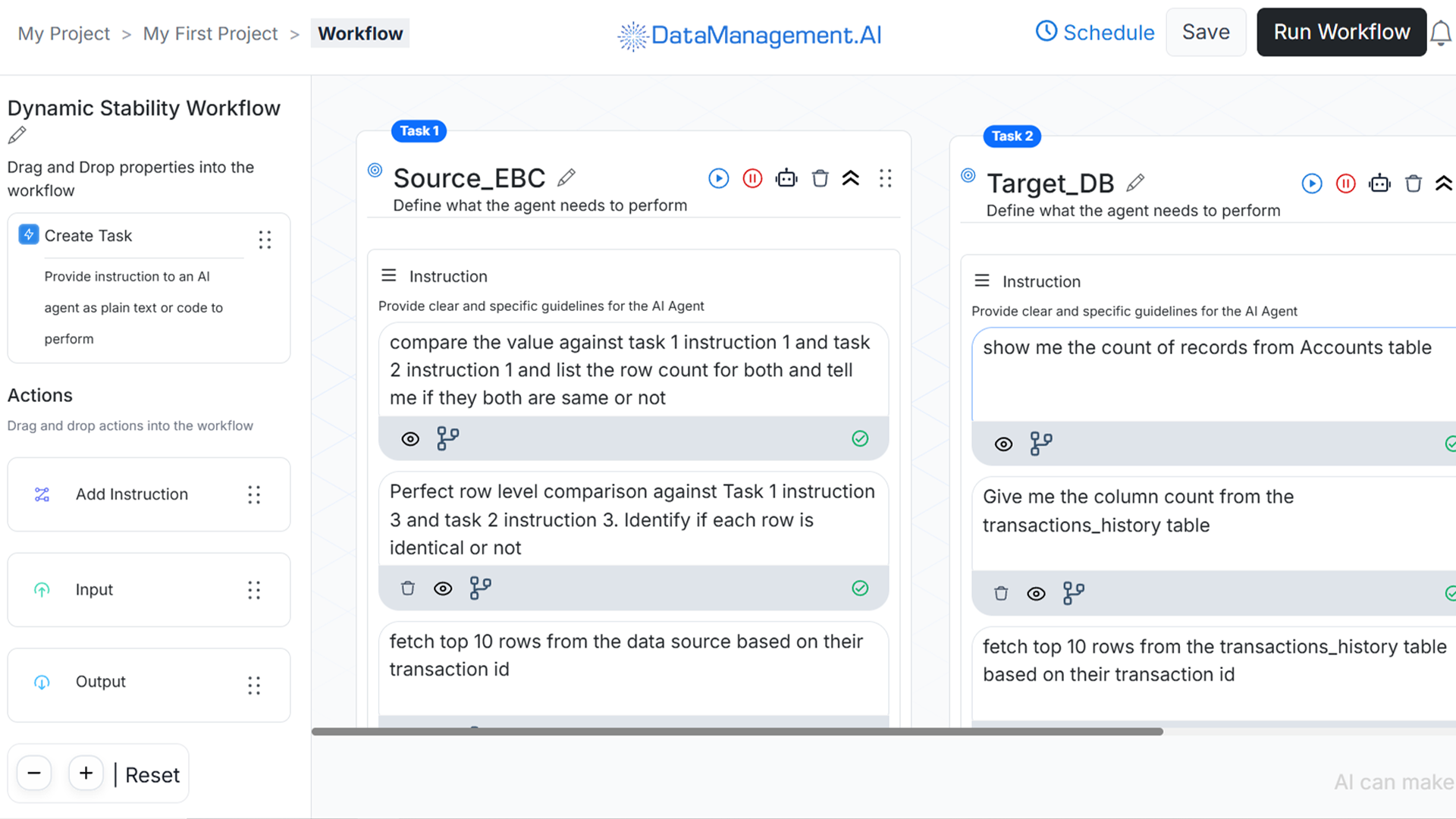
- Designing complex pipelines in minutes via a drag-and-drop Visual Canvas.
- Working with built-in governance via end-to-end lineage, audit logs, and compliance by design.
- Enabling matching, mixing, or swapping data sources, platforms, and instructions while preserving total flexibility.
These benefits are massive to you because 70% of MDM projects encounter significant hurdles in CMDM implementation.
Phase 2 – Integration designing
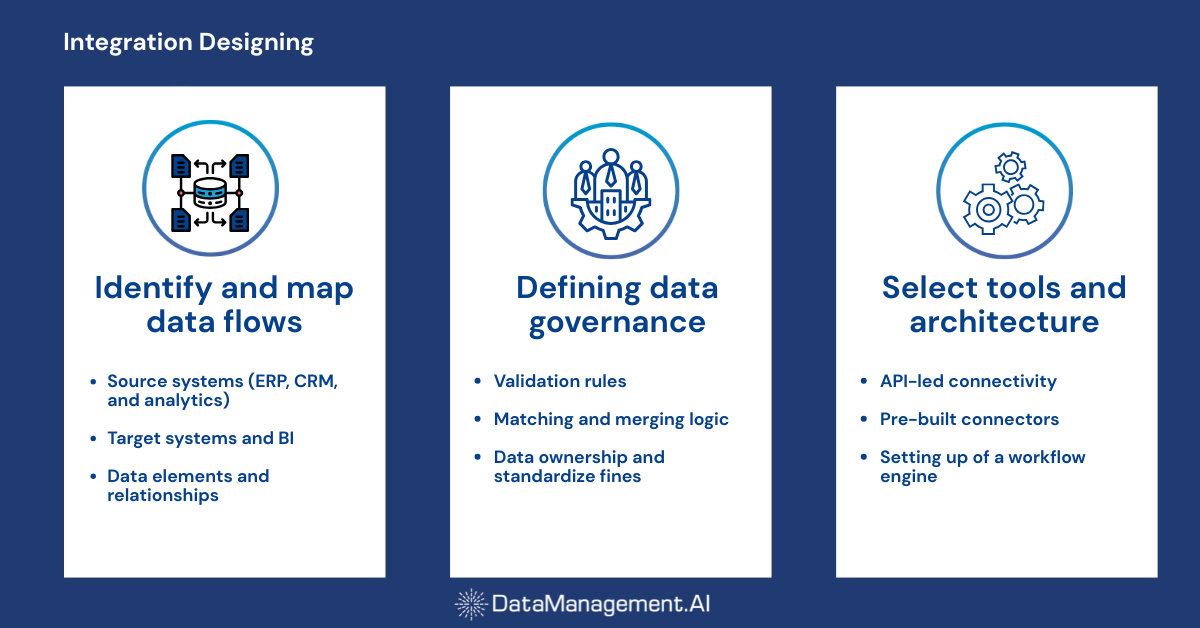
Next comes the designing of a bi-directional data pipeline.
These pipelines make use of robust cloud integration services such as AWS Glue or Azure Data Factory.
These pipelines are responsible for two-way, continuous synchronization of master data.
These pipelines ensure that information doesn’t just flow into the CMDM hub for consolidation but also flows out towards analytical and operational systems across your enterprise.
This constant exchange maintains data consistency, as changes in source systems get captured by the hub. The resulting ‘golden record’ updates are sent back out, making the ‘single source of truth’ actionable across your entire system.
The complexity of building this two-way flow requires a scalable integration network. When a CMDM is implemented with bi-directional synchronization, it improves decision quality and operational efficiency.
The second phase of CMDM implementation requires eRegulatory compliance. The CMDM hub becomes the source for PII (Personal Identifiable Information).
It manages right-to-be-forgotten requests automatically. Much on the governance layer later.
Here is a quick social media post about AI agents that you might find
Key aspects of this phase
- Creation of approval workflows
- Defining data quality standards
- Appointing of data stewards per domain
Phase 3 – Rules for matching, merging, and survivorship
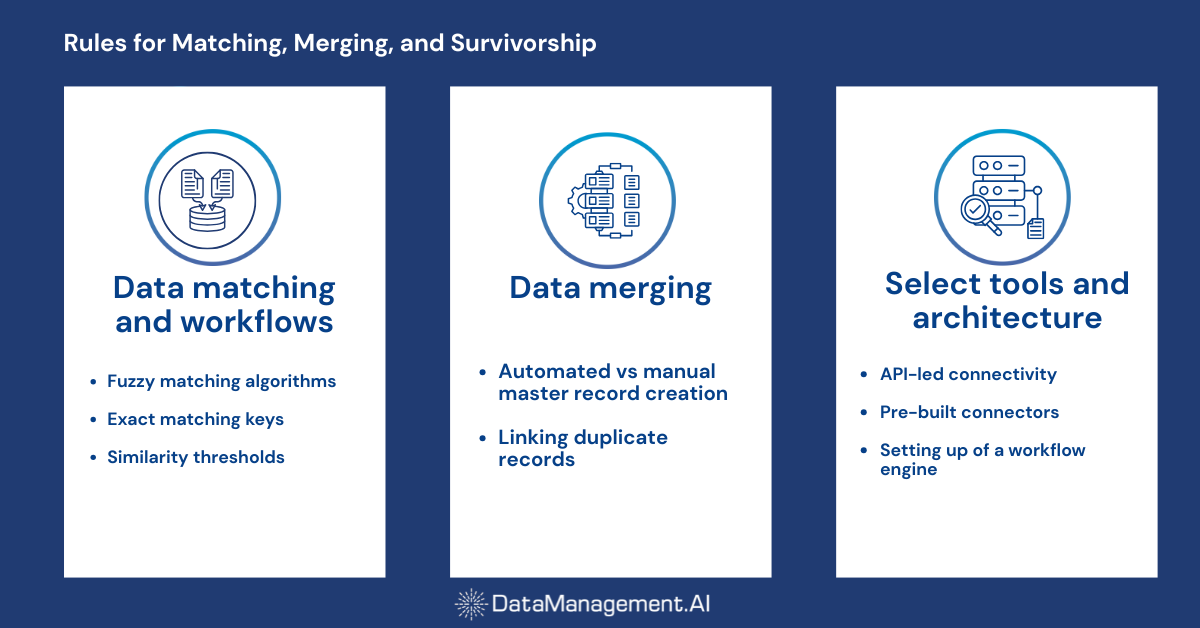
Now comes the heavy, technical aspects.
Any MDM system is a complex set of matching, merging, and survivorship rules. These rules determine how your disparate records are identified as duplicates. It’s also the same for creating a definitive ‘golden record’.
Rules creation involves deep analysis of source data to define both Exact Match rules (e.g. Comparing tax IDs) and Fuzzy Match algorithms (e.g. Comparing slightly varied addresses and names).
The goal of rules is to maximize automated consolidation of duplicates while minimizing false negatives.
The creation of the rules must be defined in collaboration with data stewards. The rules’ logic dictates which data element wins when conflicts arise (survivorship).
Let’s take an example to understand this.
Assume a rule which states that the ‘contact information from your CRM is authoritative’ when product descriptions from the ERP system are used.
Now, the effectiveness of this rule-based approach is massive for a reliable MDM.
Rule-based matching is preferred because of its ease for data stewards and business users, to identify what record patterns make up a duplicate pair.
“We believe cloud was recognized for its rapid pace of innovation, delivering new features and services to customers, and for its industry-leading capabilities.”
– Juan Loaiza. Oracle.
Phase 4 – Data Loading
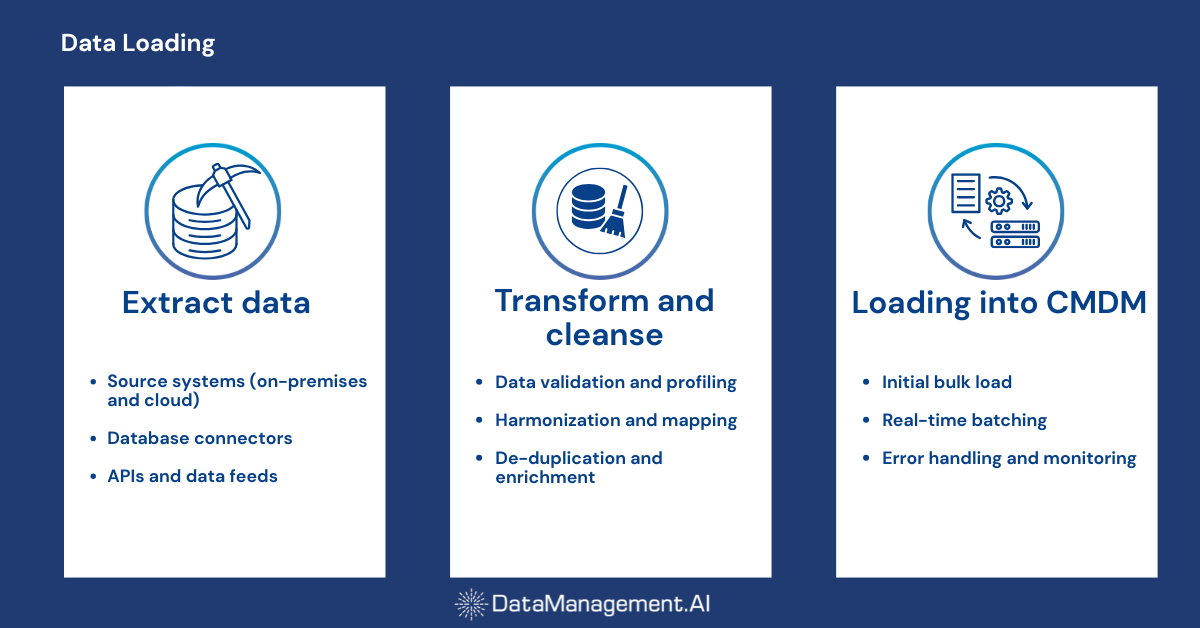
The initial data loading is the next phase which involves migrating large volumes of low-quality data and siloed data into the CMDM platform.
This isn’t a simple transfer, but something that requires the application of a deduplication algorithm.
There is also a data quality process implemented at scale to cleanse, standardize, and consolidate records before being populated into the master data hub.
As cloud environments come with immense processing power and storage, these algorithms must be capable of operating on a petabyte scale.
These include rapidly identifying and resolving duplicates across billions of records to form the first set of ‘golden records’.
This phase is fundamental because it establishes a baseline for data quality through the single source of truth. Without rigorous deduplication and consolidation during this load phase, the MDM hub is filled with unreliable data.
Phase 5 – Activating Governance Workflows
The final phase in cloud master data management implementation is embedding governance workflows directly into the CMDM platform.
This phase involves transforming abstract data policies into automated and tangible processes by embedding governance workflows.
This is vital because it helps manage the ongoing data lifecycle, specially for the creation and modification of master data.
For example, if a user attempts to create a ‘new customer record’, the workflow will automatically route the proposed data through a sequence of validation and review approval steps.
These steps are predesignated by your data stewards before the record is accepted into the master data hub.
This shift from manual approvals to CMDM-driven automation ensures all new master data conforms to enterprise-wide standards and not policies before it pollutes downstream systems.
Automating these steps enforces data quality and improves operational efficiency.
Accelerating Cloud Master Data Management with DataManagement.AI
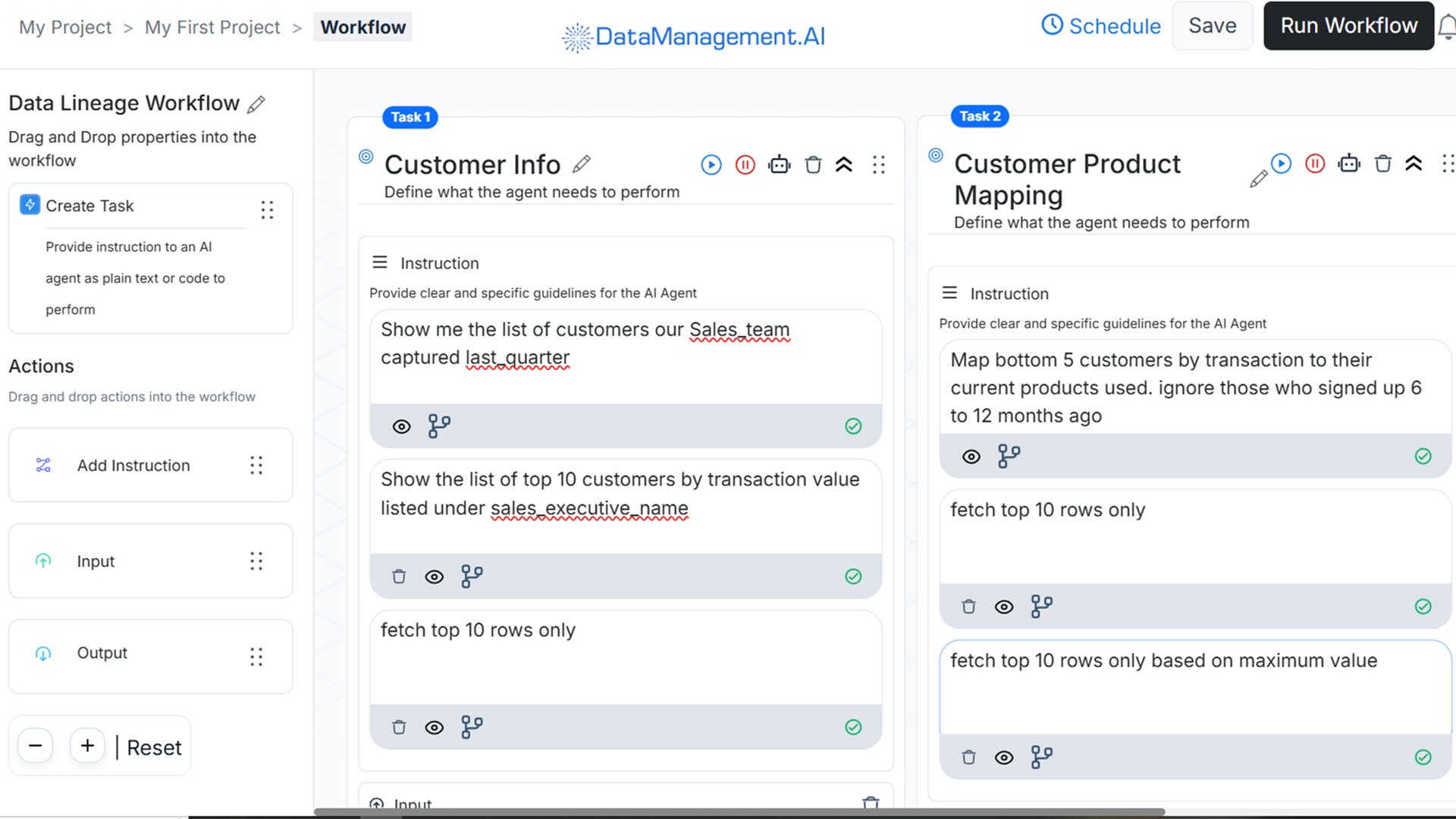
To succeed in the above CMDM implementation, you must think beyond the current solutions being adopted.
You need to prioritize integration points and ensure scalability from the outset.
This requires careful consideration of master data management that can be implemented in the cloud.
Achieving streamlined cloud master management is challenging. We help you understand how master data management can be implemented in the cloud.
The main benefits of DataManagement.AI as one of the best cloud master data management MDM solutions is,
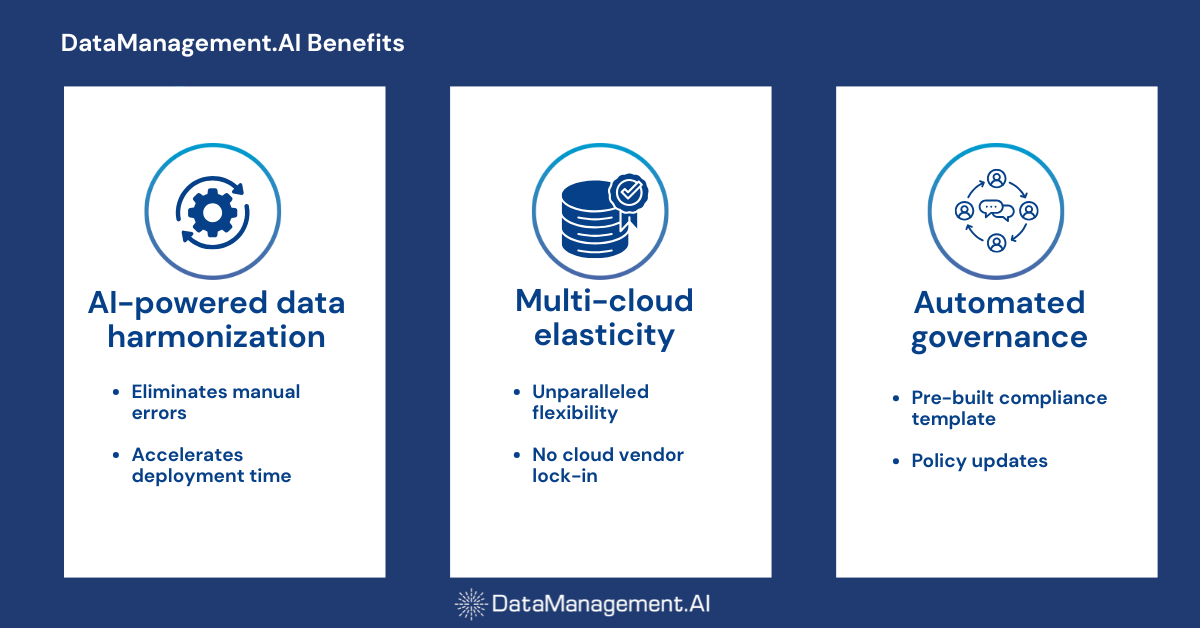
- AI-powered data harmonization – Our proprietary algorithms help you eliminate manual data stewardship efforts and accelerate the deployment timeline.
- Multi-cloud elasticity – We offer unparalleled flexibility by deploying CMDM features across Azure,GCP or AWS. No need for a cloud vendor lock-in.
- Automated governance – We provide pre-built templates for compliance that covers CCPA, GDPR, and industry-specific regulations.
Cloud Master Data Management as The Foundation
CMDM is the future of data innovation.
That’s because it addresses quality, scalability, and compliance requirements. It moves data integrity from your burden to a strategic asset.
The shift is non-negotiable for competitive advantage. CMDM minimizes risk and maximizes your ROI.
Ready to start with that ‘single, trusted view’?
Schedule a demo with our CMDM experts and get started.
Frequently Asked Questions (FAQs) on Cloud Master Data Management
Q. What is cloud master data management and why is it important?
A. Cloud master data management is a comprehensive approach to centralizing, governing, and distributing critical business data across cloud-based systems. It creates a single source of truth for customer, product, supplier, and financial information.
Q. How can master data management be implemented in the cloud successfully?
A. Successful implementation requires a phased approach starting with business case development and executive sponsorship. Organizations should begin with a single high-impact data domain like customer or product data. Most organizations require 12-18 months to address major MDM challenges and achieve operational stability. DataManagement.AI will get it implemented quicker.
Q. What are the key benefits of cloud based master data management solutions?
A. Cloud based master data management solutions deliver multiple business advantages. They provide scalability to handle growing data volumes, with platforms managing tens of billions of records and supporting 5,000 transactions per second. Organizations achieve significant cost savings through reduced infrastructure expenses and operational efficiency.
Q. What are common challenges when implementing cloud based master data management?
A. You will face multiple challenges during cloud based master data management implementation. Over 70% of MDM projects encounter significant hurdles, with data quality issues being most critical. Integration complexity with legacy systems creates technical obstacles. 90% of organizations fail to collect KPIs for their MDM programs, leading to unclear success metrics.
Q. What should organizations look for in cloud master data management software?
A. When you’re evaluating cloud master data management softwares, prioritize several key capabilities. AI-native automation is essential, as over 6,300 organizations used AI algorithms for matching and de-duplication with 31% workload reduction. Security certifications including SOC 1/2/3, HIPAA, ISO 27001, and NIST compliance are mandatory.
Q. What role do AI agents play in future cloud master data management?
A. AI agents redefine the future of cloud master data management. They automate data lineage tracking. They automatically suggest optimal merging rules. AI Agents even predict potential data quality issues before they manifest. These agents drastically reduce manual data stewardship. They accelerate data domain creation. This allows organizations to master new data sets in weeks, not months.