




When your finance team updates the chart of accounts, does that change propagate automatically across your ERP, reporting, tax systems, and cloud analytics, or does your team end up reconciling mismatched data across multiple platforms?
In most Enterprises, a single change triggers multiple manual workflows, such as email approvals, spreadsheet tracking, and delayed system updates. Each of these handoffs introduces latency, increases the risk of inconsistencies, and exposes your reporting and compliance processes to errors.
This is where enterprise data management (EDM) becomes critical. It’s at the center of these workflows, enforcing validation rules, routing approvals, and propagating changes across systems via APIs, while maintaining a complete audit trail.
Here’s how it actually works and why it matters.
What is Enterprise Data Management?
Enterprise data management is basically the strategic framework that controls how important business data is defined, changed, approved, and propagated across enterprise systems.
EDM standardizes master and reference data, enforces governance policies, and manages metadata relationships across ERP, CRM, HCM, tax, and analytics platforms.
It also ensures that a structural change in one system does not create downstream inconsistencies elsewhere. Thus, it’s not only about storage but also about orchestration.
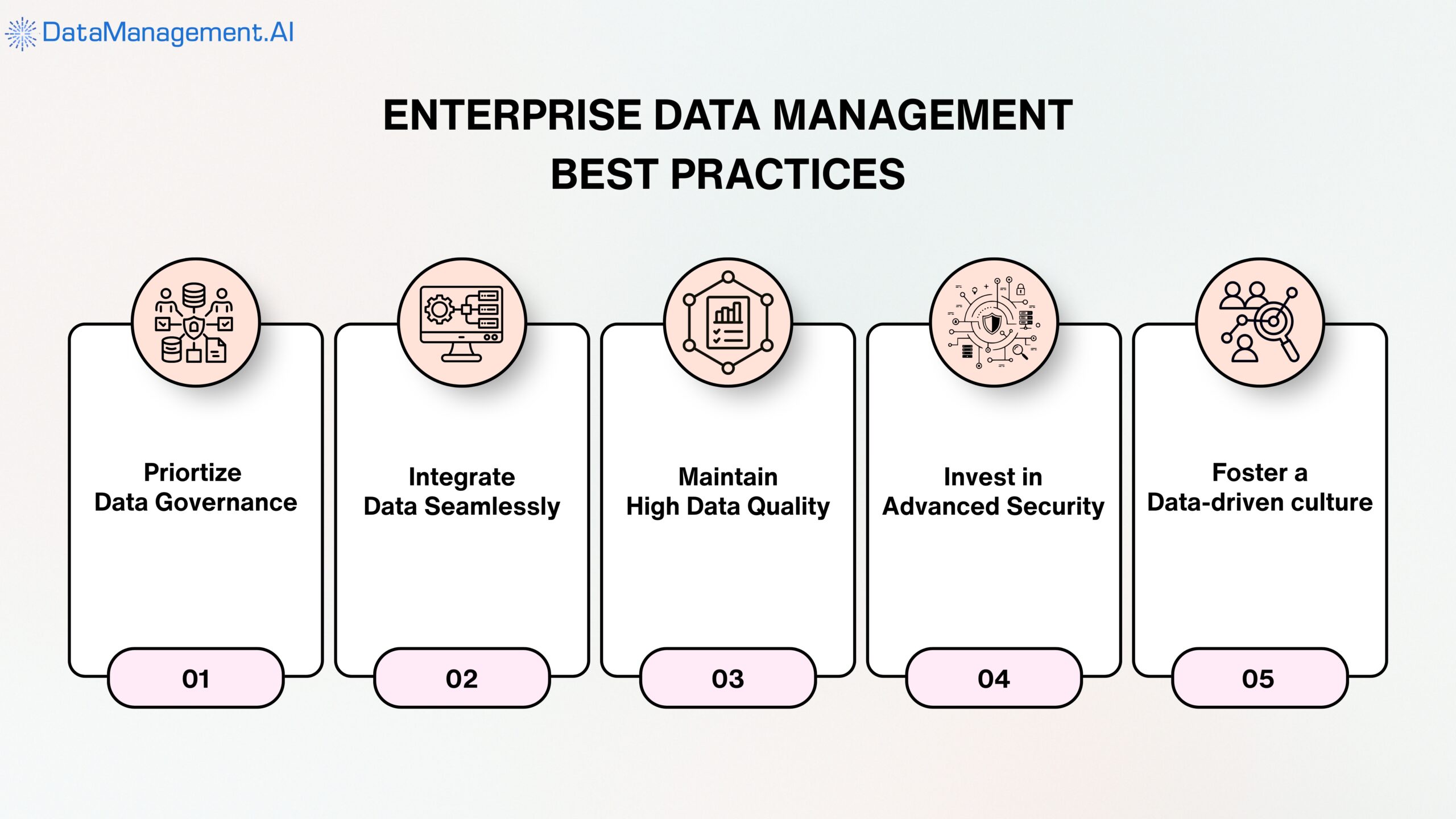
You should follow EDM best practices to ensure that your company functions smoothly
So what does enterprise data management do in reality?
It introduces workflow controls, validation rules, impact simulation, and audit traceability into data operations.
A sad fact:Gartner estimates that organizations lose up to 30% of their revenue due to operational inefficiencies, many of which usually stem from poor data coordination. EDM reduces that systemic friction by transforming unmanaged data into a governed, synchronized enterprise asset. |
Why is Enterprise Data Management important?
Without enterprise data management (EDM), every data change becomes a risk event.
For example, your tax team updates a classification rule for a product category, but that change doesn’t reflect in the billing or reporting system. This results in incorrect invoices, compliance gaps, and teams scrambling to fix discrepancies after the fact.
At scale, this isn’t a one-off issue. Moreover, it’s a systemic failure that drives operational inefficiency and hidden costs. EDM fixes this by introducing control, consistency, and traceability into every data change.
Here’s what changes with EDM:
- Controlled updates: Data changes start following validation rules and approval workflows before going live.
- System white consistency: Updates propagate across ERP, analytics, and tax systems via APIs.
- Faster decisions: Teams work on synchronized, real-time data instead of reconciling discrepancies.
- Audit readiness: Every change is logged with full traceability ( like who, what, when, and why).
- Regulatory Compliance: Ensures alignment with standards like GDPR, CCPA, and IFRS.
So, EDM shifts data from a source of operational risk to a controlled, reliable asset that supports faster and more accurate decision-making.
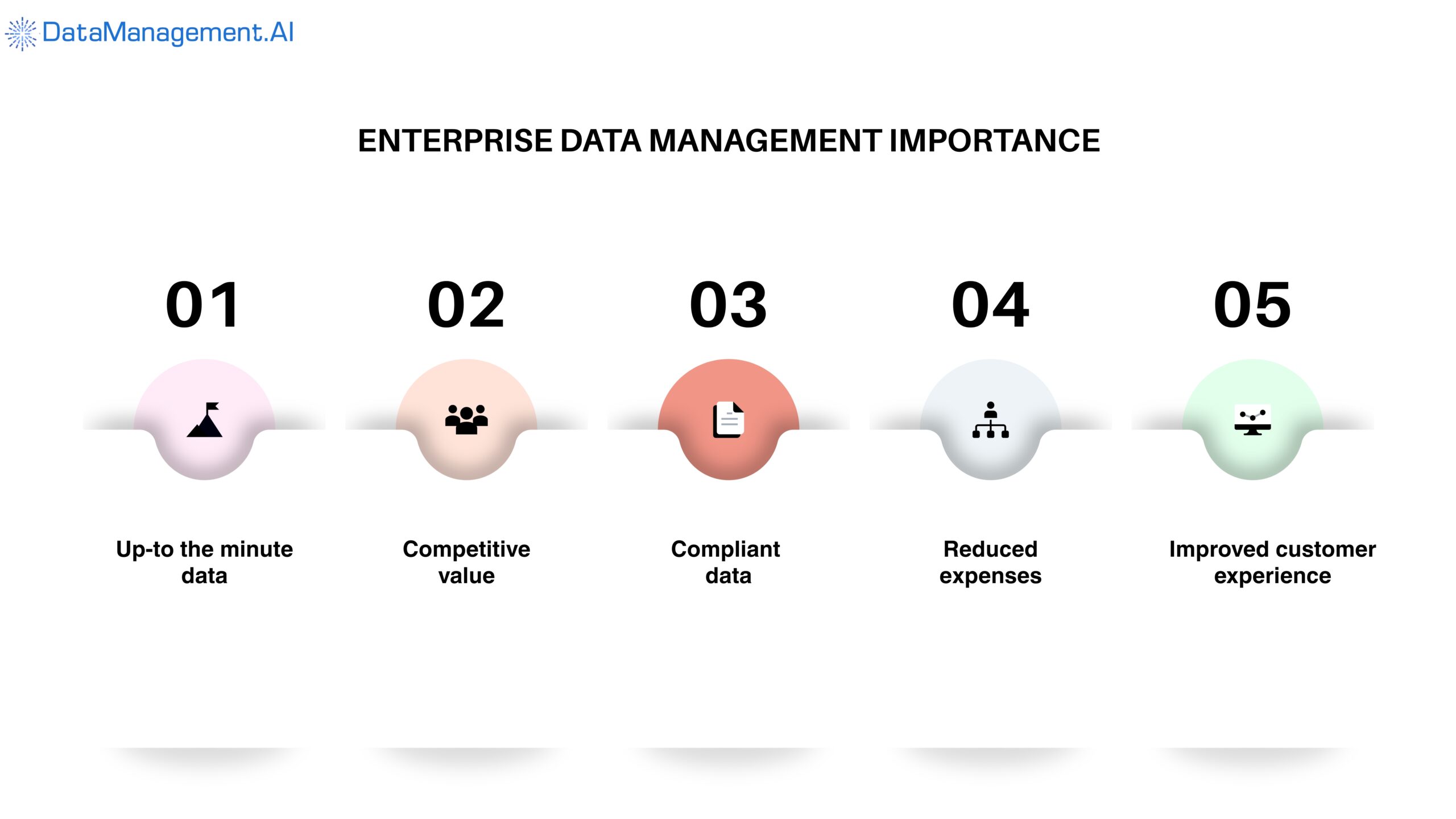
Benefits of enterprise data management.
Core components of Enterprise Data Management
Enterprise data management is not just a process; it’s a complex framework of interrelated systems, standards, and practices designed to ensure that your enterprise data remains accurate, consistent, and actionable.
At the heart of this framework are five core components: data governance, metadata management, master data alignment, data life cycle management, and technical infrastructure. Let’s learn how each of them plays a unique role in making EDM more than a compliance tool.
Data governance
You should think of data governance as the policy and control layer of your enterprise data management in a fresh environment. It defines who can access what data, under which conditions, and how changes are approved and documented.
For example:When financial or operational data changes, governance policies dictate approval hierarchies, validate the data against predefined rules, and trigger automated alerts if inconsistence is arise. |
Thus, through structured workflows, data governance ensures that your EDM enterprise data management system prevents inconsistencies, enforces security protocols, and maintains regulatory compliance.
Without robust data governance, even the most advanced analytics platforms become unreliable, turning your big data knowledge management investments into a liability.
Metadata management
Here’s an interesting thing: Metadata is the “data about your data.”
And in enterprise data management, especially, it’s very important for context and traceability. Effective metadata management ensures that every dataset, attribute, and transformation is documented with lineage, ownership, and semantic meaning.
This is most essential for compliance, impact analysis, and system integration.
With proper metadata management, you can answer these questions easily:
- Which version of a product hierarchy is live across ERP, CRM, and cloud analytics?
- What changes were made to this dataset before reporting?
- How do changes in master data affect dependent workflows?
Thus, by maintaining rich metadata, your enterprise gains more transparency, audibility, and the ability to trust analytics outputs across the organization.
Master data alignment
Now, coming to master data alignment, it is the cornerstone of enterprise data management solutions.
It ensures that the core entities of your enterprise, like customers, products, vendors, and accounts, are consistent across all systems.
For example:When you implement Oracle enterprise data management fresh environment practices, changes to master data are modeled, approved, and distributed systematically. Thus, this prevents mismatches between ERP, reporting, taxation, and analytics platforms. |
Moreover, proper master data alignment also reduces reconciliation efforts, ensures accurate reporting, and supports data-driven decisions across functions.
Master data alignment vs. Data governance
Many often get confused between these two, and it’s understandable as both somehow function in a similar manner.
But the difference is, while master data alignment ensures your core entities remain consistent across systems, data governance defines the rules, policies, and approval workflows for how data is created, modified, accessed, and audited.
So think of it in this way:
Master Data alignment enforces “what” the data should look like and where it resides, whereas the governors part controls “how” and “who” interacts with that data.
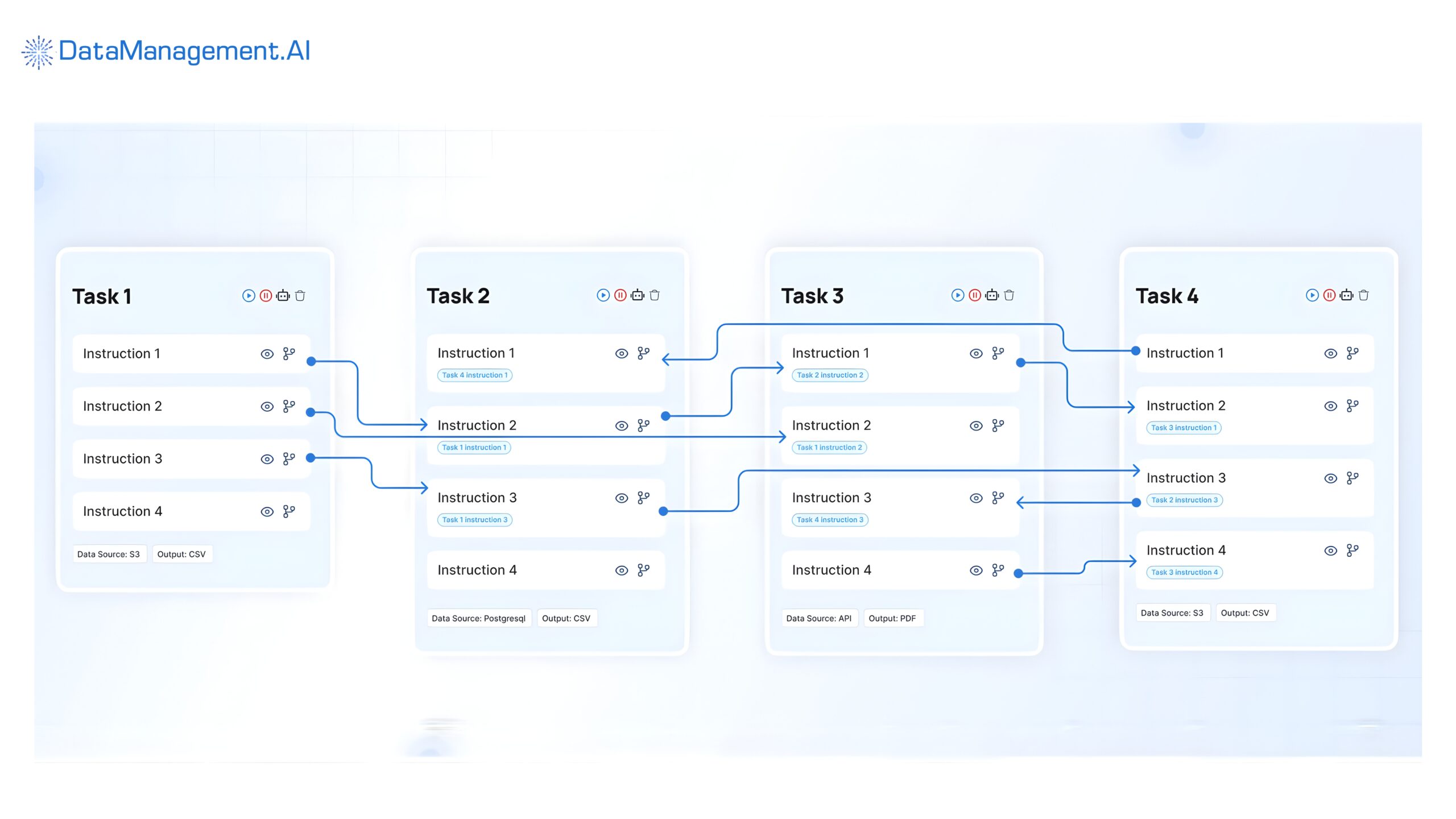
DataManagement.AI helps with this process. Its Master Data Management capability helps extract raw entity records from transactional systems and CRMs.
It then matches your need identifiers like email, tax IDs, etc, and detects duplicates. and rich records with external validation sources, and concentrated everything into a single authoritative “golden record” per entity.This automated approach improves efficiency, eliminates conflicting records across applications, and ensures every team operates from the same trusted master dataset.
Data lifecycle management
It’s an obvious fact that data doesn’t remain static. It moves from creation to archival, often crossing multiple systems and platforms within a very short amount of time.
The task of data lifecycle management is to govern this journey, ensuring that the data is stored, processed, and retired according to enterprise policy and regulatory requirements.
Using this, you can automate retention schedules, manage historical records for audit compliance, and optimize storage across cloud and on-premise systems.
By integrating lifecycle controls into your EDM enterprise data management practices, you also reduce storage costs, mitigate risk, and maintain the integrity of both operational and analytical datasets.
This is also where the enterprise knowledge management data quality approach directly intersects with data lifecycle policies, because only clean, validated, and well-managed data can be transformed into actionable enterprise intelligence.
Technical infrastructure
Finally comes the technical infrastructure, which is the backbone of all EDM efforts.
From distributed databases and cloud storage to analytics engines and workflow orchestration tools, your stack must enable scalability, real-time processing, and cross-system integration.
Modern enterprise data management in business relies on APIs, ETL pipelines, and streaming frameworks to propagate changes automatically and reliably.
Thus, when infrastructure works seamlessly with governance, metadata, and lifecycle management, your EDM fresh environment supports predictive analytics, risk modeling, and faster decision-making. It also eliminates bottlenecks and stores data.
Benefits of Enterprise Data Management
Enterprise data management is not just about controlling data; it’s also about unlocking measurable business value from it. So, when implemented correctly, idiom can transform your fragmented systems into a synchronized, intelligent data ecosystem that drives growth and resilience.
Manages complex enterprise data flows
The real value of enterprise data management (EDM) becomes visible only when complexity scales.
In large organizations, data never moves linearly. It flows across ERP systems, CRM platforms, regulatory reporting engines, cloud data warehouses, and analytics tools simultaneously. Therefore, one structure change in finance or supply chain can cascade across dozens of downstream applications.
Enterprise data management in business environments manages these complex enterprise data flows by introducing controlled change workflows, automated propagation, validation checkpoints, and audit trails.
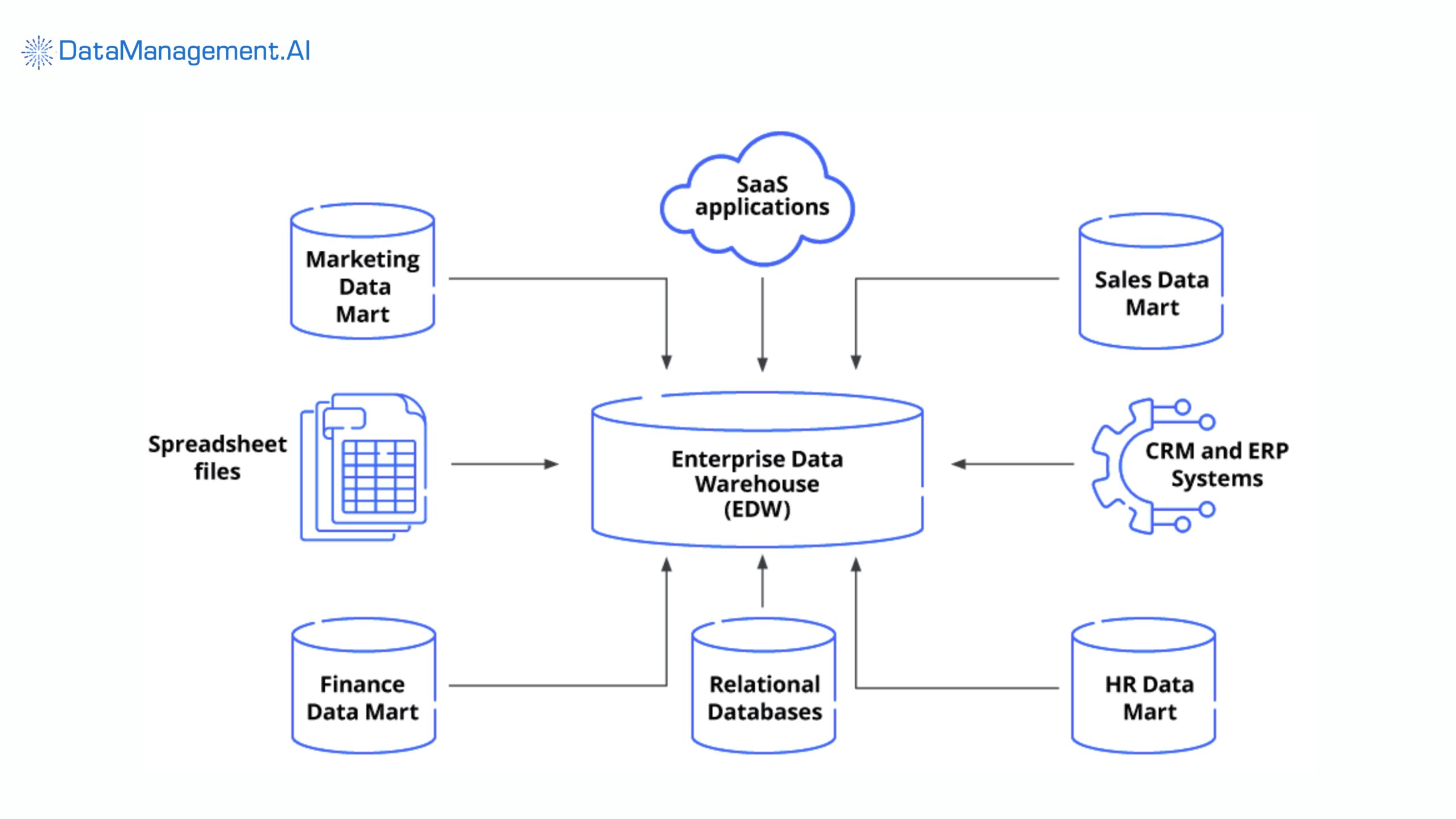
A visual representation of data flow
Enhances business intelligence and analytics
Without a governed and aligned data foundation, dashboards become opinion-based rather than fact-based.
But, by embedding governance, metadata management, and master data alignment into a unified EDM fresh environment, any organization can ensure that their analytics models of rate are consistent, lineage-tracked datasets.
This one change will significantly improve forecast accuracy, scenario modeling, and performance measurement.
Safeguards sensitive and regulated data
Regulatory environmental demand traceability, access control, retention policies, and auditability.
An organization can gain it through structured governance frameworks, role-based access models, and lifecycle controls. Enterprise data management solutions protect financial records, customer data, and operational metrics from unauthorized modification or exposure.
This is a must-have because the ability to reconstruct “who changed what, when, and why” is not optional; it’s now a compliance requirement, and EDM operationalizes that.
Enable scalable cloud transformation
As enterprises migrate to hybrid or multi-cloud architectures, inconsistencies multiply if their master data is not centrally governed. By integrating APIs, ETL pipelines, and cloud orchestration tools, EDM enterprise data management frameworks enable seamless cloud transformation.
These changes to core entities propagate consistently across on-premise and cloud systems, preventing fragmentation during digital modernization initiatives.
Reduces redundancy and operational risk
Duplicate records, inconsistent hierarchies, and conflicting data definitions create bottlenecks like financial misstatements and operational inefficiencies.
Enterprise data management helps in minimizing duplication and eliminating conflicting records through validation rules, version control, and automated alignment, resulting in faster enterprise execution.
Enterprise Data Management example
A classic real-world enterprise data management example can be seen in how Unilever standardized its global master data processes across hundreds of brands and markets.
Before the company implemented a centralized enterprise data management solution, its regional teams maintained separate product hierarchies, supplier records, and reporting structures. This setup caused Unilever reconciliation delays, inconsistent financial reporting, and compliance complexity across jurisdictions.
But after deploying a structured EDM fresh environment implementation, it aligned master data governance, embedded metadata controls, and automated cross-system data propagation between ERP, supply chain, and analytics platforms.
This shift reduced the problem of duplication, improved audit traceability, and accelerated reporting cycles.
Why should modern enterprises rethink EDM?
Without EDM, you face rising risk, compliance exposure, and operational inefficiencies driven by inconsistent master data and fragmented systems.
But with it, decision makers operate on harmonized, lineage-tracked information, reducing uncertainty and strengthening strategic execution across finance, operations, analytics, and cloud environments.
If you are ready for this change, schedule a demo and see how intelligent EDM can transform your data foundation.
FAQs
How do you know if your organization needs enterprise data management?
Your organization likely needs enterprise data management if your teams spend significant time reconciling reports, maintaining duplicate records, resolving inconsistent business definitions, or manually propagating changes across systems.
Frequent audit findings, poor data visibility, delayed reporting, and inconsistent analytics are also strong indicators that an EDM framework is required.
What is the difference between enterprise data management and master data management (MDM)?
Enterprise data management is a broader strategy that governs how data is created, managed, integrated, secured, and used across the enterprise.
Whereas MDM is one component of EDM that focuses specifically on creating consistent, authoritative records for core business entities, like customers, suppliers, products, and accounts.
In other words, MDM manages critical business entities, while EDM governance manages the entire enterprise data ecosystem.
What should you look for in an enterprise data management platform?
The write enterprise management platform should provide data governance, MDM, metadata management, lineage, workflow automation, API, based integration, data quality monitoring, role-based access controls, and real-time analytics.
It should also integrate seamlessly with ERP, CRM, cloud data warehouses, and business intelligence platforms while supporting hybrid and multi-cloud environments.
How does enterprise data management support AI and digital transformation?
AI initiatives are only as reliable as the data they consume. Enterprise data management creates trusted, governed, and standardized datasets by enforcing quality controls, maintaining metadata, tracking lineage, and synchronizing master data across systems.
This enables organizations to build AI models, analytics, platforms, and automation workflows on consistent, high-quality data rather than fragmented information.
What business outcomes can Enterprises expect after implementing EDM?
A well-implemented, enterprise data management strategy helps reduce operational inefficiencies, improve reporting accuracy, strengthen regulatory compliance, eliminate duplicate and inconsistent records, accelerate decision-making, and simplify cloud modernization.
It also lowers reconciliation effort, increases trust in enterprise data, and provides a scalable foundation for analytics, automation, and AI-driven business initiatives.