




An interesting thing happened in 2024.
Walmart, during a routine audit, found duplicate records of customers across 847 systems.
This baffled the executives at Walmart. How could a huge organization not have a standard and simplified system?
This discovery cost them USD 2.3 billion in operational efficiencies.
This is a simple reason why you as a decision-maker at your organization must learn how to implement a master data management system.
But the question remains – How to implement master data management to avoid catastrophic data inconsistencies?
In this comprehensive ‘best practices of master data management’ article, I will share at least ten proven tactics for enterprise-scale MDM deployment.
These best practices are suited for CTOs, CDOs, and data management leaders alike.
Understanding how to manage master data
I will get to ‘best practices on how to implement master data management’ in a bit. For now, let’s get clarity on what is a master data management strategy.
An effective master data management strategy is a complete framework. It unifies crucial business data across your systems.
Remember that any modern enterprise generates close to 2.5 quintillion bytes of data per day. That’s a whopping number. So without a proper MDM strategy, your enterprise will struggle with,
- Data silos scattering your enterprise data by close to 73%
- Inconsistent customer records across systems
- Regulatory compliance gaps costing nearly USD 14.8 million annually
- Decision-making delays impacting revenue by 21%
What is master data management strategy?
A successful master data management strategy consists of four fundamental pillars. The table below highlights that.
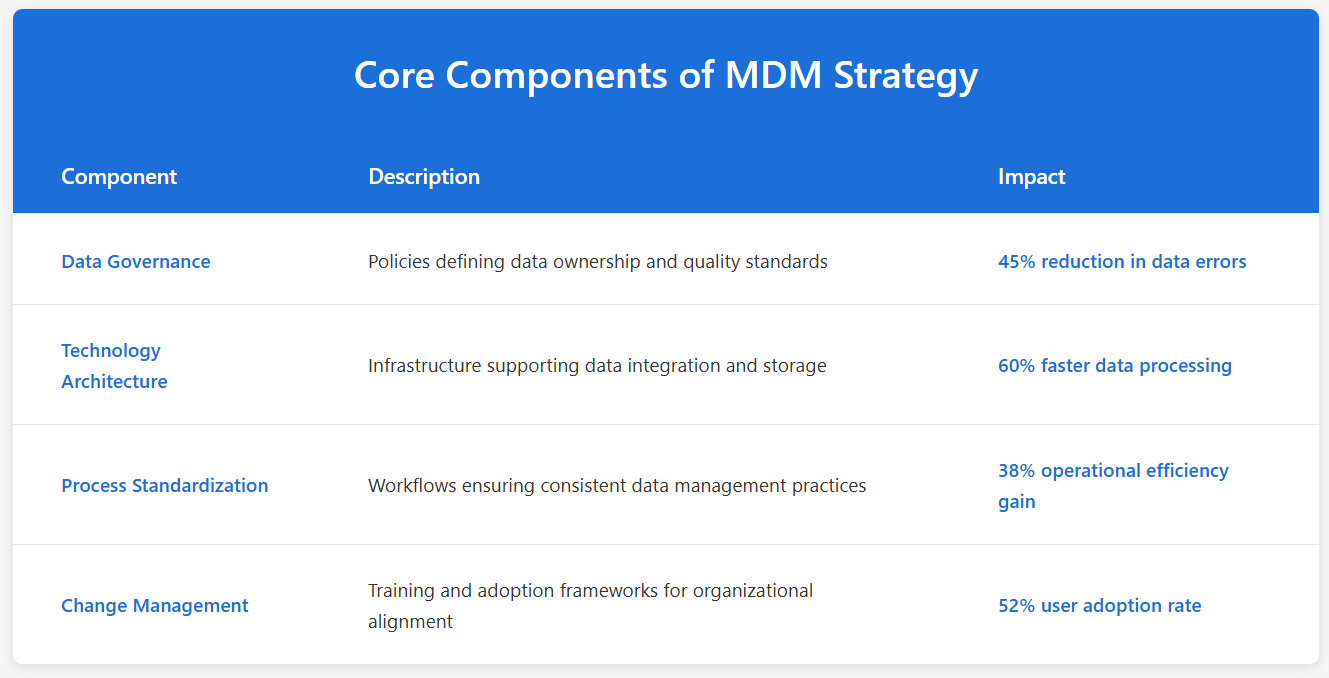
Gartner states that if enterprises like yours implement a comprehensive MDM strategy, you will achieve a higher revenue growth of 23%.
Once you have focused on which component to implement a master data management strategy onto, it’s time to set up the master data management architecture.
How to design master data management?
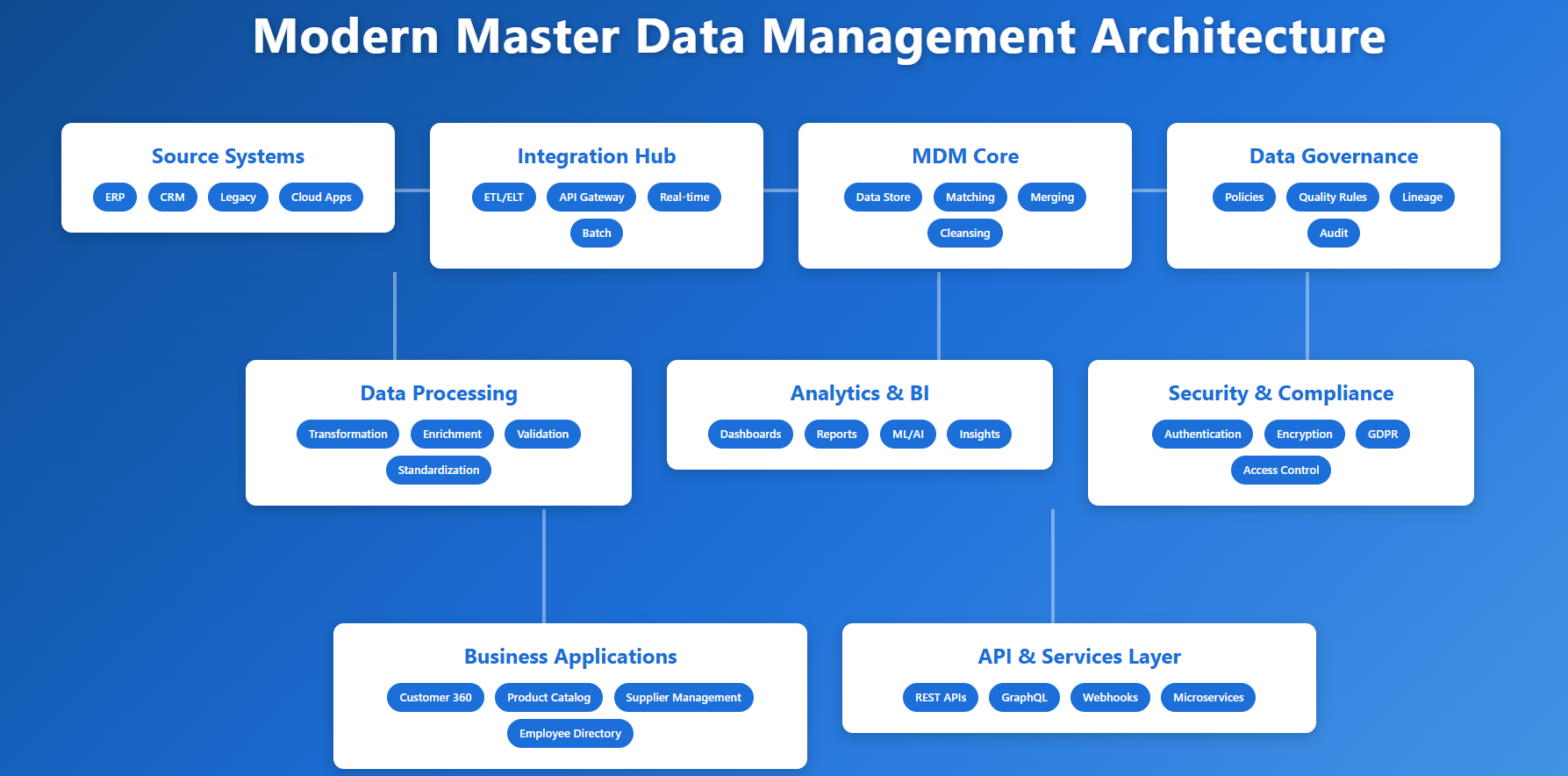
To understand how to design a master data management system, you need to understand your own enterprise data landscape.
Then comes the architecture.
Modern MDM architectures adopt a hub-and-spoke model.
This is essential for connecting with your enterprises’ disparate systems.
The MDM architecture basically centralizes master data. It also maintains system autonomy.
Forrester claims in their 2024 study that 67% of successful implementations come with centralized hub architectures.
What are the core MDM architecture design principles?
The following five core principles guide modern MDM architecture design.
- API-driven connectivity – RESTful APIs that enable seamless system integration. Being an API-first architecture reduces integration time by 56%.
- Cloud-native flexibility – Enable cloud services for elastic scaling. Cloud-based MDM reduces infrastructure costs by 42% while reducing cost and improving performance.
- Scalability planning – This principle involves design systems handling 10x of your current data volumes. For example, Netflix processes close to 500TB daily through their MDM system.
- Real-time integration – Implement streaming data pipelines for synchronization. Real-time MDM helps reduce data latency by 84%.
- Security-first design – This principle involved embedding security protocols throughout the architecture. Data breaches cost organizations close to USD 4.88 million, making security crucial.
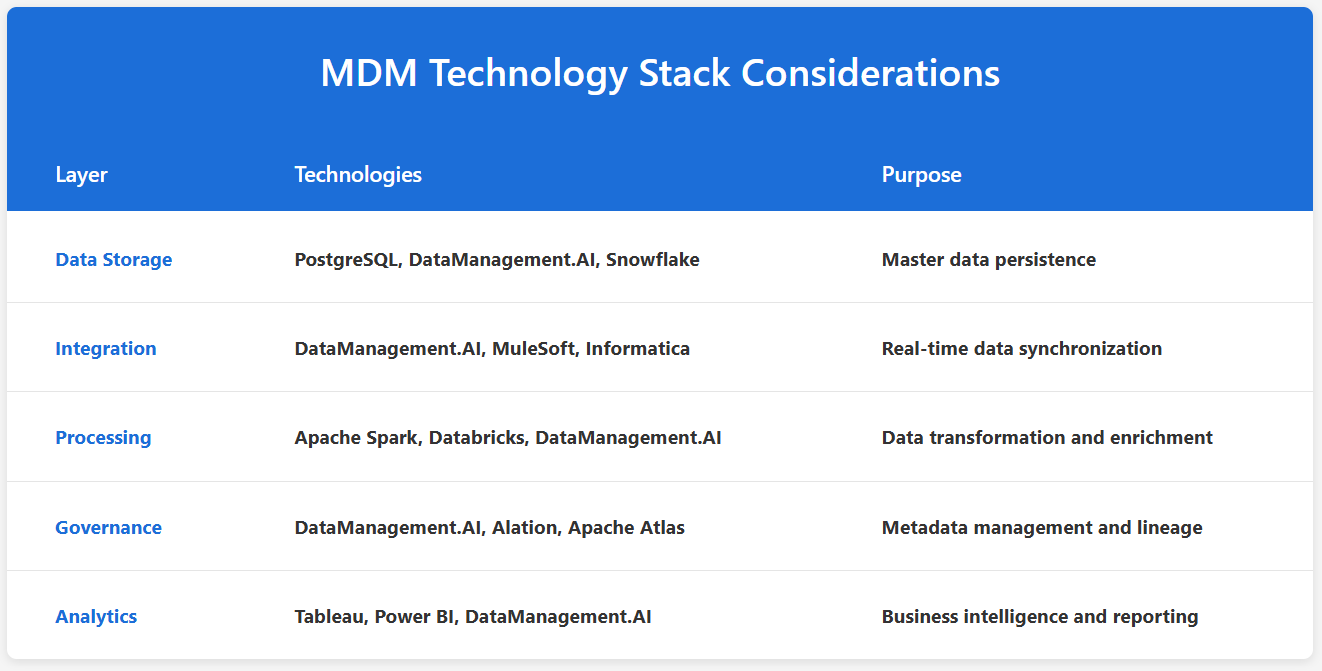
The table below gives you a snapshot of every layer of the MDM architecture, along with their purpose and examples of best MDM tools involved.
What are Master Data Management best practices?
The following best practices for master data management are important for an industry leader like you to minimize implementation risks while also maximizing business value.
The foundation that is data governance
You probably know this already as an industry leader, but data governance forms the foundation of properly-done master data management implementation.
It’s an approach that outlines responsibilities, processes, and rules for managing data assets. An impactful data governance program guarantees data accuracy, consistency, and security.
Keep in mind the following key concepts to ensure you establish good data governance implementation.
- Define data ownership and accountability – Always assign data stewards or selected owners for various datasets. This ensures that there is always someone responsible for data accuracy and data quality.
- Setup governance roles and structures – Create a clear organizational structure for data governance. Define roles for data owners and a governance committee to clarify responsibilities.
- Create governance policies and procedures – A good data governance policy provides guidance for data consistency and data handling across the organization.
- Impact analysis – Analyze any data lineage information you have to check for potential impact of updates to data sources, processes or systems.
- Data compliance and regulations – Always ensure your data management is adhering to industry-specific regulations, to avoid financial and legal consequences.
- Data flow visualization – Make it a habit to document the end-to-end journey of data as it passes through numerous processes, systems, and transformations. Visualizing your data lineage helps you understand how data is created, stored, and modified across stages.
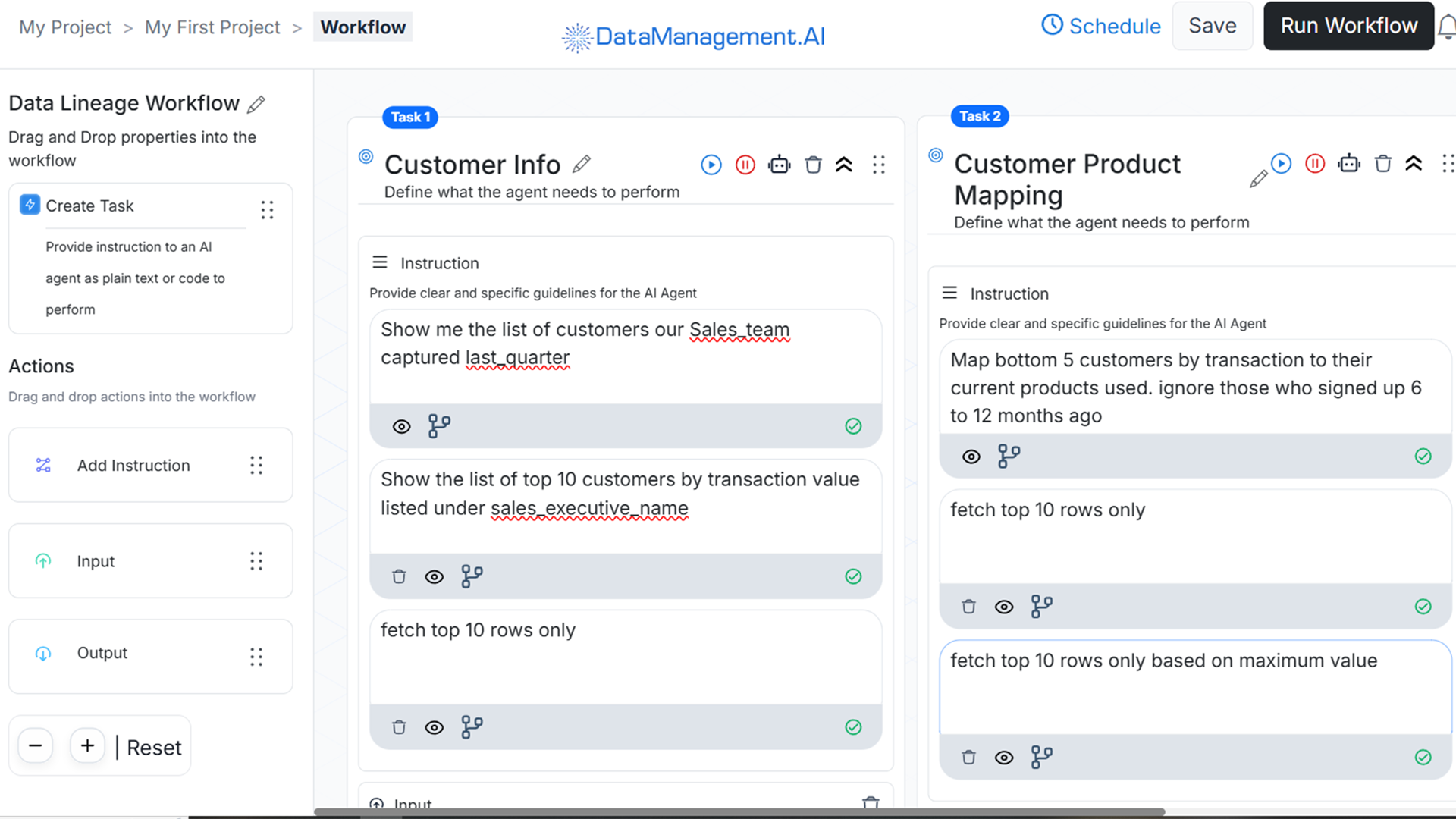
What if I tell you there is an AI-driven solution that uses an AI agent to track data lineage.
DataManagement.AI AI agent creates an audit trail and lets you know which data comes from where.
Data quality as a reliability pillar
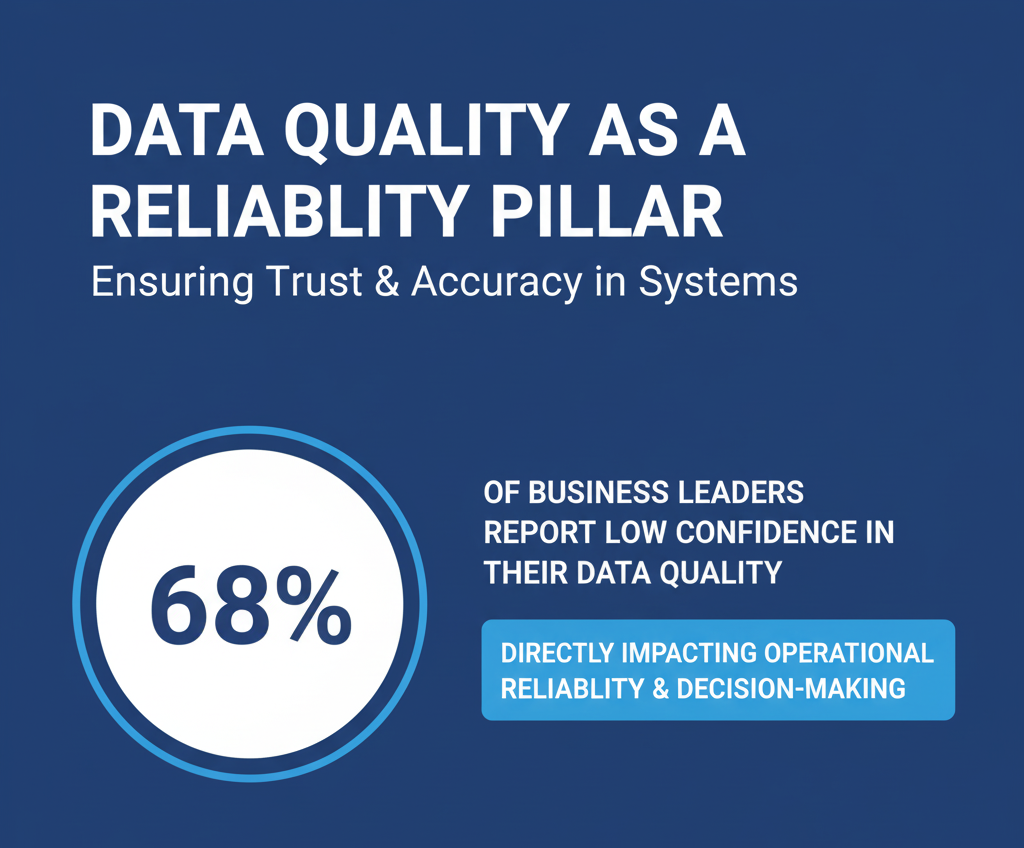
Next comes data quality management.
The goal is to maintain consistency, accuracy, and reliability of data. Poor data quality causes operational inefficiencies, incorrect decisions, and eroded customer trust. The following hygiene checks will help you maintain high-quality data.
- Data standardization – Keep formats consistent. That also goes for definitions and units across datasets which improve data usability and consistency.
- Data cleansing – Try and analyze data to identify errors, inconsistencies, and duplicates. Then get them cleaned so that the data is reliable and accurate.
- Data validation – Validation checks during data integration, entry, and transformation processes help prevent incorrect data to creep into the system.
- Data maintenance – Keep monitoring data quality metrics and perform regular maintenance to keep your data up-to-date.
- Root cause analysis – Whenever data quality issues arise, a root cause analysis determines the exact reason.
- Data quality reporting – Create regular reports that show you insights about data quality trends, improvements, metrics.
- Data quality profiling – Enable a data profiling AI agent, similar to ProfileAI, to automatically analyze datasets for issues such as inconsistencies, duplicates, and missing values.
Encrypt for data security
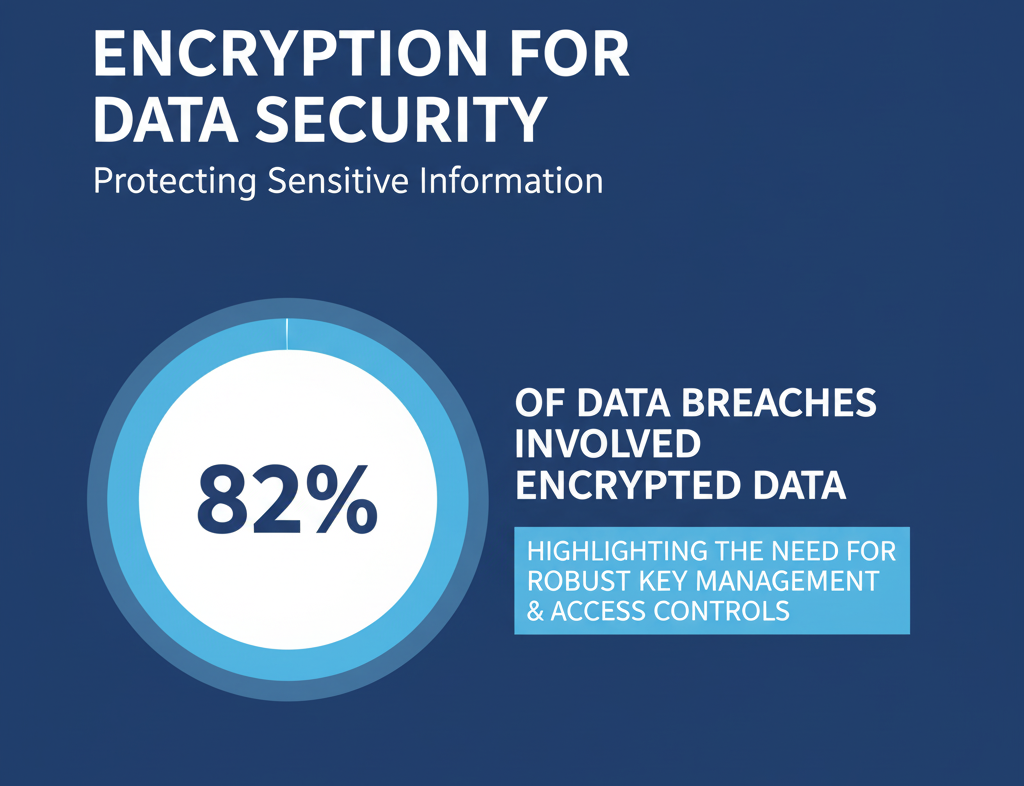
Data leaks are now common.
Personal information and sensitive data need protection at all times. It’s important to keep in mind the following pointers to maintain the safety of your data.
- Encrypt your data – Do this at both the rest and transit levels.
- Incident response plan – Develop an incident response plan to outline steps to counter data breaches.
- Data security audits – Conduct simple yet effective security audits to find weaknesses in the data management process.
- Data segmentation – Classify data based on criticality and sensitivity. This way you can optimize resource allocation for sensitive data.
- Privacy by design – The ‘privacy by design’ approach ensures security and privacy from the start.
- Anonymization – Whenever possible, anonymize and pseudonymize customer data. This reduces the impact of any potential breaches.
- Access controls – Implement strict access controls. Only authorized personnel have access to sensitive customer data. Role-based access will ensure that only employees can access relevant data.
“Digitally transformed businesses blur the lines between partner, employee, and customer.”
– Isaac Sacolick, Driving Digital
Setup an MDM solution
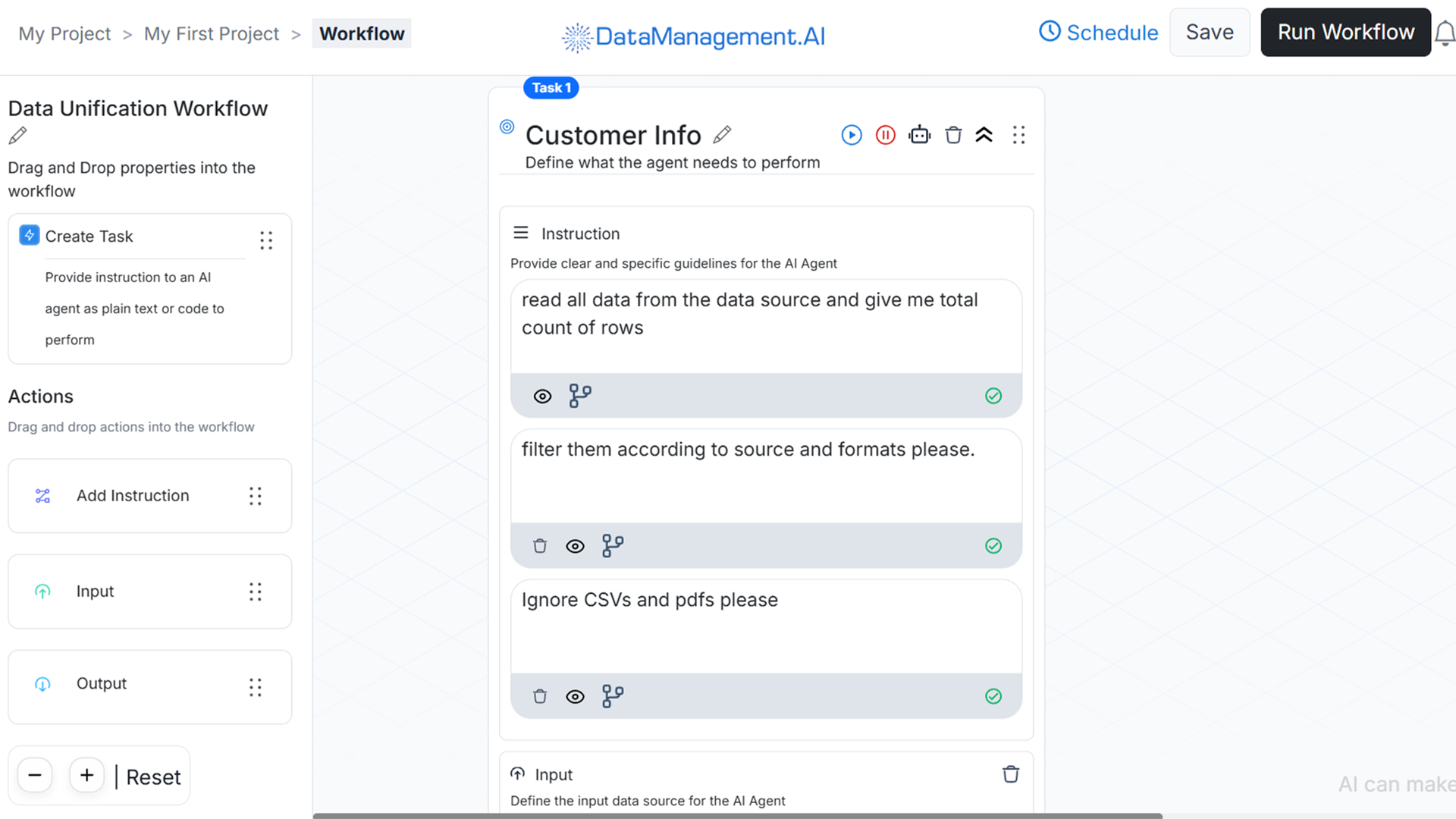
“Master Data Management (MDM) is a set of technologies and principles that maintain an accurate, consistent, and authoritative source of critical business data.
The primary goal of MDM is to establish a singular source of truth for data entities such as products, customers, employees, suppliers, and more. Modern MDM platforms and governance tools automate data matching, deduplication, and synchronization to maintain this trusted source across the enterprise.
Let’s see how we can achieve this smartly.”
- Define important entities – Start by identifying the key pivotal data entities that are the foundation of your organization. Think of products, locations, customers, and other critical elements that MDM can govern.
- Data governance collaboration – Combine MDM with a strong data governance. Establish clear ownership and guidelines for maintaining data security, consistency, and accuracy.
- Standardized data model – Develop a standardized data model. This defines the relationship and structure of master data entities across the organization.
- Central repository establishment – Create a master repository where standardized and accurate data resides.
- Synergy integration – Integrate the MDM system with other operational tools and platforms to ensure data consistency across the organization.
- Relationship mapping – Map out the relationships between different data elements. Understand how data improves contextually and in its accuracy.
- Change management strategy – Introduce MDM as a transformational initiative. Develop a change management plan to guide employees through the transition.
- Continuously monitor and improve – Gather feedback and refine the MDM strategy to align with your evolving business needs.
- Data migration – This needs a strategy to transition from existing systems to a stronger one, so that data transfer happens from system-to-system smoothly.
Looking for a reliable MDM solution?
DataManagement.ai is the one for you. Thanks to DataManagement.AI you can,
- Seamlessly integrate with every part of your data – from collection to insights.
- Enable querying and analyzing of data in its source system with no extraction, prep or delays.
- Link every step of your data journey into one efficient data matrix.
- Deliver real-time data flow to help you adapt to trends and make informed decisions.
- Automate repeatable tasks with intelligent AI agents that detect and recover from failures when optimizing compute resources.
- Work with built-in governance via end-to-end lineage, audit logs, and compliance by design.
- Enable matching, mixing, or swapping data sources, platforms, and instructions while preserving total flexibility.
- Secure every request with granular policies, built-in compliance, and continuous authentication
- Design complex pipelines in minutes via a drag-and-drop Visual Canvas.
No time-consuming data replication or extraction.
DataManagement.AI is built to eliminate all your data bottlenecks, deliver real-time insights, and significantly reduce operation and infrastructure costs.
Prepare for disaster recovery

A solid backup and disaster recovery (DR) strategy keeps your data intact and accessible.
The following practices will make it easier for you to implement a DR strategy.
- Critical data identification – Locate and identify what data is critical for your business operations. This includes financial records, intellectual property, and customer information that could impact your organization if lost.
- Backup frequency – Calculate how frequently backups should be performed. For mission-critical data, consider doing so every week, while for less crucial data, do it less frequently.
- Data classification – Classify your data based on sensitivity and importance. This helps allocate appropriate resources based on data criticality.
- Backup types – Implement a combination of differential, incremental, and full backups. Full backups capture the entire dataset, while the others capture only the data changes.
- Off-site storage – Make copies off-site or in a secured remote data center.
- Automated backup – Implement automated backup solutions, similar to an AI-driven MDM solution. This minimizes risk of human error and ensures backup occurs as per schedule.
- Test restoration – Regularly test the restoration process for backups.
- Documented recovery – Create well-documented recovery procedures that outline the steps to follow in case of a data breach.
The curious case of Chipotle Retail
A good example of a successful Master Data Management (MDM) implementation is that of Chipotle Retail.
They are a massive retailer with hundreds of physical stores and strong online presence. They produced an annual revenue of USD 3 billion but struggled with a fragmented view of its customers.
Their data was scattered for e-commerce, loyalty programs, email marketing, in-store, and Point-of-Sale operations. The fragmentation of data resulted in,
- Duplicates and redundant records existed. For example, the same customer was stored with multiple accounts with different addresses.
- The customer data was also inconsistent, outdated, and incomplete.
- There was no effort put to recognize a customer across touchpoints (e.g. call center or online).
- Individual transactions were not linked to a household, preventing inaccurate household-based marketing.
- Wasted time and resources were directly related to inconsistent marketing campaigns to the same customer numerous times.
MDM solution and implementation
Chipotle Retail implemented a customer MDM solution to create a singular, real-time, and accurate view of their customers.
The MDM solution was configured to aggregate and consolidate customer data from all primary systems. Matching and merging rules were applied to identify and link duplicate records.
A ‘golden record’ with a singular trusted view for each household.
The outcome of this MDM implementation led to,
- The retailer successfully identified over 11 million redundant customer records across systems.
- Online orders being fulfilled at physical stores and the elimination of repeatedly asking loyalty program members for information.
- Recognizing relationships between households and their respective individuals. Marketing campaigns became more targeted improving customer engagement and top-line growth.
Chipotle Retail is one example. There’s many more. If you want to successfully implement an AI-driven MDM solution, then simply click on the blue button below and schedule a quick demo with our MDM experts.
Manage your data lifecycle carefully
This practice is about handling data from its conception to ending.
It ensures data relevance, compliance, and security throughout its system-bound journey.
Data lifecycle management gives you a roadmap that guides your data from data creation to data archiving. Some quick-fire best practices for this strategy include,
- Data creation and collection – Set guidelines that provide accuracy and consistency from the start. Collect only that data which aligns with your business needs to avoid clutter.
- Data storage – Find out the appropriate storage solution for various types of data.
- Data inventory – Catalog your data assets. Look at what data you have and where it’s stored. Find its importance in your organizational operations.
- Data archiving – As data ages and becomes less frequently in usage, archive it for long-term storage. This clears up active storage space while keeping that old data accessible
- Data retention policies – Develop clear policies that outline how long a specific type of data is retained.
- Data review – Periodically review your data inventory. Remove any outdated or redundant data to maintain a streamlined dataset.
- Data transformation – When technologies evolve, ensure your data can be migrated easily to newer platforms or technologies, without any loss in integrity.
- Data disposal – Identify secure methods of disposing data that’s reached its lifecycle. This can include physical destruction or digital wiping.
Make your data discoverable
Metadata is ‘data about data’.
It’s the information about your data source, its creation date, format, and relationships.
Metadata management is a practice that may not make headlines, but is critical for maintaining data understanding and discoverability. Here are a few practices to make this strategy work well.
- Cataloging of metadata – Just like any library catalog, create a catalog of your metadata. Document its sources, types, and attributes that establish a clear reference point.
- Standardized metadata – Implement standardized metadata formats and definitions. This improves data understanding and interoperability.
- Data relationships – Capture and maintain metadata that highlights relationships between datasets.
- Metadata tools – Invest in metadata management tools that automate metadata collection, organization, and maintenance.
- Business context integration – Connect metadata to your business context. Understand how your data is used in numerous processes to ensure the relevant metadata attribute is captured.
- Change management – Implement change management practices for all metadata updates. Any changes to data structure should be reflected in corresponding metadata documentation.
- Audits – Regularly conduct metadata audits to ensure accuracy and relevance. This ongoing process maintains the quality of your metadata repository.
What if we told you we have an AI agent called MetadataAI who can automatically catalog your metadata.
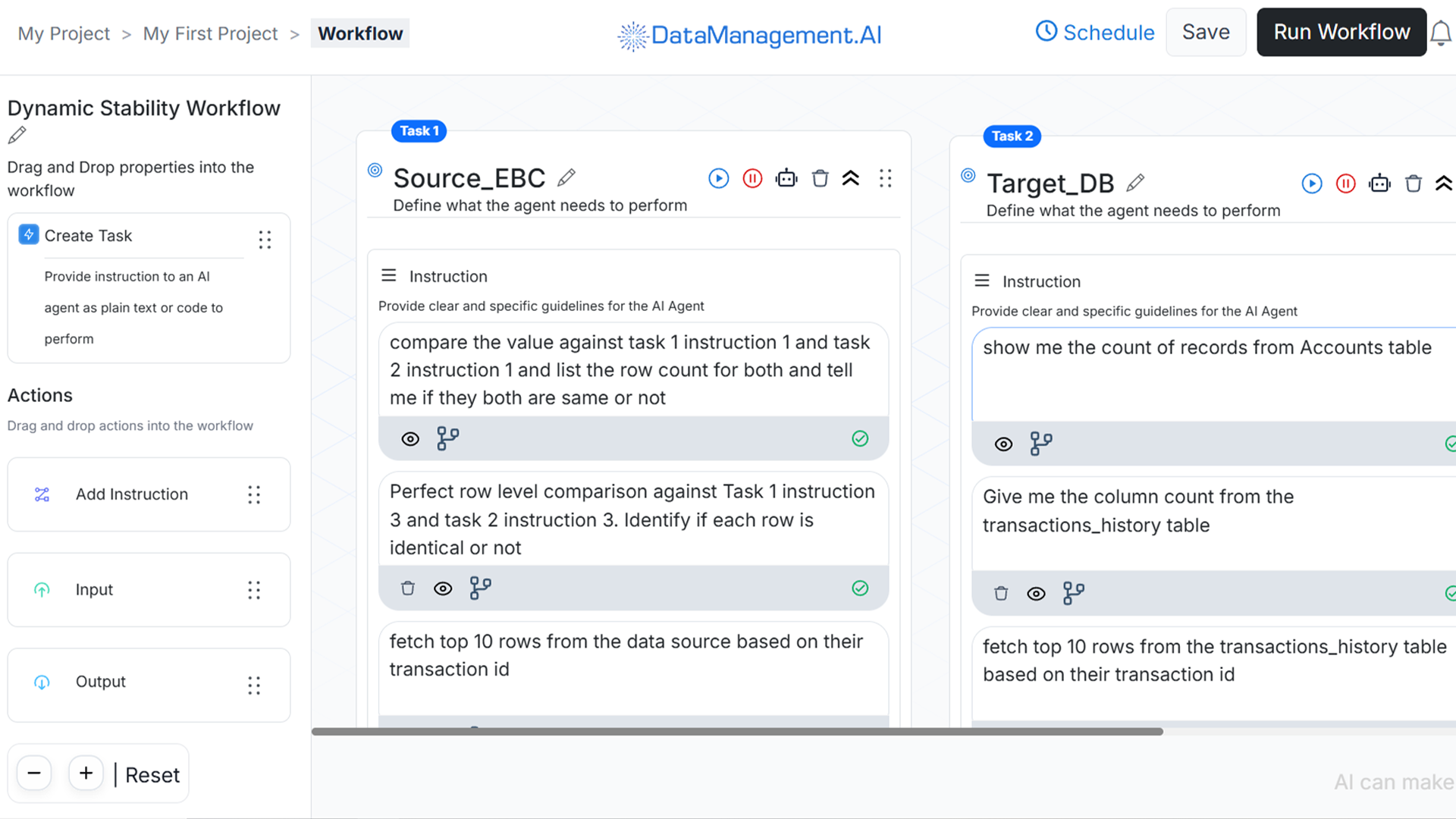
Build a safety net for data
A data storage solution gives you a safety net to ensure your storage infrastructure won’t crumble under its weight.
Here’s how to pick a good data storage solution.
- Access your current needs – Start by understanding your organization’s current data storage. Analyze data growth types, rates, and performance demands to gauge your immediate needs.
- Plan future growth – Estimate the future data storage needs and ensure your chosen solution can accommodate this growth.
- Cloud storage – Explore cloud storage solutions that offer scalability on demand. Cloud platforms let you scale up or down based on data requirements.
- On-premises scalability – If on-premises storage is your choice, opt for scalable storage. This lets you add more drives or expand existing systems without causing disruptions.
- Data redundancy – Look for storage solutions that provide redundancy options like RAID configurations.
- Data tiering – Implement data tiering. It’s a technique to allocate different types of data to appropriate storage tiers based on usage patterns.
- Integration capabilities – Choose a storage solution that integrates with your existing data management ecosystem. This includes analytics, backups and other processes.
- Data security – Prioritize data security when selecting storage solutions. Invest in storage solutions that offer access controls, advanced security, and encryption to protect your data.
- Cost efficiency – Consider both short and long-term costs. Scalable solutions should offer cost benefits as you expand and they should be financially sustainable over time.
Create a culture of data accessibility
A collaborative data environment cultivates a culture where your data isn’t locked away.
The data must be accessible and utilised across teams for decision-making and innovation. Let’s discuss the specifics related to MDM implementation.
- Unified analytics platform – Your MDM implementation needs to cover an analytics platform that different teams can access.
- Collaborative MDM tools – Use MDM tools that let your teams comment on, annotate, and share insights about specific data points.
- Regular data sharing – Organize regular data learning sessions where your teams can share their insights, findings, and challenges related to data.
- Data literacy training – Provide data literacy training to employees across departments. When everyone speaks the language of data, collaboration becomes smoother.
- Transparent communication – Encourage open communication about data projects. Transparency eliminates misunderstandings and helps teams align their efforts.
- Leadership support – Gain leadership buy-in for your collaborative data environment. When leaders champion collaboration, it becomes a part of the organizational culture.
- Cross-functional teams – Create cross-functional teams comprising members from different departments. Diverse perspectives ensure your data is analyzed holistically, so that your MDM implementation delivers better insights.
Common MDM Implementation Pitfalls To Avoid
Keep in mind these common mistakes that could affect your MDM implementation by up to 58%.
- Inadequate testing can result in production failures
- Underestimating data complexity and quality challenges
- Inadequate stakeholder buy-in leading to adoption resistance
- Technology-first approaches ignoring business requirements
- Insufficient governance structures create accountability gaps
How to config master data management?
Now we come to the part where we look at how to configure master data management technically.
This requires detailed technical planning and execution. MDM configuration encompasses integration patterns, data models, and operational procedures.
MDM Data Model Configuration
Effective MDM data models balance flexibility with structure. Key MDM configuration elements include,
- Entity definitions – These define master entities (products, customers, and locations) with attribute sets. Typical customer entities contain 150-200 attributes. These stretch across preferences, demographics, and behavioral data.
- Relationship mapping – Establish hierarchical and associate relationships between entities. Complex enterprises manage 50,000+ entity relationships on average.
- Business rules – Implement validation rules ensuring data consistency and data quality. Organizations deploy 2,000-5,000 business rules in mature MDM systems.
MDM Integration Configuration Table
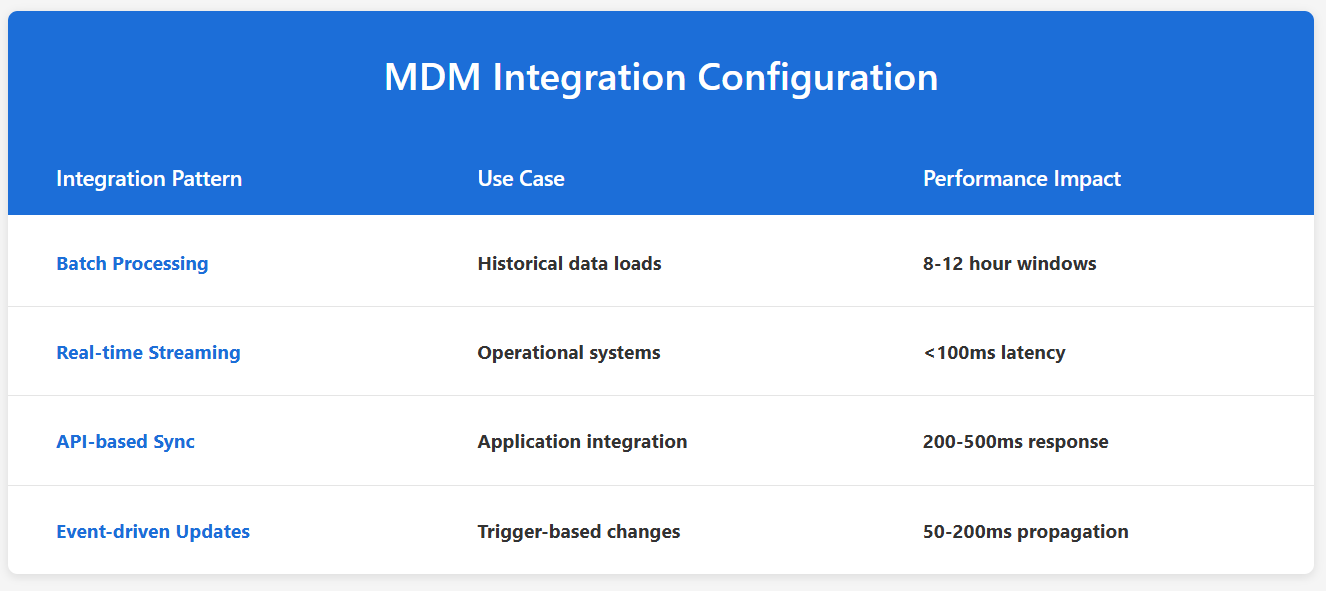
This table tells you exactly what configuration is suited to which integration, and the performance impact of those configurations. These, of course, differ based on your organizational needs and resources.
Research indicates that 78% of successful MDM implementations utilize hybrid integration approaches combining multiple patterns.
Measuring Your MDM Implementation Success
Optimize MDM performance through strategic configuration. Here are some metrics to keep track of as KPI (Key Performance Indicators).
Business Metrics
- Operational efficiency metric helps measure process MDM process improvement
- Revenue impact metric tracks data-driven revenue increases directly related to MDM success
- Cost reduction metric helps calculate operational saving thanks to MDM addition
- Compliance score metric monitors regulatory adherence
Technical Metrics
Processing throughput metrics that handle peak loads efficiently
- Data quality score checks for data accuracy obtained via MDM implementation. 95%% is industry standard
- Response time after implementation has to be under 200ms for critical queries
- Process throughput handles peak loads efficiently
- System availability should be maintained at around 99.9% uptime
These metrics are mentioned in Aberdeen Group studies. They also state an average ROI increase of 312% within 18 months of MDM implementation.
MDM implementation with AI-powered solutions
Master data management implementation success depends on technical excellence, strategic planning, and your organizational commitment.
You must follow structured methodologies to achieve significant operational improvements and competitive advantage.
The entire MDM implementation journey from data chaos to unified master data needs expertise, proper tools, and dedication.
A modern AI-powered MDM tool accelerates this implementation while ensuring enterprise-grade performance and quality.
Ready to transform your data landscape?
Schedule a demo with our MDM experts and discover how intelligent AI agents can streamline your MDM implementation process.
Frequently Asked Questions (FAQs) about MDM Implementation
A. MDM implementation timelines depend on complexity. Simple deployments need 6-9 months, while enterprise-wide ones require 12-24 months. Phased approaches reduce time-to-value by delivering functionality sooner.
A. MDM investment scales considerably. Small enterprises may spend around $500K, while large organizations’ commitments can exceed $50M. Crucially, the average Return on Investment (ROI) consistently surpasses 300% within a two-year period, demonstrating high value.
A. Cloud-native MDM provides superior scalability, cost efficiency, and notably faster deployment times. The industry shift is clear. A significant 78% of all new Master Data Management implementations are now leveraging flexible cloud platforms.
A. AI is revolutionizing MDM by automating data quality management, entity resolution, and anomaly detection. This powerful combination slashes manual effort by a remarkable 70% while simultaneously boosting data accuracy by 45%.